All images are protected by copyright. For any commercial or editorial use, please contact us via our form.
How can I be notified of new articles?
Follow us on social media or join the Sentinels Circle to receive our immersion stories before anyone else.
Do you offer hands-on workshops?
Yes, we organize masterclasses and field expeditions for members of our school. Check the Training page for details.
Blackwater Diving: A Complete Guide to Photographing Plankton in the Open Ocean at Night.
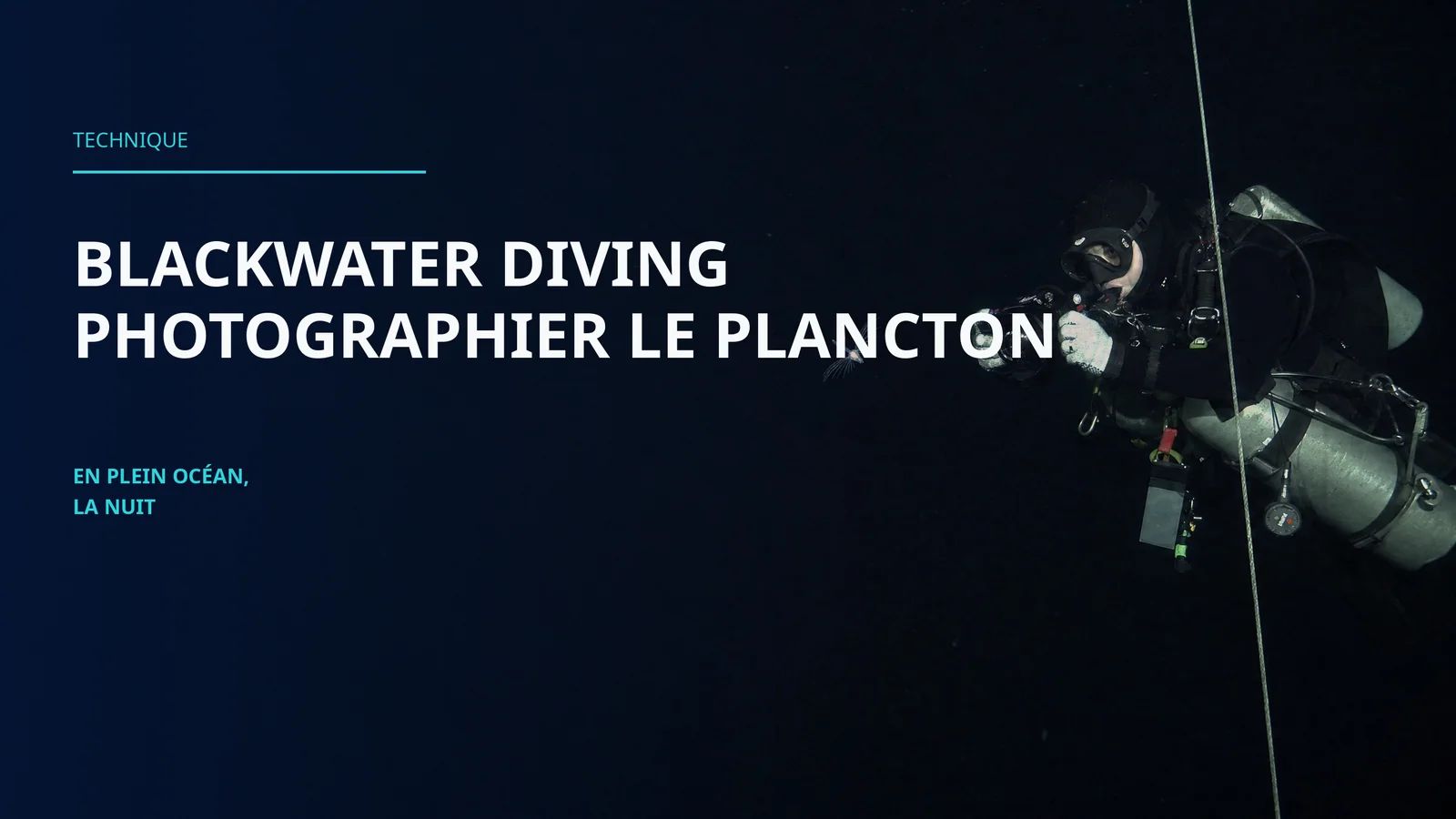
Most dives are conducted above a reef, a shipwreck, or a sandy bottom. You have a visual reference point at the bottom, you navigate relative to it, and you return to the boat by ascending along a line or following a course. A "blackwater dive" is the exact opposite of this logic. There's no visible seabed, no reef, just the column of water above hundreds of meters of depth, complete darkness at night, and a lighted line that descends from the buoy to you.
It's disorienting for the first few minutes. Then, when the first organisms arrive in the beam of light, everything else disappears.
What happens every night in the middle of the ocean.
The vertical migration of plankton is one of the most massive biological phenomena on the planet. Every evening, billions of organisms that live between 200 and 1000 meters deep during the day rise to the surface to feed on phytoplankton, before descending again at dawn to escape predators. This nocturnal window, which lasts a few hours, is exactly what blackwater divers exploit.
You don't dive on a specific spot. Instead, you look for an area in the open ocean, above significant depths, where the current conditions are stable. A boat is positioned, with a buoy and a downline illuminated over a distance of 20 to 30 meters. The organisms then arrive on their own, attracted by the light.
The Downline: The Infrastructure That Makes Everything Possible
Without a dive line, a blackwater dive is dangerous. With it, the dive becomes organized and accessible.
The downline is a weighted rope suspended vertically from the boat's buoy. Powerful video lights are attached at regular intervals, typically every 3 to 5 meters, starting from a depth of 5 meters. These lights attract plankton, and with it, all the predators that feed on plankton. You position yourself along this line, at the depth where activity is most concentrated, and wait for the subjects to come to you.
The fundamental rule is to stay close to the line at all times. In the middle of the ocean at night, with no visibility of the seabed and without fixed reference points, drift can carry you far from the boat in just a few minutes. The line is your visual anchor and your position reference. You should not stray from it, and you must always keep an eye on the boat and other divers.
Photography equipment for blackwater photography
The characteristic of blackwater environments is that the organisms are often minuscule, translucent, and very mobile. A copepod is about a millimeter in size. A lobster larva might be two centimeters long. An adult pelagic octopus can reach twenty centimeters, which seems large until you try to photograph it at a depth of 15 meters at night in a slight current.
To get started: An action camera with macro mode (GoPro Mission 1, Insta360 Ace Pro 2) or a waterproof compact camera like the Olympus TG-7 in microscope mode are serious tools for beginners. The important thing is to have fast and reliable focusing on close subjects.
For smaller subjects: A mirrorless camera with a macro lens (60mm, 90mm, or 105mm) in an underwater housing is the tool of choice for specialized photographers. The depth of field is very shallow at these focal lengths, which requires skill, but the details obtained are unmatched.
Lighting: This is where a significant part of the result comes from. A small headlamp or a compact flash pointed directly at the subject works, but the most effective technique is slightly lateral or oblique lighting, which gives three-dimensional depth to translucent organisms. With an almost transparent organism, frontal lighting washes everything out. Lighting at a 45-degree angle reveals the internal structure.
Recommended settings
Blackwater photography differs from reef diving photography. Here are a few basic principles:
Shutter speed: fast enough to freeze the movement of organisms. Between 1/100s and 1/250s, depending on the subject's activity. Slower than that, and ciliated and flagellated organisms will produce blurry images even if the camera is stable.
Aperture: Relatively closed to achieve a good depth of field for subjects in 3D. Use f/8 to f/11 on a compact or mirrorless camera. The depth of field on a subject from 2 cm to 20 cm can be confusing, and missing the focus is the primary cause of failed images when shooting in blackwater environments.
ISO: There is very little ambient light (it's night, in the middle of the ocean). Compensate with your lighting rather than by increasing the ISO. The goal is a completely black background, and to achieve that black background, your lighting must be stronger than the ambient light. With a good strobe or a powerful video lamp, you don't need to push the ISO beyond 400-800.
White Balance: Use manual mode and calibrate it to your artificial lighting. The light from LED lamps is generally cool (5500-6500K). Set your white balance to this temperature and forget about the automatic setting, which will be disrupted by the contrast between the illuminated subject and the black background.
What we encounter: a partial inventory.
One of the great joys of exploring blackwater rivers is that you never really know what you might encounter. The list below is an introduction and not an exhaustive compilation.
Regular inhabitants: copepods (often the most numerous, and among the most difficult to photograph due to their size), fish larvae at various stages, crustacean larvae (crabs, lobsters, shrimp in the zoea or mysis stage), jellyfish, siphonophores (colonies of organisms that can extend for several meters), ctenophores (these bioluminescent combs that reflect light in rainbow arcs).
Memorable encounters: pelagic octopuses (small, often translucent, capable of changing color in real time), argonauts (female squids with their spiral shell), fish larvae that are still translucent but already have well-developed eyes, and sometimes species that no one has yet identified.
What rises from the depths: On nights with calm seas and stable conditions, organisms that normally live well below 200 meters can rise to a depth of 10-15 meters. These encounters are unpredictable and represent the most intense moments of this activity.
Destinations
Kona, Hawaii: the birthplace of this discipline, where the practice was developed in the 1990s. Local operators have mastered the logistics for decades, depths reach quickly to 200-300 meters, and the biodiversity is exceptional.
Anilao, Philippines: a world-renowned destination for underwater macro photography, and one of the best locations for blackwater diving. The rich biological diversity of the Coral Triangle is present in the water column at night.
Canary Islands and Madeira: For European divers, these are the most accessible options. The depths drop off quickly, the currents are manageable, and some operators are starting to offer organized dive trips.
Mediterranean Sea: Still relatively rare, but some operators in the Balearic Islands and Corsica organize blackwater diving excursions in areas with underwater trenches. While there is less diversity compared to tropical environments, the Mediterranean has its own pelagic species that can only be observed in this way.
Security and Organization
Blackwater diving is not for beginners, but it is accessible to autonomous divers with some experience in night diving. Three non-negotiable principles:
Always go with an experienced operator or guide for your first time. Organizing the descent line, managing drift, and following ascent protocols in case of losing your way require specific experience that cannot be improvised.
Stay on the line. No exploration, no deviation. If you move away from the line, you are signaling your position to other divers and you need to return.
Mandatory safety light. A weighted signaling light with a luminous marker must remain lit throughout the dive and be attached to you. On the surface, it signals your position to the boat.
Post-processing: The black background that reveals everything.
The all-black background is the aesthetic that defines blackwater photography. To achieve this in post-processing, a few simple adjustments are sufficient: lower the blacks to crush the dark tones, slightly increase contrast and clarity to highlight the structures of translucent organisms, and adjust the white balance to correct for the color cast of your LED lights.
For translucent or bioluminescent organisms, a slight increase in vibrancy reveals hues that were not visible to the naked eye in the field. The internal color of a copepod or a chaetognath under properly processed light is often surprising.
Lightroom, DaVinci Resolve, or Capture One can all be used for this type of post-processing. The key is not to try to correct it as if it were a regular photo: here, the black background is intentional, and the strong contrast is the normal result.
Frequently Asked Questions (FAQ)
What is a blackwater dive?
A blackwater dive is a nighttime dive conducted in the open ocean, at great depths, within the water column between 5 and 20 meters. The goal is to photograph planktonic organisms that rise each night towards the surface to feed. This phenomenon (the vertical migration of plankton) occurs in all oceans of the world and every night of the year.
What photographic equipment is recommended for blackwater photography?
To get started, an action camera with a macro mode or a waterproof compact camera like the Olympus TG-7 work well. More advanced divers use a mirrorless hybrid camera with a macro lens in an underwater housing. Lighting is just as important as the camera: a powerful strobe or video light placed at a slightly lateral angle provides the best results for translucent organisms.
Is blackwater diving dangerous?
It requires rigorous organization and prior experience with supervision. The main risk is drifting, because in the middle of the ocean at night, without any reference points on the seabed, it's easy to get away from the boat. Staying on the downline and diving with an experienced operator for the first time are two non-negotiable rules.
Where can I go blackwater diving in Europe?
The most accessible options are the Canary Islands, Madeira, and the Azores for Atlantic waters, and some operators in the Balearic Islands or Corsica for the Mediterranean. The diversity of marine life is lower than in tropical destinations, but diving is a real and organized activity in these areas.
Are you looking to improve your photography skills in challenging conditions? Our AquaExposure training covers settings, lighting, and post-processing techniques for all types of underwater environments.