Which study measures divers' impact on coral reefs?
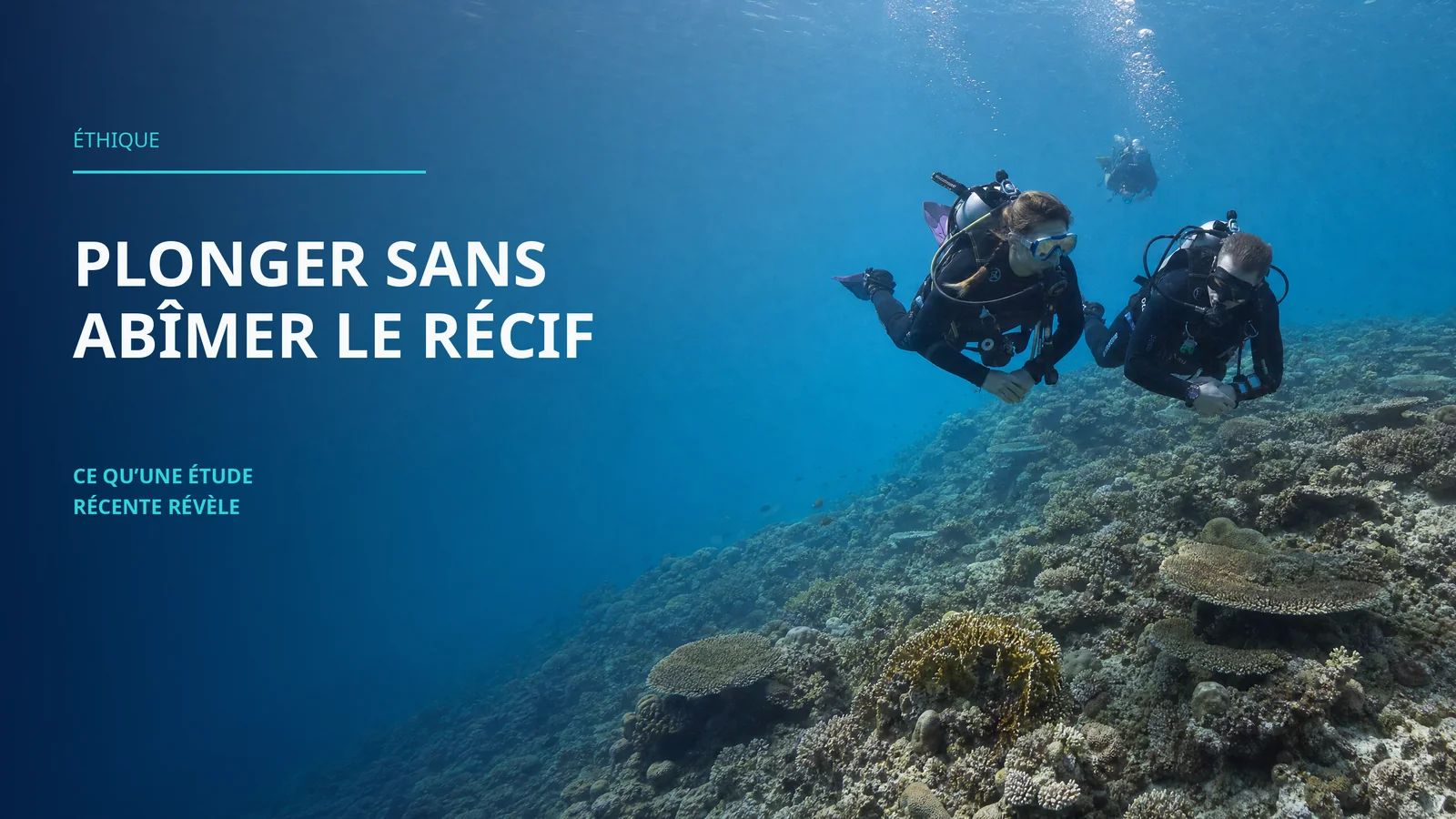
The study was published in Conservation Letters in 2026, led by Dr. Bing Lin (Thriving Oceans Research Hub, University of Sydney) with Princeton. The team observed over 700 divers across 300+ hours in Indonesia and the Philippines, including Bali.
How often do divers touch coral?
On average 0.26 times per minute, about 15 contacts during a one-hour dive. 41% of these contacts cause observable damage. Over 80% are unintentional or unnoticed by the diver.
How can you reduce your impact on coral when diving?
Most effective practices: work on neutral buoyancy regularly, maintain a horizontal trim over the reef with fins raised, monitor extremities (fins, camera, hoses), and slow down well before subjects.
Are underwater photographers at higher risk of touching coral?
Yes, because shooting divides attention. Seeking angles and managing exposure leaves less cognitive capacity to monitor spatial positioning. It requires better body control.
Should dive tourism be restricted to protect reefs?
The study recommends better training rather than bans. Reefs that survive best often have a local community including divers whose economy relies on reef health.
There is one thing we prefer not to look in the face when diving: the idea that our presence, however mindful we may be, leaves a trace. That the reefs we photograph sometimes suffer from our bubbles, our fins, our bodies in the water.
A study published in 2026 by researchers from Princeton and the University of Sydney puts numbers on what we felt without wanting to phrase it. And those numbers are uncomfortable.
What the study shows
Dr. Bing Lin's team (Thriving Oceans Research Hub, University of Sydney) followed over 700 divers in tourist hotspots across Indonesia and the Philippines, including Bali. More than 300 hours of underwater observation. 4,981 reef-diver contacts recorded among 411 participants.
Central result: divers come into contact with coral an average of 0.26 times per minute. On a one-hour dive, that represents about 15 contacts. Among these contacts, 41% cause observable damage: direct breakage of coral, mobilization of sediment suffocating polyps, or equipment abrasion.
What strikes most in the data: over 80% of these damaging contacts are unintentional or unnoticed by the diver. We touch without knowing we touch. And when divers are asked to estimate their contact frequency, they underestimate by a factor of nearly five.
Five times less than reality.
Why it happens
The image of a diver touching coral out of carelessness or curiosity exists. But the study doesn't speak of negligence. It speaks of mechanics.
Imperfect buoyancy. Wetsuit creating drag. Camera held at arm's length oscillating. Fins at the end of a dive when fatigue sets in. Slight current imperceptibly pushing. The body in water is not static - it is in constant micro-adjustment, and some of those adjustments end against coral.
That is why the 80% unintentional figure is not an excuse. It is a diagnosis. Intent is not the issue. The level of body control is.
What this means for us
I spend a lot of time photographing underwater. And I know the specific feeling of finding the right angle, stabilizing, finding the posture to hold the camera steady while keeping the right distance from the subject.
That posture is learned. Not theoretically - in practice, through repetition, by developing proprioceptive awareness of one's body in water.
What the study says between the lines is that the vast majority of divers have never deliberately worked on this aspect. They know how to dive. They don't yet know how to inhabit the reef without disturbing it.
Practices that make a real difference
Constant neutral buoyancy, not approximate. It is not a skill acquired during an entry certification. It is worked on over dozens of dives, in varying conditions, changing gear, weighting differently. A diver balanced in a 5mm suit at 28°C is not necessarily balanced in a drysuit at 12°C.
Horizontal trim above the reef, not in front of it. Contacts are far more frequent when photographing vertically facing coral, with feet unconsciously dropping. A horizontal trim, with fins raised and active, keeps the body above the bottom out of the risk zone.
Awareness of extremities. Fins, camera, wrist computer, regulator hoses - these body extensions touch the reef without us sensing it because they lack sensory receptors. That is where many documented contacts occur.
Decelerating before reaching the subject. Approaching in stages, braking well before the target distance. Water does not stop you instantly.
The underwater photographer's paradox
There is an irony in all this. Underwater photographers are often among the divers most attached to reef health. It is a reason to dive for many of us: beauty to preserve, a world to document, species to raise awareness about.
And at the same time, underwater photography creates specific conditions that increase contact risk. We seek an angle. We get close. We hold a camera with one hand, sometimes a light with the other. Attention divided between subject, exposure, and composition leaves fewer cognitive resources for monitoring spatial position.
This is not a reason not to take photos. It is a reason to take photos differently.
How to integrate this into your practice
Concrete habits:
Before the dive, check your buoyancy in the first 5 minutes. Don't wait until reaching the bottom to discover you are overweighted.
On the bottom, choose your stabilization spots. Sand patches, bare rock, or resilient algae - not coral, even dead coral. Dead coral harbors colonizing invertebrates.
In photography, use a macro wet lens on an articulated arm rather than holding a camera 10 centimeters from the subject. The distance between lens and animal increases, reducing contact risk.
After the dive, mentally review moments you felt too close. This feedback loop, done regularly, accelerates proprioceptive control development much faster than theoretical rules.
The wrong interpretation to avoid
This study will circulate. And some will conclude that dive tourism is fundamentally destructive and that access to sensitive areas should be restricted.
That is a partial reading.
Reefs that survive best today often have a local community committed to their preservation - including divers and operators whose economy depends on reef health. Banning access doesn't build that economy. Training more competent, conscious divers does.
The study is not an indictment of diving. It is a diagnosis pointing to an obvious solution: train better, equip better, raise awareness better.
One thing to remember
Eighty percent of damaging contacts are unintentional. That means awareness alone is not enough. You need body control. And control is acquired through deliberate practice - not just good intentions.
Next time you dive, look at your fins.
Sources: Princeton Center for Policy Research on Energy & the Environment, EurekAlert, Phys.org - study published in Conservation Letters, Dr. Bing Lin, University of Sydney, May 2026.