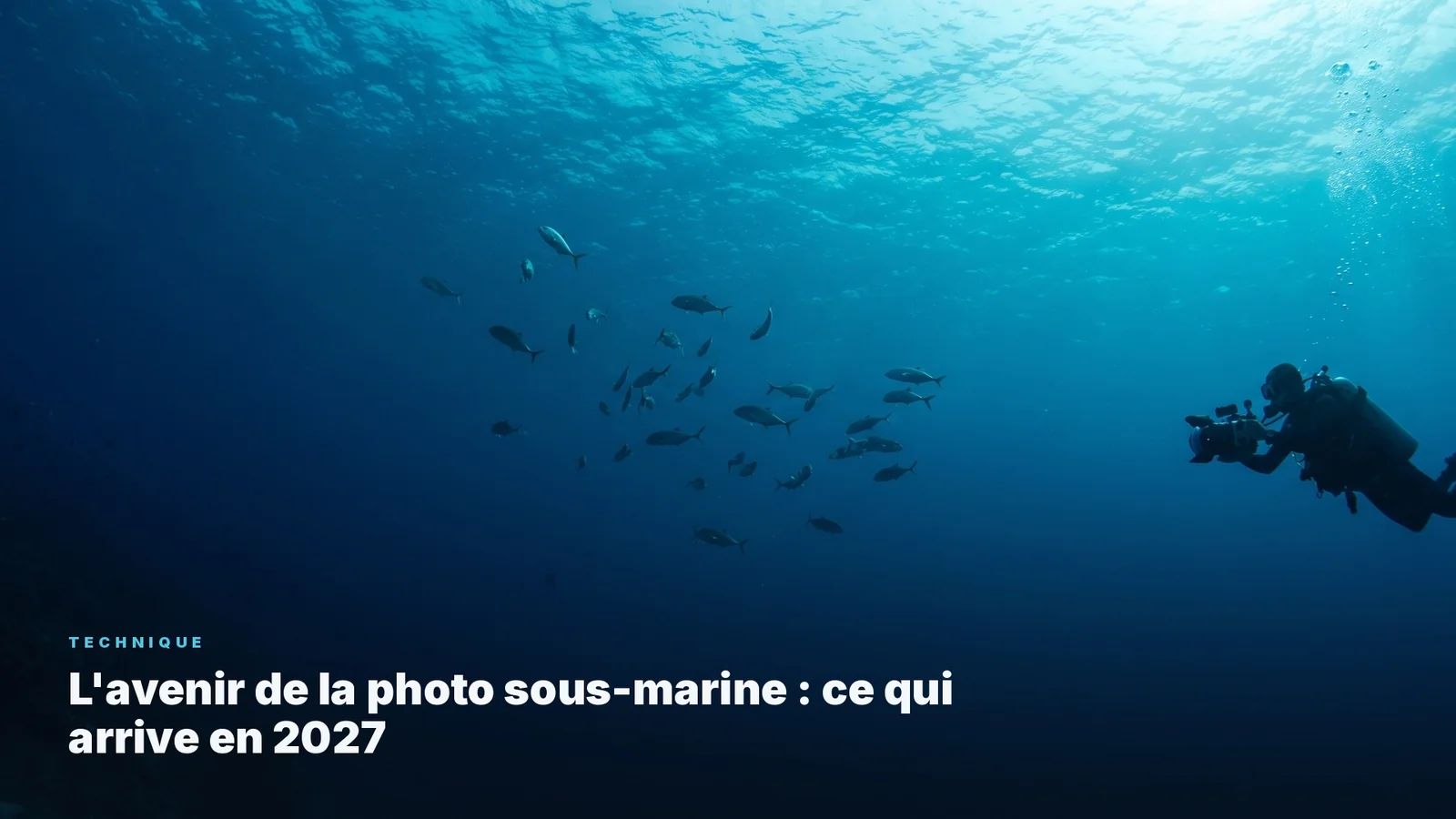
The Future of Underwater Photography- What to Expect in 2027.
What innovations will truly transform underwater photography by 2027? A look at computational sensors, embedded AI, drones, and augmented reality – an honest analysis.
Will advanced underwater housings already exist in 2026?
A few prototypes exist (particularly Paralenz), but "smart" housings in the truest sense of the word- with embedded AI and real-time connectivity- do not yet exist in a consumer version. The first viable models are expected to appear around 2027.
Can underwater drones replace scuba divers for taking photographs?
No, and that is not their purpose. Underwater drones like the FIFISH V-EVO can access perspectives impossible for a diver (descending to 100m, holding position in currents), but they lack the creative judgment or ability to interact with marine life.
Will augmented reality be useful underwater in 2026?
Not yet in a practical way. A few experiments exist with integrated masks (like the Scubapro Luna 2.0), but integration with photography remains limited. Real-time species identification using augmented reality is the most promising application for 2027.
Do you have to wait until 2027 to replace your equipment?
No. Your current equipment that you are comfortable with is more valuable than future equipment you might be waiting for. Innovations from 2027 will first be available in premium versions at high prices. The fundamental principles of underwater photography remain unchanged regardless of the generation of equipment.
Will AI replace underwater photographers?
AI can automate tasks like color correction, cropping, and noise reduction. However, it cannot decide when to wake up before dawn to capture the morning light, remain perfectly still for 20 minutes while an octopus gets used to your presence, or choose the angle that tells a story. AI enhances the artist- it does not replace them.
What will be the impact of 3D printing on the price of underwater housings?
Gradually, but significantly. Manufacturers like Ikelite and AOI are already using 3D printing for certain components. In the long term, modular and custom-made housings could reduce prices by 30 to 50% in the mid-range segment.
Will smartphones from 2027 be better for underwater photography?
Sensors continue to improve, but the real breakthrough will come from specialized underwater algorithms. Samsung's Ocean Mode has paved the way. When Apple and Google offer comparable underwater profiles, smartphone underwater photography will truly cross a significant threshold.
In 2027, underwater photography will be transformed on three fronts simultaneously- computational sensors will become available in housings, consumer underwater drones will become viable, and augmented reality will begin to assist with real-time species identification.
I read the announcement of the second generation Sony IMX989 sensor in March 2026. I was in a café in Brussels between two training sessions at the pool. The technical article described a 1-inch sensor with embedded multi-frame processing, optimized for low-contrast environments. My first reaction: this is exactly what I expected for underwater photography. My second reaction: how long will it take before it's available in a housing at a reasonable price?
That question drives this article. No press releases, no hype. Just what will actually change for you when you dive with a camera.
Computational Sensors- The Revolution Underway
What Current Sensors Don't Do
The fundamental problem in underwater photography is not resolution. A well-exposed 12-megapixel sensor produces a usable image. The problem is contrast (reduced by water diffusion), dynamic range (compressed at depth), and noise (amplified by the high ISO values needed in low light).
Current sensors address these problems after the fact, in software. The result is often acceptable, sometimes excellent, but always a compromise.
Comparison of a standard sensor versus a computational sensor underwater at a depth of 15 meters. A visible difference in contrast and noise levels.
What's Changing with the Next Generation of Computational Sensors
Computational sensors integrate processing directly into the silicon, rather than a separate processor. Specifically: multi-frame merging happens in milliseconds, noise reduction is applied before the data even leaves the sensor, and optimization profiles can be specific to the environment.
For underwater photography, this opens up a concrete possibility: an embedded water mode that adjusts processing in real time based on depth, turbidity, and available light.
The comparison between 1-inch sensors and 8K formats remains relevant for current equipment choices, but computational sensors will significantly reshape these criteria.
Embedded AI in Housings: The Real Situation
Current Status: Many Promises, Few Products
In 2026, the only real embedded AI in a consumer underwater product is Samsung's Ocean Mode (on the S24 Ultra and S25 Ultra). Traditional housings (Nauticam, Aquatica, Ikelite) do not offer software intelligence. They are simply waterproof enclosures that transmit the photographer's commands to the camera.A few manufacturers of specialized underwater cameras (particularly Paralenz) are integrating smart automation, but without generative AI or advanced multi-frame processing.
What is realistic for 2027
Two concrete applications seem close to becoming a reality.
Predictive autofocus. Current AF systems struggle with fast-moving subjects underwater (due to turbidity and refraction). An AI model trained on thousands of underwater sequences could predict the trajectory of a fish and anticipate focus adjustments.
Real-time color correction. Not just a profile like "Ocean Mode," but dynamic correction that compensates for chromatic absorption based on the depth measured by the housing. Nauticam filed patents in this direction in 2025.
My honest assessment: embedded AI in housings will first appear in the professional segment (€10,000 and more), and then trickle down to the consumer market over 3 to 5 years. Expect announcements in the premium segment in 2027, but not accessible products.
Underwater Drones: The moment is approaching
Underwater drones like the FIFISH V-EVO have existed for several years. The video quality is good. The current problem remains maneuverability in currents, battery life (45 to 90 minutes in practice), and above all, a control interface that is not intuitive for a photographer.
FIFISH underwater drone during a dive, autonomous descent to a depth of 30 meters, coral seabed in the background
What will change by 2027: The latest ARM processors enable semi-autonomous control. The drone maintains its position relative to the subject, automatically compensates for currents, and can follow an animal along a predefined vector. The photographer designates the subject, and the drone handles stabilization.
What this does not replace: your physical presence in the water, your relationship with marine life, and your ability to read the light in real time. A drone doesn't know that the morning light on this specific reef is better at 7 am than at 10 am.
Augmented reality for species identification
Scubapro Luna 2.0 and a few competitors already offer connected masks with information displays (depth, time, heading). The integration with photography remains minimal.
What is under development: real-time species identification via the mask camera, displaying the name and typical behavior of the identified animal. Both iNaturalist and Wildbook have APIs that could power this type of interface.
For the photographer, this has the potential to be useful for spotting rare species before they disappear into the blue. It's not for composing the image, but for avoiding missing an opportunity.
3D printing and modular housings
This is the least glamorous but perhaps most concrete trend for the average photographer.Current housings are expensive because they are mass-produced for specific camera models. When Sony releases a new housing, the housing manufacturer has to start from scratch designing the port and buttons. Lead time: 6 to 18 months. Price: €700 to €3,000 for a quality housing.
SLS nylon or high-precision resin 3D printing allows for custom parts on demand. Several manufacturers (AOI, Ikelite) are already using this technology for spare parts and accessories.
In 2027, we can expect hybrid housings to appear: a standard waterproof body (traditionally injection-molded for mechanical strength) with control panels and interfaces that are 3D-printed and customized for each camera body. Potential cost: 40 to 60% less than a fully integrated housing.
The AquaExposure perspective: what I'm really waiting for
I will be direct about what I personally expect from these developments.
Predictive underwater autofocus interests me greatly. It is the technical limitation that I encounter most often: fast fish (kingfish, barracuda, fleeing red snapper) are difficult to photograph in focus with large apertures using current systems.Generative AI interests me for noise reduction, not for image manipulation. The issue of the authenticity of underwater photos is central to AquaExposure, and I have developed my position on marine deepfakes in a separate article.
Visual timeline of expected innovations in underwater photography from 2026 to 2028: sensors, drones, AR, 3D printing
Modular housings are very interesting to me for accessibility reasons. Currently, the initial costs of underwater photography with DSLR or mirrorless cameras remain too high for many divers. Anything that reduces these costs without sacrificing quality is a step in the right direction.
What doesn't interest me: features that automate the photographer's perspective. Choosing the angle, waiting for the right moment, deciding whether or not to take a photo: that's where the art lies. AI can technically help me execute, but it cannot decide for me what is worth photographing.
AquaExposure does not receive affiliate commissions on products mentioned in this article.
Mastering the fundamentals remains essential, regardless of the generation of equipment. The AquaExposure underwater photography course prepares you to get the most out of your current equipment and what is yet to come.
The Future of Underwater Photography- What to Expect in 2027. | AquaExposure