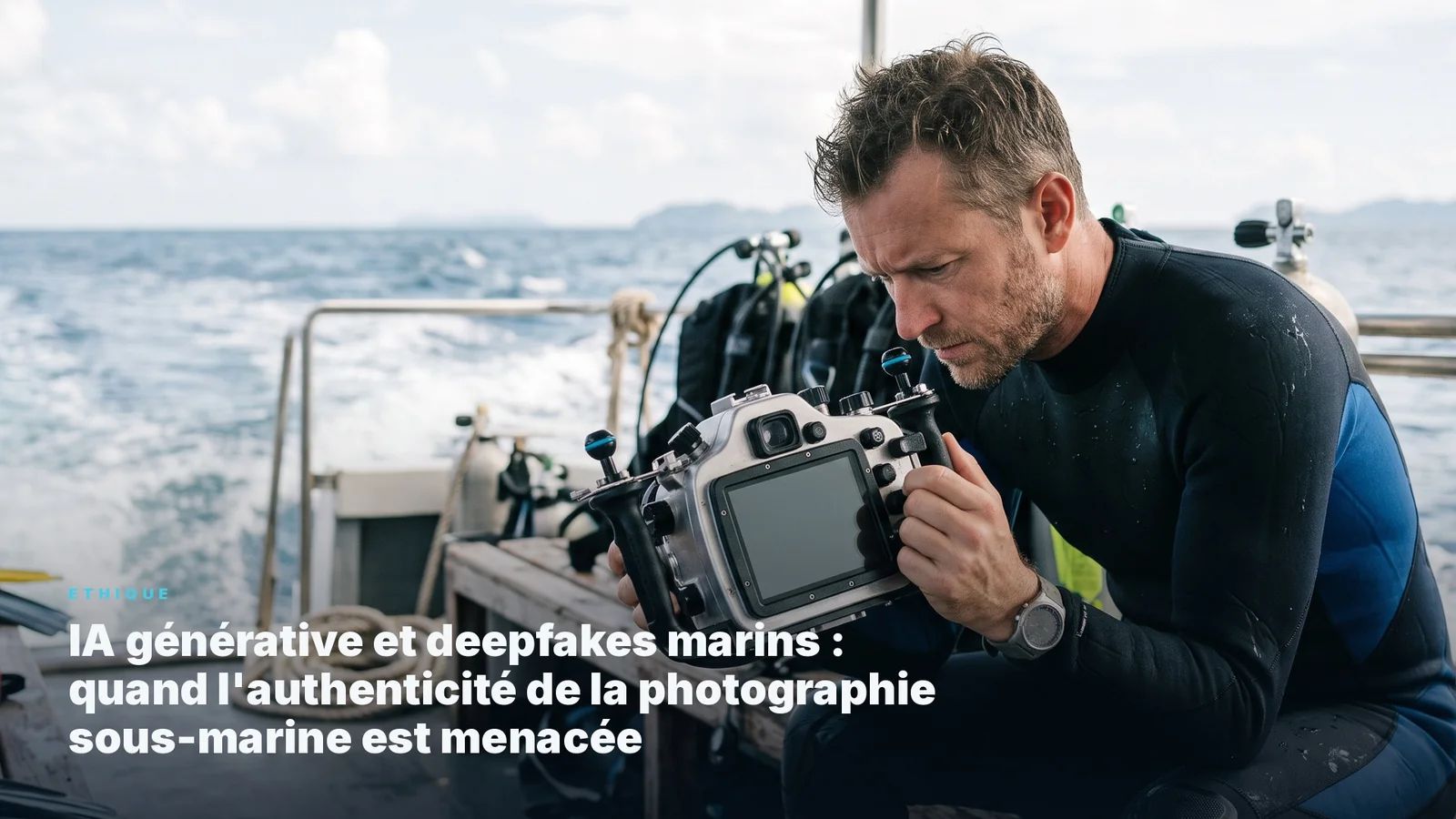
Generative AI and Ocean Deepfakes: When the Authenticity of Underwater Photography Is Under Threat
Generative AI produces fake underwater photos indistinguishable from real. Risks for marine conservation, photo competitions and ocean visual credibility in 2026.
Are AI-generated ocean images truly indistinguishable from real underwater photos?
For isolated images in common underwater contexts, the answer is often yes in 2026. Midjourney v7, Stable Diffusion XL and equivalent tools produce underwater images that the majority of non-specialist viewers cannot distinguish from authentic photographs. Indicators exist for a trained eye (animal anatomy, hydrodynamics, surface light reflections) but they are not universally obvious.
Do underwater photo competitions have rules against generative AI?
Most major competitions updated their rules between 2024 and 2026. Underwater Photographer of the Year (UPY) explicitly prohibits any AI-generated content and requires that images represent genuinely photographed scenes. Disqualification applies to images partially or fully altered by generative tools beyond accepted retouching criteria.
Does Adobe Firefly and Adobe's generative AI threaten photographic authenticity?
Adobe Firefly, integrated into Photoshop via Generative Fill, is the most widespread case because millions of photographers already use Photoshop. It allows elements to be added or removed from existing photos realistically. The boundary between acceptable retouching (removing a diver's tank bubble from a face) and documentary manipulation (adding a species absent from the actual scene) depends on the intended use, not the tool itself.
Do AI-generated underwater images affect marine conservation?
Potentially yes, in two ways. First, AI-generated images of healthy reefs can mask the real state of ecosystem degradation and create a false perception of normality. Second, species identification data from AI images infiltrating scientific databases would corrupt distribution and abundance models used to inform conservation decisions.
How can you tell if an underwater photo is authentic or AI-generated?
No detection tool is 100% reliable in 2026. Common indicators include: anatomically incorrect animals (fins at impossible angles, misplaced eyes), unrealistic hydrodynamics (bubbles rising in the wrong direction), repeated textures across coral or rock surfaces, absent or inconsistent EXIF metadata, and a complete lack of geographic or contextual detail. Verifying who took the image, when, where and with what equipment remains the most reliable method.
Can generative AI be used ethically in underwater photography?
Yes, within clearly delimited uses: editorial illustration explicitly identified as AI-generated, training and simulation of underwater scenes, or artistic creation presented as such. The line is transparency: an AI-generated image presented as a documentary photograph is a deception, regardless of how beautiful it is.
What are Content Credentials and do they help against ocean deepfakes?
Content Credentials (C2PA) is an open standard for embedding authenticity metadata in image files. Adobe, Nikon, Sony and other manufacturers are beginning to integrate it. A C2PA-signed file contains an edit history and a cryptographic signature from the source device. The system is promising but not yet universally adopted or immune to all manipulations.
Generative AI can now produce underwater images indistinguishable from real dive photographs. A fluorescent coral in perfect health in crystal-clear water, a manta ray in ideal silhouette against the surface, a school of bluefin tuna in the Mediterranean: images that have never existed, circulating as genuine visual testimony. For underwater photography, whose documentary value sits at the heart of marine conservation, this is a structural threat that few photographers have fully measured.
Side-by-side comparison: authentic Mediterranean coral photo and AI-generated image on the same theme, with annotations indicating artificiality indicators
A recent problem accelerating fast
At the end of 2022, the first underwater images generated by models like DALL-E 2 or Stable Diffusion were easy to spot: strange anatomy, repetitive textures, incoherent lighting. A diving photographer with six months of experience identified them in seconds.
By 2025, new-generation image models produce underwater scenes that even experienced photographers cannot systematically distinguish from authentic images. I ran comparison tests during workshops in Brussels: from mixed batches of 20 images (real photos and AI-generated), my students made errors on an average of 4 to 6 images. Experienced photographers I respect had similar scores.
This is not a judgment on their competence. It is a measurement of how fast the technology has moved.
What generative AI concretely changes
The end of "I was there, I have the photo"
Underwater photography has always derived part of its authority from the fact that it implies a physical presence in a hostile environment. Photographing a moray eel in the Mediterranean requires diving, approaching, waiting. The photo was proof of that presence.
That proof no longer works if anyone can generate an image of a moray eel in the Mediterranean without having ever touched a dive mask.
Practical consequences: divers sharing photos on social media lose their automatic credibility as witnesses. Reporting an invasive species, documenting a bleaching site, or recording unusual animal behaviour now requires additional verification that a photograph alone can no longer guarantee.
Pressure on underwater photo competitions
Major underwater photography competitions responded relatively quickly. Underwater Photographer of the Year (UPY) updated its rules to explicitly prohibit AI-generated content and require that every submitted image represent an authentically photographed scene. The AI rules in underwater photo competitions have evolved since 2023 and continue to be refined.
But enforcement remains difficult. AI detection tools are far from reliable. A jury evaluating potentially thousands of images has limited resources. Bad-faith participants have a structural head start over verification systems.
The conservation impact
The case that concerns me most in the long term: marine biodiversity scientific databases are vulnerable.
If AI-generated images of marine species at fictional or false locations reach iNaturalist or GBIF, they can corrupt species distribution models. An algorithm detecting the presence of an invasive species from an AI image cannot distinguish a real observation from a fabricated one.
Coral bleaching is partially documented through citizen diver photographs. If AI-generated images of healthy reefs circulate as authentic photos, they can create a false perception of normality where the reality is degradation. This mechanism is not theoretical: it corresponds exactly to how social platforms amplify spectacular images without authenticity verification.
Two categories of tools create legitimate confusion:
Pure generative AI (Midjourney, DALL-E, Stable Diffusion, Firefly Generative Fill to add elements): it creates content that did not exist in the real scene.
Restoration AI (Topaz Denoise AI, DxO PureRAW, Lightroom AI Denoise): it improves an existing image without modifying its documentary content.
The boundary is not always clear. Adobe Firefly, integrated into Photoshop as "Generative Fill", sits between the two depending on use: removing a tank bubble from a diver's face is aesthetic retouching. Adding a fish absent from the original scene is documentary manipulation.
Spectrum diagram of AI manipulation, from acceptable light retouching to unacceptable full generation, with underwater photography examples at each level
How to identify an AI-generated underwater image
No automated detection tool is 100% reliable in 2026. Automatic detectors (GPTZero, Hive Moderation, specialised tools) have significant error rates on photographic images. Developing a trained human eye remains the most reliable method, with its own limitations.
Indicators to look for in a suspicious image:
Animal anatomy. AI models make mistakes on the anatomical details of marine species: fins at impossible angles, incorrectly placed eyes, a mouth that does not match the supposed species, tentacles with the wrong count or texture. A diver who knows Mediterranean species spots these errors quickly.
Hydrodynamics. Bubbles always rise vertically underwater. Corals do not bend in directions inconsistent with the current. Sunlight filtering underwater forms vertical rays, not arcs. These physical constraints that AI models have not fully mastered remain valuable indicators.
Repetitive textures. AI models sometimes create repetitive patterns across corals, rocks or sandy areas. Examining the image at scale reveals these repetitions that do not exist in nature.
Absent EXIF metadata. A real photo carries metadata: camera model, focal length, shutter speed, ISO, sometimes GPS coordinates. A generated image has none of this unless metadata is manually added. The absence of EXIF metadata on a photo allegedly taken with a physical device is a strong signal.
Missing context. Who took the photo? When? At which dive site? With what equipment? An authentic image comes with a context its author can detail. A generated image has none.
My position on generative AI in underwater photography
I have been working with AI tools since 2022. I use Topaz for denoising and upscaling. I find these tools legitimate because they improve real images taken in difficult conditions, without modifying what was actually photographed.
I refuse to use generative AI to create or modify the documentary content of my images. Not out of dogmatism, but because the value of underwater photography rests on what it attests: a physical presence in a hostile environment, an encounter with living creatures, a moment that actually happened.
AquaExposure teaches underwater photography in natural light, without strobe, with the real limitations that this implies. Those limitations are part of the honesty of the medium. A photo taken at 18 metres in the Mediterranean in winter, with the blue-green colour cast that natural light produces at that depth, is authentic precisely because it carries the constraints of the environment.
An AI-generated image of the same scene, perfect, luminous, without grain, without motion blur, without the imperfections of reality, is a beautiful image. It is not a photograph.
What photographers can do
Systematically contextualise. Share your photos with information about the dive site, date, conditions and equipment used. This context is both proof of authenticity and added value for your audience.
Keep RAW files. The RAW file is the incontestable evidence that the photo was captured by a physical sensor. In case of dispute, it is the primary proof.
Use Content Credentials if your equipment supports it. Sony, Nikon and Canon are beginning to integrate the C2PA standard which cryptographically signs image origin within the camera. This signature can accompany the file throughout its distribution chain.
Contribute pressure to platforms. Social platforms and competitions without a clear policy on generative AI content deserve to be challenged. Demands for transparency from authentic content creators are a real lever.
Contributing to citizen marine science illustrates what an authentic geotagged photo is worth: data that researchers can actually use. An AI-generated image carries none of that value.
Ethical underwater photography has always included the question of the relationship with living subjects. It now also includes the question of the relationship with the truth of the image.
Content Credentials screenshot: authenticity metadata of a C2PA-certified underwater photo in Adobe Photoshop, showing the full provenance chain
A challenge that will not go away
The quality of generative models will continue to improve. In two years, the anatomical indicators I describe above will likely be corrected. The gap between a generated image and an authentic photograph will continue to narrow on a purely visual level.
What will not change: the intrinsic value of presence. Being in the water, at that moment, with that species, in those conditions, is something no AI can generate because it did not happen.
The 2026 underwater photography competition calendar features competitions that still value this authenticity. As long as there are forums where the truth of presence is recognised and rewarded, authentic underwater photography has a defended space.
For those who want to progress in underwater photography within this commitment to authenticity, the AquaExposure underwater photography course teaches how to use the constraints of the underwater environment as assets rather than obstacles to overcome with technology.
The question of authenticity in underwater photography is not a technical question. It is a question of what you want your photos to serve.
Generative AI and Ocean Deepfakes: When the Authenticity of Underwater Photography Is Under Threat | AquaExposure