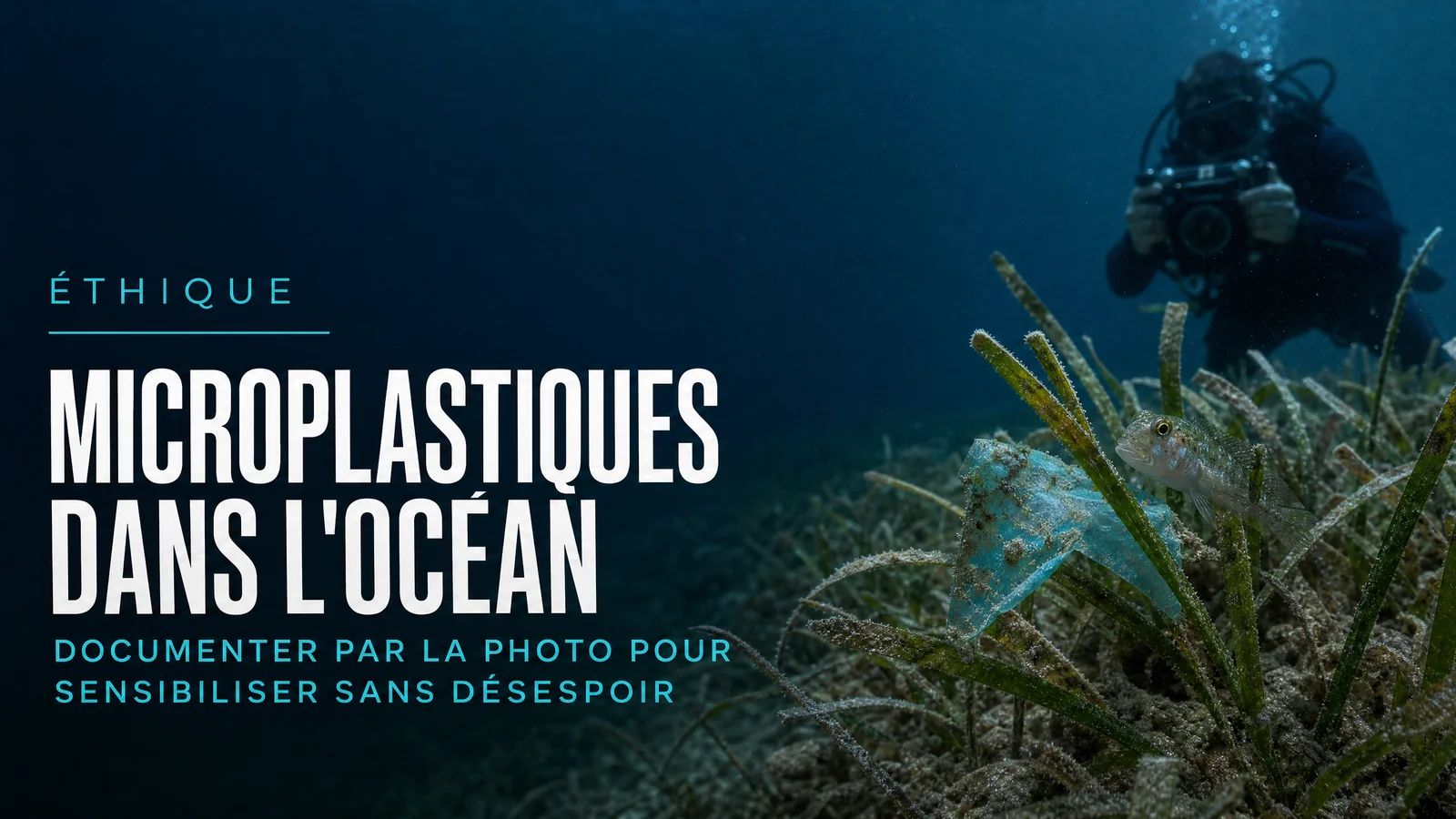
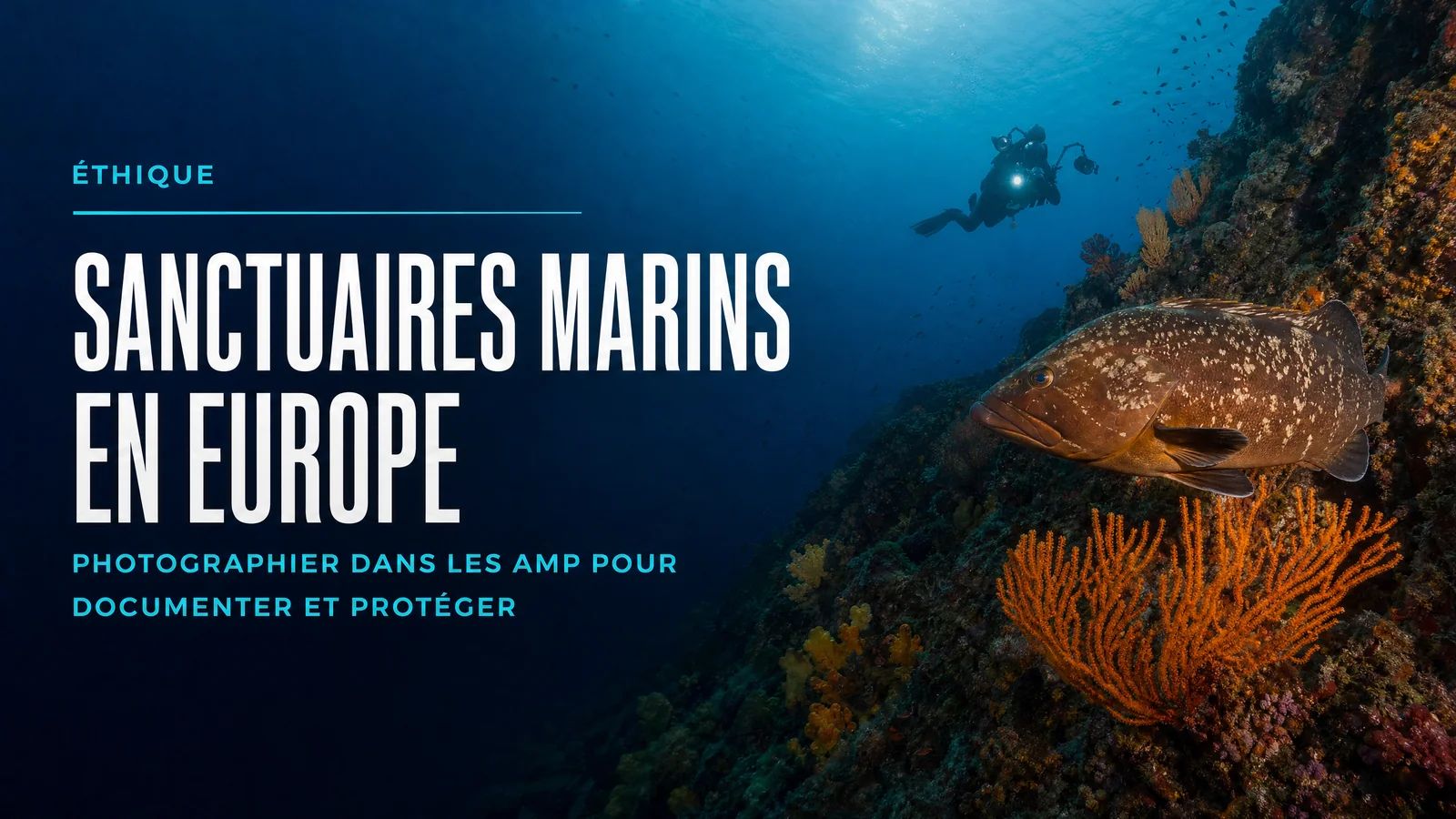
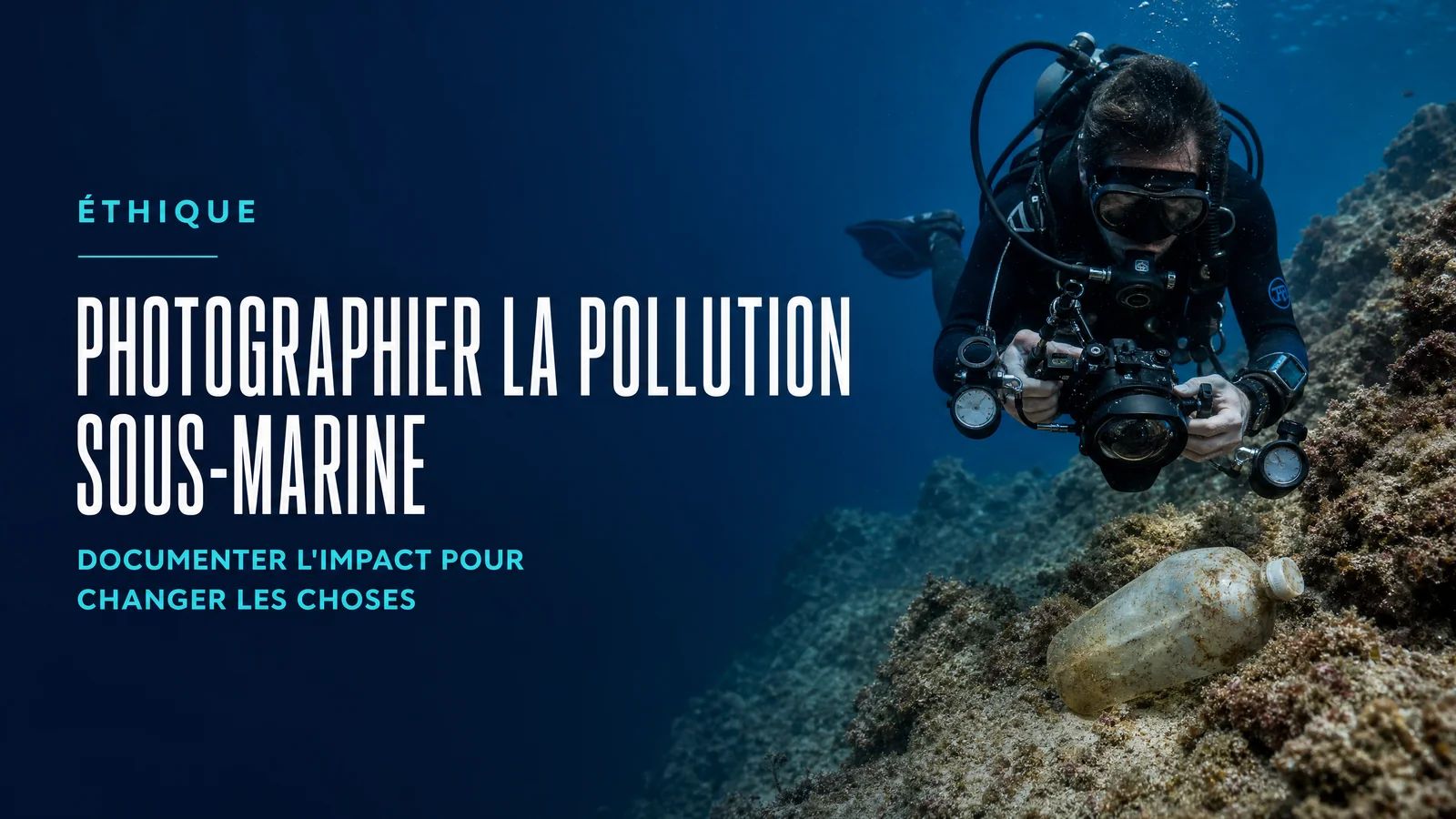
Microplastics in the Ocean- Documenting with Photography to Raise Awareness Without Despair.
How to photograph microplastics underwater- macro photography, backlighting, blue backgrounds. AquaExposure techniques, citizen science initiatives, responsible reporting. A guide for scuba diving photographers.
Yes, but it requires knowing where and how to look. Microplastics are invisible in the water column during normal dives, but they can be seen when viewed against a bright light source (like dust particles in a sunbeam), on a dark background, or with close-up macro photography of a colonized substrate. Filaments and fragments ranging from 1 to 5 mm can be photographed using a standard macro lens.
What equipment do you recommend for photographing microplastics underwater?
A macro lens with +10 or +15 diopters, suitable for your camera housing, is ideal for capturing fine details. A smartphone with portrait mode or a strong digital zoom can also produce acceptable results when photographing accumulations visible at shallow depths. The key is lighting- natural backlighting or a dark background that contrasts with the light-colored particles.
Where can I find microplastics while diving so that I can photograph them?
In areas with low currents where particles accumulate- such as rocky crevices, Posidonia seagrass beds, and sandy bottoms between rock formations. Also, on the surface and at very shallow depths after periods of wind or rain that bring surface plastics down. Thermocline boundaries can also concentrate light particles.
How can I participate in microplastic monitoring programs as a scuba diver?
Dive Against Debris (Project AWARE) accepts reports of microplastics along with geolocated photos. The organization 5 Gyres has protocols for surface surveys that are accessible to coastal divers. In France, initiatives such as the IUCN's Mission Microplastiques are seeking volunteers for structured surveys. Contact the managers of Marine Protected Areas in your region to learn about local programs.
Can you collect microplastics while scuba diving?
Fragments larger than 1 mm can be carefully collected using a fine-mesh net or bag. Smaller particles are too light to be effectively recovered without specialized equipment and risk being dispersed by your movement. In such cases, photographic documentation and geolocation are more useful than collection.
Do microplastics affect marine species that are visible during dives?
Yes, and this has been documented. Sea cucumbers ingest microplastics while filtering sediments. Bivalves (mussels, wild oysters) accumulate particles through filtration. Some planktivorous fish mistake shiny fragments for zooplankton. These behaviors can be photographed in situ and provide important data for documentation.
What is the difference between documenting microplastics and creating impactful images of marine pollution?
The shocking image aims to provoke an immediate emotional response. Documentation presents the facts to encourage an informed and lasting reaction. In the case of microplastics, this means photographing the ecological context- the affected species and the environment it inhabits- rather than just the plastic itself. And each publication should be accompanied by information about citizen initiatives actively working in the area.
There is a type of pollution that our photos rarely show. Not because it isn't there, but because it is often too small to frame without specialized techniques, or too diffuse to be dramatized. Microplastics are everywhere in the ocean. We are only just beginning to learn how to see them.
What Our Images Don't Yet Show
I have taken thousands of underwater photographs. The vast majority show what I can clearly see with my naked eye: fish, coral, seagrass beds, and large pieces of debris. For years, I didn't capture the invisible chemical context in which all these species live.
The first time I deliberately saw microplastics while diving, I had a flashlight on, shining against the light in a crevice at 8 meters deep, off the coast of Catalonia. The floating particles, which I would normally ignore as "noise" in a typical image, suddenly formed an identifiable cloud. It wasn't dramatic. It wasn't photogenic in the conventional sense. But it was real, documentable, and transmittable.
This realization, this shift from "I don't see anything" to "I now know where and how to look," is what I am trying to convey here.
Understanding Microplastics to Photograph Them
We can only effectively photograph what we understand. Here's the essential information you need to know about microplastics before heading out with your camera.
What We Call MicroplasticsThe standard definition: plastic fragments smaller than 5 mm. Below 1 mm, we sometimes speak of nanoplastics, which are invisible to the naked eye and impossible to photograph without a microscope.
For us, underwater photographers, the useful range is between 1 and 5 mm. These fragments are visible to the naked eye under good conditions and can be photographed with a macro lens. Fragmented plastic films, synthetic fibers (from clothes washed in machines), and industrial pellets (virgin plastic granules) are the most common types at these sizes.
Where to find them while diving
Microplastics are not evenly distributed. They accumulate according to local hydrodynamic patterns.
In rocky crevices exposed to currents: light particles become trapped there, like leaves in a street corner. On the rhizomes of Posidonia seagrass beds: dead leaves that fall to the bottom accumulate plastics that settle with them. In areas with low current between rock formations, on sandy bottoms: particles deposit along with fine sediments. Just below the surface after rainfall events that wash plastics from the surface: the hours following a heavy coastal rain concentrate runoff plastics.
The species that ingest themAn image of a sea cucumber filtering sediments in an area with a high concentration of microplastics is both scientific data and a visually compelling narrative. Sea cucumbers do not distinguish between organic sediment and microplastics. The same applies to bivalves (wild mussels, oysters), which actively filter suspended particles.
Photographing the species exhibiting its normal feeding behavior, within a context where you have documented the presence of microplastics, creates a visual connection that the public intuitively understands.
Photography Techniques for Nearly Invisible Subjects
This is where the practice diverges from classic underwater photography. Microplastics require a deliberate technical approach, often less instinctive.
Macro and Super-Macro for Visible Fragments
For fragments ranging from 1 to 5 mm in size, resting on a substrate (posidonia rhizomes, rocks, sand), a macro lens with +10 or +15 diopters, compatible with your camera housing or smartphone case, provides the best results. The focus distance is short, and the depth of field is shallow- requiring precise focusing and ideally a tripod or support to stabilize the camera.The additional challenge is that translucent or white fragments on a light background can disappear in the image. Look for contrasting backgrounds- such as a green posidonia leaf, a dark rock, or fine sediment that is darker than the fragments. If the background is too light, an artificial background (a square of dark fabric placed under the fragment) can be used in a controlled documentation setting.
Backlighting for Suspended Particles
To make visible what is floating in the water column, backlighting is the basic technique. Position yourself between the subject and your light source (the surface sunlight during shallow dives, or your own dive torch placed behind the particles). The fragments and fibers, made opaque by the light passing through them, become visible against the dark background.
This technique works well between 3 and 10 meters, where sunlight is still directional. In the Mediterranean Sea in summer, between 8 am and 11 am, the grazing light offers the best conditions for this type of work.
The Blue Background as a RevealerAnother approach is to photograph from below, looking upwards towards the surface, with microplastics suspended between you and the bright surface. This position provides a naturally illuminated background against which the particles stand out. It's the same principle as photographing a jellyfish or a school of small fish from below: the blue/white background of the surface becomes a natural studio backdrop.
The main drawback is that it can be difficult to control the depth of field with this type of lighting. Close down your aperture slightly (f/8 to f/11) to increase the area in focus, even if you need to compensate by using a higher ISO sensitivity.
Citizen Initiatives Focused on Microplastics
Documentation only becomes valuable when it is integrated into a database or monitoring program. Several organizations accept contributions from divers regarding microplastics.
Dive Against Debris (Project AWARE)
The Dive Against Debris platform accepts reports of photographed and geolocated microplastics, even when it is not possible to collect them physically. A photo with GPS metadata and a description of the context (substrate type, depth, conditions) constitutes a valid contribution.For fragments that can be recovered (larger than 5 mm), physical collection and submission of a complete report are the ideal steps. For smaller particles, photographic documentation alone is already useful.
5 Gyres and research on macro-fragments
5 Gyres focuses on surface plastic waste, including macro-fragments that break down into microplastics. Their surface observations are accessible to sailors and coastal snorkelers. Their mobile application allows users to contribute to mapping areas of accumulation.
Local research programs
In the Mediterranean Sea, several microplastic monitoring programs are seeking volunteers for structured surveys. The IUCN, Surfrider Foundation Europe, and some coastal universities (particularly in France and Spain) have protocols that allow divers to contribute with standardized data.
Contact your local dive center or the manager of the nearest Marine Protected Area: these partnerships often develop at the local level.
Combining microplastic data with other types of observations (species observed, condition of seagrass beds, condition of coral) in the Reef Check and BioObs protocols enhances the value of each observational dive.
Publishing responsibly: Communicating effectively about microplasticsThe risk with microplastics, more so than with visible pollution, is that it generates despair rather than action. Saying "plastic is everywhere, even in the air we breathe" doesn't motivate anyone to act. It's information that paralyzes.
The narrative framework that mobilizes
For microplastics, the effective approach isn't simply "here's the horror," but rather "here's what's happening, here's how to measure it, and here's how you can contribute to changing it." This framework requires three elements in each publication: a concrete image or observation that shows reality, a minimal scientific context that explains what we are seeing, and a possible action for the reader.
The action can be as simple as: joining a monitoring program, avoiding certain cosmetic products containing microbeads, or choosing clothing made from natural fibers that release fewer synthetic fibers. These are actions at a human scale, not general calls to "save the oceans."
Consistency with threatened beauty
The approach I have advocated for years, and which is particularly well-suited to microplastics: alternate between images of beauty and images of threat in your communication. A seahorse in healthy seagrass (Posidonia). The same seagrass with fragments of plastic in its rhizomes. The same seahorse filmed in a context where you have documented the presence of microplastics.This sequence of beauty/threat/action is infinitely more effective than a succession of images depicting pollution, which gradually numbs the viewer. It's also closer to reality: threat and beauty coexist. Microplastics and seahorses share the same seagrass beds. This coexistence in itself sends a message.
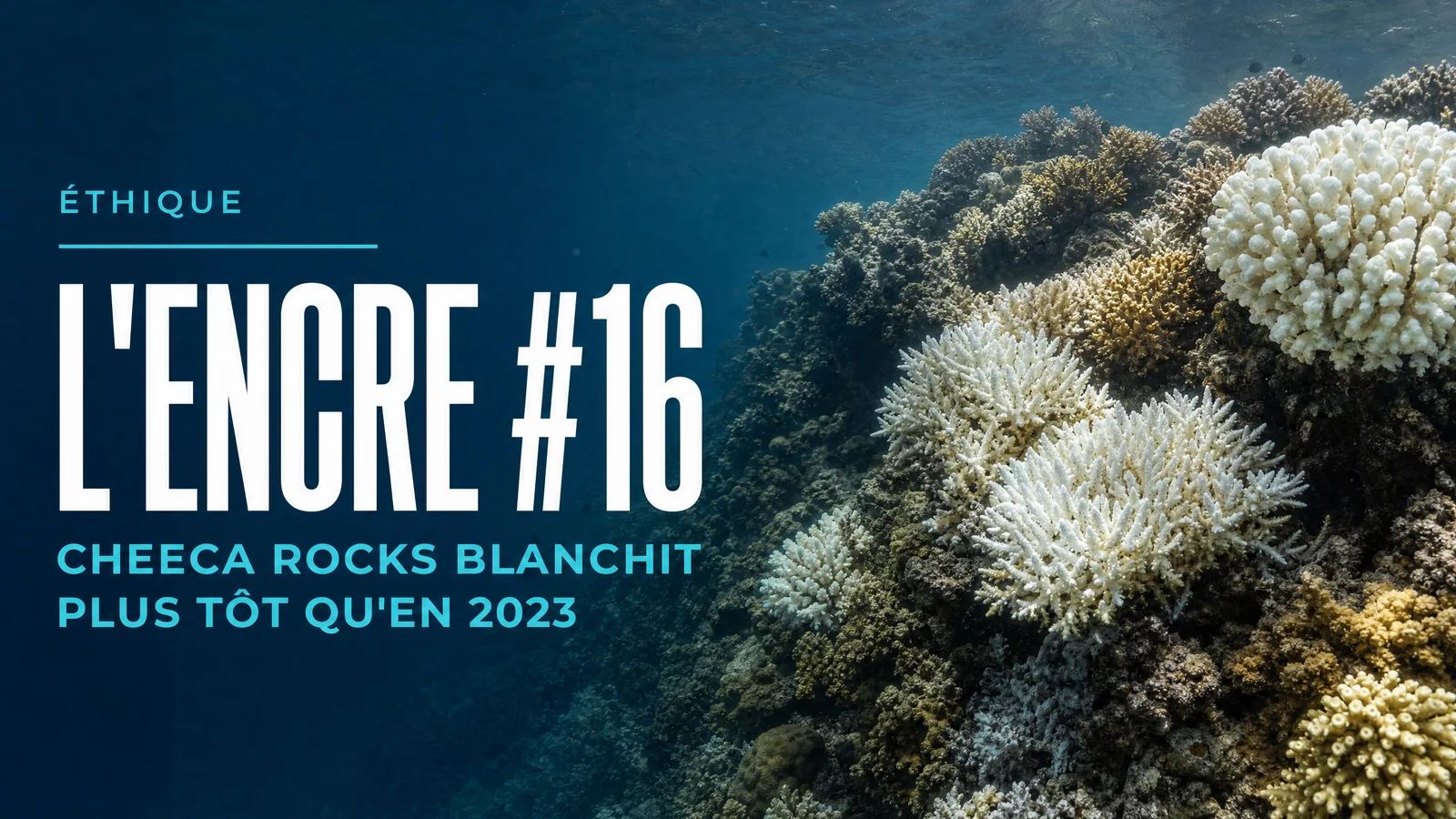
Coral bleaching has benefited from this approach in scientific and activist communication: images of healthy corals have become an essential counterpoint to images of bleached corals. The same logic applies to microplastics.
Incorporating microplastic documentation into your diving practice
If you haven't consciously done so before, your next dive is a good opportunity to observe the water differently. Turn on your underwater light in a dimly lit crevice and look at what floats between you and the light source. Examine the posidonia rhizomes with a close-up light. Look at the sandy bottom in areas with low currents, using the trained eye of someone searching for something small.
This attention changes the dive. It doesn't make it less beautiful. It makes it more complete.The connection between photographing microplastics and protecting marine life is direct: documenting the presence and effects of microplastics on species and habitats helps to build a scientific case for policies that reduce plastic production at its source.
If you want to delve deeper into this form of documentary photography and learn how to structure your underwater observations to maximize the value of each dive, the AquaExposure underwater photography course incorporates environmental documentation as an integral part of a photographer's perspective.
What is invisible deserves to be shown. That is one reason why we dive with a camera.
Microplastics in the Ocean- Documenting with Photography to Raise Awareness Without Despair. | AquaExposure