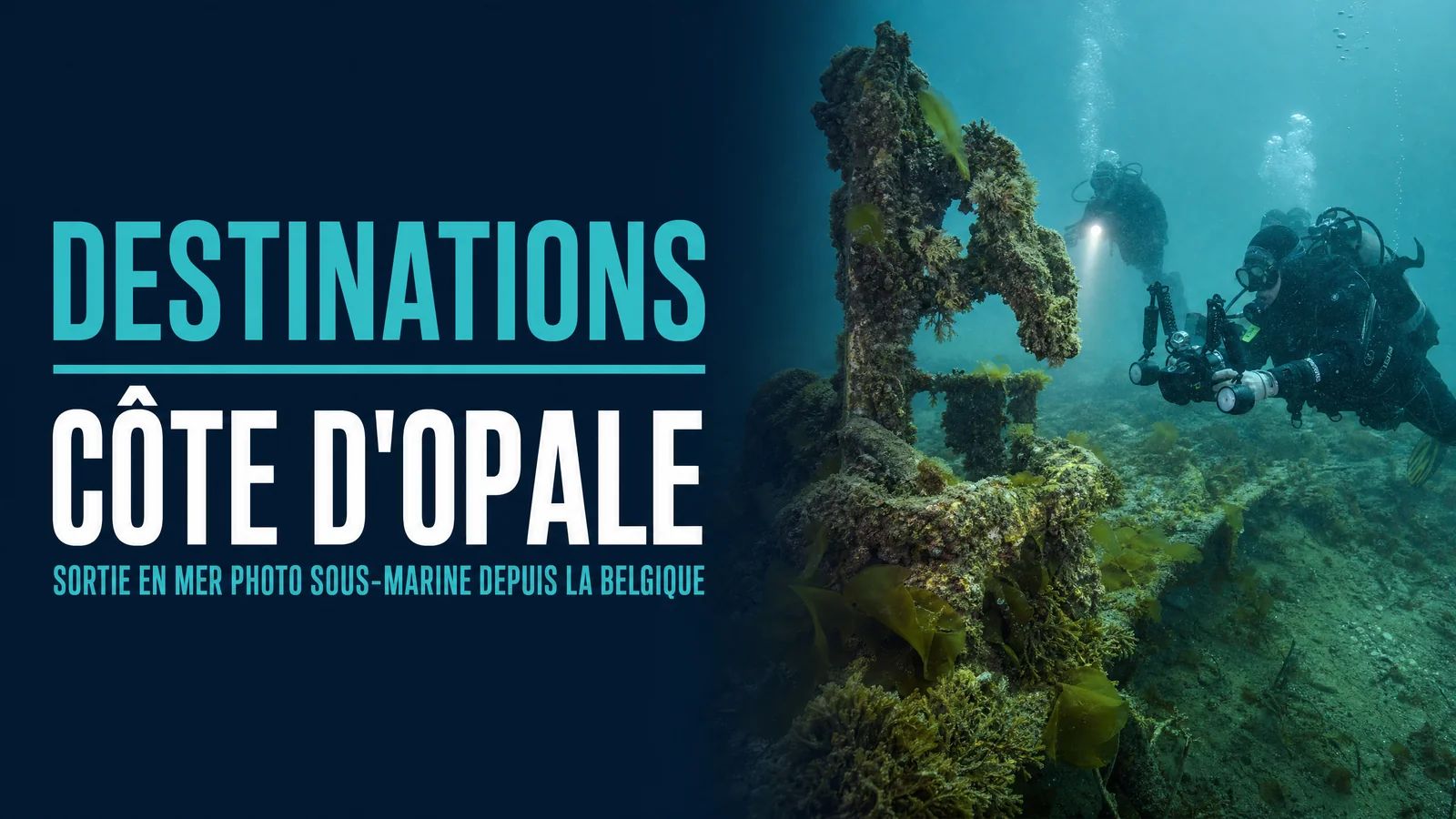
Is the Opal Coast worth the drive for underwater photography?
Yes, if you accept its constraints. Water is green with variable visibility (3 to 10 metres depending on tides), but the marine life is genuinely surprising: grey seals near Calais and Wissant, English Channel wrecks, conger eels, lobsters and abundant invertebrates. For Belgian divers, it is the closest real sea dive site - under 2 hours from Brussels.
What are the best dive sites for photography on the Opal Coast?
Wimereux for rocky formations and benthic life. Boulogne-sur-Mer for boat dives and access to Channel wrecks. Ambleteuse for large boulders and conger eels. Wissant for grey seals in season (mainly October to March). Calais bay for seal watching from a zodiac.
How is the water visibility on the Opal Coast?
Average 3 to 8 metres. Green-brown dominant colour with red absorption below 5 metres. The texture and richness of the seabed (kelp, invertebrate- covered rocks) compensates significantly. Lightroom post-processing is essential to recover colours, especially adding warmth in the tone curve.
Are the tidal currents dangerous for underwater photographers?
Tidal flow in the Channel can be strong (2 to 4 knots depending on the coefficient and site). Plan dives around slack water - the window of calm between two tidal flows. Always consult tide tables and dive with a local club who knows the timing. Controlled current is actually useful: it brings subjects to you.
What season is best for grey seals at Wissant?
Grey seals rest on Wissant sandbanks mainly from October to March. They are less numerous in summer. Approach rules are strict: minimum 50 metres distance, never position yourself between a seal and the water. Some clubs organise dedicated seal dives from Calais or Boulogne.
Do I need to go through a local dive club?
Strongly recommended, especially for first visits. Local clubs know tidal conditions, protected zones and accessible spots at any given time. Boulogne-Côte d'Opale Plongée and CRIS Wimereux are well-established references.
Can I photograph wrecks on the Opal Coast?
Yes. The English Channel has hundreds of wrecks from two world wars and merchant shipping. Some are accessible for recreational diving (15-25m), others require technical training (30m+). The HMS Falmouth and several trawlers are regularly visited from Boulogne. Visibility on wrecks is often better than inshore, as you dive further from suspended sediment.
The Opal Coast sits 1h30 from Brussels. It has grey seals, English Channel wrecks and a benthic life that most Belgian divers systematically underestimate. It is the most accessible sea dive from Belgium for learning to photograph in genuinely difficult conditions - the kind of conditions that cover half the dives in the world.
I understand the hesitation. The water is green. Visibility is variable. When you dream of underwater photography, you think turquoise, not the November Channel. But if I had to advise a photographer on where to start diving in the sea before their first big trip, I would say Wimereux before the Red Sea. Not because it is more beautiful - but because it trains you better.
During a stage I ran from Brussels, I took a group to Wimereux on a beautiful spring day, calm sea, low tidal coefficient. Water temperature was 12°C and visibility was 6 metres. One participant told me afterwards: "I thought it would be disappointing, but I made the best photos of my life." What he meant: for the first time, he had to search, wait, observe - and the subjects he found (a conger out of its hole, an orange starfish on algae-covered limestone) were real. Not fish trained to eat tourist food.
Why the Opal Coast is different
The North Sea and English Channel produce a different ecosystem from the Mediterranean or the tropics. Cold, nutrient-rich water supports impressive invertebrate biomass: starfish, sea urchins, anemones, crustaceans. The rocks are covered in encrusting life. Wildlife is discreet, wary, and photographing it demands patience and serious approach work.
For an underwater photographer, this is a school. Subjects do not wait for you. You have to move slowly, anticipate, stabilise in the current without disturbing the seabed, and compose with a restricted colour palette (green, brown, orange). All the skills that will make you a better photographer in the Mediterranean or the Maldives.
Rocky formations at Wimereux with kelp and invertebrates in filtered natural light, English Channel
Main dive sites from Belgium
Wimereux - the training site
Wimereux is the site I use most often with groups from Brussels. Access is simple (parking nearby, shore entry from the beach), most spots stay under 20 metres, and benthic life is rich: starfish, sponges, lobsters under boulders, small reef fish.
Diving can be done from shore or from a zodiac depending on conditions. The tide dictates timing: slack at low or high water gives the best current conditions. CRIS Wimereux runs regular dives with local guides.
For photography: water is generally greener than at Boulogne, but the proximity of algae-covered rocks and the abundance of macro subjects compensates. Recommended settings: ISO 400-800, f/8, 1/125s. Custom white balance or Lightroom correction (+50 tint towards red).
Boulogne-sur-Mer - access to wrecks
Boulogne is the main departure port for Channel dives including wrecks. Active dive clubs run regular boat trips. The Channel has hundreds of wrecks, some within recreational limits (15-25m), others requiring technical training.
For wreck photography, Boulogne opens unique possibilities: metal structures colonised by invertebrates, light filtering through portholes, diver silhouettes in corridors. Wreck visibility is often better than inshore diving.
Wissant - grey seals
Wissant Bay is known for its grey seal (Halichoerus grypus) colony. From October to March mainly, seals rest on sandbanks between the two capes. Some clubs organise specific dives - by zodiac or from the beach - with respectful approach protocols.
Photographing grey seals in the sea, from the water, is a rare experience. Seals are curious and sometimes approach of their own accord. Correct approach: never position yourself between a seal and the water, maintain at least 50 metres distance, do not try to touch them. Stressed seals abandon resting beaches, which can impact pups.
Grey seal underwater in green Channel water, natural diffuse light, Wissant Bay
Getting there from Brussels
Brussels to Wimereux takes approximately 1h40 (E40 towards Dunkirk then A16). Boulogne is 1h50. Wissant is slightly further (around 2h from Brussels).
Tide timing. This is the main constraint. Tide tables for Boulogne are available online (SHOM, Windy). Plan dives around slack water and dive within a 2-hour window centred on the slack.
Local clubs. CRIS Wimereux, Boulogne-Côte d'Opale Plongée, Club de plongée de Wissant. Contact in advance for availability and current conditions.
Equipment. Minimum 5mm wetsuit (water between 8°C in winter and 18°C in summer). Hood and gloves. Semi-dry or drysuit if you plan dives over 45 minutes.
Photography technique for green water
The Channel and North Sea present specific photographic challenges that the AquaExposure natural light approach handles well.
Green dominant colour. Chromatic absorption differs from the Mediterranean. Red disappears quickly (below 4-5 metres), but green remains dominant throughout the visibility range. In Lightroom: increase red and yellow in the tone curve, reduce green slightly, and use a custom profile if shooting RAW.
Low visibility. Working at close range (30-80cm from the subject) mechanically reduces the water column and improves colour and sharpness. Same principle as Mediterranean wide-angle: get close to cross less water. On a compact or smartphone in a case, macro mode is your best friend.
Rich seabed. Unlike open-water dives, Opal Coast photography happens close to the bottom, which is itself rich and colourful. Subjects are static (sponges, starfish, anemones) or semi-static (crustaceans, small reef fish). Ideal conditions to work composition without chasing subjects.
Anemones and sponges on Opal Coast rocky bottom, warm tone post-processing, natural light only
Benthic life. Common starfish (Asterias rubens, bright orange), sea urchins (Echinus esculentus), beadlet and plumose anemones, European lobsters under boulders, sponges of multiple forms.
Rock fish. Wrasse, gurnard, scorpionfish, blennies, gobies. Short-spined sea scorpions (Myoxocephalus scorpius) are excellent macro subjects - stationary, camouflaged, a real test for the observant eye.
Crustaceans. Edible crabs (Cancer pagurus), velvet crabs (Necora puber with their striking red eyes), spider crabs. Velvet crabs are particularly photogenic.
Grey seals. Seasonal (October-March), accessible from Wissant and Calais.
Comparing with Belgian dive training sites: the Opal Coast coastal marine life is richer and more varied than Belgian quarries, though quarries have the visibility advantage.
The Opal Coast as a stepping stone
If you are diving in Belgium and want to make the move to the sea, the Opal Coast is the logical next step. It combines proximity (no flight), real sea conditions (current, marine life, depth), and formative conditions (difficult water, subjects that require effort).
The AquaExposure training builds this progression: pool in Brussels, Belgian quarries, then sea diving on the Opal Coast before major trips. This sequence reflects how you actually learn to photograph underwater.
The Opal Coast will not give you Mediterranean colours. It will give you something more valuable: the habit of finding and photographing subjects in imperfect conditions. These grey-green dives are the ones that make photographers.
Opal Coast: underwater photography day trip from Belgium | AquaExposure