Underwater Photo-Identification: How Your Photos Help Identify Marine Animals.
Marine photo-identification: Every dive contributes to scientific research. MantaMatcher, Wildbook, and HappyWhale identify manta rays, whale sharks, and cetaceans.
Create a free account on manta-matcher.org and then upload a clear photo of the manta ray's belly (not its back). The system automatically compares the spot patterns with its database. You will receive a notification if your manta is already known, along with its encounter history.
Do you need to be a scientist to contribute to photo-identification projects?
No. Platforms like MantaMatcher, Wildbook, and HappyWhale are designed for recreational divers and photographers. You simply need to submit photos of sufficient quality- clear images with the correct angle- along with the location and date. Validation is performed by researchers.
What is the minimum resolution required for a valid photo-identification?
For MantaMatcher, a photo with at least 8 megapixels is generally sufficient if the image is sharp. It's not the raw resolution that matters, but rather the clarity of the distinctive markings (spot patterns for manta rays, white spots for whale sharks).
Does HappyWhale recognize dolphins?
HappyWhale primarily focuses on toothed whales- humpback whales, blue whales, and gray whales- as well as certain dolphin species. For smaller dolphins- such as the common dolphin and bottlenose dolphin- Flukebook is the specialized alternative. The platform clearly indicates which species are covered.
Can I contribute photos taken with a smartphone?
Yes, if the photograph is clear and clearly shows the distinctive markings. An iPhone or Samsung in an underwater housing can produce valid results for MantaMatcher. The quality of the composition is more important than the size of the sensor.
Are GPS metadata required?
GPS data is not required, but it is very useful. If your camera does not record GPS information (most housings block the signal), please manually note the dive site and approximate coordinates when submitting your photos. Accuracy to within a kilometer is sufficient for mapping purposes.
Does Wildbook work for reef sharks?
Wildbook primarily focuses on whale sharks (Wildbook for Whale Sharks) and great white sharks (through other Wildbook instances). For reef sharks (blacktip reef shark, grey reef shark), regional databases exist depending on the destination.
Can my photos really make a difference?
Yes. HappyWhale has enabled the tracking of humpback whale migrations over more than 15,000 km using photos from divers and tourists. MantaMatcher has identified manta ray individuals living for over 40 years and documented previously unknown migration routes.
Marine photo-identification transforms every dive into a direct scientific contribution. By photographing the underside of a manta ray, the tail fin of a whale, or the markings on a whale shark using the correct technique, you contribute to global databases that track individual animals, map their migrations, and measure populations.
In 2018, during a dive in the Maldives near Hanifaru Bay, I photographed a manta ray from below, angling slightly upwards towards the surface to ensure the underside was clearly visible in the frame. At the time, I didn't fully understand why I chose that angle rather than another- it was likely the photographer's instinct, recognizing a pattern of markings that seemed unique. Back at the hotel, I uploaded the photo to MantaMatcher. Two days later, I received a notification: this manta ray had already been photographed in 2014 and 2016, first off the coast of Timor-Leste, and then in the Maldives. The same individual. A life documented over four years and two oceans.
That's when I understood the power of a well-composed photograph.
How Photo-Identification Works
The Principle: Each Animal Has a Signature
Photo-identification is based on a simple principle: certain natural markings on marine animals are unique to each individual and remain stable over time, much like fingerprints for humans.For manta rays, it is the pattern of spots on their ventral (underside) surface. This pattern does not change over the years and allows each individual to be identified with remarkable accuracy.
For whale sharks, it is the white markings on their flanks and back, arranged in a unique pattern for each individual.
For humpback whales, it is the underside of the tail fluke. The coloration, irregular edges, and scars form a signature that lasts throughout the animal's life.
For bottlenose dolphins and certain other cetaceans, it is the notches, scars, and shapes of the dorsal fins.
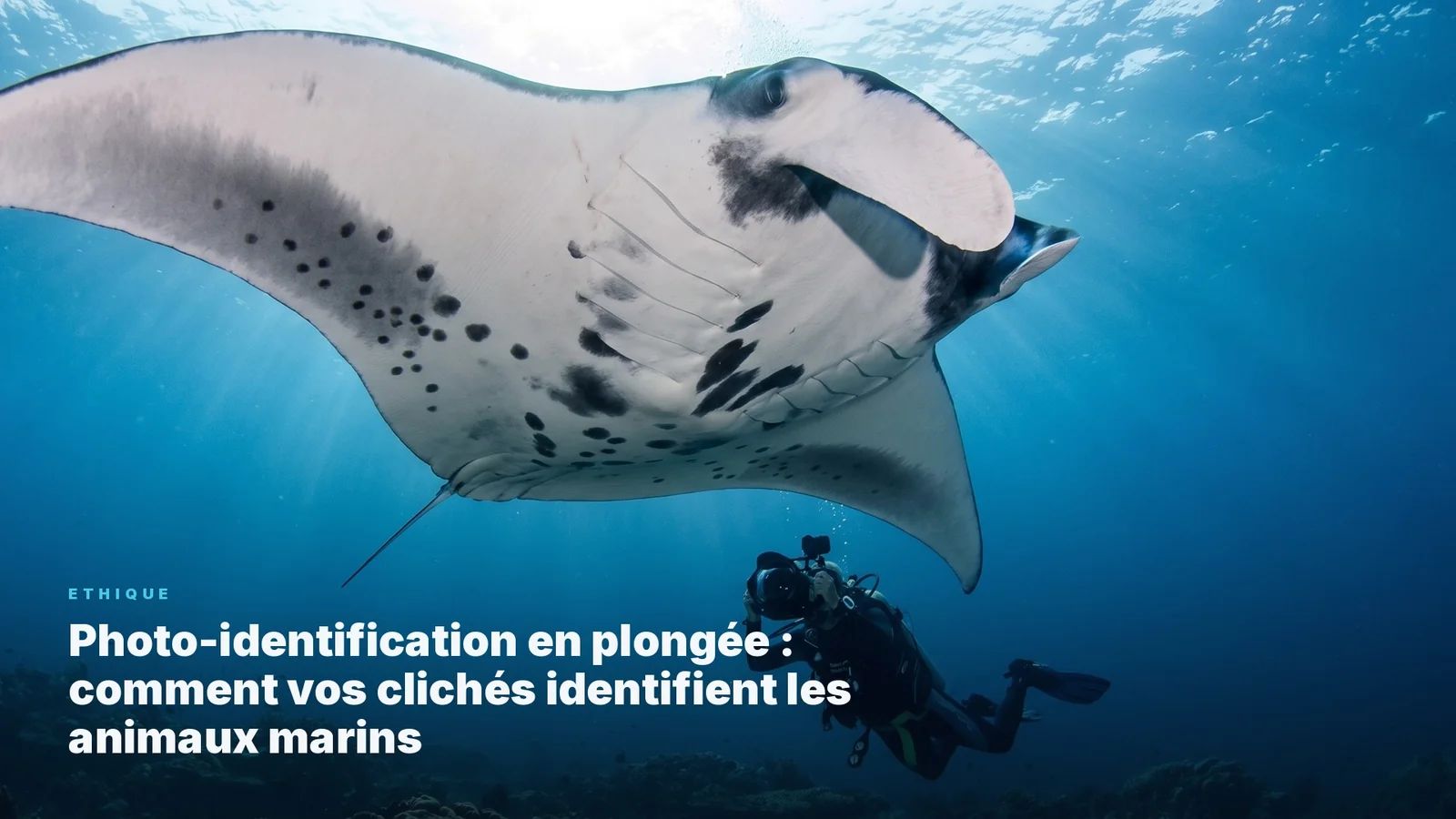
Example of a manta ray ventral pattern (underside), showing black spots on a white background forming a unique individual identifier
What recognition algorithms do
MantaMatcher, Wildbook, and HappyWhale use computer vision algorithms to automatically compare your photo with the thousands of individuals already registered in their databases. The process is similar to facial recognition, but applied to natural patterns.
For mantas, the algorithm analyzes the position, size, and relative arrangement of the spots. For whales, it compares the edges of the tail fluke and pigmentation areas.The comparison process takes anywhere from a few seconds to several minutes, depending on the size of the database. The result will tell you whether the animal is known (along with its history), unknown (a first sighting), or if the image is not clear enough for analysis.
Shooting Techniques for Photo-ID
This is where the photographer truly makes a difference. A technically correct photo taken from the wrong angle is unusable for identification.
The Crucial Angle for Each Species
For manta rays: photograph from below, looking upwards towards the surface. You must clearly see the ventral (belly) side, not the back. The photo should be as frontal as possible to ensure a reliable algorithmic comparison. Avoid oblique angles that distort the pattern.
For whale sharks: aim for the flank, laterally, framing just behind the pectoral fin and up to the first dorsal fin. This area contains the most distinctive pattern of spots and is the one most commonly used by Wildbook.
For humpback whales: wait for the dive moment (when the whale lowers its head and the tail emerges). Frame the entire underside of the fluke as clearly as possible. Both lobes must be visible.
For dolphins: photograph the dorsal fin from a profile view. The notches and shape of the trailing edge are key identifiers.
Resolution and Sharpness: The Real RequirementsResolution alone is not the primary factor. A sharp photo with 8 megapixels is better than a blurry photo with 50 megapixels.
What matters is the sharpness of distinctive features (spots, markings, fin edges). If these areas are blurred due to movement or focus issues, the photo will be rejected by the algorithm.
To achieve this: use a shutter speed of at least 1/160s in open water (1/250s for fast-moving sharks), position your subject in the central half of the frame, and ensure sufficient light to avoid high ISO settings, which can degrade fine detail sharpness.
Freediver framing the belly of a manta ray from below, an ideal angle for submission to MantaMatcher
Metadata: Essential Context
The photo alone is not enough. The associated data is essential for your contribution to be scientifically useful.
Precise location: the name of the dive site, island, or mooring location, and GPS coordinates if available. Accuracy within a kilometer is sufficient.
Date and time: as precise as possible for tracking migratory patterns.
Approximate depth: useful for behavioral studies.
Number of individuals observed at the site on the same day: this contextual information helps researchers understand group behavior.If your dive housing blocks the GPS signal, which is common, record this information manually in a dive log during your ascent, before it fades from your memory.
Databases to Contribute To
MantaMatcher: For Manta Rays
MantaMatcher (manta-matcher.org) is the world's leading database for tracking manta rays. Launched in 2009, it now contains over 50,000 photos submitted by divers from around the world and covers all known species of mantas.
Creating an account is free. Uploading a photo is simple: you choose the species (Mobula alfredi for reef manta rays, Mobula birostris for giant manta rays), upload the image of the underside, and provide the location and date.
The results usually arrive within 24 to 48 hours. If your manta ray is known, you will receive its complete history: where it has been photographed before, on what date, and by whom.
Wildbook for Whale Sharks (whaleshark.org) does for whale sharks what MantaMatcher does for manta rays. It contains data on over 90,000 individuals in more than 70 countries.The ideal shooting angle is lateral, just behind the pectoral fin. The recognition algorithm uses the pattern of spots, much like astronomers use stars: each configuration is unique.
Wildbook also supports research into the migration patterns of these animals. Migration corridors between the Philippines, the Maldives, and Djibouti have been identified thanks to submissions from amateur divers.
HappyWhale: for cetaceans
HappyWhale (happywhale.com) primarily focuses on humpback whales, blue whales, and bottlenose dolphins. The interface is particularly well-designed: after submitting a photo, you can see on a map the movements of the individual you photographed, if it is already known.
Humpback whales have been tracked over 15,000 kilometers using photos submitted by divers and passengers on boats.
To contribute, a photograph of the underside of the fluke taken during the dive is crucial. The quality doesn't need to be perfect: whales typically only stay in position for photo-ID purposes for a few seconds.
Concrete results: what your photos have made possible
The figures I have collected by following these platforms since 2018 give an idea of the real impact.MantaMatcher has enabled the documentation of manta ray individuals living for over 40 years (far longer than previously estimated), the identification of migration corridors between Micronesia and the Philippines, and the measurement of population declines following episodes of targeted overfishing.
Wildbook for Whale Sharks confirmed that the same whale shark individual can cross the Atlantic in less than 6 months. This data has influenced negotiations regarding protected fishing zones.
HappyWhale helped map the winter feeding areas of blue whales in the North Atlantic, facilitating advocacy for restrictions on maritime traffic in these corridors.
These results are only possible because recreational divers have submitted photos with accurate data. Not scientists with specialized equipment. It's people like you, diving recreationally, using a smartphone or a compact camera in an underwater housing.
Map of the migration route of an individual manta ray documented on MantaMatcher between the Maldives and Timor-East, 4 years of tracking thanks to photos from divers
Photo-ID is the most direct link between your photography and marine science. It naturally integrates into a broader approach to ethical underwater photography, and it complements AI-powered species identification tools that allow you to identify what you have photographed.
For destinations with high potential for photo-ID, coral bleaching and the decline of certain species make these contributions increasingly urgent. The article on the state of reefs in 2026 provides context for what science is trying to document.
Marine turtles are also potential subjects for photo-ID: the scales on their heads form a unique individual pattern. More information can be found in the article on photography of marine turtles.
AquaExposure does not receive any affiliate commissions from the citizen science platforms mentioned in this article. Participation is free on all platforms listed.
The AquaExposure underwater photography course includes a module on ethical photography and contributing to citizen science. Learning how to photograph well and contribute to research go hand in hand.
Underwater Photo-Identification: How Your Photos Help Identify Marine Animals. | AquaExposure