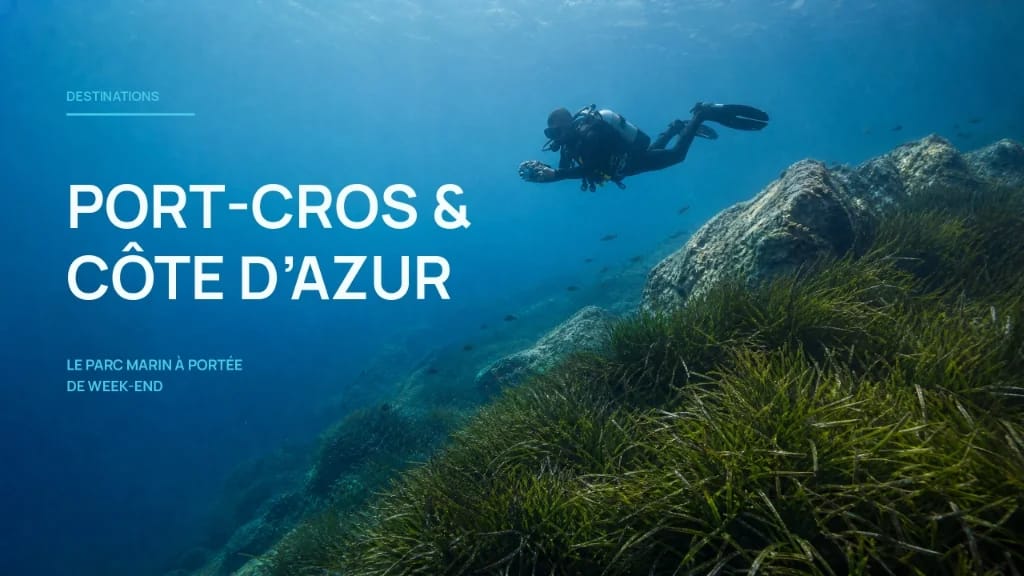
Underwater Photography in Port-Cros and the French Riviera- Exploring the National Marine Park.
Underwater photography in Port-Cros and the French Riviera- marine life, Posidonia seagrass, gorgonian corals. Practical guide for flash-free photography in France's first marine park.
Is Port-Cros accessible on weekends from Paris or Brussels?
Yes, it's possible by combining a high-speed train (TGV) to Toulon (3 hours from Paris, 4.5 hours from Brussels with a connection) and a ferry or water taxi from Hyères or La Tour Fondue. The total travel time from Brussels, door-to-door, is approximately 6 to 7 hours. It's feasible to leave on Friday evening and return on Sunday.
Do you need a specific diving certification level to dive at Port-Cros?
No. The most interesting sites for photography are typically located between -5 and -25 meters. A Level 1 (Open Water Diver) certification is sufficient for most dives. Scuba diving is required for the deeper sites, but snorkeling in seagrass beds can also be very rewarding for underwater photography.
Is photography permitted within the national park?
Underwater photography is completely permitted within the Port-Cros National Park. However, it is forbidden to anchor on Posidonia seagrass beds, to collect marine organisms, and to touch the seabed. Adhering to these rules is what ensures the quality of the marine life that people come to photograph.
What is the difference between diving at Port-Cros and at the Lavezzi Islands (Corsica)?
Port-Cros offers more underwater relief and gorgonian drop-offs that are more easily accessible from the mainland. The Lavezzi islands have superior water clarity and a wilder atmosphere. Port-Cros is ideal for a long weekend, while the Lavezzi islands require extending the trip to southern Corsica.
What is the best time of day for underwater photography in Port-Cros?
Between 8:30 AM and 11:30 AM for natural light. The Mediterranean sun enters at this time at a favorable angle, reaching depths of approximately 12 meters. In the afternoon, the light arrives more vertically, and the resulting shadows become less interesting for photography.
Are there sea turtles in Port-Cros?
Loggerhead sea turtles (Caretta caretta) are frequently seen in the park's waters, particularly in September and October. While sightings are not guaranteed, they occur several times each season. They are very photogenic on the surface, during their breathing intervals.
There's something peculiar about the geography of Port-Cros. This 7 km2 island, located 30 minutes by boat from La Tour Fondue, appears from a distance like dozens of unremarkable Mediterranean islands. But then you put your head underwater, and everything changes.
The Port-Cros National Park is France's first marine park, established in 1963. Sixty years of strict protection have created something that money cannot buy: a wildlife that no longer fears humans. Grouper come to sniff your fins. Moray eels swim across your camera frame. Barracudas form luminous columns beneath the surface, as if posing for a painter.
For underwater photography in Port-Cros, it's this lack of animal fear that makes all the difference. You don't need to be discreet, patient, or an expert. You just need to be present, properly equipped, and let the marine life come to you.
Port-Cros: 3 Key Facts for Photographers
First, the protection. The national park covers not only the island but also 1,800 hectares of marine environment. Fishing is completely prohibited. This status as a protected area is the key to everything else.
Next, the accessibility. Port-Cros is a 30-minute ferry ride from Hyères, and Hyères is accessible from Paris or Brussels without the need for a domestic flight. It's a weekend photography destination that few Mediterranean locations can claim.Finally, the diversity. In a single day of diving in Port-Cros, you can move from meadows of Posidonia to steep drop-offs covered in gorgonian corals, from areas of white sand that shelter cephalopods to rocky crevices where moray eels reside. The variety of habitats within less than 30 minutes of diving is remarkable.
Posidonia Meadows: An Entire Ecosystem to Photograph
Posidonia ( Posidonia oceanica) is a marine plant endemic to the Mediterranean Sea, not an algae. It forms true underwater meadows that cover the seabed between -1 and -35 meters. In Port-Cros, the meadows are in excellent condition thanks to the ban on anchoring.
Posidonia
Why Posidonia Meadows are Photographic Paradises
Posidonia meadows are home to a specific and very photogenic fauna. Seahorses (Hippocampus guttulatus and H. hippocampus) hide among the green leaves. By using a local guide who knows the sites, you can regularly find them. A seahorse in a Posidonia meadow, photographed in natural light at a depth of 8 meters, is an image that doesn't require a flash and tells the story of an entire ecosystem.
Seahorses' cousins, the pipefish (Syngnathus acus), also inhabit the meadows. They are more elongated and more discreet, but just as photogenic if you take the time to search for them slowly.Octopuses hunt in the seagrass meadows during the day in Port-Cros. This observation is rare in unprotected areas, where octopuses have learned to hide from fishing pressure. Here, they operate in the middle of the day, which provides opportunities for behavioral shots that are difficult to find elsewhere.
To understand how to compose around a complex habitat like seagrass meadows, the principles of underwater composition apply differently than in clear water. The background is busy, so you need to find a clear plane of focus on the main subject and accept that the Posidonia seabed will be slightly out of focus.
Gorgonian Walls: Photographing Color Without Flash
In Port-Cros, the most well-known gorgonian walls are located on the east and north sides of the island. La Gabinière, at the southern tip, descends to -55 m and offers one of the most accessible colonies of red gorgonians in the French Mediterranean.
Technique for Gorgonians in Natural Light
Red gorgonians (Paramuricea clavata) and white gorgonians (Eunicella singularis) colonize the vertical faces of the walls starting from -20 m. Their bright colors – reddish-orange for the former, off-white for the latter – provide a strong natural contrast with the blue of the water.Photographing gorgonian corals without a flash requires positioning yourself below the subject, so that the light from the surface is in the background. This transforms the gorgonian into a silhouette against a bright background, which is visually more impactful than an image with flash that "flattens" the colors against a black background.
At a depth of -22 meters at Gabinière, between 9 am and 11 am, the light is still sufficient to shoot at ISO 800 with a shutter speed of 1/160. The result is images of gorgonian corals that have depth, not just color.
Wildlife at Ease: Protocol to Avoid Scaring Them
The great advantage of Port-Cros is also its main risk: because the animals don't flee, divers tend to get too close, which eventually causes them to move. A few simple rules can prevent ruining a dive session.
Descend slowly, without sudden bubbles. Sudden bubbles are the main cause of grouper and moray eel escape.
Never touch the bottom. This is the rule of the park, but also the rule of good photographic sense: a cloud of sediment behind you ruins the background of all the subsequent images.
Move in a horizontal position from the beginning of the descent. A vertical diver is more disruptive than a horizontal diver who "flies" above the seabed.It's better to wait for the animals to come to you rather than actively searching for them. In Port-Cros, if you stop and wait for just 30 seconds, something usually appears in the frame. It's one of the few Mediterranean destinations where this strategy consistently works.
Snorkeling and Freediving: Photographing Seagrass Beds from the Surface
Port-Cros is one of the few French destinations where snorkeling is as rewarding as scuba diving. Seagrass beds of Posidonia begin at a depth of about 6 feet (2 meters), directly below the surface.
The beach at La Palud, on the north side of the island, has buoys marking a protected snorkeling area. During the summer, instructors from the French Ministry of Education lead introductory sessions there. Outside of these scheduled activities, the area is freely accessible.
To photograph seagrass beds while freediving, the primary technique is static apnea: take a deep breath, slowly descend to the level of the seagrass beds (approximately 10-13 feet or 3-4 meters), remain floating in a horizontal position, and allow the marine life to resume its activities. Seahorses, in particular, usually return to their normal positions within 30 seconds if the freediver remains still.
Combining Port-Cros with Other Destinations in the MediterraneanPort-Cros is a logical stop in a Mediterranean photography itinerary. From Hyères or Nice, you can reach Corsica by overnight ferry (an 8-hour crossing, with routes from Toulon or Nice), which transforms the trip into a coherent loop: Port-Cros for the weekend, and Corsica and Scandola the following week.
For those who want to explore the eastern Mediterranean, Croatia and Dalmatia offer a different profile, with spectacular wrecks and caves that have a radically different light compared to French marine parks.
Practical Logistics
Access from the mainland: Ferry from La Tour Fondue (Giens) or Hyères in the summer, 30 to 35 minutes. Outside of peak season, crossings are less frequent, so check the schedules of the TVM company.
Dive centers: Two centers operate on the island during the season, offering guided dives and equipment rental. Book in advance, especially in July and August.
Accommodation: Accommodation is limited on the island (only one hotel, the Manoir de Port-Cros). Most visitors come for the day from Hyères or Toulon, or camp in designated areas.
Budget: Expect to pay around 25 to 35 euros for a round-trip ferry, and 45 to 60 euros for a guided dive.The AquaExposure underwater photography course includes specific modules on photography in protected natural areas, covering techniques for approaching wildlife in a non-intrusive manner and camera settings adapted to the Mediterranean light conditions.
Benjamin Coste has been teaching underwater photography using natural light since 2014. He firmly believes that the best diving images do not require a flash, especially in well-protected areas of the Mediterranean.
Underwater Photography in Port-Cros and the French Riviera- Exploring the National Marine Park. | AquaExposure