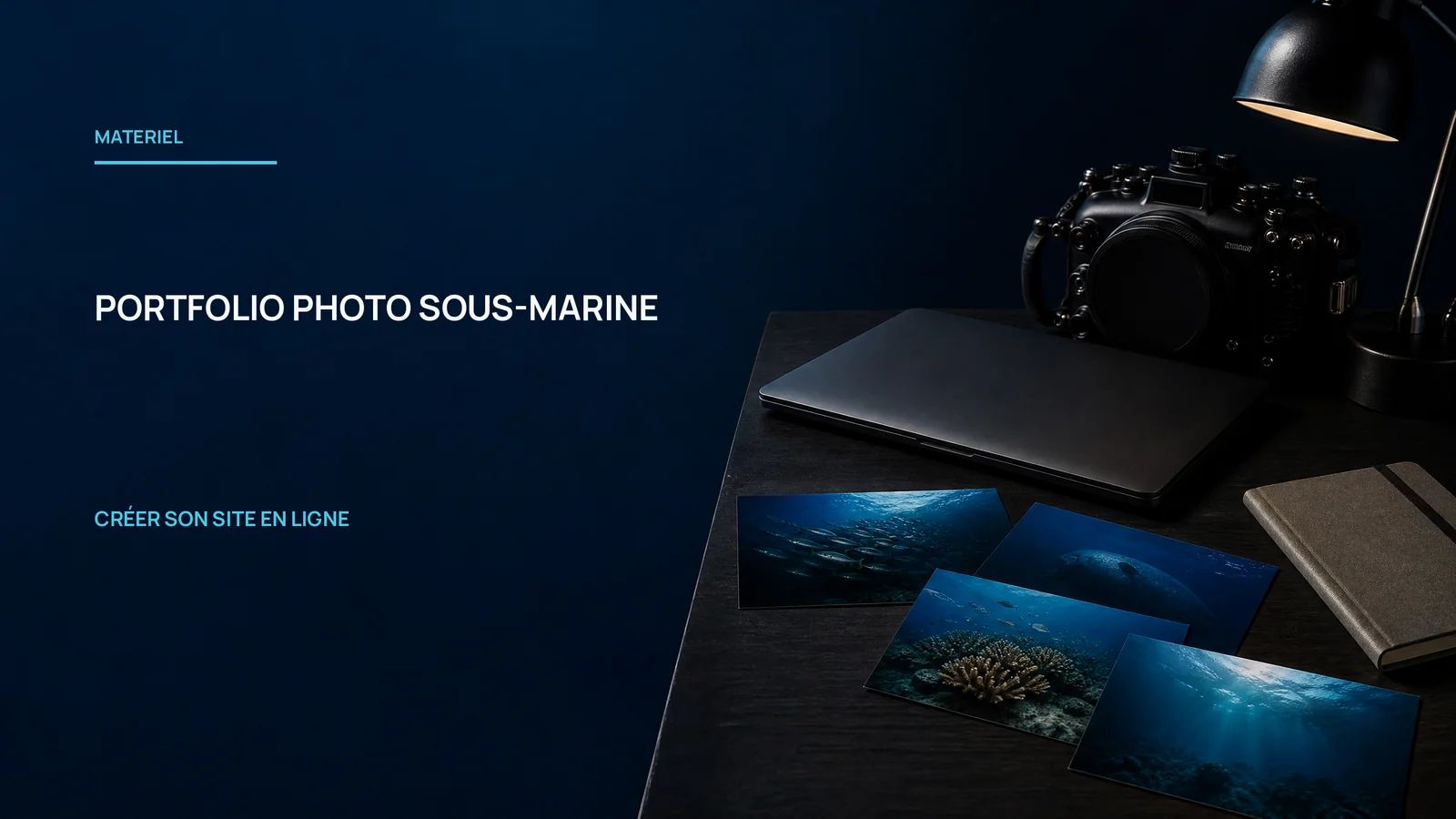
Creating Your Online Underwater Photography Portfolio: Mistakes to Avoid.
Create an online underwater photography portfolio- which platform to choose (SmugMug, Squarespace)? How many images to include and the 5 mistakes to avoid.
What is the best platform for an underwater photography portfolio?
SmugMug is the go-to platform for serious photographers- offering protected galleries, integrated sales options, and high-quality display capabilities. Adobe Portfolio is ideal if you use Creative Cloud as it's included in the subscription. Squarespace is the simplest solution for beginners who want a beautiful website without technical constraints.
How many photographs should I include in an underwater photography portfolio?
A maximum of 20 to 30 photos is recommended. Quality always takes precedence over quantity. A buyer or a judging panel looking at 50 photos will remember the worst one. The same panel viewing 20 excellent photos will perceive the entire set as a cohesive whole.
Do I need a separate website, or is Instagram sufficient?
Instagram quickly reaches its limits for a photographer who wants to be taken seriously. The algorithm controls who sees your images, the compression degrades your photos, and a change in rules can drastically reduce your reach overnight. A dedicated website appears in Google search results, displays your images without aggressive compression, and is completely under your control.
How should I organize galleries in an underwater photography portfolio?
Three approaches work well: by destination (Mediterranean, Maldives, Caribbean), by subject (macro photography, large pelagic fish, wrecks), or by technique (natural light, underwater portraits of divers). Choose the organization that best reflects your personal approach and the type of clients you want to attract.
Should you include your prices in your online portfolio?
Not necessarily. If you are selling direct licenses, a contact page is sufficient to start the conversation. If you are selling prints, providing an approximate price range can help the buyer visualize the cost. Avoid displaying very low prices publicly, as this creates a perception of value that can be difficult to change later.
Is a portfolio on Behance sufficient?
Behance is useful for gaining community visibility but remains a social platform- not an independent professional portfolio. You don't have a custom domain or control over the presentation. It can complement a dedicated website- but it doesn't replace one.
Should you protect your photos from being downloaded?
Yes, this applies to high-resolution photos. SmugMug and Squarespace offer options for image protection. Watermarks can be used, but they detract from the visual experience. Disabling right-click functionality and limiting display resolution to 1200 pixels are often sufficient for most online portfolios.
Do you need a custom domain name for your photography portfolio?
Yes. The URL yourfirstname.squarespace.com does not project the same image as yourfirstname.com. Purchase your domain name (approximately €15 per year) and configure it on your platform. This is a minimal investment for a significant increase in credibility.
Creating an online portfolio of underwater photographs requires three key decisions: choosing the right platform (SmugMug, Adobe Portfolio, or Squarespace), carefully selecting your 20-30 best images and eliminating anything that doesn't meet your standards, and organizing your galleries by destination, subject, or technique depending on the type of clients you want to attract.
There is one image that I haven't published for almost a year. It's my best photo from 2021: an eagle ray in Cyprus, backlit, natural light, perfect timing. I kept it "for the right moment" for too long before finally releasing it. I eventually put it at the top of my portfolio in early 2022. It's the first image that editors see when they visit my website.
An online portfolio is not a souvenir album. It's an active business card that works for you twenty-four hours a day. And like any business card, what it says first is what people remember.
Why an Online Portfolio is Essential
Instagram quickly reaches its limits for a photographer who wants to be taken seriously. The algorithm controls who sees your images. The platform's compression degrades your photos. A change in rules can reduce your reach overnight.A portfolio website that you control works differently. It appears in Google search results (a potential client searching for "underwater photographer Brussels" can find you directly). It displays your images without aggressive compression. You have complete ownership of it.
It is also an essential tool if you are considering selling your underwater photos. A professional portfolio is a prerequisite for being considered by publications and agencies.
Which platform to choose
SmugMug
SmugMug is the standard for professional and semi-professional photographers. Its strengths include high-quality display galleries, advanced image protection against downloading, and direct integration for selling prints and licenses.
The administrative interface is more complex than other platforms, but it offers complete control over the presentation. It's the platform that projects the most professional image for a nature or documentary photographer.
Price: starting from €12-15 per month depending on the subscription.
Adobe Portfolio
If you are subscribed to Creative Cloud, Adobe Portfolio is included in your subscription. The integration with Lightroom is seamless. The result is clean and professional.The customization interface is more limited than SmugMug or Squarespace. However, for photographers already within the Adobe ecosystem, it's the simplest and most cost-effective solution.
Squarespace
Squarespace is the most accessible platform for a photographer who wants a beautiful website without technical skills. The templates are well-designed, the administration interface is intuitive, and the result is immediately professional.
Image compression is good (better than Wix). Price: starting at €20/month.
Behance
Behance is an Adobe community platform, very active in creative circles. It offers visibility to other creatives and potential clients, but it remains a social platform.
You don't have a custom domain, you have no control over the presentation, and the perception remains that of a profile rather than a professional website. Use it as a complement to a dedicated website.
Selecting Your Best Images: A Maximum of 20-30 Photos
This is where most photographers sabotage themselves. The temptation is to include as many photos as possible "to show the diversity." This is a mistake.
A jury or buyer who looks at 50 photos will remember the worst one. The same jury that looks at 20 excellent photos remembers the entire set as a cohesive whole.
The recommended selection process in three steps:First, select your best photo from each diving session over the past two years. You will likely end up with 80 to 120 photos.
Next, eliminate all those that do not meet these criteria: sharpness on the main subject, correct exposure or artistically intentional exposure, and a subject that justifies the composition.
Finally, from what remains, select the 20 to 30 photos that form a cohesive set in terms of style, light, and tone.
For each photo, ask yourself: "Does this image enhance the overall perception of my portfolio?" If the answer is not a clear yes, remove it.
How to Organize Your Galleries
Three approaches work depending on your positioning.
By destination suits photographers who have a traveler identity: Mediterranean, Maldives, Red Sea, Indonesia. This organization appeals to travel agencies and specialized travel publications.
By subject suits nature photographers: macro photography, large pelagic fish, wrecks, marine mammals. This organization appeals to scientific publications, environmental NGOs, and researchers.
By technique suits instructors and educational photographers: natural light, portraits of divers, depth ambiance. This organization appeals to dive schools and training institutions.Regardless of the organization you choose, avoid galleries that are too crowded (more than 12 photos per gallery) and make sure the first photo in each gallery is your best.
A gallery of 8 perfect photos is better than a gallery of 25 photos where some are subpar.
The Most Common Mistakes
Mistake 1: Keeping photos out of sentiment. That photo from your very first dive that you're really attached to doesn't belong in a professional portfolio if it's not technically up to par with the rest. Separate your personal attachment from your editorial judgment.
Mistake 2: Neglecting the introductory text. A portfolio without context is like a silent gallery. Each image benefits from being accompanied by a line of context- location, species, situation. This context creates a connection between the photo and the viewer, and improves your natural search engine optimization.
Mistake 3: Using a non-custom domain. The URL yourefirstname.squarespace.com doesn't convey the same impression as yourefirstname.com. Purchase your own domain name (around €15/year) and configure it on your platform. It's a minimal investment for a significant gain in credibility.
Mistake 4: A missing or hard-to-find contact page. A potential buyer who can't find how to contact you will likely abandon the site. The contact page should be accessible with just one click from any page on the website, and it should include a simple form and a visible email address.Mistake 5: Never updating your portfolio. A portfolio with photos that are five years old gives a poor impression. Plan to review it every six months to remove outdated images and add your best new ones.
To delve deeper into the topic of monetizing your photographic work, our article on becoming a professional underwater photographer covers the strategic steps that follow the creation of your portfolio.
Building an effective underwater photography portfolio takes time. The rigorous selection process is the most challenging and important part. If you want to improve the quality of your images and regularly enrich your portfolio, the AquaExposure underwater photography course provides you with practical tools to develop your own style.
To improve your mastery of your equipment and optimize your procedures while diving, discover the AquaExposure training modules.
Creating Your Online Underwater Photography Portfolio: Mistakes to Avoid. | AquaExposure