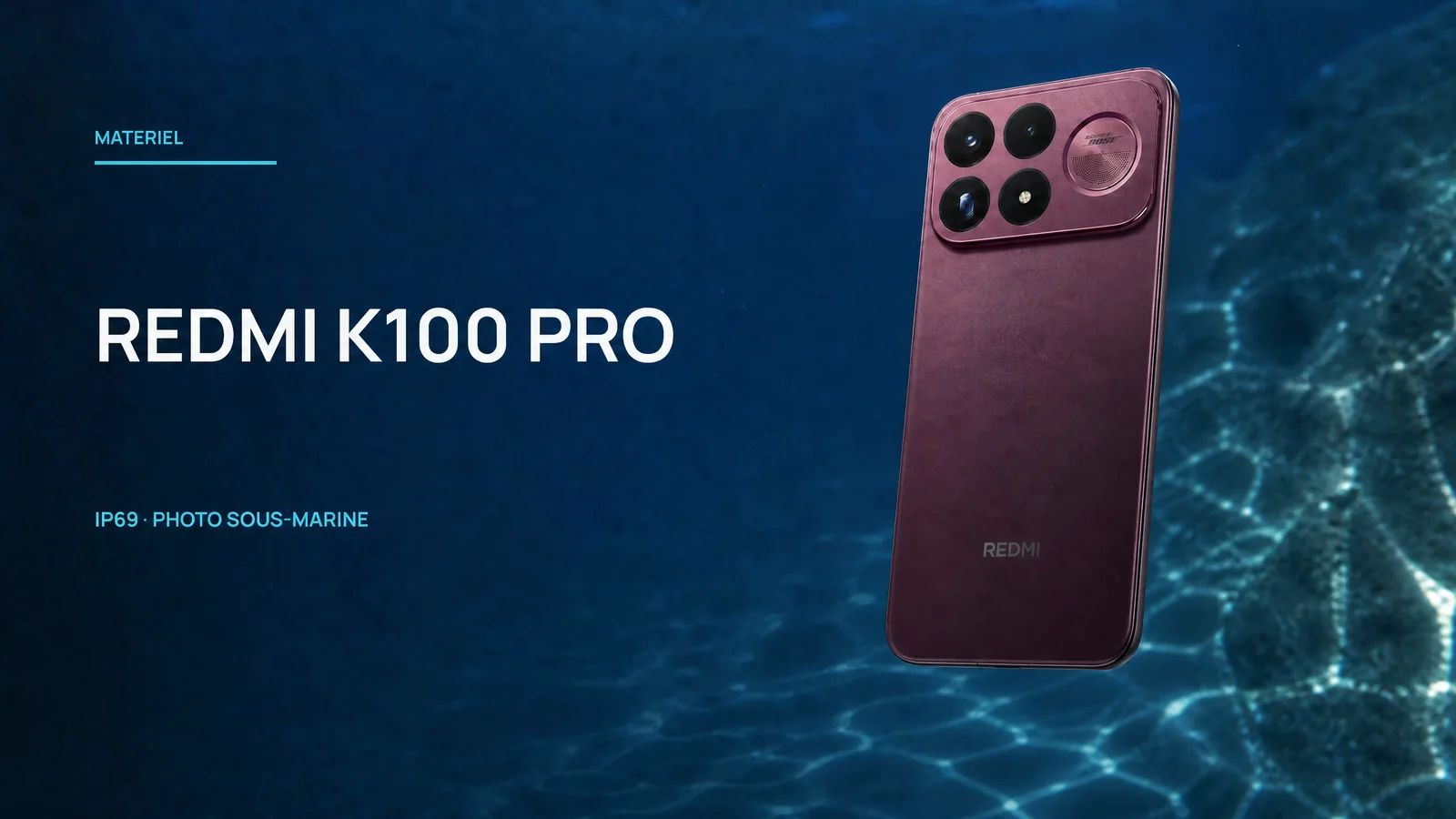
No. The IP69 rating describes resistance to high-pressure, high-temperature water jets, typically an industrial cleaning process using a device like a Kärcher. It does not specify any depth rating. The Redmi K100 Pro has IP66, IP68, and IP69 ratings, but its specifications still state a maximum submersion depth of 1.5 meters for 30 minutes.
What is the difference between IP67, IP68, and IP69?
The second number describes the type of protection, not an increasing depth rating. IP67 corresponds to submersion at a depth of one meter for 30 minutes. IP68 corresponds to submersion at a depth greater than one meter, with the exact value specified by the manufacturer, which is almost always 1.5 meters. IP69 refers to protection against high-pressure jets. Therefore, a device can be IP69 without being better suited for submersion than an IP68 device.
Why does seawater change everything?
Because IP tests are conducted in freshwater, in a laboratory, on a brand-new device. Salt is corrosive. It attacks seals, connectors, and the charging port, and it leaves a crystalline deposit as it dries. No manufacturer certifies its IP ratings in saltwater, and most explicitly exclude this condition from the warranty.
Is the Redmi K100 Pro suitable for underwater photography?
It receives a score of 2.9/5 according to the AquaExposure rating system, the lowest score in our August 2026 comparison. Its main 200-megapixel sensor is decent, but its 1/1.56-inch size remains modest. Professional RAW applications are not available in the Chinese version, and no dedicated underwater housings are available.
How can you tell if a phone is truly waterproof for diving?
No phone can truly be used for diving. The only solution is a pressure-tested housing certified for a specific depth, with properly maintained O-rings, and ideally a vacuum testing system before each dive. An IP rating protects against accidental water ingress, but it does not permit underwater use.
There's a phrase I hear at least once per season, on a boat, before a dive. Someone pulls out their phone, shows it, and says: "It's IP68, it's not afraid of anything."
On August 12, 2026, Xiaomi launched the Redmi K100 Pro and K100 Pro Max in China, certified with IP66, IP68 and IP69 simultaneously. Three ratings on the same device, one of which sounds like an extreme certification.
However, the technical specifications of the same device clearly state: immersion up to 1.5 meters for 30 minutes. This is the perfect example for the year to explain a confusion that regularly costs someone their phone. Let's take the time to explain it properly.
The Verdict in Summary
Overall score: 2.9/5 (Redmi K100 Pro Max)
Criterion
Score
What it means
Optics and sensor
3.1/5
200 megapixels on a modest sensor, disappointing macro at 30 cm
RAW and color
2.8/5
Native RAW, but no professional application in the Chinese version
Storage
3.8/5
256 GB to 1 TB, USB-C 3.2, no memory card slot
Thermal management
2.3/5
Conductive aluminum, triple IP rating that doesn't protect during diving
Battery
3.0/5
9070 mAh, the largest in the comparison, but no documented cycles
Autofocus
3.0/5
Correct PDAF, penalized by the lack of manual focus tools
Housing
2.0/5
No dedicated housing, but the dimensions are compatible with universal housings
This device is designed for: enthusiasts and users who want exceptional battery life at an affordable price.
This device is not ideal for: underwater photography, where it ranks last in our August comparison.
What an IP Rating Really Means
An IP rating consists of two numbers, and that's where the key information lies. The first number relates to protection against solid objects, and the second relates to protection against liquids.
The first number ranges from 0 to 6. A 6 means completely dustproof. A 4, as found on some foldable devices, only means protection against solids larger than 1 millimeter, which allows fine sand to pass through.
The second number ranges from 0 to 9, and this is where the logic often confuses people. It's tempting to think it represents an increasing scale of depth. However, that's not the case. It's a list of different types of exposure.
Rating
What is Actually Tested
IPX5
Low-pressure water jets, from all directions
IPX6
Powerful water jets
IPX7
Immersion at 1 meter for 30 minutes
IPX8
Immersion beyond 1 meter, depth specified by the manufacturer
Therefore, an IP69 is not an improved version of an IP68. It's a device designed to withstand an industrial pressure washer, which is very useful on a food processing plant machine but has nothing to do with the hydrostatic pressure encountered during a dive.The Redmi K100 Pro accumulates these three ratings because they are three separate tests that it passed individually. This does not mean they are added together.
The real issue: 1.5 meters, that's the pool's depth
This is the figure that no one will read.
In the complete specifications of the Redmi K100 Pro, the IP68 and IP69 ratings are explicitly stated as: resistance to high-pressure jets, immersion up to 1.5 meters for 30 minutes.
One and a half meters. That's the depth of the shallow pool. That's the depth at which a phone dropped from the pier can be retrieved. This is not diving, it's not even serious snorkeling, since a duck at three meters already exceeds the specification.
And there's a simple physical reason for this. At ten meters, the pressure is doubled compared to the surface. The seals of a smartphone are not designed to be compressed, they are designed to be airtight at low pressure differentials. Beyond a certain threshold, water doesn't slowly seep in, it enters.
The three things that no IP rating covers
Salt. All IP tests are performed in freshwater. Salt attacks the seals, corrodes the contacts of the charging port, and leaves a crystalline deposit when it dries, which mechanically separates the sealing surfaces. A device that has survived three swims in the sea does not have the same level of water resistance as it did on the first day.Aging. The rating is measured on a new device, fresh from the production line. The adhesives that seal a smartphone lose their properties due to thermal cycles, impacts, and openings for repairs. No manufacturer guarantees the rating over time.
Dynamics. The tests are static: the device is submerged, it waits, and then it is retrieved. Underwater, a phone is moved, and it experiences rapid pressure changes during descent. Even a simple arm movement creates localized pressure that is much higher than the static pressure at a given depth.
Since we're using it as an example, let's give it some credit. The Redmi K100 Pro Max is a very good phone that simply wasn't designed for our purposes.The main 200-megapixel sensor uses a Samsung S5KHP5 with a 1/1.56-inch format and an aperture of f/1.68. The resolution is impressive, but the sensor size is much less so. It's the smallest main sensor in our August comparison, far from the 1/1.3-inch sensors found in the Pixel 11 Pro XL and the Galaxy Z Fold8 Ultra. Our smartphone comparison for underwater photography puts these figures into context.
The telephoto macro lens presents a real problem. It focuses at 30 centimeters on the Pro Max, compared to 2.5 centimeters for the ultra-wide-angle lens on the Honor Robot Phone. Underwater, where you rarely get close enough, 30 centimeters is a significant limitation.
The 9070 mAh silicon-carbon battery, on the other hand, is remarkable and by far the best in its class.[!NOTE] For more information
K100 Pro Max: Main camera: 200 MP Samsung S5KHP5, 1/1.56 inch, f/1.68, optical and electronic stabilization, 16-in-1 pixel binning. Ultra-wide angle: 50 MP OV50M f/2.4, 102 degrees. Periscope telephoto lens: 50 MP f/2.75, 5x optical zoom, macro focus at 30 cm. Video: 8K. Battery: 9070 mAh Si-C, 100W charging. Processor: Snapdragon 8 Elite Gen 5. Dimensions: 163.5 x 77.9 x 8.45 mm.
Score B2 of 2.8, the lowest in the comparison: the Chinese version runs HyperOS 3 without Google services, which makes MotionCam Pro and Blackmagic Camera unavailable. Our rating system automatically applies a penalty to this criterion and to the autofocus.
Good news regarding the housing: with a thickness of 8.45 mm, the device fits within the 174.4 x 81.3 x 8.8 mm dimensions of the Kraken KRH08 V2, which earns it a 2 out of 5 rather than a 0.
What you need to know before buying
Available Housings. No dedicated housing. The universal Kraken KRH08 V2, certified to 85 meters, accepts these dimensions. Seafrogs housings, limited to 175 x 75 x 8 mm, are marginal in terms of thickness and require a case-by-case verification.
Availability. Currently only available in China, which means the absence of Google services and therefore professional RAW applications.
Prices. Approximately 4199 to 5999 yuan for the Pro Max depending on the configuration, which is roughly 550 to 790 euros at the exchange rate observed at the end of August 2026. Check the current exchange rate.The right approach. If you want to use a phone underwater, the key question isn't its IP rating. It's whether a suitable housing is available for it, what depth it is certified for, and whether you can test it in a controlled environment before taking it underwater.
Our verdict
This phone shouldn't be judged based on a use case for which it wasn't designed. It's a gaming device with exceptional battery life, sold at a reasonable price, and it performs that function very well.
Its relevance to our topic lies elsewhere. It demonstrates that a manufacturer can honestly list multiple water resistance certifications on the same product page, while a rushed buyer might incorrectly conclude the opposite.
Remember one thing from this article. An IP rating protects you from an accident, but it doesn't authorize a specific activity. If your phone falls off the boat, the IP68 rating might save it. However, if you decide to take it diving, that rating becomes irrelevant.
Can an IP69 smartphone be used for diving? No. The IP69 rating describes resistance to high-pressure, high-temperature jets, not depth. The Redmi K100 Pro is IP69, but its specifications still state a maximum of 1.5 meters for 30 minutes.
What is the difference between IP67, IP68, and IP69? These are three different tests, not a progressive scale. IP67 corresponds to 1 meter, IP68 to a depth specified by the manufacturer, and IP69 to resistance against high-pressure jets.Why does seawater change everything? IP tests are conducted in freshwater on a new device. Saltwater corrodes seals and connectors, and leaves a residue as it dries.
Is the Redmi K100 Pro suitable for underwater photography? It receives a score of 2.9/5, the lowest score in our August 2026 comparison, primarily due to a modest sensor and the unavailability of professional RAW applications.
How can you tell if a phone can really be used for diving? None of them can. The only reliable solution is a certified waterproof housing, with well-maintained seals, and ideally a vacuum test before entering the water.
Understanding how water affects light and equipment completely changes the way you prepare for an underwater photo shoot. This is the foundation of the AquaExposure training program.
IP68, IP69, waterproof: what these ratings don't tell divers. | AquaExposure