Reef Check and BioObs- Two protocols accessible to scuba diving photographers.
Reef Check and BioObs explained for underwater photographers- methods, required training, and how to incorporate these citizen science protocols into your dives without it feeling like a burden.
Do you need to be a biologist to participate in Reef Check?
No. The EcoAction training program offered by Reef Check typically takes one to two days. It covers the identification of indicator species, the transect method, and data recording techniques. Underwater photographers without a scientific background regularly participate in this training and make valuable contributions.
Do Reef Check and BioObs cover the same species?
Not exactly. Reef Check focuses on coral reefs and indicator species that reflect the health of the reef (target fish, invertebrates, coral cover). BioObs is more general and applies to Mediterranean seabeds, Posidonia seagrass meadows, and rocky substrates as well.
Can I contribute to BioObs without any training?
Yes, in part. BioObs accepts observations from individuals at the "observer" level, even without specific training. However, data collected by trained observers carries more weight in scientific analyses. The BioObs Mer training is short and is often offered by dive clubs and marine reserves.
Can I combine underwater photography with a Reef Check survey during the same dive?
Yes, but with discipline. Scientific surveys require following the designated survey line without straying, which limits creative freedom in composition. Ideally, a morning dive should be dedicated to the survey itself, followed by an afternoon dive for photography. On less-visited sites, some teams use a fixed camera along the survey line to combine both activities.
Does Reef Check operate exclusively in tropical regions?
No. Reef Check Méditerranée has been operating since 2008 and uses a protocol adapted to local species and habitats (Posidonia seagrass, gorgonian corals, grouper, sea urchins). Surveys are conducted in French and Spanish marine reserves, including Banyuls-sur-Mer, Les Medes Islands, and Scandola.
Where can I find a Reef Check training course in France or Belgium?
EcoAction training programs are organized by local Reef Check chapters. In France, marine reserves such as Banyuls-sur-Mer and Les Medes host annual sessions. Visit reefcheck.org for upcoming dates. In Belgium, clubs affiliated with LIFRAS sometimes offer introductory workshops on the BioObs protocols.
Are the data collected by Reef Check actually used?
Yes. Reef Check has been producing reports on the health of coral reefs in over 90 countries since 1997. This data is used in IPCC reports, IUCN analyses of coral reefs, and has directly influenced management decisions in several marine protected areas.
The first time I heard about Reef Check was during a dive in the Banyuls-sur-Mer marine reserve with a researcher from the local oceanographic observatory. He was counting sea urchins along a 50-meter transect while I was photographing gorgonian corals just a few meters away. When he explained that his data from that day would be included in a comprehensive report on the state of Mediterranean reefs, I realized that a dive could have a dimension that my photos alone couldn't capture.
That day, I became interested in marine observation protocols that are accessible to scuba diving photographers. Reef Check and BioObs are the two most relevant options for French-speaking divers. Here is what they entail and what they offer.
In one sentence: Reef Check and BioObs are two citizen science protocols that can be accessed after a short training course, allowing any scuba diving photographer to contribute real data on the state of marine ecosystems.
Why these protocols existThe vast majority of data on the health of coral reefs and marine environments comes from professional scientists with limited budgets, small teams, and a necessarily partial geographic coverage. The strength of citizen science initiatives lies in their ability to exponentially increase this coverage, as divers are already present at these sites, in areas that research teams may not visit every year.
However, for this data to be scientifically valid, it must be collected in a standardized manner. Two different observers at two different locations must record exactly the same things, in the same way, so that their data can be compared. This is precisely the purpose of a protocol.
Reef Check: The International Standard
Reef Check is a program founded in 1996 by Dr. Gregor Hodgson, who was then a researcher in Hong Kong. It is now the most widely deployed coral reef monitoring program in the world, with data from over 90 countries since 1997.
The EcoAction Method
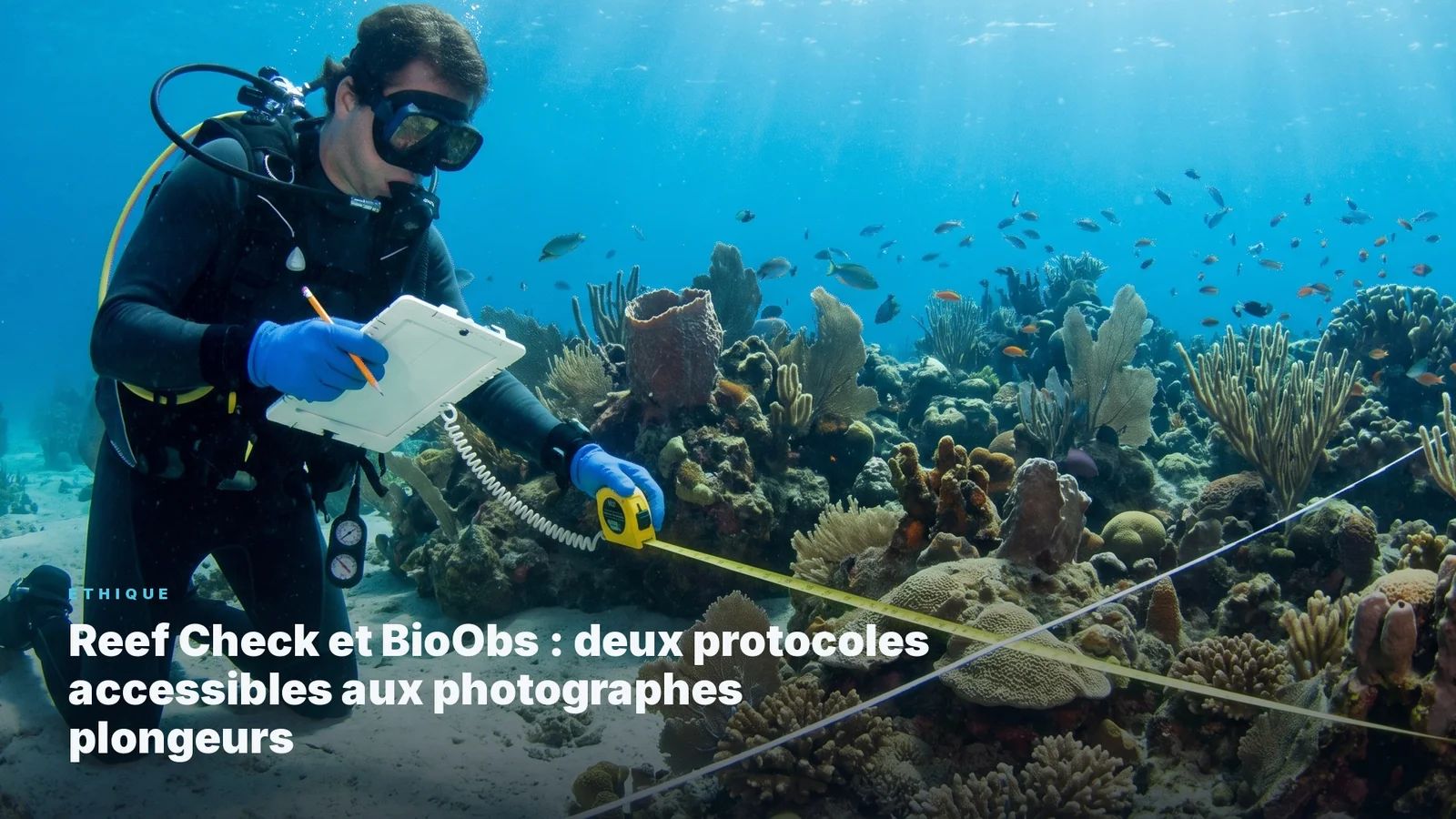
The basic method is called EcoAction. A 100-meter transect is laid out on the reef at a defined depth. Teams of divers conduct surveys along this transect, each taking on specific roles.What is observed and recorded: - Percentage of substrate coverage (live coral, dead coral, algae, bare rock, sand, debris) - Indicator fish species (groupers, parrotfish, snappers, surgeonfish, and other groups defined according to the area) - Indicator invertebrates (sea urchins, sea cucumbers, feather stars, lobsters, starfish) - Visible stress factors (bleaching, diseases, mechanical damage)
One or two divers from the team photograph the transect at regular intervals to visually document the survey. This is where the underwater photographer brings something unique.
The EcoAction Training Program
The training lasts one to two days. It covers the identification of indicator species (30 to 40 species for tropical coral reefs, fewer for the Mediterranean), the transect method, and the use of data recording sheets. No prior scientific training is required.
Reef Check Méditerranée has been operating since 2008 with a protocol adapted to local species and habitats (Posidonia seagrass, gorgonians, groupers, purple and white sea urchins, seahorses). Surveys are conducted in the reserves of Banyuls-sur-Mer, Les Medes in Spain, and Scandola in Corsica.
BioObs: The French and General VersionBioObs is a protocol developed in France by the National Museum of Natural History (MNHN) through the INPN platform (National Inventory of Natural Heritage). Unlike Reef Check, which focuses primarily on coral reefs, BioObs covers the entire marine biodiversity of France and Belgium, from rocky seabeds to seagrass meadows, including soft-bottom habitats.
Two Levels of Participation
"Observer" Level: You submit your observations without specific training. The data contributes to the biodiversity atlas but carries less weight in formal analyses. It is compatible with iNaturalist for French species: both platforms exchange data.
"Surveyor" Level: After a short training course (a few hours, either in person or online), you conduct surveys according to a protocol defined by the MNHN. This data is directly integrated into the INPN's formal scientific analyses and carries more weight in conservation decisions.
What Makes BioObs Different
BioObs is geographically more accessible for divers in Belgium and northern France. The species covered include those found in colder, temperate waters, not just tropical coral reefs. The survey method at the "surveyor" level is also less demanding than Reef Check EcoAction, which makes it easier to combine with underwater photography in certain conditions.
|---------|------------|--------| | Scope | International | Primarily France and Belgium | | Target Habitat | Coral reefs (including the Mediterranean) | All marine habitats | | Training | 1 to 2 days (EcoAction) | A few hours (observer level) | | Effort per dive | High (strict protocol) | Variable (light to moderate) | | Data Interface | Global Reef Check | INPN / BioObs France | | iNaturalist Compatibility | Indirect | Direct (data sharing) |
Integrating Protocols into Your Dive Photography Routine
The practical question that every underwater photographer asks: can you take photos and conduct a survey during the same dive?
For Reef Check EcoAction, the answer is generally no for most roles. The protocol requires complete focus on the transect, counting, and data sheet. However, the role of "transect photographer" (taking photos at regular intervals along the transect) is perfectly compatible: you document the survey with your usual photography equipment, and your contribution is directly integrated into the report.
For BioObs Mer, it's more flexible. The observer level is fully compatible with a normal dive photography session: you record what you see without any transect constraints. The "monitor" level imposes a framework, but remains adaptable if the site allows.The strategy I now use at sites where I know the procedures is to do a first dive in the morning dedicated to data collection and a second, free diving session for photography in the afternoon. The knowledge gained during the data collection (where the interesting subjects are located, what species are present, and the condition of the seabed) makes the photographic dive more effective. The two activities complement each other.
Training: What it really involves
For Reef Check EcoAction: look for local chapters on reefcheck.org. In France, the marine reserves of Banyuls-sur-Mer and Les Medes (Spain) organize annual sessions. The training is usually inexpensive, often between 50 and 100 euros depending on the organizers, and sometimes included in a diving package.
For BioObs Mer: the training is available online through INPN and in person through partner dive clubs. Search for "BioObs training" on the INPN website or contact local marine reserves that regularly organize sessions for their volunteers.
In Belgium, some clubs affiliated with LIFRAS offer introductions to observation protocols. Inquire at your club or the marine nature reserves along the Belgian coast.
What it changes, in practiceParticipating in programs like Reef Check or BioObs changes your perspective underwater. You begin to notice patterns you didn't see before- the distribution of species by depth and substrate type, seasonal variations, and the condition of the seabed compared to what you observed the previous year at the same site.
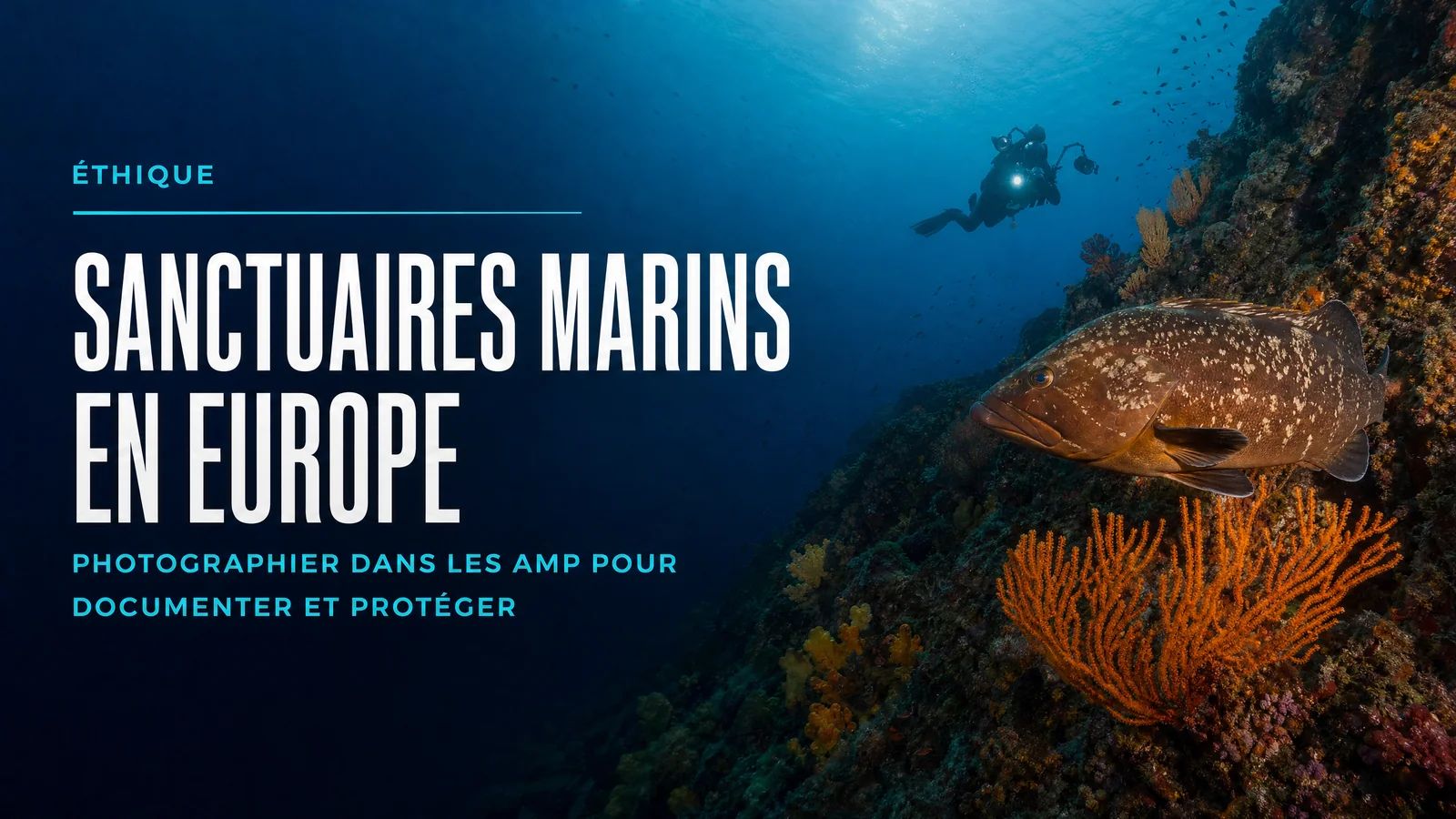
This understanding of the environment makes your photos more meaningful because you better understand what you are photographing and why it is there. A grouper resting on a gorgonian becomes something different when you know that this association indicates good ecosystem health, and that you have contributed to documenting it.
To become a scuba diver-photographer who contributes to scientific research while also improving your technical skills, the AquaExposure training course integrates ethical considerations and photographic techniques into a cohesive program.
Reef Check and BioObs- Two protocols accessible to scuba diving photographers. | AquaExposure