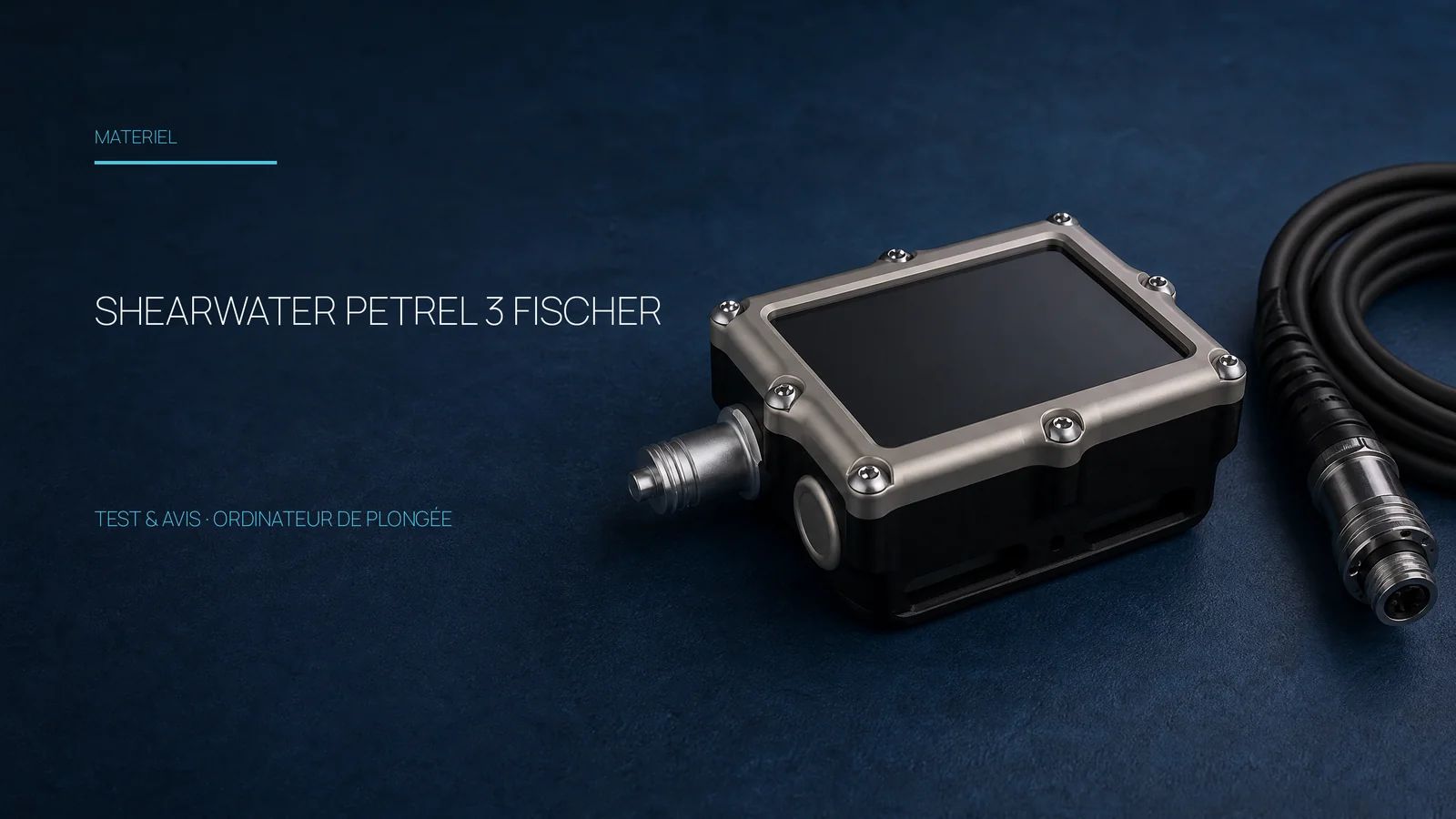
Shearwater Petrel 3 Fisher Dive Computer Review: The Ultimate Rebreather Control Center
Detailed review and test of the Shearwater Petrel 3 Fisher. Explore its 2.6-inch AMOLED screen, titanium bezel casing, and Fischer connector for real-time PO2 monitoring.
What is the specific feature of the Fisher model compared to the classic Petrel 3?
The 'Fisher' version is equipped with a specific waterproof connector (Fischer port) allowing the computer to be linked directly to the oxygen cells of a rebreather (CCR). The computer thus reads the PO2 in real time to calculate decompression.
Is the Petrel 3 Fisher strictly reserved for rebreathers?
No, although it is designed for that, it integrates all open-circuit modes (Air, Nitrox, Trimix). It can perfectly be used as a primary or backup computer in classic technical diving.
Does the computer support wireless air integration?
Yes, the Petrel 3 (including the Fisher version) can pair with up to 4 Shearwater Swift wireless transmitters for tank pressure monitoring.
What type of battery does the Petrel 3 use?
It runs on a single AA battery (Alkaline, Lithium 1.5V, or rechargeable 3.7V). For dives in very cold waters and optimal use of the vibration motor, a Lithium battery of type Saft LS14500 is highly recommended.
To learn how to get the most out of your gear underwater, discover the AquaExposure training.
Introduction
Technical rebreather diving (CCR) requires absolute and continuous monitoring of the partial pressure of oxygen (PO2). In the cold and murky waters of a Belgian quarry, when both hands are busy stabilizing a heavy waterproof housing for the Sony RX10V or deploying an Insta360 pole, vital information must be immediately readable and grab attention in case of deviation. It is precisely for this type of extreme scenario that the Shearwater Petrel 3 Fisher was designed. The evolution of a legendary line in the "tech" world, this third iteration brings a spectacular 2.6-inch AMOLED screen, an armored titanium bezel, and powerful vibration alerts. Its iconic Fischer connector allows physical integration with the machine's sensors, making it much more than a simple depth gauge: the brain of your decompression.
Summary Verdict
Global Score: 4.8/5
Criterion
Score
What this means
Algorithm & stops
5.0/5
Pure Bühlmann ZHL-16C, configurable Gradient Factors, and real-time PO2 monitoring.
Air & multi-gas
5.0/5
Hypoxic Trimix, wired CCR, bailouts, and up to 4 wireless transmitters (AI).
Screen & ergonomics
5.0/5
Exceptional 2.6-inch AMOLED color display, reference Shearwater interface.
Battery & power
4.6/5
Uses a standard AA battery that is user-replaceable.
Connectivity & app
4.8/5
Fast Bluetooth synchronization with Shearwater Cloud.
Compass & instruments
4.8/5
Very fluid 3D digital compass integrated into the main screen.
Robustness & depth
5.0/5
Titanium bezel, hardened aluminosilicate glass, certified to 290 meters.
Price & service
4.2/5
Expensive gear, reserved for a technical niche, but exceptional global customer service.
This computer is suitable for: The rebreather diver (CCR) requiring hardware PO2 reading, or the deep Trimix tech diver demanding a giant screen, a user-replaceable battery, and vibrating alerts under thick layers of neoprene.
This computer is not ideal for: The strictly recreational diver. Its massive size, the presence of a Fischer port useless in open circuit, and its price make it an oversized tool for no-stop dives.
Detailed Analysis
O1 Algorithm & stops (5.0/5)
The Petrel 3 Fisher calculates your saturation surgically, using not a theoretical setpoint, but the mixture actually measured by the rebreather probes via the Fischer cable.
Algorithm: Bühlmann ZHL-16C with Gradient Factors (GF). The tool applies the mathematical model without any opaque approach, allowing you to plan decompression with the greatest rigor. (Score: 5/5)
Deco display: Perfect integration of TTS, NDL, and ceilings. The green/red color coding for PO2 instantly alerts in case of hypoxia or hyperoxia. (Score: 5/5)
Ascent alert: A powerful haptic vibration motor has been added. It easily penetrates the gloves and seals of a drysuit. (Score: 5/5)
O2 Air & multi-gas (5.0/5)
This is a true Swiss army knife for gas blending and logistical management of bailouts (backup cylinders in CCR).
Number of gases managed: 5 gases in closed circuit (CCR) and 5 gases in open circuit (OC). (Score: 5/5)
Trimix & CCR: Complete dedicated mode. Switch to Bailout mode in two button presses. (Score: 5/5)
Air integration: Compatible with 4 Swift transmitters. Direct display of backup cylinder pressure on the screen. (Score: 5/5)
O3 Screen & ergonomics (5.0/5)
The size and brightness of the screen constitute the major asset of this model for videographers and divers operating in degraded visibility conditions.
Screen type: 2.6-inch color AMOLED (resolution 320x240). (Score: 5/5)
Readability: Impeccable. The deep blacks of the AMOLED reinforce the contrast of critical data, at night as well as in murky water. (Score: 5/5)
Navigation: Titanium piezoelectric buttons. Pressure-sensitive, they have no moving parts, eliminating the risk of blockage by sediment or salt. (Score: 5/5)
O4 Battery & power (4.6/5)
The independent battery compartment allows perfect logistical management during remote expeditions.
Battery type: Standard AA battery, user-replaceable. Shearwater recommends a 3.6V lithium battery (Saft type) to maximize the intensity of the vibrator and cold resistance. (Score: 5/5)
Autonomy: From 40 to 100 hours depending on the battery type and brightness (the AMOLED consuming more than a classic LCD). (Score: 4/5)
Compartment: Double O-ring isolating the battery compartment from the rest of the electronics. (Score: 4.5/5)
O5 Connectivity & app (4.8/5)
The digital bridge with the Shearwater suite allows for a meticulous analysis of technical dive profiles.
Synchronization: Bluetooth Smart. (Score: 5/5)
Companion app: Shearwater Cloud. The interface displays in detail the decompression curve and the millivoltage behavior of the O2 sensors. (Score: 5/5)
Firmware updates: Fast and fluid via mobile. (Score: 4.5/5)
O6 Compass & instruments (4.8/5)
Integrated instrumentation eliminates bulky consoles, a clear plus for hydrodynamics.
Built-in compass: 3D digital with tilt compensation. Overlay display on the main screen very practical for heading. (Score: 5/5)
The Petrel 3 casing is designed to withstand the assaults of rusted wreck metal and tight passages in caves.
Certified depth: 290 meters (950 ft). One of the deepest computers on the consumer market. (Score: 5/5)
Protective glass: Aluminosilicate glass (high impact resistance), encircled by a thick titanium bezel. (Score: 5/5)
Connective hardware: The Fischer 103 7-pin port is the robust industrial standard for CCR connections. (Score: 5/5)
O8 Price & service (4.2/5)
The budget is substantial, but fits the financial logic of heavy rebreather equipment.
Value for money: Around €1450, it is a high price but in perfect adequacy with the niche CCR market and survival electronics. (Score: 4/5)
Service availability: Shearwater has one of the best customer services in the industry, with very reactive repair centers in Europe. (Score: 4.5/5)
What to know before buying
Fischer cable maintenance: This is the nerve center of this system. Fischer connectors are waterproof once plugged in, but a drop of salt water inside the disconnected pin is enough to create millivolt reading problems. Scrupulous maintenance (dielectric grease, dry air cleaning) is mandatory after each outing.
Cable vs AK: Shearwater also offers the Petrel 3 with an "AK" connector (for some specific models). Check the compatibility of the connection of your rebreather head before buying.
Wrist size: With its very thick casing (to accommodate the AA battery and heavy calculation electronics), it requires a rigorous adjustment of the bungees so as not to turn on the forearm, especially at the end of the dive during the drysuit decompression.
Safety Reminder
The role of a decompression algorithm is to frame desaturation mathematically and safely. There is no magic setting allowing you to completely eliminate bubbles or artificially prolong bottom time. Rigorous planning according to the chosen Gradient Factors remains the key.
Furthermore, the intensity of haptic alerts or the exceptional clarity of the AMOLED screen do not replace the fundamentals of diving. Whether scrutinizing erratic behavior on an O2 cell or configuring Bailout mode in an emergency, this instrument manipulation must be done in calm. From the descent until the arrival at the surface, the regulator (or the rebreather mouthpiece) must remain in the mouth, without exception, in order to guarantee immediate breathing safety throughout the immersion.
Our Verdict
The Shearwater Petrel 3 Fisher is a technical prowess that honors its heritage. It makes full sense for the technical diver and the videographer for whom losing information on the screen is not an option. The addition of the 2.6-inch AMOLED display and haptic alerts make it the most accomplished control interface for managing a rebreather, reading its O2 sensors, and planning the exit. While the leisure diver will orient themselves rather towards the Peregrine TX, the engaged explorer will find in this Fisher version the definitive companion for their most demanding immersions.
Power Source
The computer runs on a standard AA-type battery. To ensure the best operational performance (durability in extreme cold, maintenance of powerful haptic vibrations), Shearwater recommends using 3.6V Lithium batteries (such as Saft LS14500). The battery housing is fully isolated from the internal electronics by a double-barrier seal.