STEM Scuba: When diving becomes a laboratory for young people.
STEM Scuba Programs: Discover how diving and underwater photography introduce young people to science, marine environments, and the scientific method. The AquaExposure educational guide.
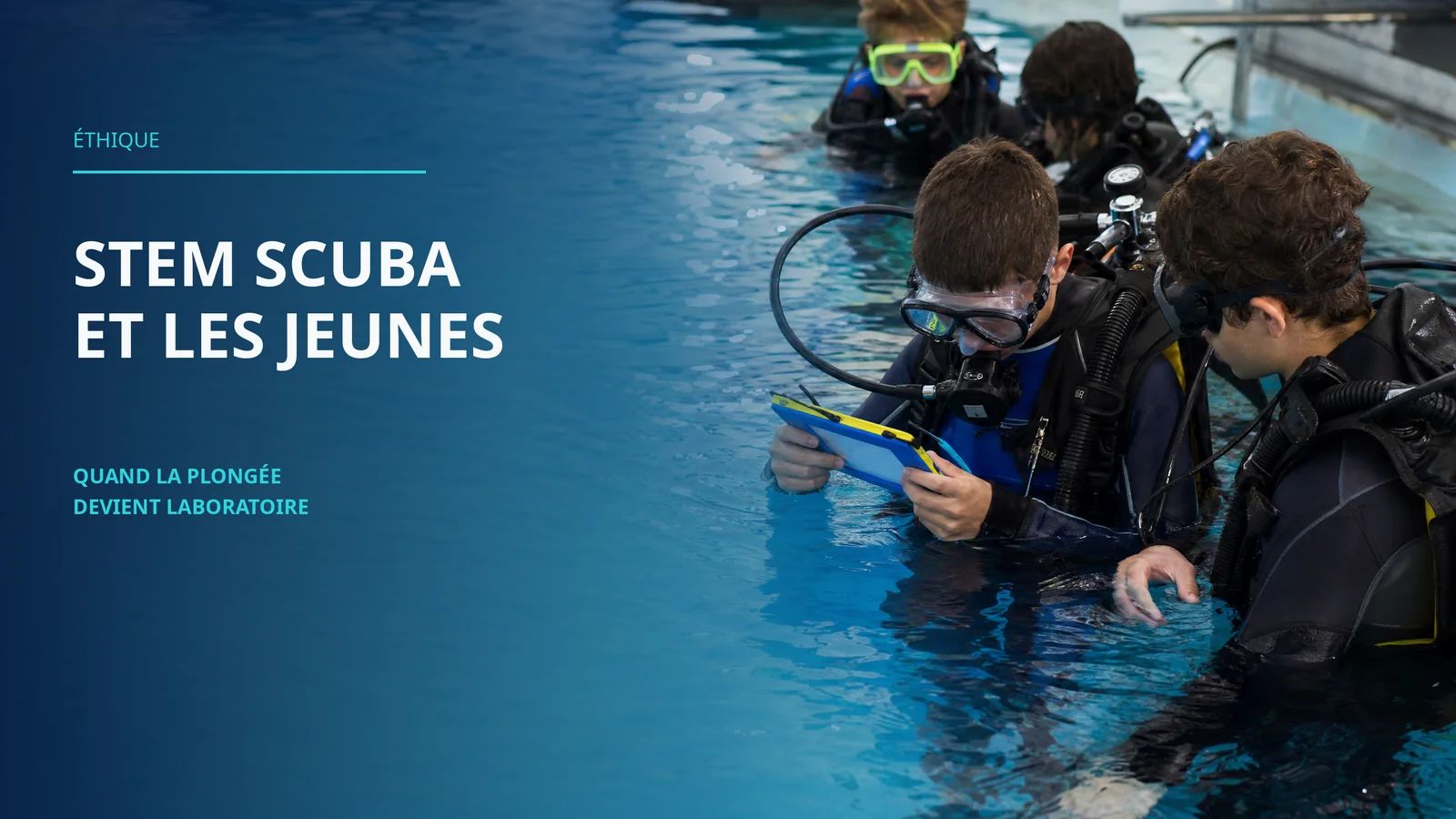
A STEM Scuba program combines scuba diving instruction with scientific disciplines – Science, Technology, Engineering, and Mathematics. Young people use the underwater environment as a real-world exploration platform, collecting data, observing species, and applying principles of physics and marine biology.
From what age can someone participate in a STEM Scuba program?
The programs vary depending on the organization. For snorkeling and freediving, introductory courses are available for children as young as 8-10 years old. For scuba diving, most junior training programs start at ages 10-12, depending on the certification chosen (PADI Bubblemaker, SSI Junior Open Water). Surface-based citizen science activities are accessible to all age groups.
Can underwater photography be a tool for STEM education?
Yes, in several ways. Underwater photography involves concepts of physics (light, refraction, pressure), biology (species identification, animal behavior), and technology (sensor operation, post-processing). The resulting images can become valuable scientific data used in citizen science programs like the PADI Shark & Ray Census.
How can citizen science be integrated into scuba diving education for young people?
By combining diving excursions with simple data collection protocols- such as species identification, counting, and photographic documentation of reefs- programs like PADI AWARE, Reef Check, or the Global Shark & Ray Census provide tools that are accessible to young divers and allow them to contribute their observations to real scientific databases.
STEM Scuba: When Diving Becomes a Laboratory for Young People
There is a specific moment, during a child's first dives, when something shifts. It's not about mastering the technical skills, not yet. It's about encountering a question that no textbook can answer in place of direct experience: what exactly is happening beneath the surface?
It is within this suspended space between two worlds that STEM Scuba programs find their purpose. Not by adding an artificial layer of pedagogy to diving, but by revealing what diving already teaches naturally to anyone who takes the time to observe.
What STEM Scuba Means in Practice
STEM (Science, Technology, Engineering, Mathematics) is a pedagogical approach that seeks to connect theoretical disciplines with real-world contexts, tangible problems, and experiences that make sense to those who live them.
Diving is one of the most powerful vectors for this approach, precisely because it is demanding. You don't dive passively. You manage your buoyancy (physics), you read your instruments (technology), you anticipate currents and tides (geography, environment), you identify species (biology). And all of this takes place in an environment that offers little room for approximations and rewards attention.For young people, this requirement is a valuable learning tool, not an obstacle. Adolescents learn better when the stakes are real, when mistakes have noticeable consequences, and when the skills acquired extend beyond the classroom. Scuba diving fulfills all three of these conditions simultaneously.
Large training organizations have gradually formalized this understanding into structured programs. SSI, PADI, and others offer junior courses that incorporate modules on marine biology, seabed geology, and participatory science protocols. Junior divers are no longer just trained to master their equipment. They learn to observe, document, and contribute.
The physics you learn by experiencing it
It's one thing to explain in a classroom that pressure increases with depth according to Boyle's Law. It's another to feel your ear compress at 5 meters, to understand physically that water has weight, that air becomes denser, and that every meter gained towards the bottom changes something concrete about how your own body functions.The thermocline, this invisible boundary between two bodies of water with different temperatures, becomes a tangible reality from the very first dive in open water. Refraction of light, which distorts perceived distances underwater, is the first explanation a diver seeks when they miss a fish they thought they were going to photograph. The calculation of decompression time, integrated into diving tables and computers, is a lesson in applied mathematics that the importance of safety makes unforgettable.
These lessons learned through experience and physical sensation have no equivalent in a lecture-based course. They create lasting cognitive anchors precisely because they are linked to sensations, decision-making processes, and moments where understanding had immediate significance.
Photography as a Measuring Instrument
In the AquaExposure training program, I often emphasize this idea: an underwater camera is not just an artistic tool. It's a measuring instrument. The image it produces encodes scientific information, provided that the person who took it followed a specific protocol.For a young diver entering a STEM-focused approach, this aspect of photography is particularly valuable. Documenting a coral reef using a pre-defined analysis grid is essentially marine biology. Photographing the dorsal fin of a shark in its entirety to enable individual identification contributes to a research program in ethology. Counting fish within a one-square-meter quadrat and noting the species present helps populate a database used by researchers.
Underwater photography places the young person in an active role of knowledge creation, rather than simply consuming experiences. They don't just look at the reef. They observe it, document it, and participate in the collective understanding of a living system that is constantly changing.
This approach also changes the way we interact with marine life. We no longer approach a lionfish solely to obtain a beautiful portrait. Instead, we approach it according to a protocol that respects its space and maximizes the quality of information collected. Ethics and scientific methodology naturally converge.
From Image to Data: A Three-Step Learning Process
In the training modules I have developed for AquaExposure, the transition from image to scientific data follows a progression that works well with both adults and teenagers.The first step is identification. Before taking photographs, it's essential to know what you are trying to document. What species? What behavior? What morphological characteristic? This phase requires studying the species present at the site beforehand and building a mental image of what you will encounter. It engages visual memory, basic taxonomy, and preparation.
The second step is data collection with a standardized protocol. When diving, observations are only useful if they can be compared to other similar observations. Angle of view, distance, lighting, behavioral context: the protocol standardizes these variables so that data collected by different divers, at different sites, remain comparable. Teaching this protocol to a young person is teaching them the scientific method in its most concrete form.
The third step is sharing and contributing. Entering your observations into a citizen science platform like PADI AWARE or Reef Check transforms you from an observer into a contributor. The young person sees their data integrated into a larger database, sometimes commented on by researchers, and sometimes cited in conservation reports. This feedback on the value of their work is educationally powerful and too rare in traditional school learning.
What Young People Really LearnThe skills formally taught in a STEM Scuba program are measurable- species identification, instrument reading, data collection protocols, image processing, and contributions to databases. However, what these programs convey more deeply is less easily defined, and perhaps even more valuable.
They impart an understanding of complexity. A coral reef is a system where everything interacts- water temperature, light quality, the health of the corals, the presence or absence of certain predator species. Observing a reef over several dives allows one to begin to perceive this complexity without simplifying it. This intellectual approach is something that traditional schooling often struggles to develop.
They foster a responsible relationship with the marine environment. Not through lectures about ecological disaster, but through direct experience of both the fragility and the richness of an ecosystem. A young person who has seen the difference between a healthy reef and a bleached reef doesn't need to be told why conservation is important. They understand it in their own images.They also instill confidence in one's ability to produce something of value. The scientific data provided by a young diver is no less valuable than that collected by an adult, as long as the protocol has been followed. This equality of value between the young contributor and the experienced researcher is a lesson that extends far beyond marine biology.
What the AquaExposure training offers
In the AquaExposure training program, Module 3 (Ethics and Approach) and Module 10 (Citizen Science) were specifically designed to connect these two dimensions: the image as an expression and the image as a tool.
Module 3 teaches the method of the three invisible circles and the tangential approach- a way of moving in a progressive arc around an animal, allowing it to choose whether to stay or move away. This method is not only ethical. It produces better images and better data because an animal that does not feel threatened behaves naturally.
Module 10 integrates the main protocols of citizen science used in marine environments, with practical exercises in documentation and data submission. Participants learn how to use the actual tools employed by programs such as PADI AWARE, Reef Check, or the Global Shark & Ray Census.For young divers embarking on a STEM Scuba journey, these modules provide a solid foundation that goes beyond the scope of certification. They offer the tools to make each dive a potential contribution and allow the camera to become an instrument serving a lasting curiosity.
Frequently Asked Questions
What is a STEM Scuba program?
A STEM Scuba program combines scuba diving education with scientific disciplines (Science, Technology, Engineering, Mathematics). Young people use the underwater environment as a real-world exploration platform, collecting data, observing species, and applying principles of physics and marine biology directly related to their diving experience.
What is the minimum age for participating in a STEM Scuba program?
For snorkeling and freediving, initiation is possible from ages 8-10. For scuba diving, most junior training programs start at ages 10-12, depending on the chosen certification. Surface science activities (observation from a boat, counting coastal species) are accessible to all ages and often provide an ideal introduction before the first dive.
Can underwater photography truly be a STEM educational tool?Yes, in several ways. Photography involves concepts of physics (light, refraction, pressure), biology (species identification, animal behavior), and technology (sensor operation, digital post-processing). Images can become scientific data that is useful in citizen science programs, provided they are taken according to a specific protocol.
How to integrate citizen science into diving education for young people?
By combining dive trips with simple data collection protocols: species identification, counting, photographic documentation of reefs or large marine animals. Programs like PADI AWARE or Reef Check provide accessible tools and value the observations of young divers by including them in real scientific databases, sometimes with direct feedback from research teams.
``json { "@context": "https://schema.org", "@type": "Article", "headline": "STEM Scuba: When Diving Becomes a Laboratory for Young People", "description": "STEM Scuba programs: how diving and underwater photography introduce young people to science, the marine environment, and the scientific method.", "author": { "@type": "Person", "name": "Benjamin Coste", "url": "https://www.aquaexposure.com" }, "publisher": { "@type": "Organization", "name": "AquaExposure", "url": "https://www.aquaexposure.com" }, "datePublished": "2026-08-03", "image": "https://www.aquaexposure.com/images/blog/stem-scuba-jeunes-plongee-sciences-2026.jpg", "mainEntityOfPage": "https://www.aquaexposure.com/en/blog/stem-scuba-jeunes-plongee-sciences-2026" } ````json { "@context": "https://schema.org", "@type": "FAQPage", "mainEntity": [ { "@type": "Question", "name": "What is a STEM Scuba program?", "acceptedAnswer": { "@type": "Answer", "text": "A STEM Scuba program combines scuba diving instruction with scientific disciplines (Science, Technology, Engineering, Mathematics). Young people use the underwater environment as a real-world exploration platform, collecting data, observing species, and applying principles of physics and marine biology." } }, { "@type": "Question", "name": "What is the minimum age for participating in a STEM Scuba program?", "acceptedAnswer": { "@type": "Answer", "text": "For snorkeling and freediving, introductory programs are possible from ages 8-10. For scuba diving, most junior training courses start at ages 10-12. Surface-based citizen science activities are accessible to all ages." } }, { "@type": "Question", "name": "Can underwater photography be a STEM educational tool?", "acceptedAnswer": { "@type": "Answer", "text": "Yes. Photography involves concepts of physics (light, refraction, pressure), biology (species identification, animal behavior), and technology. The image can become scientific data that is used in citizen science programs, provided it is taken according to a specific protocol." } }, { "@type": "Question", "name": "How can citizen science be integrated into scuba diving education for young people?", "acceptedAnswer": { "@type": "Answer", "text": "By combining dive trips with data collection protocols- species identification, counting, photographic documentation of reefs. Programs like PADI AWARE or Reef Check value the observations of young divers by incorporating them into real scientific databases." } } ] } ``
STEM Scuba: When diving becomes a laboratory for young people. | AquaExposure