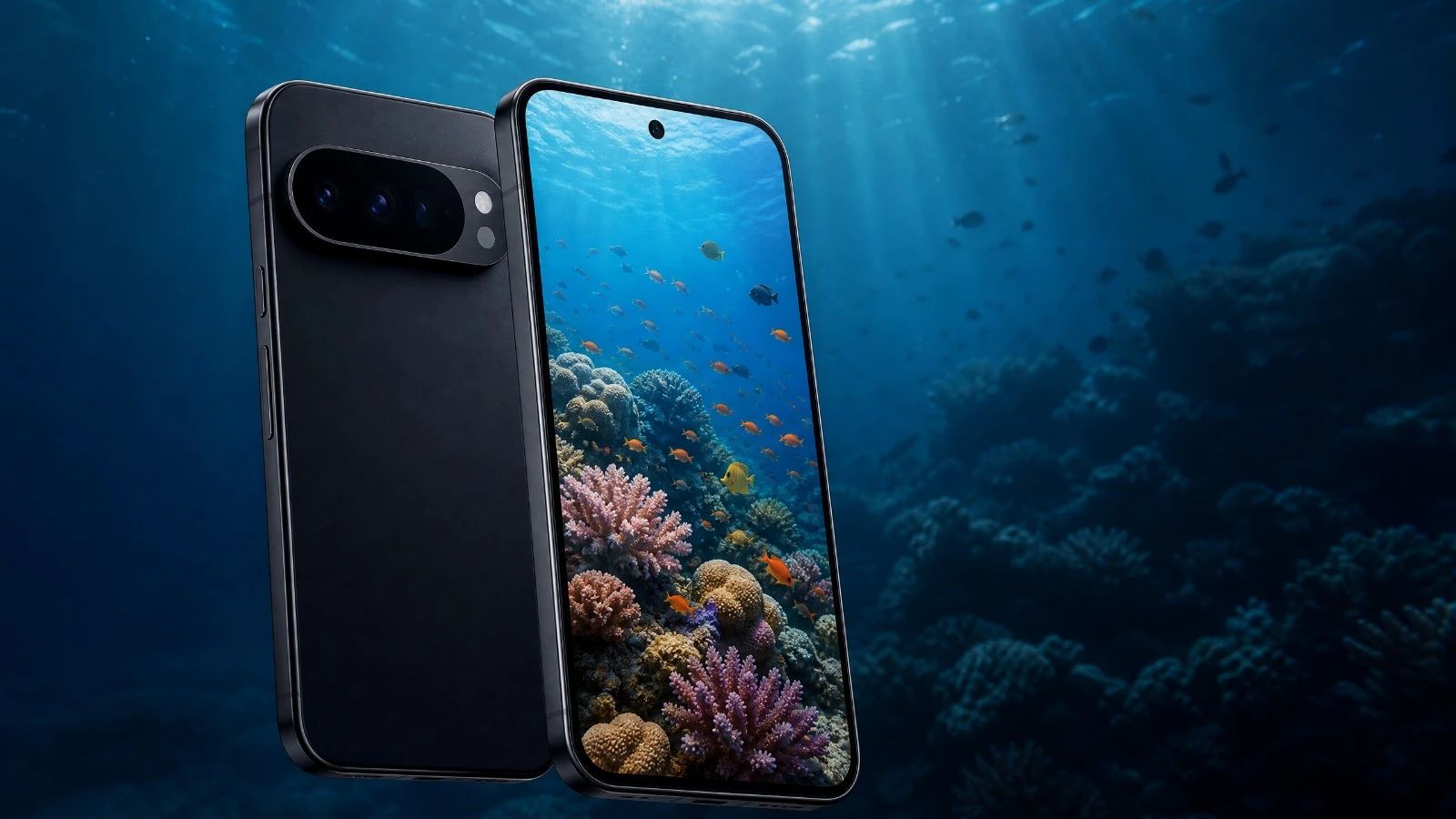
Test Google Pixel 10 Pro: Underwater Photography Review and 2026 Score
Google Pixel 10 Pro underwater camera test- natural light photography. Scores B1-B7. Divevolk housing. Price: July 2026. Different from the Pixel 10 Pro XL.
What is the difference between the Pixel 10 Pro and the Pixel 10 Pro XL for underwater photography?
The Pixel 10 Pro shares the same triple camera system as the Pro XL (a 50 MP main sensor with a 1/1.31-inch size, and a 5x telephoto lens), but in a more compact and lightweight design. In practice, the difference in size favors the standard Pro model when housed in a Divevolk underwater housing: it puts less pressure on the side buttons and offers a better grip when wearing diving gloves. The Pro's battery is slightly smaller (4870 mAh compared to 5100 mAh on the XL), which could be a factor during multiple dives in cold water.
Does the Pixel 10 Pro support RAW image capture while diving?
Yes. The Pixel 10 Pro records in DNG format natively directly from the Google camera app. For complete control over white balance in Kelvin and for RAW video recording, you need to use MotionCam Pro (available on Android, as Google uses GMS). This is one of the strengths of the Pixel when using natural light techniques.
Should you cover the autofocus laser on the Pixel 10 Pro before diving?
Yes, it is essential. The Time-of-Flight laser module does not penetrate the polycarbonate of the housing or the water. Without masking, autofocus becomes erratic underwater. A small piece of opaque tape placed over the laser module (visible in the camera bar) is sufficient. The Pixel then switches to Dual Pixel PDAF, which works very well for diving.
What housing should I use for the Pixel 10 Pro when diving?
The Divevolk SeaTouch 4 Max Plus is the compatible housing for the Pixel 10 Pro. It is certified to a depth of 60 meters, its gel membrane touchscreen remains usable underwater, and it supports all the accessories in the Divevolk range (handles, lenses, lights). Please note: the internal adapter is not interchangeable between the Max, Max Plus, and Platinum versions. Be sure to have the correct Pixel 10 Pro adapter before entering the water.
Should an anti-fog treatment be used with this device?
Yes, absolutely. Due to its housing (often made of aluminum) and heat dissipation system using a vapor chamber, the risk of condensation forming in cold water (below 15°C) is significant. Using an anti-fog treatment (such as a silica gel packet or inserts) inside the housing is mandatory before each dive.
How can I quickly transfer my photos and videos from this device?
This device offers excellent connectivity. With a wired connection, the USB 3.2 port allows you to quickly transfer large amounts of RAW files or 4K videos – gigabytes worth – to an external SSD or computer in just seconds. For wireless transfers, Quick Share is ideal for fast and reliable data transmission.
Model Distinction: This review is dedicated specifically to the Google Pixel 10 Pro (compact 6.3-inch form factor, offering optimal handling inside the housing). If you have or plan to purchase the larger version, see our Google Pixel 10 Pro XL underwater test. To verify compatibility with universal waterproof housings (Divevolk, SeaLife, Kraken), use our smartphone housing comparison tool.
Is the Pixel 10 Pro the best smartphone for diving in 2026?
When Google releases a new Pixel Pro, photographers who shoot in natural light immediately ask themselves this question.
Not because the Pixel is necessarily the best choice. But because the Android system with Google Mobile Services (GMS) opens the door to MotionCam Pro, the leading tool for RAW video on Android. And Google's Tensor G5 runs smoothly on it.
This review focuses exclusively on the Pixel 10 Pro (standard format). Not the basic Pixel 10, which has a smaller main sensor. Nor the Pixel 10 Pro XL, which shares the same camera system but in a larger body. If you are undecided between the two Pro models, I have published a complete review of the Pixel 10 Pro XL alongside this one.
The approach here is the one I've used for over 1000 dives: natural light only, RAW format for post-production, and a universal Divevolk housing. No flash, no artificial lighting. The smartphone as a raw capture tool, to be optimized later.What interests me about the Pixel 10 Pro is the balance between a solid main sensor, a compact form factor that fits well in a Divevolk housing, and the open Android ecosystem. Here's what it looks like in practice.
Ideal for: - Photographers who shoot in natural light and want a complete RAW workflow (native DNG + MotionCam Pro) - Divers who prefer a compact and lightweight format in the housing - Android users who are committed to regular use (at least 20 dives per year)Not ideal for: - Divers who dive in cold water (lake, quarry, North Atlantic): the Li-Ion battery suffers. - Photographers who want a dedicated rigid housing with threaded filter ports. - Those on a tight budget: the value for money of a used iPhone 16 is still better.
B1 - Optics
The Pixel 10 Pro features three sensors: a main sensor of 1/1.31 inch with 50 megapixels and an aperture of f/1.7, an ultra-wide angle sensor of 1/2.55 inch with 48 megapixels at f/1.7, and a 5x telephoto lens of 1/2.55 inch with 48 megapixels at f/2.8.
The main sensor is the strong point of the Pixel 10 Pro. At 1/1.31 inch, it captures more light than most direct Android competitors, and the f/1.7 aperture helps to recover detail in dimly lit areas. The ultra-wide angle lens also handles macro photography from 2-3 centimeters, which opens up interesting possibilities for small subjects.
The compact Pro format (smaller than the Pro XL) does not affect the optical quality: both devices share the same camera system.
A point to note: DxOMark notes a significant loss of contrast in backlit conditions and artifacts related to Google's aggressive algorithmic processing. Backlighting (a brightly lit surface above a subject) is common when diving. It is preferable to shoot in RAW format to recover these situations during post-processing.
B2 - RAW and ColorimetryThis is the most important factor for achieving natural light results. And the Pixel 10 Pro performs well, for three distinct reasons.
First, native DNG files are available directly within the Google camera app. There's no need for a third-party application to access RAW photo data. The bit depth in DNG is typically 10-bit on recent Pixel phones, with a wide computational dynamic range thanks to the Tensor G5 processor.
Second, Android with GMS allows for the full installation and use of MotionCam Pro. This is the leading app for video RAW recording on Android, and it runs without restriction on the Pixel 10 Pro. This is a direct advantage over Android devices that don't have GMS (like recent Huawei models).
Third, the Tensor G5 features a proprietary image signal processor that produces recognizable colorimetry. The rendering doesn't have the naturalism of Leica or Zeiss optics, but it remains consistent and can be easily adjusted in post-production.
The lack of a true logarithmic profile is a limitation for high-end video recording. While there is a 10-bit HDR mode, it's not equivalent to Apple Log or S-Log. For natural light underwater videography workflows, this remains a significant constraint. However, in pure RAW photography, the DNG format largely compensates for this.
B3 - Storage and TransferThe Pixel 10 Pro is available in 128 GB, 256 GB, 512 GB, and 1 TB versions. An important technical detail to know before purchasing: the 128 GB version uses the UFS 3.1 standard, which is significantly slower than the UFS 4.0 used in the 256 GB and higher versions.
In practice, transferring large RAW files after a dive is twice as fast with the 256 GB model. For serious underwater photography use, the 128 GB version should be avoided. The connector is USB-C 3.2, and there is no microSD card slot.
For a week-long diving trip, 256 GB is the minimum reasonable capacity. The 512 GB or 1 TB models allow you to go an entire week without transferring files if you alternate between RAW photos and videos.
B4 - Thermal Management
The aluminum frame of the Pixel 10 Pro is a good conductor of heat, combined with an internal passive vapor chamber. In practice, the Tensor G5 processor has a reputation for getting warm, but the aluminum dissipates heat better than plastic or ceramic.
When diving, thermal constraints work in reverse: the Divevolk housing partially insulates the phone from cold water, but repeated dives (2-3 dives per day over several days) can strain the passive cooling system if you are continuously recording RAW video.
The aluminum is also a factor to monitor for condensation inside the housing, especially when transitioning from cold water to warm air. A silica gel packet in the housing remains a basic precaution.[!WARNING] Silica gel: mandatory. Aluminum housing + vapor chamber, similar thermal management to recent iPhones. Without silica gel, condensation is almost certain below 15°C. The good news is that the Tensor G5 runs cooler than its predecessors, which provides better tolerance in tropical environments.
Tropical overheating: The Tensor G5 represents a significant thermal improvement over the Tensor G3/G4 generations. In water at 28°C, software overheating occurs after approximately 28 minutes of continuous video recording. This provides a comfortable margin for typical underwater clips.
Overall connectivity score: 4.4/5 - The excellent Bluetooth 6.0 (the best in this comparison) improves the stability of short transfers and the accuracy of accessory connections. USB 3.2 is used for on-site data transfer, and Wi-Fi 7 complements a connectivity ecosystem that is among the best on the market.
For underwater photography dives using a mixed mode (some video, many photos), the thermal performance of the Pixel 10 Pro is acceptable. When shooting continuous RAW video during 60-minute dives in warm water, monitor temperature alerts.
B5 - Battery
The battery capacity of the Pixel 10 Pro is 4870 mAh, slightly less than the 5100 mAh found in the Pixel 10 Pro XL. The standard Li-Ion chemistry is sensitive to cold temperatures.When diving in water below 15°C (quarry, lake, Atlantic), the effective battery capacity can decrease by 15 to 25%. During a 60-minute dive in cold water with the screen on and autofocus active, expect the battery to consume 20 to 30%. This leaves enough power for 3 to 4 dives per day if you recharge between each.
The aluminum housing accelerates heat dissipation, which exacerbates the loss of battery capacity in cold conditions compared to a glass or plastic housing.
Practical recommendation: start each dive with a fully charged battery. In cold water, do not exceed two consecutive dives without recharging if you are recording video in RAW format.
Before each diving session, remember to check your external battery. Use our portable battery comparator tool to choose the power bank that is suitable for your housing and your desired dive time.
B6 - Autofocus
The Pixel 10 Pro combines a Dual Pixel PDAF system with a multi-zone laser autofocus. The shutter lag is less than 50 ms, which matches the continuous shooting architecture of the Pixel cameras.The problem with the Time-of-Flight (ToF) laser is well documented: it does not penetrate the polycarbonate of the housing or water. As a result, if the laser module is not masked before diving, autofocus becomes unpredictable and searches without locking onto a subject. The solution is simple and free: a piece of opaque tape placed over the laser module (located in the camera bar) is sufficient. The Pixel then automatically switches to Dual Pixel PDAF, which works very well underwater.
Focus peaking is not available in the native Google app. It can be accessed through MotionCam Pro or Blackmagic Camera.
Always mask the laser before each dive: this is a crucial step to remember. Without masking, focus will be the main problem during the dive. With masking, the autofocus on the Pixel 10 Pro is among the most responsive in an underwater environment.
B7 - Housing
The Pixel 10 Pro does not have a dedicated rigid housing. The chosen solution is the Divevolk SeaTouch 4 Max Plus, a universal housing certified to 60 meters and compatible with the Pixel 10 Pro (a specific Pixel 10 Pro adapter is required).
Divevolk's inert gel touch membrane allows you to use the capacitive screen directly underwater, including complex interfaces like MotionCam Pro. Beyond 40 meters, compression of the membrane can create phantom touches: it is best to lock the settings before descending.The compact size of the Pixel 10 Pro is an advantage in this housing- less lateral pressure on the buttons and a better grip.
The lack of a dedicated rigid housing remains the main limitation. For intensive use with threaded filter ports and ultimate robustness, specialized housings (Ikelite, Nauticam) are not an option for a smartphone. The Divevolk meets the need without reaching that level.
The Divevolk SeaTouch 4 Max Plus is the best-documented solution for the Pixel 10 Pro. It is essential to choose the internal adapter specifically designed for the Pixel 10 Pro (not interchangeable with adapters for Pixel 9, iPhone or Samsung phones). The certified depth rating is 60 meters, which is more than sufficient for recreational diving.
If you already own a SeaTouch 4 Max or a SeaTouch 4 Max Platinum, the internal adapters are not compatible between versions. Be sure to obtain the correct adapter before traveling for a dive trip.
Post-dive workflow
The Tensor G5 processes DNG files using a proprietary algorithm. In native RAW format, the foundation is solid. When working with Lightroom or Darktable, correcting underwater white balance requires similar adjustments as with any other smartphone RAW file.For RAW video, MotionCam Pro is the recommended option. The raw video DNG files are large (plan for a minimum of 256 GB of internal storage). The USB-C 3.2 transfer is fast with UFS 4.0 to an external SSD.
AI features like Magic Eraser or Best Take are not relevant in underwater photography. Magic Eraser removes elements, which goes against the principle of documenting a natural environment. Best Take selects the best facial expression from multiple shots- this is unnecessary underwater. These functions are tools for social photography, not nature photography.
Current Prices (July 2026)
New: - 128 GB: 1,099 EUR (store.google.com/fr, July 2026) - Summer 2026 sales offers allow you to find the 128 GB model for around 599-689 EUR at Darty and other retailers.
Used and Refurbished: - Starting from 659 EUR in refurbished condition on Back Market (July 2026, 128 GB, good condition) - 256 GB refurbished: starting from 820-850 EUR on Back Market - Source: backmarket.fr, consulted July 2026
Used Market Considerations
The Pixel 10 Pro was released recently enough that the used market is just beginning to develop. As of July 2026, the stock on Back Market is still limited. The price reduction compared to new models is modest (15-25% depending on condition). If your goal is to save money, refurbished Pixel 9 Pro and Pixel 9 Pro XL models offer a better value proposition in the used market.For those on a tight budget, also see our general comparison of the best underwater camera for beginners.
Our Verdict
The Pixel 10 Pro scores 3.9/5 on our rating system based on 7 criteria.
It's a good smartphone for underwater photography in natural light, with two key strengths: the 1/1.31-inch main sensor that performs well in low-light conditions, and access to MotionCam Pro via Android GMS for complete RAW workflow capabilities.
The compact size of the Pro (compared to the Pro XL) is a real advantage when used with a Divevolk housing. The sensor difference between the two Pro models is negligible, the choice between them comes down to hand feel and battery life.
The drawbacks include the Li-Ion battery's sensitivity to cold, the lack of a dedicated rigid housing, and an AI algorithm that can sometimes be overly aggressive, requiring you to shoot in RAW format consistently. These are not insurmountable problems, but rather limitations to be aware of before purchasing.
Equipment doesn't make the photographer. Training that teaches you how to read natural light underwater, approach animals without disturbing them, and compose an image before taking the shot is available at aquaexposure.com.
Overall Score
3.9/5
Test Google Pixel 10 Pro: Underwater Photography Review and 2026 Score | AquaExposure