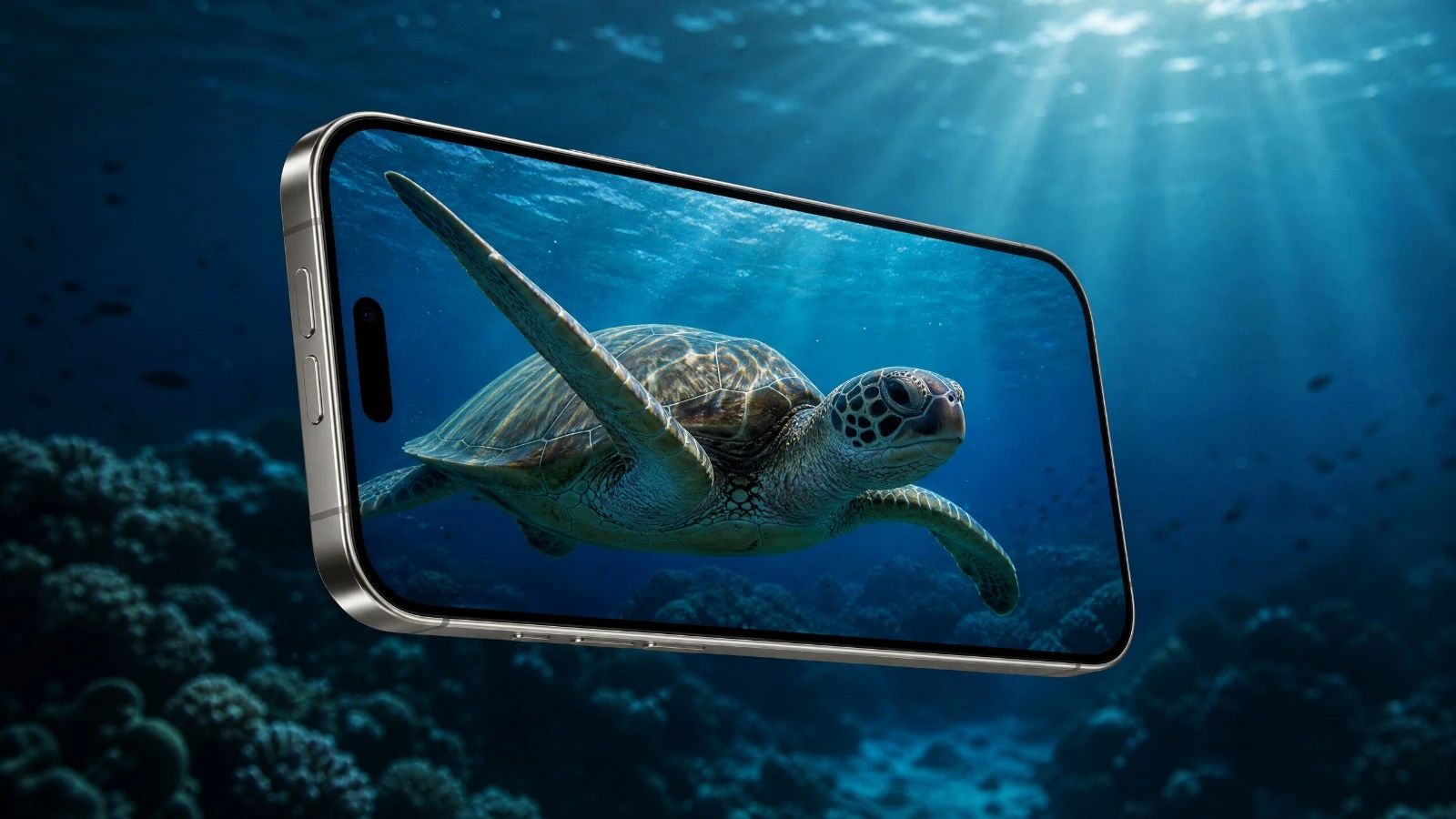
iPhone 17 Pro Scuba Dive Test: IP68 Limits, Depth in Feet & Housings (2026)
iPhone 17 Pro scuba dive test: IP68 rating limits (20 ft / 6 m) vs 196 ft (60 m) in a housing. Native ProRes RAW, score 4.1/5 & Kraken, SeaLife, Divevolk guide.
Yes, but only for an accident. The iPhone 17 Pro carries an IP68 rating of 20 ft (6 m) for 30 minutes, measured in still fresh water on a brand new device. That is the profile of a phone dropped off a boat, not the profile of a dive. Salt, pressure cycles, thermal shock and two years of ageing seals are all outside those conditions. Take it in the water, but take it in a certified pressure housing.
Can you take underwater photos with the iPhone 17 Pro?
Yes, and this is where it earns its 4.1/5. The Pro pairs a 1/1.28-inch main sensor with LiDAR autofocus, which is the difference-maker in turbid water where contrast detection hunts. Through Blackmagic Camera you get 12-bit ProRAW with lockable Kelvin white balance. What you cannot do is operate any of it on a bare screen underwater, which is why the housing is part of the setup rather than an accessory to it.
Can the iPhone 17 Pro record video underwater?
Yes, including ProRes RAW natively, which is the headline feature of this generation. In practice, the constraint underwater is thermal rather than technical: sustained RAW video heats the chassis, and heat inside a sealed housing condenses on the port when you drop into colder water. Plan an anti-fog insert and shorter takes rather than one continuous roll.
How deep can the iPhone 17 Pro go?
Twenty feet (6 m) for 30 minutes unprotected, per Apple's IP68 rating. Inside a Divevolk SeaTouch 4 Max Plus, the certified depth becomes 196 ft (60 m), with a usable touchscreen down to roughly 50 ft (15 m) before hydrostatic pressure stiffens the membrane. That covers recreational diving in full.
Is a €250 housing worth it on top of a €1,099 phone?
Put it the other way around. You have already committed €1,099 to a camera you cannot operate below the surface and cannot legitimately take past 20 ft (6 m). The housing is what converts that into a working underwater camera: certified to 196 ft (60 m), conductive membrane for full app control, optical glass that does not undo the RAW file you came for. A €10 pouch does none of those things, and it is the phone that pays for the difference.
Is the iPhone 17 Pro good for underwater photography?
Yes, with an AquaExposure score of 4.1/5, the iPhone 17 Pro is an excellent smartphone for natural light diving photography. Its ProRes RAW video (world first), LiDAR, and 2 cm macro capabilities make it a formidable tool in a more compact form factor than the Pro Max. Key watch point: condensation in cold water (below 15°C/59°F) due to the aluminium chassis.
What is the difference between the iPhone 17 Pro and 17 Pro Max for diving?
Sensors and the ProRes RAW system are identical. Practical differences when diving: the Pro battery is smaller (3998 mAh vs 5088 mAh), reducing run time on a 3-dive day with intensive video. The Pro is lighter (206 g vs 233 g) and easier to handle in a housing. Maximum internal storage is 1 TB on the Pro vs 2 TB on the Pro Max. For photo only, results are identical.
Which housing fits the iPhone 17 Pro for diving?
The Divevolk SeaTouch 4 Max Plus (or Platinum) with specific iPhone 17 adapters is the most suitable solution. Certified to 60 meters, it retains full touchscreen access, including control over the Blackmagic Camera app. Divevolk confirmed compatibility on launch day, using the same modules as the 17 Pro Max.
Can the iPhone 17 Pro shoot RAW underwater?
Yes. It uses the same system as the Pro Max: native ProRes RAW video (world first), 12-bit ProRAW photos in DNG, and Kelvin white balance access via the free Blackmagic Camera iOS app. Apple Log 2 and Genlock are also available. For post-production color grading, this is a major upgrade.
Should I use an anti-fog treatment with this device?
Yes, absolutely. With its conductive aluminium chassis and vapor chamber heat dissipation, the risk of condensation in cold water (below 15°C/59°F) is high. Using an anti-fog treatment (fresh silica gel sachet or anti-fog inserts) inside the housing is mandatory before every dive. > Further reading: [Smartphone overheating and fogging in underwater housings: the physics explained](/blog/underwater-smartphone-condensation-overheating-physics) -- dew point, thermal management and silica gel protocol.
How can I quickly transfer my photos and videos from this device?
This device offers excellent connectivity. Wired, the USB 3.2 / Thunderbolt port allows you to offload gigabytes of RAW files or 4K videos in seconds to an external SSD or computer. For wireless transfer, using AirDrop is ideal for fast and stable transfers.
Does the iPhone 17 Pro make RAW in diving?
Yes. It uses the same system as the Pro Max: native ProRes RAW video (world first), 12-bit ProRAW photos in DNG, and Kelvin white balance access via the free Blackmagic Camera iOS app. Apple Log 2 and Genlock are also available. For post-production color grading, this is a major upgrade.
To learn how to get the most out of your gear underwater, discover the AquaExposure training.
iPhone 17 Pro Scuba Dive Test: IP68 Limits, Depth in Feet & Housings (2026)
The short answer
Yes, the iPhone 17 Pro can go underwater. Apple rates it IP68, 20 ft (6 m) for 30 minutes, and we would still tell you not to do it.
What that rating actually certifies is survival after an accident. Still fresh water, a device straight out of the box, no current, no thermal shock, no salt. A dive is none of those things. Add two seasons of use and a descent into 16-degree water and you have left the test protocol behind without noticing.
The part the spec sheet never mentions is that a bare screen stops responding underwater. No focus, no exposure, no shutter. The phone comes back alive and the memory card comes back empty, which is a strange definition of waterproof.
So the answer we give is the same one every time. Use a housing. The Divevolk SeaTouch 4 Max Plus sits around €250. It is not the €10 transparent pouch from the airport shop and it is not trying to be. It is certified to 196 ft (60 m), its conductive membrane keeps the touchscreen alive to roughly 50 ft (15 m), and it lets you run Blackmagic Camera in ProRAW and ProRes RAW at depth. On a phone at €1,099, that is the accessory with the best return in the bag.
What people ask
Straight answer
Can it go underwater?
Yes, 20 ft / 6 m for 30 min (IP68), accidental immersion only
Can it take photos underwater?
Yes, 12-bit ProRAW with LiDAR autofocus, housing required to control it
Can it record video underwater?
Yes, including native ProRes RAW. Watch the heat
Is it certified for diving?
No. No smartphone is. The certification belongs to the housing
How deep with a housing?
196 ft / 60 m certified, touchscreen usable to roughly 50 ft / 15 m
The rest of this article is the measured part: what the iPhone 17 Pro is worth in the water, block by block.
Context Before the Specs
The iPhone 17 Pro raises a question that nobody was asking frankly two years ago: is the "standard Pro" model enough for dive photography, or do you always need to go for the Pro Max?
This isn't about brand vanity. It's a practical question. The Pro Max weighs 27 grams more, measures 6.9 inches, and accepts up to 2 TB of storage. The Pro is 6.3 inches, 206 grams, and maxes out at 1 TB. In a Divevolk housing, these differences have concrete consequences on handling, battery life, and field workflow.
This test aims to answer a specific question: does the iPhone 17 Pro (standard Pro model, not Max) deliver on its promises when diving in real-world conditions, shooting live marine subjects in natural light? And how does it differ in practice from the Pro Max under the surface?
The Verdict in Brief
AquaExposure Global Score: 4.1/5
Criterion
Score
What It Means
Optics & sensor (B1)
3.8/5
Identical sensors to the Pro Max, 2 cm macro, good main sensor
RAW & color (B2)
4.7/5
ProRes RAW video (world first), 12-bit ProRAW, native Blackmagic Camera
Storage & transfer (B3)
4.1/5
Up to 1 TB, 10 Gbps USB-C 3.2 Gen 2, no external card slot
Thermals (B4)
2.8/5
Critical point: aluminium + vapor chamber = condensation in cold water
Battery (B5)
3.5/5
3998 mAh, tight for a 3-dive day with intensive video
Autofocus (B6)
5.0/5
LiDAR + dual-pixel PDAF + AI + Focus Peaking: maximum configuration
Housing (B7)
5.0/5
Divevolk SeaTouch 4 Max, 60 m, full touchscreen access
This device is built for: the diving photographer looking for a lightweight and compact setup, with a professional video workflow (ProRes RAW) and superior handling in the housing. Ideal for photo and short-duration video in temperate or tropical water.
This device is not ideal for: cold water diving (below 15°C / 59°F) due to condensation risk, and 4-dive days or more shooting continuous ProRes RAW, where the smaller battery compared to a Pro Max can become a limiting factor.
B1 - Optics: What Enters the Sensor
Score: 3.8/5
Good news to start: the optical system of the iPhone 17 Pro is identical to that of the 17 Pro Max. The three sensors are the same, at the same resolution, with the same apertures. Underwater, the image quality produced by both models is strictly equivalent.
For medium-sized subjects at close range, the main sensor (24 mm, f/1.78) takes over. For macro - nudibranchs, egg clutches, small cowries - the ultra-wide lens automatically switches to a 2-centimeter minimum focus distance. This is one of the shortest macro distances available on a smartphone, and it works without any additional accessories.
Going Deeper Technical specs of the three sensors: - Main (Fusion): 48 MP, f/1.78, 24 mm, 1/1.28" sensor, 2nd-gen sensor-shift stabilization, dual-pixel PDAF - Ultra-wide (UWA): 48 MP, f/2.2, 13 mm, 120-degree field of view, 1/2.55" sensor, 2 cm macro - Telephoto (periscope): 48 MP, f/2.8, 100 mm (4x + 8x optical), 1/2.55" sensor, 3D sensor-shift stabilization Native ISO range: estimated at 55 to 7600 ISO (not officially published by Apple, cross-referenced via Exif analysis with Halide). ProRAW buffer: noticeable slowdowns after 12-15 consecutive fast shots at 48 MP, despite 12 GB of RAM. Shutter latency: 20-30 ms (virtually Zero Shutter Lag in bright light, slightly extended for ProRAW in low underwater light). The 1/1.28" main sensor remains in the large smartphone sensor category, but sits below the 1-inch size of dedicated compact cameras. In turbid water or low light, this surface area difference becomes noticeable.
Shooting into sunbursts (angling up toward the surface, low light) benefits from a new anti-reflective coating, estimated to be 33% more effective. Sun flare through the surface is better controlled, with some residual ghosting under very precise angles - a situation not documented in real diving conditions to date.
B2 - RAW and Color: The Real Generational Shift
Score: 4.7/5
This is the same revolution as on the Pro Max, and it is not a hollow claim. The iPhone 17 Pro is the first smartphone in the world to record ProRes RAW video natively - and this capability is identical on both Pro sizes.
This format captures the sensor's raw data before any color profile is applied. In diving, this change translates directly to post-production: you can correct white balance non-destructively, just like you would with a RAW photo. The free Blackmagic Camera app (iOS) gives you access to lockable Kelvin manual white balance, the ProRes RAW codec, Apple Log 2 (15 stops of documented dynamic range), and Genlock for syncing multiple iPhones on a shoot.
Two years ago, this workflow only existed on €5,000 cinema cameras.
Going Deeper Photo RAW format: ProRAW, 12-bit DNG, native in the Camera app Video RAW format: ProRes RAW (new since 2025, identical Pro and Pro Max) up to 4K 120fps Apple Log 2: log profile for color grading, up to 15 documented stops Video manual WB: lockable Kelvin via Blackmagic Camera, also accessible via native Camera app Color science: Apple proprietary ISP (Photonic Engine, A19 Pro chip), no certified third-party partnerships like Leica or Zeiss Recommended apps: Blackmagic Camera (video reference), Halide (photo RAW with Process Zero), Kino (cinematic) ProRes RAW generates high bitrates. For long video sessions, a USB-C NVMe SSD connected via OTG through the USB 3.2 Gen 2 port handles the overflow between dives.
The iPhone 17 Pro offers 256 GB, 512 GB, and 1 TB options. There is no 2 TB tier (reserved for the Pro Max). In practice, for photo in ProRAW (around 25 MB per image) and a few ProRes HD video clips, a day of three 45-minute dives requires 15 to 40 GB depending on settings and shooting frequency. The 256 GB model is sufficient for photo, with comfortable margin. For intensive ProRes RAW video, 512 GB is the minimum comfortable choice.
The USB-C 3.2 Gen 2 connector (10 Gbps nominal) allows you to transfer files to a portable SSD between dives, on the boat, without using a computer. A short USB-C cable and a 500 GB SSD are all you need. No external card slot is the only drawback on this criterion.
Going Deeper Connector: USB-C 3.2 Gen 2, up to 10 Gbps nominal (~500-800 MB/s real-world to compatible external SSD) Internal storage: 256 GB / 512 GB / 1 TB (NVMe, no external slot) Pro vs Pro Max difference: 1 TB max on the Pro, 2 TB on the Pro Max. For photo only, 1 TB is more than enough. Quick calculation: 3 dives of 45 min shooting ProRAW photo = roughly 20-40 GB depending on frequency. On a 256 GB model, a day passes without offloading.
B4 - Thermals: The Critical Point of This Review
Score: 2.8/5
The aluminium chassis of the iPhone 17 Pro is identical to the Pro Max, with the same internal vapor chamber. The risk is therefore identical. This is the only real drawback of this test, and it needs to be addressed before any purchase.
Aluminium conducts heat 20 times better than titanium (which equipped the iPhone 16 Pro). Combined with the vapor chamber, this yields excellent thermal management on the surface, particularly during long video runs. Underwater, this is the opposite problem. When the iPhone goes from 20°C ambient air to 12°C water, the aluminium transfers the cold to the air trapped inside the housing. This cooled air condenses on the inner surfaces, particularly the front glass.
In warm tropical water (above 25°C), the thermal differential is low and the risk is minimal. In cold water (Atlantic, Mediterranean in winter, mountain lakes), this risk is documented on previous generations of aluminium iPhones. The Pro and Pro Max share exactly the same level of risk on this point.
[!CAUTION] Anti-buée obligatoire. Aluminium chassis + vapor chamber = maximum thermal conductivity. Without a protocol, condensation below 15°C (59°F) is almost guaranteed. A silica gel packet in the housing before every dive, 5 minutes of acclimatization in the shade, and checking the O-ring at each outing are mandatory.
Tropical Overheat: ProRes RAW encoding draws 7 to 8 watts from the A19 Pro processor. In water at 28°C (82°F), the housing blocks all heat dissipation. Software thermal shutoff occurs in about 12 minutes of continuous shooting. Segmenting rushes into 2 to 3-minute clips with 90-second pauses in between is imperative for long shoots in warm water.
Going Deeper Chassis material: Series 7000 aluminium (return vs titanium on iPhone 16 Pro) Internal cooling system: recycled copper vapor chamber Certification: IP68, 6 meters, 30 minutes (accidental only, housing mandatory for diving) Ceramic Shield 2 front and back Field solution: silica gel packet in the housing, progressive acclimatization of the iPhone for 5 minutes in the shade before closing, submerging the closed empty housing to balance temperatures before inserting the iPhone. Checking the O-ring at each outing.
B5 - Battery: The Only Area Where the Pro Loses Ground
Score: 3.5/5
This is the most concrete difference between the Pro and the Pro Max for diving. The iPhone 17 Pro packs 3998 mAh (Nano-SIM international model) or 4252 mAh (US eSIM model). The Pro Max rises to 5088 mAh. The difference represents roughly 25% less capacity.
In practice: a day of 2 dives shooting mixed photo passes without issue. A day of 3 dives with active ProRes RAW video on each session is tighter. Beyond 3 dives or on liveaboards, a 10,000 mAh external power bank is recommended.
Standard Li-Ion chemistry remains a factor in cold water: below 5°C (41°F), a Li-Ion battery can lose 20% to 40% of its effective capacity. This is not specific to Apple, but it is something to monitor in winter.
Going Deeper Capacity: 3998 mAh (Nano-SIM international) or 4252 mAh (US eSIM) Pro Max comparison: 5088 mAh (eSIM) - roughly 25% more capacity Chemistry: standard Li-Ion (no cold-resistant Silicon-Carbon cell, unlike some Android competitors) Documented life: 1000 cycles to 80% capacity (EU label) Apple video battery: up to 33 hours of video playback (vs 39 hours on the Pro Max)
Before each dive session, make sure your external battery is ready. Use our portable battery comparator to choose the right power bank for your housing and usage.
B6 - Underwater Autofocus: Maximum Configuration
Score: 5.0/5
The autofocus system is identical between the Pro and the Pro Max. It is the most complete configuration available on a smartphone in 2025.
The LiDAR (3D ToF scanner) physically measures the distance to subjects, even in turbid water. Dual-pixel PDAF covers 100% of the main sensor's pixels. The Photonic Engine integrates AI subject tracking that adapts in real time. The Blackmagic Camera app brings Focus Peaking for manual focus assist.
In real-world use under the surface, this delivers a device that locks onto slow-moving subjects (rays, turtles, groupers) without hunting, and maintains focus when a wall of bubbles passes between the sensor and the subject. For fast subjects (barracudas, sea basses), the combination of LiDAR + dual-pixel PDAF + AI is the best available on the smartphone market in 2025.
Going Deeper AF technologies: LiDAR ToF 3D + dual-pixel PDAF 100% pixels (main sensor) + Hybrid Pixels PDAF (ultra-wide and telephoto) + Photonic Engine AI tracking Focus Peaking: via Blackmagic Camera iOS app LiDAR disable: no from native app, yes in 100% manual focus via Blackmagic Camera Animal safety note: the LiDAR operates in the infrared spectrum, outside the visible range, and at very low energy levels. No documented impact on marine life behavior.
B7 - Housing: Divevolk, Same Day, Same Compatibility
Score: 5.0/5
Divevolk confirmed iPhone 17 (Pro and Pro Max) compatibility on launch day, with specific adapter modules for the SeaTouch 4 Max Plus and SeaTouch 4 Max Platinum housings. Both Pro sizes use the same modules - an important difference compared to previous generations where some adapters varied by format.
These housings are certified to 60 meters. The SeaTouch conductive gel membrane faithfully reproduces touchscreen gestures on the iPhone screen, requiring no physical buttons. You can access all functions from depth - including Blackmagic Camera. Sea Frogs and Nauticam offer alternatives (certified to 40 m and deeper), but full touchscreen access remains the unique feature of Divevolk.
Going Deeper Compatible housings: Divevolk SeaTouch 4 Max Plus, SeaTouch 4 Max Platinum, SeaLife SportDiver Ultra, Kraken Sports KRH08 V2 Certified depth: 196 ft (60 m) for Divevolk, 130 ft (40 m) for SeaLife, 262 ft (80 m) for Kraken Screen access: SeaTouch gel membrane (full access to iOS UI and third-party apps) or electronic Bluetooth buttons (SeaLife / Kraken) Alternative: Sea Frogs SF-PH-01-PRO Universal (130 ft / 40 m, Bluetooth physical buttons) Availability: modules announced and available since September 2025
Divevolk SeaTouch 4 Max Plus / Platinum: Certified to 196 ft (60 m). Conductive gel membrane enables full touchscreen use for native camera app and Blackmagic Camera.
SeaLife SportDiver Ultra: Certified to 130 ft (40 m). Electronic Bluetooth controls with dual internal vacuum and moisture alarms.
Kraken Sports KRH08 V2: Certified to 262 ft (80 m / 85 m). High-strength aluminum housing with electronic vacuum pump and pressure sensor.
Field Workflow: What Changes vs the Pro Max
The main difference in real-world conditions is the battery. With an iPhone 17 Pro in continuous ProRes RAW video (active Blackmagic Camera app over three 45-minute dives), it is best to pack a 10,000 mAh external battery. For ProRAW photo without video, the battery easily lasts the day.
The 6.3-inch format is more comfortable in the housing for medium and small hands. The weight difference (27 g) is negligible in the water.
Watch Points
Condensation: same risk as the Pro Max, same countermeasures. Silica gel in the housing, acclimatization of the iPhone before closing, checking the O-ring at each outing.
Storage: the 1 TB ceiling can become a limit for videographers working in ProRes RAW on multi-day liveaboards. In this case, the Pro Max and its 2 TB option is more suitable. For photography, 512 GB easily covers an intensive week.
Current Prices (Relevé June 2026)
New: - Apple Store France: from €1,099 (256 GB) - source: idealo.fr, June 2026 - 512 GB: around €1,229 / 1 TB: around €1,449 - Fnac: aligned Apple Store pricing, with financing options
Used / Refurbished: - Back Market France: refurbished iPhone 17 Pro available, starting around €750-850 depending on condition and capacity (estimated based on typical 25-30% discount on Back Market for models under a year old) - Leboncoin: peer-to-peer listings, expect €900-1,000 for a 256 GB model in good condition (tight market, recent model)
Price note: New prices are confirmed. Used prices are estimates based on Apple secondary market data in June 2026 and observed discounts on comparable models. Verify real-time prices on backmarket.fr and leboncoin.fr before any purchase.
The Used Market Angle: The iPhone 17 Pro is under 9 months old (launched September 2025). The used market is still tight. Back Market remains safer than private sellers for this model: 1-year warranty, quality control, 30-day money-back guarantee.
Our Verdict
4.1 out of 5. This is what the iPhone 17 Pro scores for natural light underwater photography.
This score is just 0.1 points behind the Pro Max (4.2/5), and this gap comes primarily from the smaller battery. On everything else - optics, RAW, autofocus, housing - the two models are strictly equivalent.
The question "Pro or Pro Max for diving" therefore has a simple answer. If you dive mainly for photography, or short-run video, the Pro is sufficient and it is more compact, lighter, and €200 cheaper. If you are a videographer and you record ProRes RAW on every dive of a 3 or 4-outing day, the Pro Max battery justifies the extra cost.
For someone looking for their first serious underwater smartphone in 2025, or coming from an iPhone 15 Pro, the iPhone 17 Pro represents a real generational leap on one point: ProRes RAW video. This is the main reason to buy this phone for diving.
Having the right gear is only half the battle. Manual focus, managing natural light at depth, approaching animals without disturbing them: these techniques must be learned.
The AquaExposure training is built around natural light underwater photography, compatible with all devices and housings, including this iPhone 17 Pro and the Divevolk SeaTouch. It adapts to all levels, from the diver taking their first smartphone underwater to the one wanting to step up to ProRes RAW.