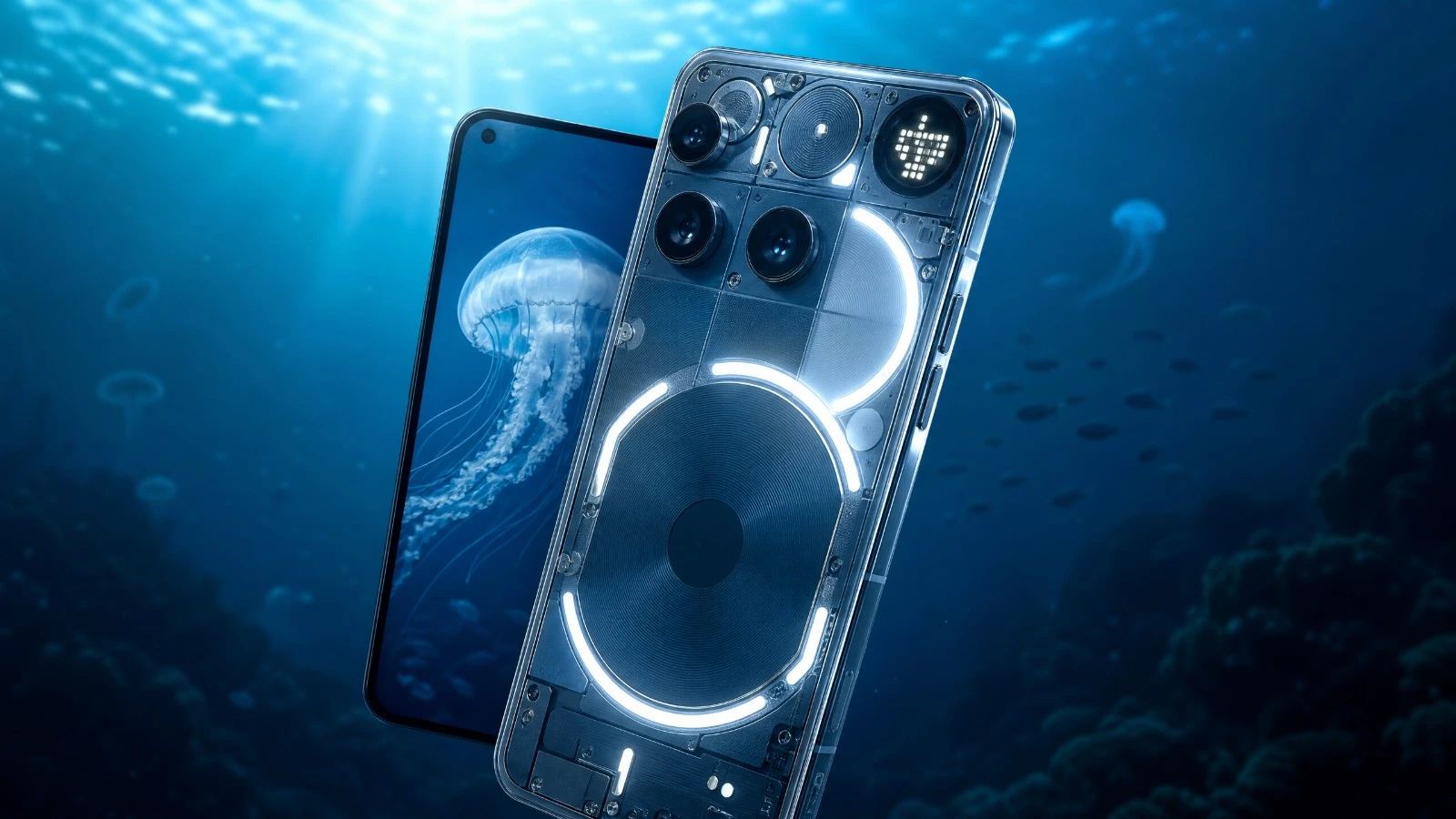
Yes. The Nothing Phone (3) is IP68 certified (1.5 meters for 30 minutes). This is sufficient for light diving using a universal underwater housing like the Divevolk SeaTouch 4 Max. For deeper or longer dives, a dedicated underwater housing is still recommended- no specific models are available for this phone at this time.
Can I shoot in RAW format with the Nothing Phone (3) underwater?
Yes. The native Pro mode produces 12-bit DNG files with adjustable white balance in Kelvin. The MotionCam Pro app (available on Android with GMS) also unlocks video RAW and focus peaking, two valuable tools for underwater photography in natural light.
What type of underwater housing should I choose for the Nothing Phone (3)?
There is no dedicated housing available for this camera model. The most practical solution is the Divevolk SeaTouch 4 Max (a universal membrane touchscreen housing), which allows you to control the screen underwater. Universal mechanical housings like those from Kraken Sports also work, but they require precise optical alignment.
Why is file transfer slow after a dive?
The Nothing Phone (3) uses a USB-C 2.0 port despite its ultra-fast UFS 4.0 storage. In practice, the actual data transfer rate via USB is limited to approximately 40 MB/s. For photo sessions involving RAW files, plan to use Wi-Fi or cloud for transferring your images. This is the main technical limitation of this device for intensive photographic use.
Should an anti-fog treatment be used with this device?
Yes, absolutely. Due to its housing (often made of aluminum) and heat dissipation system using a vapor chamber, the risk of condensation forming in cold water (below 15°C) is significant. Using an anti-fog treatment – such as a silica gel packet or inserts – inside the housing is mandatory before each dive.
How can I quickly transfer my photos and videos from this device?
This device offers excellent connectivity. With a wired connection, the USB 3.2 port allows you to quickly transfer large amounts of RAW files or 4K videos – gigabytes worth – to an external SSD or computer in just seconds. For wireless transfers, Quick Share is ideal for fast and reliable data transmission.
Nothing is a brand that has built its reputation on transparency. Literally: the back of the phone shows the components, and the brand's communication avoids empty superlatives. When asked if this phone can go underwater, we expect the same honesty.
The good news: the Nothing Phone (3) is IP68 certified. It can be submerged to a depth of 1.5 meters for 30 minutes. This isn't a deep-diving phone, but it provides a solid foundation for use with a universal underwater housing.
The less good news: the brand hasn't yet caught the attention of manufacturers of dedicated underwater housings. There are no Nauticam or Fantasea options available. The only serious option remains a universal housing.
This review tests the Nothing Phone (3) using our 7 criteria for underwater photography in natural light. Scores are calculated using our B1-B7 rating system. To compare it with other smartphones, see our 2026 smartphone underwater camera comparison.
Suitable for: snorkeling, shallow dives in natural light, RAW DNG workflow with MotionCam Pro.
Not ideal for: fast transfer of large RAW files, deep dives without a dedicated housing, long sessions under continuous power.
B1 - Optics (3.5/5)
The 50 MP main sensor in a 1/1.3" format with an f/1.7 aperture and OIS is honestly good for a mid-range to high-end smartphone. Underwater in natural light, the sensor size makes a real difference: more light captured, less noise in shadows.
The periscope telephoto lens (3x, 1/2.75", f/2.7) adds flexibility for distant subjects. The ultrawide angle lens (114°, f/2.2) covers large reef scenes well. The minimum focus distance is around 8-10 cm: no native macro capability.The ISP (Image Signal Processor) Qualcomm Snapdragon 8s Gen 4 is generic, without any optical partnerships (no Hasselblad, no Leica). The basic color rendition is contrasty, which can be corrected in RAW but requires significant post-processing work to restore the accurate colors of the underwater world.
B2 - RAW and Color Rendition (3.8/5)
Three components, three distinct realities.
B2a - Native RAW (4/5). The native Pro mode of Nothing OS produces 12-bit DNG files with adjustable white balance in Kelvin. This is the minimum required for serious underwater photography: automatic white balance is consistently incorrect underwater, and manual adjustment in Kelvin before diving is essential.
B2b - MotionCam Pro (4.5/5). Android with full GMS = MotionCam Pro available. This application unlocks the raw sensor stream, focus peaking, and RAW video. For underwater photography in natural light, this is a reference tool that transforms a good smartphone into a serious piece of equipment.
B2c - Color Science (3/5). The Qualcomm ISP, without optical partnerships, delivers a rather contrasty profile and a tendency towards haze on the telephoto lens in difficult conditions. Everything can be corrected in RAW. In direct JPEG format, underwater renderings require careful consideration.
The combination of 12-bit DNG + MotionCam Pro places the Nothing Phone (3) in a good position for natural light workflows. The weakness is the basic color science, not the output format.
---## B3 - Storage and Transfer (2.5/5)
This is where the Nothing Phone (3) disappoints most for intensive photography use.
The internal storage using UFS 4.0 seems excellent on paper: 256 GB or 512 GB, with ultra-fast read/write speeds. However, the USB-C port uses the 2.0 standard, which limits actual transfer rates to around 40 MB/s for wired transfers. Calculating how long it takes to offload a RAW session of 200 DNG files is simple and painful.
There's also no microSD card slot: there's no quick alternative in the field.
Always plan to transfer data via Wi-Fi or cloud after your dive. The USB cable should be a last resort for this phone, not part of your regular workflow.
B4 - Thermal Management (3.0/5)
The Snapdragon 8s Gen 4 is a powerful chipset, but the Nothing Phone (3) doesn't have an active vapor chamber dedicated to prolonged sessions. The cooling is passive.
In practice, a long video recording session in 4K (more than 20-30 minutes continuously) can cause thermal throttling. This isn't a real problem for short bursts of shooting or mixed photo/video sessions.
Underwater, cold water naturally helps to dissipate heat. This is a significant contextual advantage for dives in temperate waters.[!WARNING] Silica gel: mandatory. The Nothing Phone (3) has an aluminum chassis that conducts heat. Without a vapor chamber to redistribute heat, there is a real risk of condensation forming as cold water (below 15°C). Place silica gel packets in the housing before each dive.
Tropical overheating: Without an active vapor chamber, but with a chip that consumes less power than the full Gen 4 version, the Nothing Phone can record approximately 30 minutes of 4K video in water at 28°C before thermal throttling occurs. For still photography only, there are no limitations.
For typical underwater photo shooting (short bursts, alternating between pauses and shots), the temperature is manageable. However, for extended underwater time-lapse videos, monitor the surface temperature before submerging.
B5 - Battery (4.0/5)
The 5150 mAh battery uses silicon-carbon (Si/C) chemistry: this is a good battery. GSMArena tests indicate an endurance of almost 13 hours with active use. Fast charging at 65W (from 1% to 100% in 54 minutes) is a real logistical advantage between dives.
Performance in cold water (below 10°C) follows the universal rule for Li-Ion batteries: expect a 15 to 20% reduction in available battery life. This is not specific to Nothing, it's due to physics.
The 1400 guaranteed charge cycles before noticeable degradation (EU certification) are a good indicator of durability for regular use over several seasons.For a day of underwater photography (two dives + surface interval), the battery lasts without needing to be recharged. This is one of the key strengths of this device.
Before each dive, remember to check your external battery pack. Use our portable power bank comparison tool to choose the power bank that's right for your underwater housing and desired battery life.
B6 - Autofocus (3.5/5)
The PDAF (Phase Detection AutoFocus) system is equipped on both the main sensor and the periscope telephoto lens. It's reliable in normal conditions, with decent subject tracking.
There are two limitations for underwater use: no LiDAR (no depth-assisted focusing), and an estimated shutter lag of 150-200 ms in low light. This is acceptable for slow-moving subjects like nudibranchs, corals, or stationary fish. For fast-moving subjects, you need to anticipate.
The lack of native focus peaking is compensated by MotionCam Pro, which integrates it directly into its manual interface.
The PDAF on the Nothing Phone (3) is suitable for most underwater subjects in natural light. It shows its limitations with small, fast-moving subjects or in very low light conditions.
B7 - Underwater Housing and Waterproofing (3.0/5)
The Nothing Phone (3) is certified IP68 (submersible up to 1.5 m for 30 minutes). This provides a solid foundation for use with a universal underwater housing.Currently, no manufacturer of dedicated housings (Nauticam, Fantasea, Ikelite) offers a specific housing for this model. The available solutions are universal. The Divevolk SeaTouch 4 Max (touch membrane, access to the screen underwater) is the primary recommendation. Mechanical housings like those from Kraken Sports can work, but require careful optical alignment.
The IP68 certification protects against accidental water ingress, not against repeated pressure from deep dives without a housing. With a well-suited universal housing, diving to depths of 20-30 meters is feasible.
The Glyph Matrix interface (489 LEDs on the back of the phone) is inaccessible and useless underwater. It's not a functional loss for underwater photography, it's simply a surface feature.
What you need to know before buying
The Housing and Waterproofing
IP68 means that the phone can survive an accidental immersion in one and a half meters of water for thirty minutes. This is not an invitation to dive without protection. For any scuba diving, a housing is mandatory. It protects against both pressurized water flow and mechanical impacts.
For snorkeling on the surface, the IP68 rating provides an acceptable margin of safety if you stay close to the surface. However, as soon as you descend beyond 2-3 meters, a universal housing becomes essential.The Divevolk SeaTouch 4 Max (around €150-180) is currently the most practical solution for this phone. It maintains touchscreen access underwater, allowing you to navigate MotionCam Pro without dedicated buttons.
Post-Dive Workflow
USB-C 2.0 is the main limitation to consider in your workflow. Plan for transferring files via Wi-Fi or Bluetooth to an intermediate storage device. DNG 12-bit files weigh between 25 and 35 MB each. A wired USB transfer of a session with 100 files takes approximately 60-90 minutes. With Wi-Fi 7 (integrated into this phone), the data rates are significantly higher.
For post-processing, Lightroom Mobile handles DNG files perfectly. The white balance set in Kelvin before the dive provides a clean starting point for adjustments.
Current Prices (July 2026)
New: Approximately €599 on Amazon.fr (summer 2026 sale price, launch price was €849).
Used/Refurbished: Not available on Back Market France at the time of writing (recent model).
Snorkeling vs. DivingFor snorkeling on the surface with your phone without a case, an IP68 rating covers splashes and brief immersion at shallow depths. This is suitable for images taken on the surface or at very shallow depths (maximum 1-2 meters).
For actual scuba diving (with or without tanks, beyond 3-5 meters), a universal underwater housing is essential. Pressure increases with depth, and IP68 ratings are tested in still water, not under current or during repeated dives.
Our Verdict
The Nothing Phone (3) is an honest smartphone, which aligns well with the brand's image. For underwater photography using natural light, it offers a good starting point with its 1/1.3" sensor, 12-bit DNG format, and MotionCam Pro compatibility.
Its limitations are identifiable but not dealbreakers: there is no dedicated housing available on the market (a universal solution is required), the USB-C 2.0 port slows down file transfers, and its generic color science requires post-processing adjustments.
For an underwater photographer who is starting with natural light, looking for a serious Android phone at a reasonable price (599 EUR during sales), and willing to work with RAW files in post-processing, the Nothing Phone (3) is worth considering. Those seeking a ready-to-dive solution with a dedicated housing will need to look elsewhere.
Having the right phone is not enough. Underwater photography in natural light relies on understanding light, managing depth, and positioning yourself relative to your subject.
If you are a beginner or want to improve, aquaexposure.com provides step-by-step training, from manual settings underwater to post-processing RAW files. The basic principles learned with a smartphone can be directly applied with a dedicated camera.