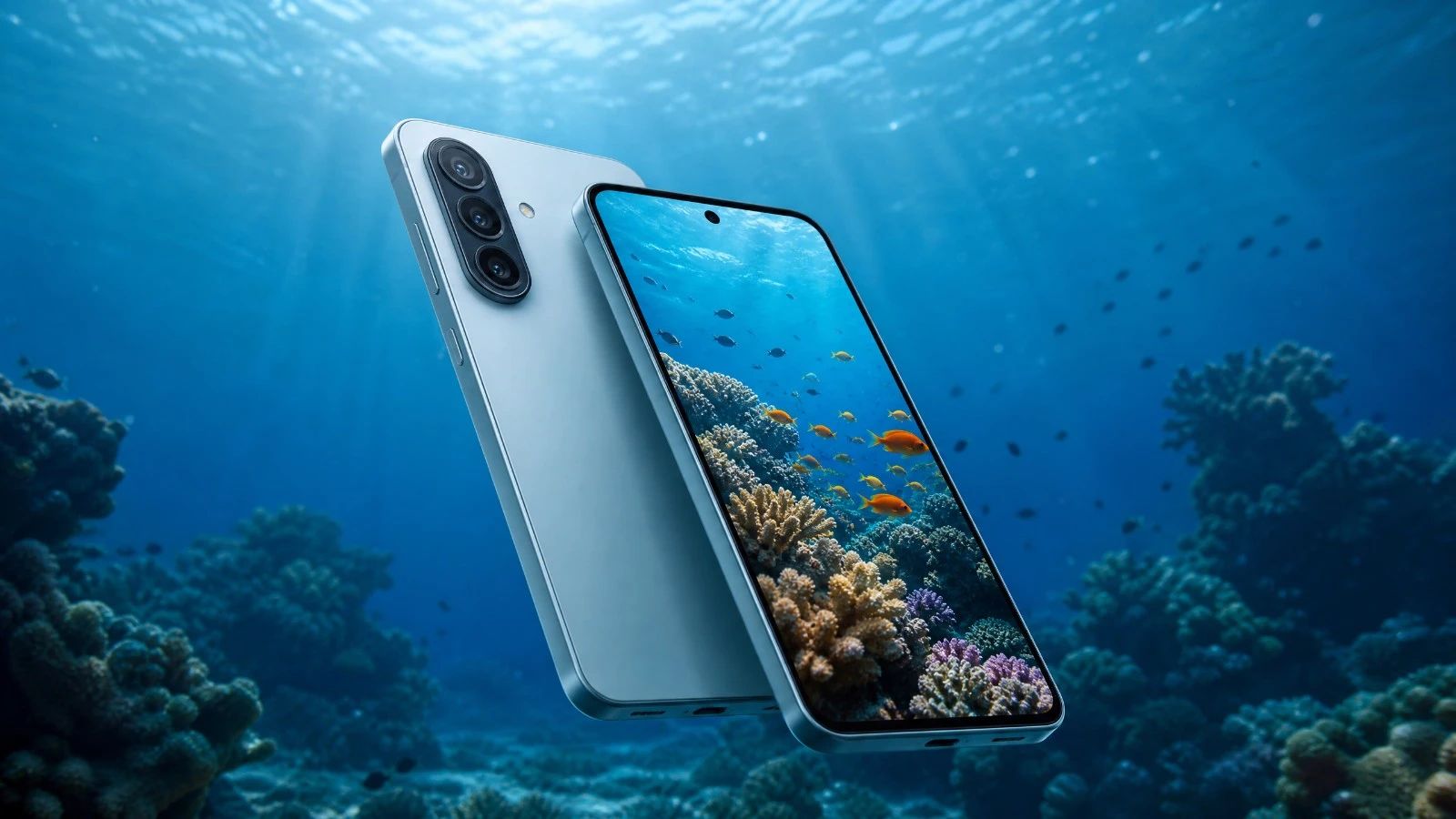
Test Samsung Galaxy A56 5G: Underwater Photography Review and 2026 Score
Is the Samsung Galaxy A56 5G worth it for underwater photography? Complete review, B1-B7 scores, and honest assessment of this mid-range phone's limitations.
Is a mid-range smartphone like the Samsung Galaxy A56 5G sufficient for underwater photography?
For snorkeling or occasional dives in natural light, the Galaxy A56 5G can produce acceptable JPEG images under favorable conditions. However, for more serious diving (depth, dark waters, RAW processing), its limitations are too significant: it lacks RAW support, has a smaller sensor than the S series, and does not have LiDAR autofocus.
Is the Samsung Galaxy A56 5G compatible with the Divevolk SeaTouch 4 Max Plus underwater housing?
Yes. The Divevolk SeaTouch 4 Max Plus is a universal underwater housing compatible with the vast majority of Android smartphones. The Galaxy A56 5G fits within its specified dimensions. The price for the housing alone ranges from €249 to €279 (divevolk-france.com, July 2026).
Is Samsung Expert RAW available on the Galaxy A56 5G?
No. Samsung explicitly blocks access to Expert RAW on the entire A series. The native camera app offers no RAW formats- only JPEG and HEIF. Third-party apps like MotionCam Pro have very limited or even non-existent Camera2 API support on this model.
What is the concrete difference between the Galaxy A56 5G and the Galaxy S25 for underwater photography?
The difference is significant. The S25 offers native Expert RAW processing, a larger main sensor (1/1.3"), support for ProRAW through third-party apps, superior thermal management, and a faster autofocus system with phase detection. The A56 costs two to three times less, but the compromises are real for serious underwater use.
Should an anti-fog treatment be used with this device?
Yes, absolutely. Due to its housing (often made of aluminum) and heat dissipation system using a vapor chamber, the risk of condensation forming in cold water (below 15°C) is significant. Using an anti-fog treatment (such as a silica gel packet or inserts) inside the housing is mandatory before each dive.
How can I quickly transfer my photos and videos from this device?
The wired connection of this device is limited to the USB 2.0 standard, which makes physical file transfers relatively slow. To quickly transfer your RAW files or video clips, it is highly recommended to use the fast wireless protocol within the system (Quick Share), or to remove the memory card if the housing and device allow it.
The Samsung Galaxy A56 5G was released in the spring of 2025 with a specific goal: to offer the appearance of a decent camera phone without the price tag of a flagship model. Priced between €310 and €332 new (idealo.fr, July 2026), it is aimed at divers who want to try underwater photography without committing to a significant budget.
This positioning is honest. However, it involves real compromises, and our role here is to clearly identify them before you purchase the equipment.
What this phone can do underwater in natural light: It can produce acceptable JPEG photos under good conditions, on shallow dives, with a universal housing. What it cannot do: It cannot produce a usable RAW file, seriously correct color balance in post-processing, or perform well in dark or turbid waters.
If you are considering several smartphones for underwater photography, start by reading our complete comparison for 2026. This review of the A56 5G is part of that series.
Suitable for: Divers interested in underwater photography, with a limited budget- snorkeling and shallow dives in good light conditions- acceptable JPEG quality without extensive post-processing.
Not ideal for: Deep diving, dark or murky waters, RAW processing, serious and regular underwater photography practice.
B1 - Optics and Sensor (2.5/5)
The main sensor of the Galaxy A56 5G is a 50 MP sensor with a 1/1.56-inch size, an f/1.8 aperture, and optical image stabilization (OIS). This is respectable for a mid-range device, but significantly smaller than the 1/1.3-inch or larger sensors found in Samsung's flagship models.
The advertised telephoto lens does not actually exist- it is a digital zoom. For diving, this means that apart from the wide-angle and main sensor, you have no additional optical options.The 1/1.56" sensor has a light-gathering surface that is approximately 35% smaller than that of the Galaxy S24. In deep dives or on overcast days, this difference becomes noticeable in the initial images.
B2 - RAW and Colorimetry (1.8/5)
This is the most limiting aspect of the Galaxy A56 5G for serious underwater photography. Samsung has deliberately locked Expert RAW across the entire A series- the application is not available, and this is not an oversight.
The native camera only produces JPEG and HEIF files in 8 bits. The Pro mode allows you to manually lock the white balance (in Kelvin), which is a positive point. However, without RAW files, this correction is fixed at the time of capture, leaving no room for fine adjustments during post-processing.
Third-party applications like MotionCam Pro or Blackmagic Camera encounter a very restrictive Camera2 API on this model. According to available field tests, access to RAW files via these apps is at best inconsistent, and at worst completely non-functional on the A56. The Exynos 1580 ISP used here is not the same as that of the S series.
In natural light underwater photography, 80% of the work is done in post-processing on RAW files. With only JPEGs, you are working with already compressed data and a very limited range for correction.
B3 - Storage and Transfer (2.0/5)The Galaxy A56 5G is available with 128 GB and 256 GB of internal storage (UFS 3.1). There is no microSD card slot - a common limitation on recent A series phones.
The USB-C connector is limited to the USB 2.0 standard, which limits actual transfer speeds to around 30-40 MB/s. Transferring 256 GB of 4K video after an intensive dive session can become tedious.
With USB 2.0, transferring 10 GB of video takes approximately 4-5 minutes. This isn't a major issue for occasional use, but it's a real limitation if you consistently record in 4K at 30fps.
B4 - Thermal Management and Water Resistance (2.5/5)
The Galaxy A56 5G is certified IP67. It's important to state this clearly: IP67 guarantees immersion up to 1 meter for a maximum of 30 minutes, under laboratory conditions with fresh water at static pressure.
This does not protect against the dynamic pressure encountered during diving, saltwater exposure over time, or pressure variations during descent. A waterproof housing is still required for any dive, even shallow ones.
The cooling system is passive, using a basic vapor chamber. The Exynos 1580 is a mid-range processor: it may throttle its performance during extended 4K video recording in warm conditions.[!WARNING] Silica gel: mandatory. Despite the plastic and glass back (a better insulator than aluminum), the risk of condensation in cold water remains real. Silica gel is the first line of defense to use before any dive below 15°C.
Tropical overheating: The Exynos 1580 consumes less power than gaming chips or ProRes processors. In water at 28°C, overheating occurs after approximately 35 minutes of continuous shooting - one of the best results in this comparison for this parameter, thanks to the processor's more modest thermal profile.
The IP67 certification provides reassurance against splashes and rain. However, it does not replace a waterproof housing. This is not specific to the A56 - no smartphone should be submerged without dedicated protection during diving.
B5 - Battery (3.5/5)
A key strength of the Galaxy A56 5G. Its 5000 mAh battery offers solid autonomy, typically sufficient for two dives on the same day with intensive use of the camera.
The standard Li-Ion chemistry means a predictable voltage drop in cold water (below 10°C). Plan to start with the battery fully charged (100%), and anticipate reduced battery life if you are diving in cold waters.
On a tropical snorkeling day with the screen active between dives, expect a battery life of 5 to 7 hours. The battery is not the limiting factor for this phone.
---Before each dive session, remember to check your external battery. Use our portable power bank comparison tool to choose the power bank that is suitable for your underwater housing and your desired battery life.
B6 - Autofocus (2.5/5)
The main sensor of the Galaxy A56 5G uses PDAF (phase detection autofocus integrated into the sensor). This works well for photographing stationary or slowly moving subjects in good light.
There is no LiDAR or ToF sensor. When diving, this results in difficulties maintaining focus on fast-moving subjects, complex backgrounds, or in waters with reduced visibility.
Focus peaking is not natively available. Third-party applications that offer it remain dependent on a Camera2 API that is not very cooperative on this model.
The PDAF autofocus works well in clear and bright water for subjects like calm reef fish. However, when photographing fast-moving subjects (cephalopods, pelagic fish) or in turbid water, missed focus shots become frequent.
B7 - Underwater Housing (3.0/5)
There is no custom-molded underwater housing available for the Galaxy A56 5G. Samsung does not position the A series as a camera phone, and underwater housing manufacturers follow the same logic.The most viable solution is the Divevolk SeaTouch 4 Max Plus, a universal waterproof housing rated to 60 meters that uses conductive gel to transmit touch commands through the screen. The Galaxy A56 5G fits within its acceptable dimensions.
Housing units with mechanical buttons (like Kraken) are technically compatible, but access to manual settings underwater becomes very limited without tactile interaction.
The SeaTouch 4 Max Plus provides an acceptable solution for the lack of a dedicated housing. It's a universal compromise that works, although it's not equivalent to a custom-made housing.
The Divevolk SeaTouch 4 Max Plus is the recommended solution for the Galaxy A56 5G. It is available directly from divevolk-france.com, priced between €249 (black) and €279 (gray/pink). Packages including arms and lights are available starting at €350.
It is essential to remove any screen protector before inserting the phone: the conductive gel does not work through plastic films or tempered glass.
The post-dive workflow
Be realistic about what you can achieve in post-processing with this phone. You will only be working with JPEG or 8-bit HEIF files. Correcting the blue/green color cast of the water in post-processing will be limited: JPEGs have little dynamic range.The manual white balance in Pro mode (adjustable in Kelvin) is your primary control for taking photos. Take the time to adjust it before starting the dive, by testing a few shots underwater.
For transferring files to your computer, plan to use a card reader if you are using a USB-C to memory card adapter, or use Wi-Fi (which is slower but more convenient than USB 2.0 for smaller file sizes).
Current Prices (July 2026)
New: - Galaxy A56 5G 128 GB: starting from 310 euros (idealo.fr, July 2026) - Galaxy A56 5G 256 GB: starting from 332 euros (idealo.fr, July 2026)
Used: - Back Market / Rakuten: starting from 250-290 euros depending on cosmetic condition - Reepeat: starting from 250 euros in perfect condition (128 GB)
Divevolk SeaTouch 4 Max Plus Housing: 249-279 euros (divevolk-france.com, July 2026)
Total minimum budget (phone + housing): approximately 500-580 euros.
Versus Samsung Galaxy S (flagship)
If you are considering between the A56 5G and a Galaxy S24 or S25, ask yourself this question: do you plan to take underwater photos regularly and edit your images in post-processing?If so, upgrading to the S series is justified. It offers native RAW capabilities, a larger sensor, functional third-party RAW apps, more responsive autofocus, and better thermal management. The S24 can be found used for between 450 and 550 euros. The price difference compared to a new A56 is reduced to 150-200 euros, yet the performance gap underwater is significant.
If not, if you only dive three times a year on vacation and want nice JPEG photos of your local reef, the A56 5G is an honest option. Check out our guide to underwater cameras for beginners to compare it with other options in this price range.
Our Verdict
The Samsung Galaxy A56 5G is a decent mid-range smartphone, sold at an accessible price. When diving, its strengths are real: good battery life, optical image stabilization on the main sensor, and compatibility with the universal Divevolk underwater housing.
However, its limitations are equally significant. The complete lack of RAW support (Expert RAW is blocked, third-party apps don't work) is the biggest drawback for anyone who wants to edit their images after diving. The smaller sensor and autofocus without LiDAR also contribute to this.For a snorkeler who wants decent photos without taking a financial risk, this is a viable option. However, for a diver who is starting to take underwater photography seriously, it's better to invest an additional 150-200 euros in a used Galaxy S24. The results will be incomparably better. Also, consult our guide to waterproof housings for smartphones to choose the right housing for your device.
The equipment is part of the equation. But some of the best underwater photos I've seen were often taken with modest devices by photographers who understood light, composition, and subject behavior.
If you are a beginner or want to improve your natural light underwater photography skills, I have designed a comprehensive training program for this purpose.