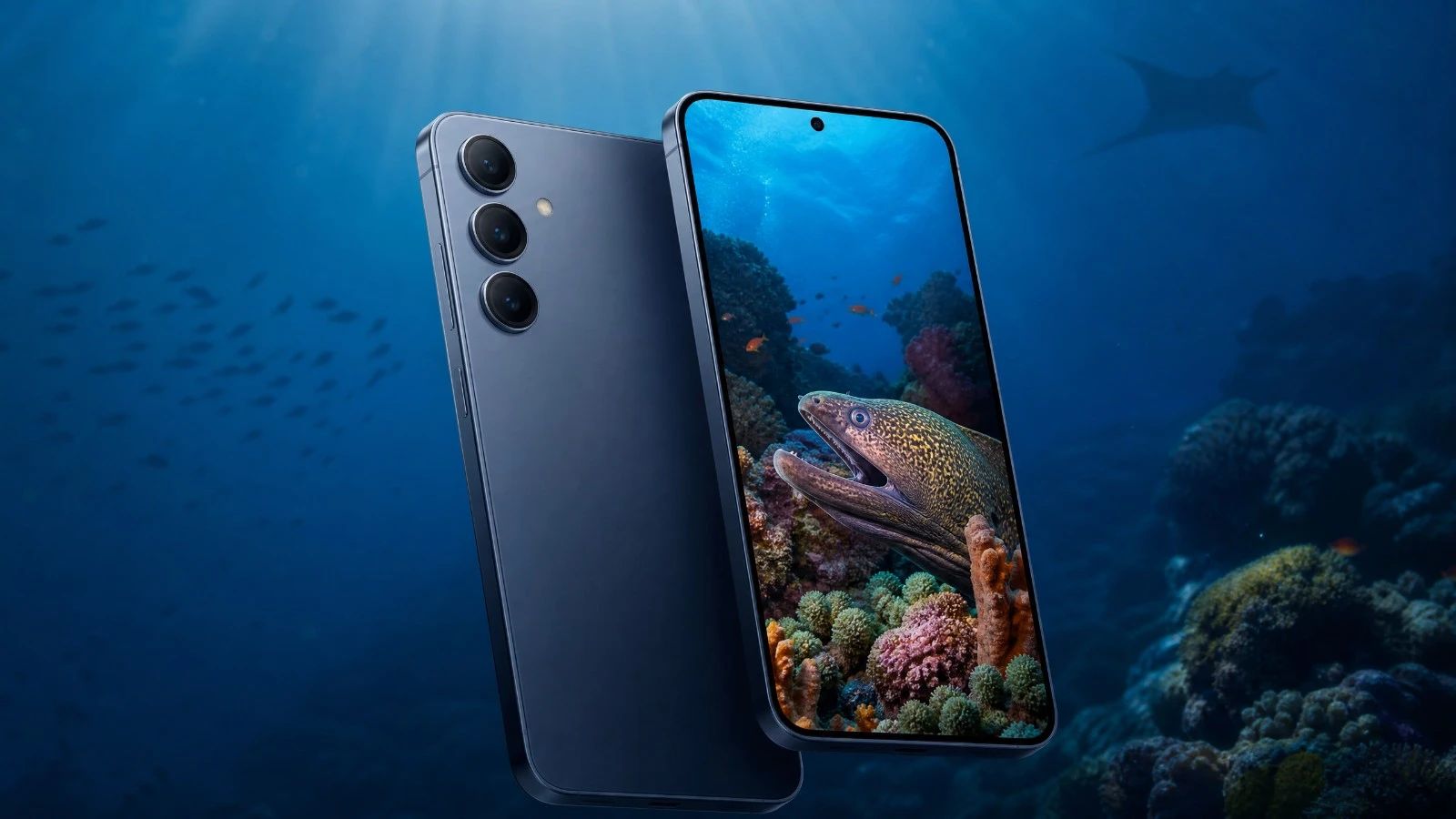
Test Samsung Galaxy S24: Underwater Photography Review and 2026 Score
Is the Samsung Galaxy S24 good for underwater photography in natural light? Complete review, B1-B7 scores, compatible housing, and price information for July 2026.
No. Its IP68 certification covers a depth of 1.5 meters for 30 minutes in freshwater. To use it while diving, a dedicated pressure housing is essential. The Divevolk SeaTouch 4 Max Plus is compatible and certified up to 60 meters.
Can I shoot in RAW format with the Galaxy S24 underwater?
Yes. The Expert RAW application (available for free on the Galaxy Store) unlocks the RAW DNG format and provides full manual controls. MotionCam Pro is also available through the Android GMS platform and functions perfectly within a Divevolk touchscreen housing.
Is a used basic Samsung Galaxy S24 worth buying in 2026?
Yes, to a certain extent. Available around €280 to €330 refurbished in July 2026, it offers Expert RAW, MotionCam Pro, and Divevolk compatibility. Its USB-C 2.0 port and 4000 mAh battery remain its main limitations for intensive use on extended trips.
What are the differences between the Samsung Galaxy S24 and the S24 Ultra for diving?
Many things. The S24 Ultra features a larger main sensor of 1/1.3 inches (200 MP) compared to the 1/1.56 inch (50 MP) sensor in the standard S24. The Ultra also includes USB-C 3.2 Gen 2, a 5000 mAh battery, and a titanium frame. For serious underwater photography, the S24 Ultra is significantly better. The standard S24 remains an interesting option for those on a tighter budget.
Should an anti-fog treatment be used with this device?
Yes, absolutely. Due to its housing (often made of aluminum) and heat dissipation system using a vapor chamber, the risk of condensation forming in cold water (below 15°C) is significant. Using an anti-fog treatment (such as a silica gel packet or inserts) inside the housing is mandatory before each dive.
How can I quickly transfer my photos and videos from this device?
This device offers excellent connectivity. With a wired connection, the USB 3.2 port allows you to quickly transfer large amounts of RAW files or 4K videos – gigabytes worth – to an external SSD or computer in just seconds. For wireless transfers, Quick Share is ideal for fast and reliable data transmission.
The Samsung Galaxy S24 was released in early 2024. In July 2026, this entry-level flagship phone can be found refurbished for between €280 and €330, sometimes even less, on French online marketplaces.
This is when a smartphone becomes an attractive option for divers looking to get into underwater photography without breaking the bank.
The question deserves to be asked honestly. The basic S24 is not the S24 Ultra. It doesn't have the same sensor, the same USB connector, or the same battery. However, it does have Expert RAW, Android with Google Services (GMS), Samsung Ocean Mode, and an IP68 certification. This is a real starting point, not just a gimmick.
This review uses the AquaExposure evaluation grid, designed for natural light photography only. No artificial lighting is used. What we are evaluating here is: does the basic S24, in a Divevolk housing, produce usable images at depths of 15 to 20 meters in 2026?
Suitable for: - Recreational divers on a tight budget who want to shoot in RAW underwater. - Purchasing a refurbished unit paired with a used Divevolk housing. - Dives in clear, shallow water (less than 15 meters) with good lighting conditions.
Not ideal for: - Multi-day dive cruises involving intensive RAW shooting (due to the limitations of USB 2.0 and battery life). - Photographers who need to quickly retrieve their files between dives. - Those considering the S24 Plus or Ultra: the difference in performance justifies the higher price.
B1 - Optics (20%): 3.0/5
The base S24 has three sensors. The main sensor is a 50 MP wide-angle lens with a 1/1.56-inch sensor, an f/1.8 aperture, and optical image stabilization. This is a noticeably smaller light-gathering surface compared to the S24 Ultra (1/1.3 inch) or the S25 Ultra (also 1/1.3 inch). In low-light underwater conditions, this difference directly translates into increased noise starting at around 15 meters.The ultra-wide lens (12 MP, f/2.2, 1/2.55 inch) does not have a native macro mode. The 3x telephoto lens is 10 MP, 1/3.52 inch, and f/2.4. For natural light diving, the main wide-angle lens and the ultra-wide lens are the two modules that are truly useful.
The results are decent for an entry-level flagship released in 2024. It is not better than several mid-range devices currently available in terms of raw sensor quality. This is a compromise accepted on this model.
The main 1/1.56 inch sensor places the base S24 in our "entry-level" category according to the AquaExposure rating system. For scenes at depths of 10-15 meters in full light, the results are acceptable. Below 15 meters or with reduced visibility, the lack of surface area becomes noticeable. A score of 3.0/5 is applied.
B2 - RAW and Colorimetry (25%): 3.7/5
B2a - Expert RAW: 3.5/5
Expert RAW is available on the base Galaxy S24 via the Galaxy Store (free application). It unlocks the DNG RAW format with complete manual controls over ISO, shutter speed, white balance in Kelvin, and focus. The bit depth of the DNG files varies depending on the mode: the native RAW format is 12 bits on this model, not 16 bits as on the Ultra.It can be edited in Lightroom and Darktable, with a reasonable latitude for correction. Manual white balance adjustment in Kelvin is the key tool underwater- it allows you to lock in the color compensation of a scene and prevent the system from recalculating between shots.
With Expert RAW on the base S24, the 12-bit DNG RAW format is the limit. This is lower than the 16-bit DNG format on the Ultra model, but it's usable for natural light photography down to depths of 15-20 meters. The important thing is to enable manual white balance before placing the camera in its housing.
B2b - MotionCam Pro (Android GMS): 4.5/5
The base S24 runs on Android with full Google services (GMS). MotionCam Pro is available without restrictions. This application produces video RAW files that can be edited with complete manual control over exposure, white balance, and focus.
This is one of the real strengths of the Samsung Android ecosystem for underwater photography. An iPhone, a Huawei, or a model without GMS cannot replicate this workflow.
Inside a Divevolk SeaTouch 4 Max Plus housing, the gel touch membrane allows you to access all MotionCam Pro controls from within the water. The workflow functions exactly as it does on the surface.
B2c - Samsung ISP Color Processing: 3.0/5The Samsung ISP on the base S24 is proprietary and lacks certified optical partnerships (no Zeiss, no Leica). The automatic JPEG rendering tends to over-process scenes, with boosted saturation and contrast that can complicate editing of underwater blues and greens.
In RAW format, this bias can be overcome. However, it requires knowledge of post-processing techniques. For a beginner who doesn't edit their files, the automatic JPEGs taken underwater may seem appealing on the surface but less convincing at depth.
Samsung Ocean Mode (available via Expert RAW) adds a layer of color correction geared towards the underwater environment. In clear and well-lit water, it simplifies post-processing. Its limitations depending on the depth are detailed in our article Samsung Ocean Mode: really useful underwater?
B3 - Storage (15%): 2.5/5
This is the most significant drawback of the base S24 for intensive underwater photography use. The USB-C connector is version 2.0, not 3.x. In practice, transfers to a portable SSD are limited to approximately 40-60 MB/s instead of the 400-800 MB/s available on the S24 Ultra.
The concrete consequence: transferring 10 GB of RAW files (a typical dive) takes about 3 to 4 minutes instead of a few seconds. On a diving cruise with three dives per day, this quickly becomes a bottleneck.The internal storage is UFS 3.1 (for fast read speeds), but the USB port is the only connection option. There is no microSD card slot. It is available in 128 GB or 256 GB depending on the market.
For a day of two dives shooting in RAW format, the 128 GB version is sufficient if you transfer the files each evening. For a 5-day cruise, the 256 GB version is recommended to avoid daily transfers imposed by the slow USB 2.0 connection.
B4 - Thermal Management (15%): 3.5/5
The Snapdragon 8 Gen 3 (or Exynos 2400 depending on the region) offers decent energy efficiency for its generation. The frame is made of aluminum with a Gorilla Glass Victus 2 back, and it lacks the oversized vapor chamber found in the S24 Ultra.
Under normal underwater photography conditions (RAW format, screen active within the housing, one-hour sessions), thermal issues are not a problem. Inside a housing, the surrounding water provides effective passive cooling.
The limitation concerns very long video recording sessions in 4K, where accumulated heat may force a reduction in performance. For sequential photo shooting (no video), this point remains theoretical.
[!WARNING] Silica gel packs: mandatory in cold water. The aluminum frame of the S24 conducts heat. In water below 15°C, a silica gel pack inside the housing is essential to prevent internal condensation.Tropical Overheating: Without the heavy 4K Log format and with a Snapdragon 8 Gen 3 that is less demanding than the Elite version, the S24 can record approximately 30 minutes of continuous footage underwater at 28°C before thermal throttling occurs. There is no risk for still photography.
In cold water (below 15°C), there is virtually no risk of overheating inside the housing. The issue arises on the surface, during post-dive processing of images on the device, where the Snapdragon processor may reach its limits when importing large numbers of files.
B5 - Battery (10%): 2.5/5
The 4000 mAh battery is the smallest of the three S24 models (the Plus has 4900 mAh, and the Ultra has 5000 mAh). With the 25W charger, a full charge takes approximately 65 to 70 minutes.
With intensive photo use (RAW format, screen continuously active within the housing), two one-hour dives are possible without needing an intermediate recharge, but with limited battery life remaining. For a day of three dives, a recharge between the second and third dive is likely necessary depending on conditions.
In cold water (below 10°C), Li-Ion batteries temporarily lose some of their rated capacity. This is normal physical behavior and not a specific defect of the S24. However, with only 4000 mAh, the margin is tighter than with the Ultra model.
Ensure a full charge the night before each day of diving. If the schedule includes more than two dives, an external battery pack for lunchtime is a useful precaution.Before each dive session, remember to check your external battery. Use our portable power bank comparison tool to choose the power bank that is suitable for your underwater housing and your desired battery life.
B6 - Autofocus (10%): 3.5/5
The Samsung Pro Visual Engine in the S24 combines PDAF (Phase Detection) and a laser AF sensor. Subject tracking is fast on scenes with high contrast. AI-powered scene detection automatically adjusts settings based on the context.
When diving, the laser AF can sometimes lock onto suspended particles in murky water, as with all laser systems. Manual focus using Expert RAW or MotionCam Pro remains the recommended method for stationary or slow-moving subjects in turbid water.
Focus peaking is not available in the native Samsung camera app. You need to use Expert RAW or a third-party application to get this visual aid for focusing.
In clear water with a cooperative subject, the S24's Pro Visual AF is reliable and fast. In murky water, manually locking focus before taking the picture remains the best practice.
B7 - Underwater Housing (5%): 3.0/5
There are no dedicated underwater housings available for the standard Samsung Galaxy S24 from specialized diving manufacturers (no Ikelite, no Nauticam, no SeaFrogs specifically for the standard S24).The natural solution is the Divevolk SeaTouch 4 Max Plus universal housing, certified to 60 meters, with a full-screen gel membrane. The S24 format (6.2 inches) fits within the universal dimensions of the SeaTouch. Expert RAW, MotionCam Pro, and Samsung Ocean Mode are fully accessible through the touch membrane.
When purchasing the Divevolk SeaTouch 4 Max Plus, ensure that the internal support is correctly sized for the base S24 model (6.2 inches). Make sure this adjustment is done before your first dive.
The Divevolk SeaTouch 4 Max Plus is the reference solution for this format in 2026. Compatible with many Android smartphones of similar size, it represents an investment of 300 to 350 euros, which can exceed the price of a refurbished S24 itself.
This is the economic reality of underwater smartphone photography: the housing lasts longer than the phone.
Post-dive workflow
DNG files from the S24 import directly into Lightroom (desktop or mobile) and Darktable. The Samsung color profile in RAW 12 bits is easier to demosaic cleanly than native JPEGs, but it's less rich than a 16-bit DNG.For MotionCam Pro files (RAW video), processing is done in the dedicated application or by exporting frame by frame as DNG for individual editing.
The most important aspect of the workflow on the basic S24 is the USB 2.0 transfer. If you have a large number of files, plan to connect the cable overnight rather than between dives.
Current Prices (July 2026)
New: - Starting from €499 (128 GB) on Amazon.fr and Fnac (prices checked in July 2026, availability may vary). - Launch price in January 2024: €899.
Refurbished / Used: - Back Market France (July 2026): starting from €280 (good condition) / approximately €320 (very good condition / excellent condition), with a 12-month warranty. - Idealo.fr - used: starting from €260 (July 2026).
Sources consulted on July 1, 2026: backmarket.fr, idealo.fr, amazon.fr. Prices are indicative and subject to change.
The Used Option: The Real Advantage of the S24 in 2026
A refurbished Samsung flagship from 2024 for around €290 is a difficult offer to ignore for a diver who wants to get into underwater photography without paying the price of a current model.
Expert RAW is available. MotionCam Pro is available. Samsung Ocean Mode is available. The Divevolk SeaTouch 4 Max Plus is compatible.The limitations are real: USB 2.0, 4000 mAh battery, and a 1/1.56-inch main sensor. However, for a recreational diver who makes two dives per day in warm, clear water, these limitations don't necessarily result in poor images.
A refurbished S24 (290 euros) combined with the Divevolk SeaTouch 4 Max Plus (320 euros) provides a complete setup for less than 620 euros. This is the most affordable entry point into RAW underwater photography using an Android smartphone in 2026.
Our Verdict
The basic Samsung Galaxy S24 scores 3.2/5 in our underwater natural light photography test.
This score reflects a decent, but not exceptional, device. Expert RAW and MotionCam Pro help to improve the overall evaluation. The 1/1.56-inch main sensor and USB 2.0 connector limit its potential.
In July 2026, it's not the best choice if your budget allows for the S24 Plus or the S24 Ultra. The larger sensor and USB 3.2 on the Ultra significantly enhance the experience.
However, if your budget is truly limited and the intended use is recreational diving in clear, bright water, a refurbished S24 around 290 euros will suffice. It doesn't replace a dedicated underwater camera. But it allows you to capture usable RAW images underwater, which remains the key factor.To understand how the S24 compares to its alternatives in this price range by 2026, our comparison of smartphones for underwater photography in 2026 details the key considerations.
The quality of the smartphone only goes so far. Natural light underwater has its own rules: angles of incidence, absorption of wavelengths, understanding conditions in real time.
These techniques can be learned. And they transform any device, even a basic S24, into a serious creative tool.