Test Vivo X100 Pro: Underwater Photography Review and 2026 Score
Vivo X100 Pro underwater camera test: AquaExposure rating of 3.7/5. Features a 1-inch Zeiss sensor, native RAW on all 3 lenses, and a Si-C battery. Read the full review.
Is the Vivo X100 Pro suitable for underwater photography?
Yes, with an AquaExposure score of 3.7/5, it is one of the most comprehensive Android devices of its generation for natural light diving photography. The 1-inch Zeiss sensor and native RAW support on all three lenses are significant advantages. The drawback is a somewhat slow autofocus when lighting conditions decrease.
What underwater housing is suitable for the Vivo X100 Pro when diving?
The Divevolk SeaTouch 4 Max Platinum is listed as compatible with large-format devices and includes the Vivo X100 Pro. Certified to a depth of 60 meters, it maintains full touchscreen access despite the substantial camera block on the phone.
Does the Vivo X100 Pro shoot in RAW format while diving?
Yes, it natively supports all three sensors: the main sensor, the ultra-wide angle lens, and the telephoto lens. The Pro mode in the camera app provides access to complete manual settings for both photo and video shooting. This is a real advantage for post-production work related to underwater photography.
What is the battery life for a full day of diving with three dives using the Vivo X100 Pro?
Large. With a 5400 mAh Silicon-Carbon battery and a semi-solid electrolyte, the Vivo X100 Pro can last for 3 to 4 dives on a single charge. This is especially true in cold water, where this type of chemistry performs better than a traditional Li-Ion battery.
Should an anti-fog treatment be used with this device?
Recommended. The aluminum housing and internal vapor chamber of the Vivo X100 Pro necessitate a silica gel desiccant pack inside the housing before each dive in temperate or cold water. It is also recommended to allow the housing to acclimatize to the ambient temperature before placing it in the water.
How can I quickly transfer my photos and videos from this device?
The USB-C 3.2 Gen 1 port on this device offers comfortable transfer speeds (approximately 270 MB/s measured), which are sufficient to quickly offload a batch of RAW files and 4K videos to an external SSD in just a few minutes between dives.
Test Vivo X100 Pro: Underwater Photography Review and 2026 Score
Context Before Specifications
The Vivo X100 Pro isn't a name you often hear in French-speaking diving clubs. It doesn't have the recognition of an iPhone or a Samsung, and yet, on paper, it's one of the most ambitious Android phones released in recent years when it comes to photography.
It features a 1-inch main sensor, optics from Zeiss, native RAW capture for all three lenses, and a silicon-carbon battery. Many promises. The question we ask before investing in a less well-known device is: do these impressive specifications hold up once submerged, in natural light, away from testing labs?
The Verdict in Summary
Overall AquaExposure Score: 3.7/5
Criterion
Score
What it means
Optics & Sensor
3.4/5
Solid Zeiss 1-inch sensor, but macro focus distance is limited to 18 cm
RAW & Color
4.3/5
Native RAW capture for all 3 lenses, certified Zeiss color science
Storage & Transfer
4.0/5
USB 3.2, comfortable transfer speeds for offloading data
Thermal Performance
2.5/5
Aluminum + glass construction, caution recommended in cold water
Battery
4.3/5
5400 mAh silicon-carbon battery, excellent performance in cold temperatures
Autofocus
2.8/5
Reliable in good light, slower when it gets darker
Housing
4.5/5
Divevolk SeaTouch 4 Max Platinum, full touchscreen access
This device is ideal for: divers who want a very good sensor and native RAW capabilities without using an iPhone, and who are willing to accept slightly less responsive autofocus in dark water.
This device is not ideal for: those who prioritize close-up macro photography or who primarily dive in cold water without taking precautions regarding the housing.
B1 - The Optics: A One-Inch Sensor by Zeiss
Score: 3.4/5
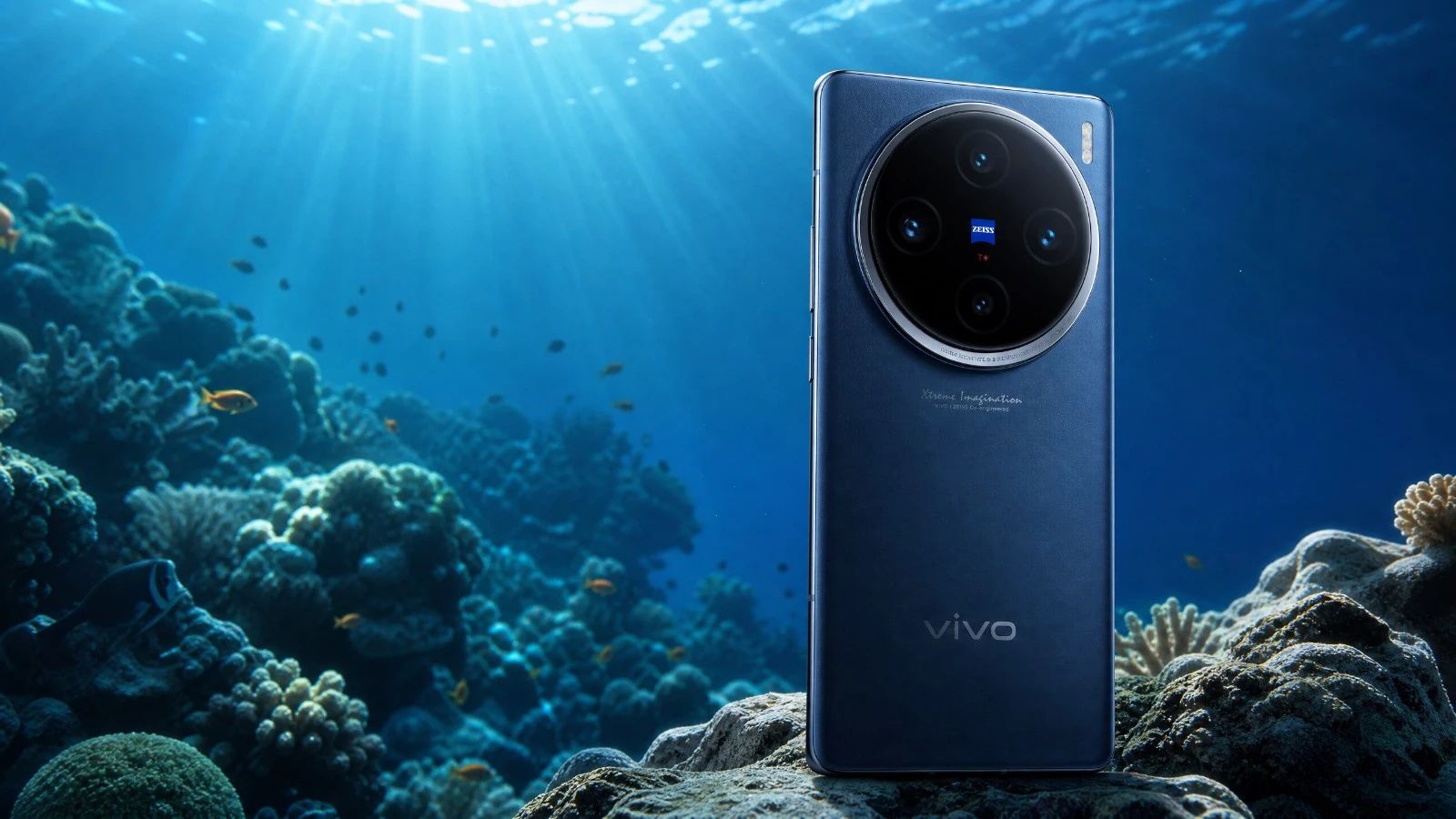
The Vivo X100 Pro features a one-inch Sony IMX989 main sensor with an f/1.75 aperture, paired with a Zeiss lens featuring T* anti-reflective coating. This is one of the largest sensors available on a smartphone to date, offering the usual advantages of large sensors underwater: more light captured and less digital noise at the end of the day or at depth.
The Zeiss APO periscope telephoto lens (100mm equivalent, 4.3x) is a unique feature of this device. Thanks to its floating lens element, it can focus as close as 18 centimeters, which opens up possibilities for macro photography from a distance on subjects you don't want to disturb, such as a scorpionfish or an eel, for example.For More Details
Main sensor: Sony IMX989, 50 MP, 1 inch, f/1.75, 23 mm equivalent, optical stabilization Telephoto lens: Zeiss APO periscope, 50 MP, 1/2", f/2.5, 100 mm (4.3x optical), OIS, macro focusing distance of 18 cm Ultra-wide angle: 50 MP, 1/2.76", f/2.0, 15 mm Zeiss T* coating: anti-reflection coating that limits flare and ghosting caused by sunlight filtering through the surface.
The maximum native ISO, RAW burst shooting speed, and shutter lag are not precisely documented by Vivo for this model. A conservative score has been applied to these criteria.
The real drawback is the lack of a dedicated close-up macro lens. Neither the main sensor nor the ultra-wide angle lens focuses closer than 15-18 centimeters. For miniature subjects that you approach at just a few centimeters, this isn't the most suitable device.
B2 - RAW and Color: A Real Strength
Score: 4.3/5
This is where the Vivo X100 Pro truly stands out. The camera app's Pro mode provides access to native RAW files on all three lenses, with complete manual controls (shutter speed, ISO, white balance) available for both photos and videos. Few manufacturers offer this level of control directly within their native app, without requiring a third-party application.
The Zeiss colorimetry, with its own certified color processing, provides a natural rendering that requires less correction in post-production than most proprietary image signal processors (ISPs).For More Information
RAW: Native, DNG format available on all three sensors in Pro mode. Manual White Balance: Available for both photo and video, adjustable within the native app. Maximum Video Resolution: 8K at 30 frames per second, 4K up to 60 frames per second. Compatible Third-Party App: MotionCam Pro (Android, available via Google Play on the international version of the X100 Pro). Color Science: Certified partnership with Zeiss, documented T* treatment.
The bit depth of RAW files and the presence of a dedicated Log video profile are not definitively confirmed in the publicly available documentation. This should be verified on a case-by-case basis depending on the regional firmware version.
The Vivo X100 Pro offers up to 512 GB of internal storage, with no external slot. The USB-C connector operates at USB 3.2 Gen 1, with measured transfer speeds around 270 MB/s in practice. This is significantly faster than smartphones still limited to USB 2.0, but it doesn't reach the speeds of a USB 3.2 Gen 2 or Thunderbolt connection.
For a day of diving with a lot of RAW files and 4K video, transferring data to an external SSD between dives remains reasonable.For More Information
Connector: USB-C 3.2 Gen 1, approximately 270 MB/s measured in real-world use, compatible with OTG. Internal Storage: Up to 512 GB, no microSD card slot. Quick Calculation: A day of three dives shooting in RAW format plus 4K video clips represents 25 to 40 GB depending on the frame rate. The USB 3.2 transfer speed allows you to offload this data to an external SSD in just a few minutes.
B4 - Thermal Management: Caution in Cold Water
Score: 2.5/5
The Vivo X100 Pro combines an aluminum frame with a glass back. This is a mid-range profile: less conductive than an all-aluminum chassis, but not as insulating as a polycarbonate or leather back. In cold water, the risk of condensation inside the housing remains real, although it is less pronounced than on some all-metal flagship models.
The internal cooling relies on a vapor chamber, primarily designed to handle the 100W fast charging and performance peaks of the Dimensity 9300 chipset. This chamber accelerates heat circulation throughout the chassis, which does not help in cold water.
[WARNING] Silica gel packets: recommended. The aluminum frame and internal vapor chamber justify using a packet of silica gel inside the housing before each dive in temperate or cold water, with a few minutes of acclimatization in the shade before entering the water.For Further Information
Material: Aluminum frame, glass back. Cooling System: Internal vapor chamber (sized for 100W fast charging and the chipset). Certification: IP68. No documented MIL-STD certification for this model.
B5 - The Battery: Silicon-Carbon Technology in Action
Score: 4.3/5
The Vivo X100 Pro features a 5400 mAh battery using Silicon-Carbon chemistry, with a semi-solid electrolyte. Vivo calls this the "Blue Ocean" battery. This technology stores more energy in the same volume compared to a standard Li-Ion cell, and importantly, it is designed to better withstand low temperatures.
This is a significant advantage for diving in cold or temperate waters: a Li-Ion battery can easily lose 20 to 40% of its effective capacity below 5 degrees Celsius, while the semi-solid chemistry of the X100 Pro is specifically designed to minimize this loss.For Further Information
Capacity: 5400 mAh, Silicon-Carbon chemistry (Vivo "Blue Ocean Battery") Electrolyte: semi-solid, designed to minimize capacity loss in cold temperatures. Fast charging: 100W wired. Precise lifespan cycles are not confirmed in the publicly available documentation for this model. Documented Si-C batteries in other devices typically exceed 1000 cycles before a 20% loss of capacity.
For a day of 3 to 4 dives, this battery lasts without needing an intermediate recharge, even in cold water.
Before each dive session, remember to check your external battery. Use our portable battery comparator tool to choose the power bank that is suitable for your underwater housing and your desired autonomy.
B6 - Autofocus: Reliable, but not the fastest
Score: 2.8/5
The Vivo X100 Pro uses phase detection autofocus (PDAF) on its three lenses, with optical stabilization on the main lens and the telephoto lens. Independent tests (including GSMArena) indicate that the autofocus is generally reliable, but slightly slower to react than direct competitors, especially in low light.
Underwater, where natural light diminishes rapidly with depth, this point is worth knowing before making a purchase. When photographing a fast-moving subject (a fish swimming away, a school dispersing), you may sometimes need to allow a fraction of a second longer for the camera to lock focus.For Further Information
AF Technologies: PDAF on all three lenses, OIS on the main and telephoto lens. LiDAR: Not present. Focus Peaking: Not documented in the native app. Field Observations (from third-party sources): Reliable autofocus in good light, but responsiveness lags behind competitors in low light.
B7 - The Housing: Divevolk Platinum, despite the camera module
Score: 4.5/5
The camera module of the Vivo X100 Pro is substantial, with its three sensors, including a one-inch sensor. This type of detail often complicates compatibility with universal housings. Divevolk has solved this problem with the SeaTouch 4 Max Platinum, which explicitly lists the Vivo X100 Pro in its compatibility list, alongside other flagship phones with large sensors (Xiaomi 14 Ultra, Huawei Pura 70, Oppo Find X7).
Full touchscreen access via the SeaTouch gel membrane remains the same as with other compatible models.
For Further Information
Compatible Housing: Divevolk SeaTouch 4 Max Platinum Certified Depth: 60 meters Screen Access: SeaTouch touch membrane Access to Third-Party Apps: MotionCam Pro and the native camera app are accessible from within the housing.
Available HousingsDivevolk SeaTouch 4 Max Platinum, compatible with large format devices including the Vivo X100 Pro. Certified depth of 60 meters, full touchscreen access. Available at divevolkdiving.com.
Current Prices (July 2026)
New: Starting from approximately €500 depending on the configuration. Source: French price comparison websites, data collected in July 2026. Used - Back Market: Discounts of up to -70% on refurbished models, with regular offers below €300. Source: Back Market France, data collected in July 2026.
Field Workflow: A Day of 3 Dives
With the Vivo X100 Pro, a day of 3 dives shooting in RAW format plus some 4K clips represents 25 to 40 GB. The USB 3.2 interface allows for fast transfer to an external SSD between dives, without needing a computer.
Specific Points to Note for This Model
The first thing to know is the autofocus: it's reliable but slightly less effective when light levels are low. Secondly, availability of the model: the Vivo X100 Pro was released internationally at the end of 2023 and is now mostly available used or as new stock running out. Finally, as with most smartphones with a metal frame, condensation prevention remains important in cold water.
Our Verdict
3.7 out of 5. This is a good score, and it recognizes a device that we see too rarely in French-speaking diving clubs.The Zeiss one-inch sensor and the native RAW format on all three lenses are significant advantages, almost matching what the best flagship models on the market offer. The silicon-carbon battery is a real plus for long days and cold water conditions. The one thing that might make you hesitate is the autofocus, which is slightly slower than the competition when natural light decreases.
If you're looking for an Android phone capable of underwater photography without resorting to the usual brands, and you're willing to accept an autofocus system that's a bit less fast, the Vivo X100 Pro definitely deserves a place in your comparison.
Having the right equipment is not enough. Manual focusing, managing natural light at depth, approaching animals without disturbing them – these techniques need to be learned.
The AquaExposure training program focuses on underwater photography using natural light and is compatible with all cameras and housings, including this Vivo X100 Pro and the Divevolk SeaTouch.
Test Vivo X100 Pro: Underwater Photography Review and 2026 Score | AquaExposure