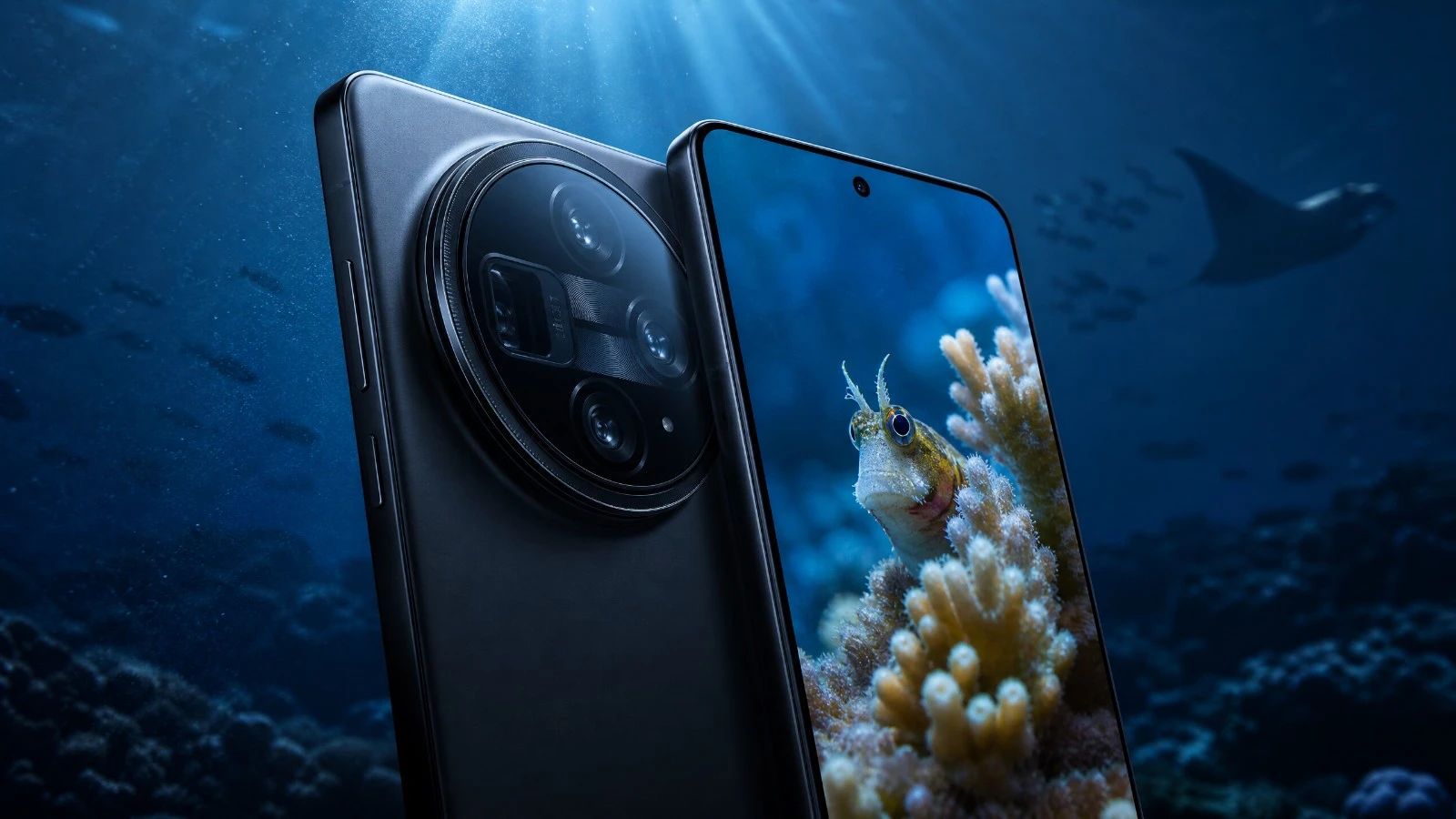
Test Vivo X300 Ultra: Underwater Photography Review and 2026 Score
Vivo X300 Ultra underwater camera review: Triple 200MP Zeiss lens, MotionCam Pro, Divevolk housing. Detailed scores (B1-B7) and price for July 2026. AquaExposure - Benjamin Coste.
Is the Vivo X300 Ultra compatible with the Divevolk housing?
Yes. The Vivo X300 Ultra is officially compatible with the Divevolk SeaTouch 4 Max Platinum V2, which is certified for use up to 60 meters. The touchscreen interface allows you to fully control MotionCam Pro while underwater.
Can I shoot in RAW format with the Vivo X300 Ultra underwater?
Yes, it supports native 14-bit DNG format (12.5 MP, 50 MP, or 200 MP depending on the module). With MotionCam Pro, available for Android GMS, you also unlock RAW video recording and DCG technology for maximum dynamic range.
What lens should I prioritize using underwater with this camera?
The main 35mm sensor (Sony LYTIA-901, 1/1.12 inch, 200MP) is ideal for reef scenes in natural light. The 85mm telephoto lens (200MP, f/2.7) is suitable for macro photography and portraits of fish taken from a distance.
What is the difference between the Vivo X200 Ultra and this product for diving?
The X300 Ultra features a larger Sony LYTIA-901 main sensor (1/1.12 inch compared to 1/1.28 inch), the Snapdragon 8 Elite Gen 5 processor, CIPA 7.0 stabilization on the telephoto lens, and the APV 10-bit codec for Log video recording. This represents a significant improvement across all photographic components.
Should an anti-fog treatment be used with this device?
Yes, absolutely. Due to its housing (often made of aluminum) and heat dissipation system using a vapor chamber, the risk of condensation forming in cold water (below 15°C) is significant. Using an anti-fog treatment (such as a silica gel packet or inserts) inside the housing is mandatory before each dive.
How can I quickly transfer my photos and videos from this device?
This device offers excellent connectivity. With a wired connection, the USB 3.2 port allows you to quickly transfer large amounts of RAW files or 4K videos – gigabytes worth – to an external SSD or computer in just seconds. For wireless transfers, using ShareMe is ideal for fast and reliable data transmission.
A game-changing partnership with Zeiss for underwater photography
A few years ago, the idea of a smartphone as a primary tool for underwater photography in natural light would have made scuba divers chuckle. Today, top-of-the-line Android phones are achieving optical performance levels that challenge this notion.
The Vivo X300 Ultra arrives in this context with an unusual feature: a hardware and colorimetric partnership with Zeiss, not just a logo on the lens. It features T* anti-reflective coating, "Zeiss Natural Color" profiles, and a 12-channel spectral sensor. For underwater photography in natural light, where colors degrade rapidly even after just a few meters, this type of processing is crucial.
This article follows our B1-B7 scoring methodology applied to all smartphones in our 2026 comparison. For information on the previous generation, see our review of the Vivo X200 Ultra.
Ideal for: Traveling divers who want a single device capable of covering both underwater photography in natural light and everyday use on the surface. Video users seeking a serious codec without a dedicated housing.
Not ideal for: Divers who already have a dedicated housing for their DSLR or high-end compact camera. Those on a tight budget (the X300 Ultra is a flagship model at almost 2,000 euros).
B1 - Optics (20 %)
Score: 4.5 / 5
The X300 Ultra's triple module is designed around large sensors for each focal length. The main sensor is a Sony LYTIA-901 with a 1/1.12-inch format and 200 MP, equivalent to a 35mm focal length, f/1.9 aperture, with Gimbal OIS CIPA 7.0 stabilization. The ultra-wide angle lens at 14mm features a 1/1.28-inch sensor and 50 MP. The periscope telephoto lens at 85mm boasts 200 MP on a Samsung HP9 sensor, f/2.7 aperture, with 3-axis OIS stabilization.
The Zeiss T* coating reduces reflections and veiling glare, two direct enemies of underwater photography in backlit conditions. The 12-channel spectral sensor helps with white balance in the mixed color temperatures encountered underwater.The 85mm lens offers a minimum focusing distance of 12-15 cm, providing a magnification ratio of 3.4:1. This is a real advantage for underwater macro photography without the need for additional optics.
B2 - RAW and Colorimetry (25%)
Score: 4.5 / 5
The X300 Ultra natively outputs 14-bit DNG files on both the main module and the telephoto lens (12.5 MP, 50 MP, or 200 MP depending on the need). The white balance can be locked in Kelvin within the native Pro mode, which is essential for maintaining consistent color reproduction between dives under similar conditions.
The inclusion of full Android with GMS means that MotionCam Pro is available. This application unlocks RAW video recording in "Open Gate" mode and utilizes DCG (Dual Conversion Gain) technology, which the native app does not utilize. In terms of codecs, the X300 Ultra records up to 4K at 120 fps in 10-bit Log format (Vivo Log or APV Log, up to 2000 Mbps). This means that color correction during post-processing starts from a solid foundation.
Zeiss Natural Color is not simply a filter applied in JPEG format. It's a rendering profile integrated into the processing chain, making it a credible starting point for serious color grading in natural light.
B3 - Storage (15%)
Score: 4.0 / 5
Three storage configurations are available: 256 GB, 512 GB, and 1 TB using UFS 4.1 technology. There is no microSD card slot, so it's important to choose the correct version beforehand. Approximately 25-30 GB is reserved by the operating system.The USB-C 3.2 Gen 1 connection has a theoretical maximum speed of 5 Gbps (approximately 500 MB/s for reading). This is sufficient for fast data transfer to an external SSD after diving, although Gen 2 would have been more comfortable for longer APV video sessions.
For two to three dives per day shooting in RAW at 200 MP and recording 10-bit Log video, 512 GB is the minimum recommended capacity. 1 TB is recommended for dive trips lasting more than a week.
B4 - Thermal Management (15%)
Score: 4.5 / 5
The aluminum chassis with a glass back incorporates a multi-layer vapor chamber. GPU stress tests (3DMark) show 97% consistency over 20 minutes of continuous operation, which is excellent for a smartphone.
When diving, the heat generated by continuous 4K recording in an underwater housing poses a real risk for less well-designed devices. The X300 Ultra's thermal management is among the best on the market in 2026.
[!WARNING] Silica gel: mandatory. Aluminum chassis + multi-layer vapor chamber: this combination presents a similar risk to Xiaomi 17 and Vivo X200 Ultra models. Condensation is possible below 15°C without silica gel. The dual IP68/IP69 certification does not change this physical phenomenon.
Tropical Overheating: The Dimensity 9400+ is one of the most thermally efficient chips in this comparison. In water at 28°C, software-based overheating occurs after approximately 22 minutes of continuous 4K recording. This provides a comfortable margin for standard underwater clips.The dual IP68 and IP69 certifications indicate robust water resistance against pressure and high-pressure jets. This is not a substitute for a pressure chamber, but it provides a welcome safety net on the surface.
B5 - Battery (10%)
Score: 4.5 / 5
The 6,600 mAh Silicon-Carbon battery is one of the largest in the flagship segment as of 2026. The Si/C chemistry is theoretically more resistant to low temperatures than traditional Li-Ion, which is an advantage for dives in cold water (below 15°C).
Fast charging at 100W via cable and 40W wirelessly allows for a full recharge in less than an hour between dives. The documented 1,200 charge cycles before the battery capacity drops to 80% promise long-lasting performance over several seasons.
During a day of two dives with active video recording, the X300 Ultra performs flawlessly. This is rarely the case with other Android flagships that have smaller batteries.
Before each dive session, be sure to check your external battery pack. Use our portable battery comparator tool to choose the power bank that is right for your underwater housing and desired battery life.
B6 - Autofocus (10%)
Score: 4.0 / 5
The AF system combines Dual Pixel PDAF on the ultra-wide lens, multi-directional PDAF on the telephoto lens, Laser AF, and a spectral colorimetric sensor. The processing occurs at 60 Hz, which provides smooth tracking of moving subjects.The focus peaking feature is not available in the native app, a drawback noted by macro photographers. However, it is available through MotionCam Pro. No specific anti-backscatter algorithms are documented at this time.
With the 85mm telephoto lens, subjects remain within reach at distances of 12-15 cm. The AF laser assists in low light conditions where a PDAF system alone might struggle.
B7 - Housing (5%)
Score: 3.5 / 5
There is no dedicated housing from a manufacturer specializing in underwater photography, which is expected for a mainstream flagship model. The Vivo X300 Ultra is compatible with the Divevolk SeaTouch 4 Max Platinum V2, certified to 60 meters.
The patented Divevolk gel touch membrane provides full access to the capacitive screen underwater, including the complex interface of MotionCam Pro. This is a significant advantage over button-based Bluetooth housings that are limited to native APIs.
The Platinum V2 version is the one to order for the X300 Ultra, not the Max Plus (which is dimensionally incompatible with the 233g chassis of the X300 Ultra). Verify the exact dimensions of your regional variant before ordering.
The housing (Divevolk SeaTouch 4 Max Platinum V2)The Divevolk SeaTouch 4 Max Platinum V2 is the solution recommended by Divevolk for the X300 Ultra. Certified to 60 meters, it features a touchscreen membrane that allows access to the screen underwater and enables unrestricted operation of MotionCam Pro. The housing cost: approximately 420 euros (around 440-460 euros depending on the exchange rate at the time of purchase). This must be added to the total budget before making any decisions.
The 14-bit DNG files in 200 MP generate large files. Plan for an external USB-C SSD (ideally USB 3.2 Gen 2 for fast transfer speeds) and software capable of natively opening Vivo DNG files. Lightroom Mobile or Lightroom Classic work well. Color correction in natural underwater light starts with the Zeiss Natural Color Profiles available for compatible third-party applications.
For video, the APV Log codec at 2000 Mbps requires a recent computer for color grading. The 4K 120 fps 10-bit files are demanding. Plan for a minimum of a 2 TB SSD for a week-long trip.
Current prices (July 2026)New (global version 16 GB / 1 TB):
Amazon.de: approximately €1,999 (price observed in July 2026, source GSMArena and NotebookCheck)
Fnac France: listed, availability varies depending on import stock (checked in July 2026 on fnac.com)
vivo-official.com: pre-orders are closed, direct purchase is available subject to stock availability.
Used: - Back Market France: As the X300 Ultra was released at the beginning of 2026, refurbished units remain rare as of summer 2026. Monitor the Vivo category on backmarket.fr for initial listings. - Idéalo.fr: A useful aggregator for comparing active retailers in real time.
Used Option
The X300 Ultra is too new for a structured used market as of July 2026. If budget is a major constraint, the Vivo X200 Ultra is starting to appear refurbished at significantly lower prices, with a similar Zeiss lens and a comparable performance on key metrics.
Our Verdict
The Vivo X300 Ultra scores 4.32 / 5 in our underwater scoring system. This is one of the highest scores we have awarded to an Android smartphone in 2026.
What sets it apart isn't a single exceptional feature, but rather a rare consistency: Zeiss optics across three focal lengths including a true full-frame 35mm lens, native 14-bit RAW support and functional MotionCam Pro, robust build quality, sufficient battery life for an intense day of diving.The limitations are well known: no dedicated housing, the "Focus Peaking" feature is absent from the native application, and the USB-C Gen 1 port is slower than expected. None of these are dealbreakers, but they should be considered against a price that approaches 2000 euros without the housing.
For a diver looking for a compact, versatile system capable of producing high-quality images in natural light, this is currently one of the most solid options on the Android market.
The best lenses cannot replace understanding how to manage light underwater. Our courses cover natural light techniques, settings for real-world conditions, and the post-dive workflow.