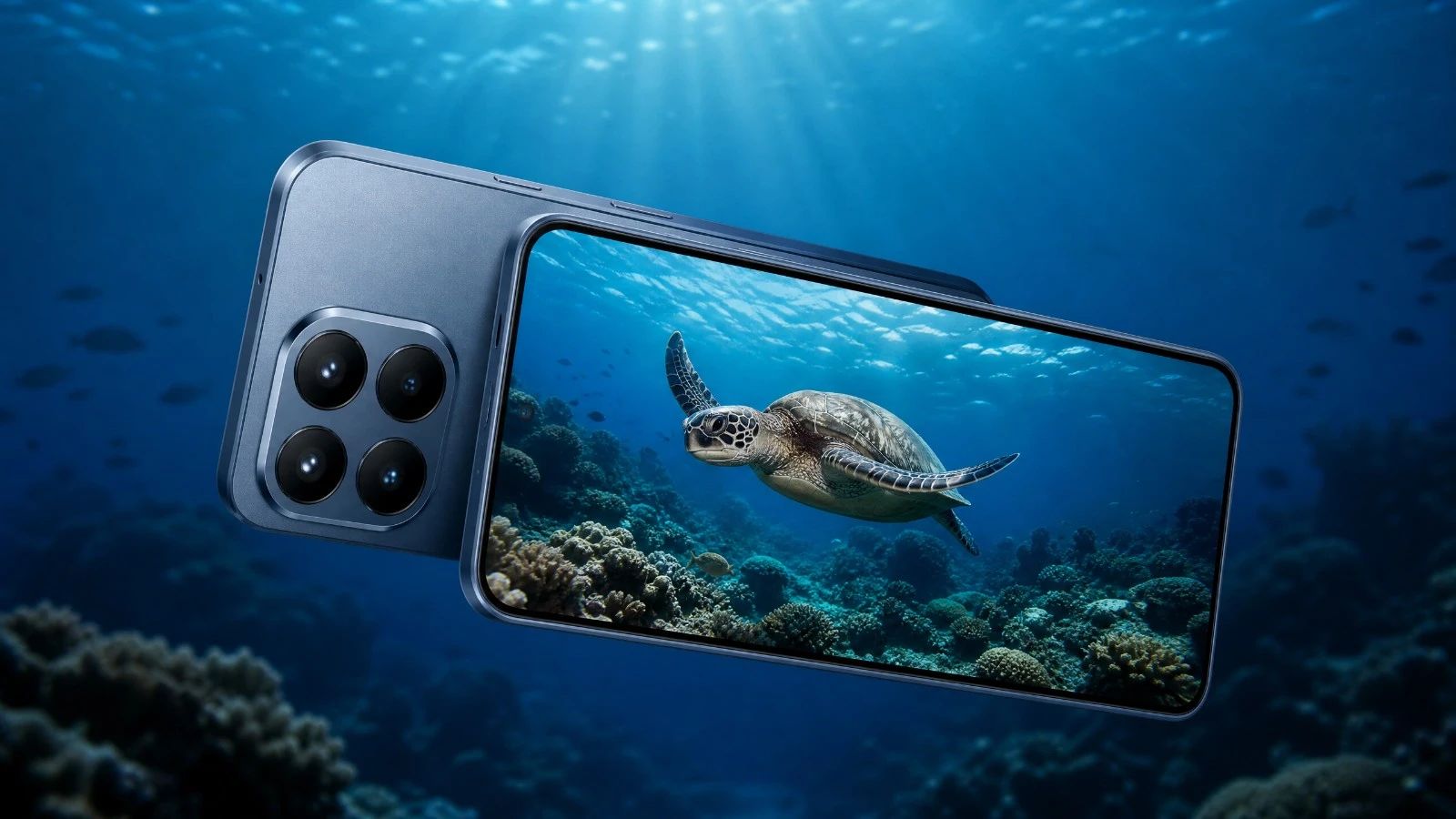
Is the Xiaomi 15T suitable for underwater photography?
Correct, with clear limitations. The 1/1.55-inch sensor with Leica optics and native RAW DNG format provide a solid foundation. However, the USB 2.0 port hinders the on-location workflow, and the standard Li-ion battery performs less well in cold water than a Si-C chemistry battery. AquaExposure score: 3.4/5. A good choice at a used price, but less obvious at its full new price compared to the 15T Pro.
What underwater housing is suitable for the Xiaomi 15T when diving?
The Divevolk SeaTouch 4 Max is the recommended solution for this phone. It is certified to a depth of 60 meters, features underwater touchscreen functionality, and is compatible via a universal adapter. It allows access to apps like MotionCam Pro and the Pro mode within the Xiaomi app. Be sure to order the dedicated adapter from Divevolk before your first dive.
Does the Xiaomi 15T shoot in RAW format while diving?
Yes. The Xiaomi camera app includes a Pro mode with native 12-bit DNG export on the main sensor. MotionCam Pro is also compatible (Camera2 API). For video, Xiaomi Log is available via HyperOS 3 in H.265 10-bit format. A RAW workflow is accessible without using a third-party paid app.
What are the differences between the Xiaomi 15T and the Xiaomi 15 Ultra for diving?
The difference is significant. The 15 Ultra features a 1-inch Sony LYT-900 sensor (compared to 1/1.55 inch on the 15T), a Snapdragon 8 Elite chipset (compared to Dimensity 8400 Ultra), a more powerful Si-C battery that performs better in cold conditions, and a USB 3.2 Gen 2 port for faster data transfer. The 15T is a step below, offered at a lower price. For diving in demanding conditions, the Ultra remains superior. The 15T is well-suited for tropical or semi-regular use with realistic expectations.
What underwater housing is suitable for the Xiaomi 15T for diving?
The Divevolk SeaTouch 4 Max is the recommended solution for this phone. It is certified to 60 meters, features underwater touchscreen functionality, and is compatible via a universal adapter. It allows access to apps like MotionCam Pro and the Pro mode of the Xiaomi app. Be sure to order the dedicated adapter from Divevolk before your first dive.
Does the Xiaomi 15T shoot in RAW format while diving?
Yes. The Xiaomi camera app includes a Pro mode with native 12-bit DNG export on the main sensor. MotionCam Pro is also compatible (Camera2 API). For video, Xiaomi Log is available via HyperOS 3 in H.265 10-bit format. A RAW workflow is accessible without using a third-party paid app.
What is the difference between the Xiaomi 15T and the Xiaomi 15 Ultra for diving?
The difference is significant. The 15 Ultra features a 1-inch Sony LYT-900 sensor (compared to 1/1.55 inch on the 15T), a Snapdragon 8 Elite chipset (compared to Dimensity 8400 Ultra), a more powerful Si-C battery that performs better in cold conditions, and a USB 3.2 Gen 2 port for faster data transfer. The 15T is a step below and offers a lower price point. For diving in demanding conditions, the Ultra remains superior. The 15T is well-suited for tropical or semi-regular use with realistic expectations.
Should an anti-fog treatment be used with this device?
Yes, absolutely. Due to its housing (often made of aluminum) and heat dissipation system using a vapor chamber, the risk of condensation forming in cold water (below 15°C) is significant. Using an anti-fog treatment (such as a silica gel packet or inserts) inside the housing is mandatory before each dive.
How can I quickly transfer my photos and videos from this device?
The wired connection of this device is limited to the USB 2.0 standard, which makes physical file transfers quite slow. To quickly transfer your RAW files or video clips, it is highly recommended to use the fast wireless protocol within the system (Mi Share / ShareMe), or to remove the memory card if the housing and device allow it.
---
If you want to learn how to effectively use this type of equipment underwater - not just technically, but also in terms of understanding light and animal behavior - the [AquaExposure training program](/lms) is designed for that purpose.
Test Xiaomi 15T: Underwater Photography Review and 2026 Score
There's a space between the absolute flagship and the mid-range that doesn't disappoint. The Xiaomi 15T occupies this space honestly. It's not a 15 Ultra - it lacks the 1-inch sensor, the Snapdragon processor, and USB 3.2. But it is a phone with Leica optics, native RAW support, a 5500 mAh battery, and an IP68 rating, all at a price that can be found for under €400 when this test was published.
The question isn't whether the 15T is as good as the 15 Ultra. The real question is what it's truly worth underwater, in the conditions where a diving photographer works with natural light. Real sensor performance, real RAW behavior, and real battery life.
This test covers exactly that. Not studio photography. Just what the 15T is capable of when you put it in an underwater housing, descend to 15 meters, and the only room for error is the dive itself.
The Verdict
Overall AquaExposure Score: 3.4/5
Criterion
Score
What it means
B1 - Optics and sensor
3.3/5
1/1.55 inch sensor + Leica Summilux f/1.7, good but not a 1-inch sensor
B2 - RAW and color
3.8/5
Native 12-bit DNG + MotionCam Pro + Log HyperOS 3 + Leica color science
B3 - Storage and transfer
2.5/5
USB 2.0 - the main bottleneck of the system
B4 - Thermal performance and condensation
3.5/5
Plastic housing: better thermal insulation than aluminum, less condensation
B5 - Battery
3.2/5
Standard 5500 mAh Li-Ion battery, decent but less resistant to cold water than a Si-C chemistry
B6 - Underwater autofocus
3.5/5
Omnidirectional PDAF + Focus Peaking, no LiDAR or Laser AF
B7 - Housing
3.8/5
Divevolk SeaTouch 4 Max via universal adapter - an effective solution
This device is ideal for: Android underwater photographers looking for a compact system with RAW capabilities and Leica optics for under €400, primarily used in tropical or temperate waters, with moderate dive session durations.
This device is not ideal for: intensive dives involving large amounts of video footage (USB 2.0 results in slow transfer speeds), regular use in very cold water (Li-Ion battery), or those who want the best possible image quality without compromise on the sensor.
B1 - The optics: what the sensor actually seesThe main sensor of the 15T measures 1/1.55 inches with an aperture of f/1.7 and a Leica Summilux lens. It is a good mid-range to high-end sensor. It is not a 1-inch sensor.
This distinction matters underwater. For every meter of depth, the available light decreases. A 1-inch sensor captures approximately 60% more light than a 1/1.55-inch sensor with an equivalent aperture. In practice, this translates to images that are usable at 1 to 1.5 ISO stops lower before noise becomes dominant. In clear tropical waters, the difference is manageable. However, in the Mediterranean Sea in October or in cold, low-light conditions, the limitations of the 15T become noticeable.
The 50 MP telephoto lens with a focal length of 46 mm (equivalent to 2x optical zoom) and a documented minimum focus distance of around 10 cm on the ultrawide offers reasonable macro capabilities. It's not the extreme macro performance of the 15 Ultra or its periscope telephoto lens with 200 MP, but it is sufficient for framing medium-sized subjects with detail.
The Leica anti-reflective coating is present on the optics of the 15T. In a marine environment with the sun behind you, this reduces unwanted reflections on the housing glass - a practical advantage that can only be truly appreciated in real-world use.Specs B1 - Xiaomi 15T
Main sensor: 50 MP, 1/1.55 inch, f/1.7, omnidirectional PDAF, OIS, Leica Summilux. 46 mm telephoto lens: 50 MP, 1/2.76 inch, f/1.9, 2x optical zoom, PDAF, OIS. Ultra-wide angle lens: 12 MP, f/2.2, 15 mm, 120 degrees. Stabilization: OIS on the main sensor + electronic EIS on the other lenses. Minimum focusing distance: ~10 cm for the telephoto lens, ~3-5 cm for the ultra-wide lens in macro mode. Chipset: MediaTek Dimensity 8400 Ultra (mid-to-high range, solid ISP, color science distinct from the Snapdragon 8 Elite in the 15 Ultra).
Score B1: 3.3/5
B2 - RAW and Color: The System's Strong Point
Underwater, everything depends on post-processing. Water absorbs red light first, then orange, and finally yellow, depending on the depth. A JPEG image taken at 12 meters looks like a blue-green flat without any adjustments. RAW is the only serious solution to this problem.
The 15T exports native 12-bit DNG files directly from the Pro mode of the Xiaomi camera app, without going through a third-party application. This is the most useful feature of the system for an underwater photographer. The DNG file provides access to all color channels to reconstruct lost reds during post-processing - using Lightroom mobile, Snapseed, or darktable depending on your workflow.The Leica partnership is present in the 15T. The Leica Authentic Look and Leica Vibrant Look profiles calibrate the colorimetry of the JPEGs with a consistency that is not found on generic Android devices. For those who don't want to post-process every image, the Leica Authentic JPEG is already noticeably more accurate than the average output from a smartphone in auto mode.
MotionCam Pro (Android) is compatible via the 15T's Camera2 API. In video, the Xiaomi Log format is accessible through HyperOS 3 in H.265 10-bit - which meets the needs of most underwater videographers without requiring a third-party app.
Specs B2 - RAW and Color RAW: Native 12-bit DNG in the Xiaomi Pro app (main sensor). Log Profile: Xiaomi Log available via HyperOS 3 (post-launch update). Maximum video codec: H.265 10-bit, HDR10+, 4K 60 fps. Color science: Leica certified partnership (Leica Summilux optics, Authentic/Vibrant profiles). Third-party apps: MotionCam Pro confirms compatibility (Camera2 API). Blackmagic Camera is also compatible. White balance in video: Manual Kelvin control available in Pro mode. B2 Score: 3.8/5
B3 - Storage and Transfer: The Achilles' Heel
This is where the 15T clearly differentiates itself from the Ultra series, and not in a positive way.The USB-C port on the 15T uses the 2.0 standard. The actual data transfer rate is 30 to 40 MB/s when writing from the device. A 50 MP DNG file weighs approximately 25 to 35 MB. An active dive of 50 minutes typically produces between 200 and 300 photos. This represents 5 to 10 GB of DNG data per dive, and between 15 and 30 GB for a day of three dives.
At a transfer rate of 35 MB/s, transferring 25 GB takes between 10 and 12 minutes - compared to less than 2 minutes with the USB 3.2 Gen 2 port on the 15 Ultra. The difference is significant between dives on a boat. It's not a deal-breaker, but it requires organization: plan for an OTG SSD and schedule regular data transfers in the evening or between sessions.
The internal UFS 4.1 storage (256 GB or 512 GB) is fast for internal writing. Only the transfer speed through the USB port is limited. There is no microSD card slot.
B3 Specs - Storage and Transfer Internal capacity: 256 GB or 512 GB (UFS 4.1). USB port: Type-C 2.0 (actual transfer rate: 30-40 MB/s for writing). Comparison with Ultra: USB 3.2 Gen 2 is 10 times faster for data transfer. RAW photo workflow for 3 dives: approximately 25 GB. Transfer via USB 2.0: ~12 minutes. Viable, but requires planning. 4K 60fps video workflow: ~800 MB/min. Transfer for 3 dives = ~60 GB = 25-30 minutes via USB 2.0. No microSD card slot. B3 Score: 2.5/5
B4 - Thermal Management: An Unexpected Benefit of the Plastic Body
The chassis of the 15T is made of fiber-reinforced plastic, with an internal LiquidCool vapor chamber.This material choice has a positive effect on diving that many tests don't mention: plastic is a poor thermal conductor. This means that the chassis of the 15T reaches the water temperature much more slowly than an aluminum or titanium chassis. The temperature difference between the air inside the housing (room temperature before entering the water) and the phone's casing diminishes more gradually.
In practice: less condensation on the interior window of the housing, all other things being equal. In cold water (below 15 degrees Celsius), the plastic offers a subtle but real advantage. The pre-acclimation protocol (housing closed for 10 minutes in the shade before diving) is still recommended, but it becomes less critical than with a metal chassis.
The IP68 certification (3 m/30 min in freshwater) is present. Saltwater is corrosive: rinsing after each dive is mandatory.
[!NOTE] Silica gel: recommended (not critical). The plastic chassis is a good thermal insulator - it's the only device in this comparison that benefits from a natural advantage against condensation. A packet of silica gel remains a good habit, but the risk is significantly reduced compared to metal models.Tropical Overheating: The Dimensity 9200+ is an efficient chip. In water at 28°C, software overheating occurs after approximately 32 minutes of continuous shooting - among the best margins in this comparison. The plastic casing also plays a role here: less heat transfer to the outside doesn't necessarily mean more internal heat, the device regulates temperature via the LiquidCool vapor chamber.
B4 Specs - Thermal and Condensation Chassis Material: reinforced fiber glass plastic + plastic frame. Internal Cooling: LiquidCool vapor chamber. Thermal Conductivity: low (plastic) - an advantage regarding condensation compared to a metal chassis. Certification: IP68 (3 m/30 min in freshwater). No MIL-STD-810 certification. Performance in Cold Water: better than aluminum regarding condensation. Pre-acclimation is recommended but not critical. B4 Score: 3.5/5
B5 - The Battery: Correct, Not Excellent
The 15T's 5,500 mAh battery uses standard Li-Ion chemistry. It doesn't use the Si-C (silicon-carbon) chemistry found in the global 15 Ultra, which is more resistant to low temperatures and offers a higher energy density.
In water at 25 degrees Celsius, the difference is negligible. In water at 12 degrees Celsius, the Li-Ion chemistry's voltage drops faster than Si-C, reducing the effective battery life by 10 to 20% in extreme cases. For a diver who regularly works in the North Atlantic or the Mediterranean Sea in autumn, this is something to consider.On a typical day of three tropical dives with the screen constantly on inside the housing, the battery lasts without any issues. The fast charging capability of 67W (wired only, unlike the 15T Pro which offers 50W wireless charging) recharges the phone in less than 50 minutes.
B5 Specs - Battery Capacity: 5,500 mAh. Chemistry: Standard Li-Ion (not Si-C). Fast Charging: 67W wired (no wireless charging on the standard 15T). Performance in cold water: Effective capacity is estimated to decrease by 10-20% below 12 degrees Celsius. Battery life for three active tropical dives: comfortably covered. B5 Score: 3.2/5
Before each dive session, remember to check your external battery pack. Use our portable battery comparator tool to choose the power bank that is right for your housing and your desired battery life.
B6 - Autofocus: Solid in the Right Context
The autofocus system of the 15T relies on an omnidirectional PDAF (Phase Detection Autofocus) sensor on the main camera. There is no LiDAR. There is also no laser AF (which is actually an advantage in murky water - the laser can reflect off suspended particles instead of focusing on the subject).
Focus Peaking is available in Pro mode within the Xiaomi app. This is the most useful manual control tool for underwater photography on this type of device: it visually indicates which elements of the image are in focus, allowing you to lock the focus on a specific subject without relying on automatic AF.In clear water, the omnidirectional PDAF autofocus is fast and reliable for subjects moving at moderate speeds. For fish that move quickly, the autofocus acquisition speed is acceptable but not exceptional. The absence of a laser AF system avoids the common problem with hybrid AF systems in murky water - it results in predictable behavior.
Specs B6 - Underwater Autofocus AF Technologies: Omnidirectional PDAF (main sensor). PDAF on other sensors. LiDAR: Absent. Laser AF: Absent (no risk of drift due to suspended particles). Focus Peaking: Available in the Xiaomi Pro app mode. AF/AE Lock: Available (long press on the subject). Scene Detection AI: Present via HyperOS 3. Score B6: 3.5/5
B7 - The Housing: Divevolk SeaTouch 4 Max
The 15T does not have a dedicated housing listed on the first page of the Divevolk website at the time of this review. The universal model that is suitable here is the Divevolk SeaTouch 4 Max (non-Platinum), with a dedicated internal adapter for the 15T.
The SeaTouch 4 Max is certified to 60 meters and features a functional touchscreen underwater (SeaTouch gel technology). It provides full access to camera apps from inside the housing - including Xiaomi Pro mode, MotionCam Pro, and Blackmagic Camera. The order for the specific adapter for the 15T must be placed directly with Divevolk before your first dive, as the exact dimensions of the phone determine the internal fit.For snorkeling or light freediving use, flexible universal housings (Seafrogs, Kraken) can be suitable down to 20-30 meters, but offer less tactile comfort and have a certified depth rating that is lower.
Specs B7 - Housing Main option: Divevolk SeaTouch 4 Max with a dedicated universal adapter for the 15T. Material: aluminum. Certified depth: 60 meters. * Tactile underwater: yes (SeaTouch gel, functional up to 40 meters). App access: complete (Xiaomi Pro mode, MotionCam Pro, Blackmagic Camera). Alternative option: flexible universal housings from Seafrogs/Kraken for snorkeling or freediving. Price of SeaTouch 4 Max: ~260 € (housing only, check with the dedicated adapter). Score B7: 3.8/5
The main option for the 15T is the Divevolk SeaTouch 4 Max with a dedicated universal adapter. Direct contact with Divevolk is recommended before purchase to confirm the availability of the 15T adapter and the mounting dimensions.
Flexible alternatives (Seafrogs H16) are available for use in shallow water (snorkeling, freediving) at a lower cost, but they are not suitable for scuba diving beyond 20 meters.
Field workflow
For a day of 3 RAW photo dives with the 15T:- 250 photos x 30 MB DNG = 7.5 GB per dive - Total for the day: approximately 22 GB - 256 GB capacity: covers 10 days without intermediate transfers - Backup transfer via USB 2.0 OTG: 22 GB in ~12 minutes
For 4K 60fps Log video, a daily transfer is mandatory with the 256 GB version. The USB 2.0 speed (~35 MB/s) requires planning: connect the OTG SSD in the evening and start the transfer before dinner.
Used/Refurbished (Back Market): - Xiaomi 15T 256 GB, good condition: ~280-320 EUR (estimated based on Back Market ranges for comparable models, June 2026 - check backmarket.fr/fr-fr/p/xiaomi-15t) - Note: Since the 15T was released in September 2025, the first refurbished units are recent. Prices for used devices will decrease in the coming months with the arrival of the 17T models.
For Comparison: - Xiaomi 15 Ultra new: ~1100-1200 EUR - Xiaomi 15T Pro new: ~650-700 EUR
The used price of the 15T makes sense: a well-rated refurbished unit for under 300 euros, plus the SeaTouch 4 Max housing at 260 €, provides a complete system for under 600 euros. This is the most compelling pricing for this phone for underwater photography.
Important ConsiderationsUSB 2.0 and video: If the primary use is 4K video with a large amount of footage, the 15T imposes a significant workflow constraint. A 15T Pro (USB 3.2 Gen 2) or a 15 Ultra would then be justified based on this criterion alone.
Li-Ion batteries in cold water: For regular dives below 12 degrees Celsius (Atlantic, English Channel, Brittany), plan for a day with an extra battery or a recharge between dives.
Housing and adapter: Always order and test the adapter before your diving trip. Divevolk prints adapters in 3D according to the exact dimensions of the model - do not assume compatibility without written confirmation.
The Xiaomi 15T is an honest phone for underwater photography, provided you don't ask it to do more than it's capable of.
The Leica RAW format is real, the colorimetry is well calibrated, the plastic chassis limits condensation better than many metal flagship phones, and the 5,500 mAh battery covers a standard day of use. For a diver who goes diving two or three times a year in tropical waters and takes a moderate amount of photos, the system works well.The limitations come from the USB 2.0 port, which can be an issue for those who film extensively, and from the Li-ion battery, which may not perform well in very cold water. These are not hidden flaws - they are documented in the manufacturer's specifications. The 15T is not intended to be an "Ultra" device.
The strongest argument for the 15T is its price. When purchased refurbished and in good condition, it can be found for around €280-300. Combined with the Divevolk SeaTouch 4 Max, it forms a complete and capable underwater system for less than €600. This is a realistic option for an Android user who is new to underwater photography using natural light and doesn't want to invest in an "Ultra" device right away.