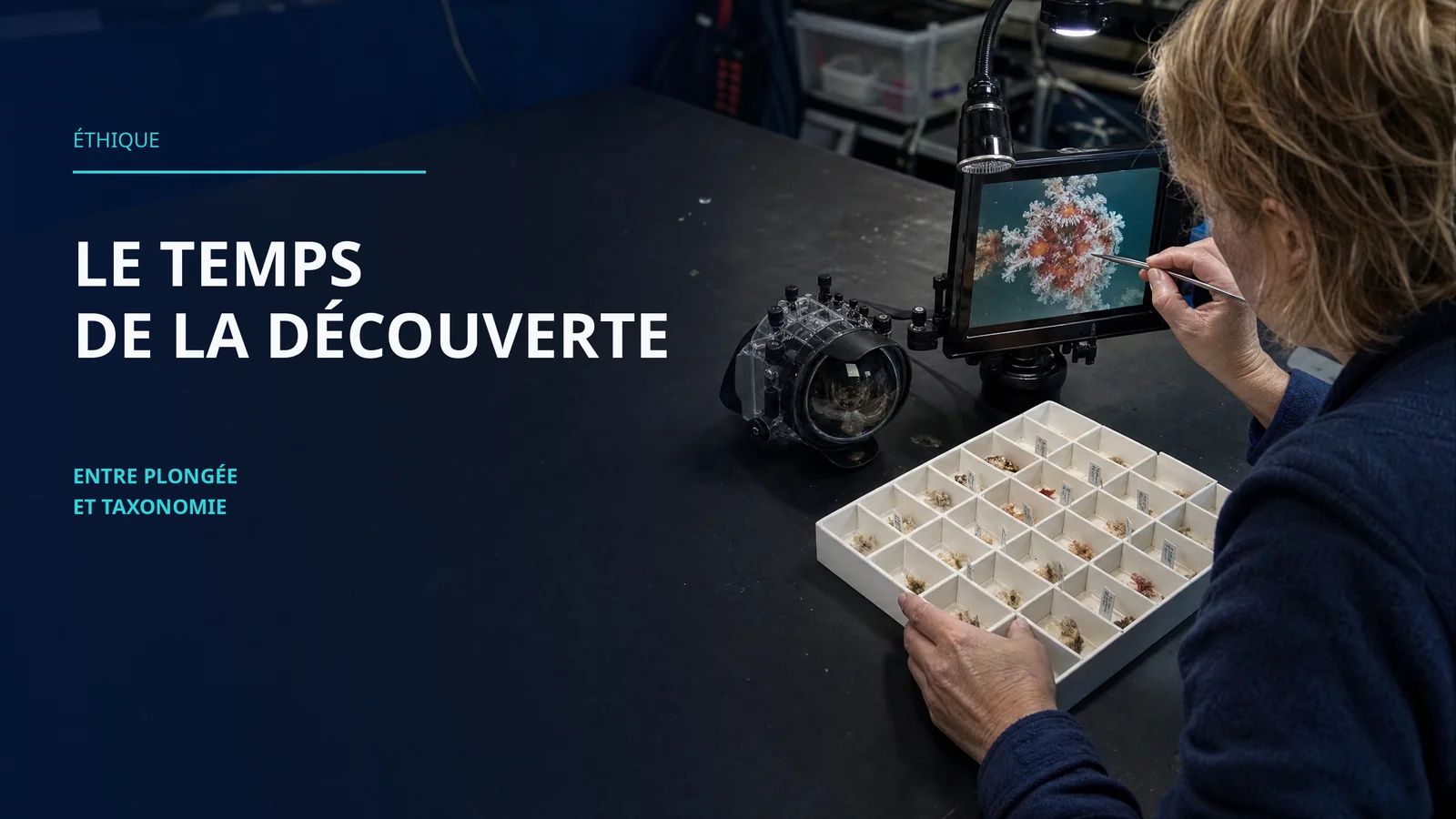
In Buenos Aires, taxonomists are identifying species from the Mar del Plata Canyon and the Talud Continental (2012-2013). What 'discovering' a species actually means. The Ink #13.
The Mar del Plata Canyon is a vast incision in the Argentine continental slope in the southwest Atlantic, descending to depths of several thousand meters. In July-August 2025, the Schmidt Ocean Institute's Falkor (too) conducted a series of ROV dives there, collecting specimens of invertebrates and other deep-sea organisms. These submarine canyons concentrate descending organic matter and host very dense ecosystems, often distinct from the surrounding reefs.
Ocean Census is an international scientific initiative founded by Nekton and supported by the Schmidt Ocean Institute. Its goal is to formally discover and describe 100,000 new marine species in ten years. To achieve this, it funds expeditions to underexplored areas, but also taxonomy workshops like the one in Buenos Aires (July 13-24, 2026), bringing specialists together to process collections from past expeditions.
The timeline varies depending on the taxonomic group and the availability of specialists. For deep-sea invertebrates belonging to poorly studied groups, it can range from a few months to several decades. The case of the Talud Continental I-III expeditions (2012-2013), with samples still being identified in 2026, illustrates this bottleneck: fewer than a hundred specialists worldwide master the identification of certain abyssal invertebrate groups.
Underwater photographs document characteristics that preserved specimens no longer show: natural coloration, behavior, habitat context. Platforms like iNaturalist compile millions of citizen observations, some of which have contributed to documenting rare species or identifying new behaviors. The image is not a formal species description, but it can be the trigger that starts one.
The Ink is a weekly series on recent marine discoveries. The ink of writing. The anchor of the seabed. One issue, a few stories, and what they change when you dive with a camera.
"If names are unknown, knowledge of things is lost." Carl von Linnaeus, Critica Botanica, 1737
You surface from a dive. You filmed something. An animal whose name you don't know, or whose name you thought you knew but that turns out to be a distinct species no one has yet described.
The image exists. The dive is over. What happens next, almost no one reports.
From July 13 to 24, 2026, around twenty taxonomists from several countries gathered in a building at the Universidad Maimónides in Buenos Aires. It was not an expedition. There were no ROVs, no research vessel, no great depths that morning.
What there was: specimens in jars. And people whose job is to look at what no one has yet managed to name.
In July and August 2025, the Schmidt Ocean Institute's research vessel conducted a series of ROV dives in the Mar del Plata Canyon, a long incision in the Argentine continental slope reaching several thousand meters deep.
Images were filmed. Specimens were collected in nets and robot arms. The expedition ended, the ship returned to port, and the teams published their first results alongside images capable of stopping your breath.
And that is where the part that most press releases don't cover begins.
A specimen collected by an ROV at several thousand meters depth does not become a "newly discovered species" the moment it surfaces. It becomes an object in a container, labeled with GPS coordinates and a date, preserved in a liquid that slows degradation without stopping it, and it waits.
It waits for a taxonomist with the specific training for that precise group of organisms to have the time, the budget, and the physical access needed to examine it.
That wait can take a few months. It can also take several decades.
The Buenos Aires workshop does not cover only the 2025 samples.
It also covers specimens from the Talud Continental I, II and III expeditions, conducted between 2012 and 2013 in the deep waters of Argentine Patagonia. Samples that have spent thirteen years waiting for the right available specialist.
This is not an exception. It is a structural reality of deep-sea taxonomy.
Natural history museum collections around the world hold marine specimens gathered during historical expeditions whose identification has never been fully completed. For certain groups of deep-sea invertebrates (abyssal polychaetes, hadal holothurians, deep-slope sponges), the list of experts capable of formal identification can be counted on the fingers of one hand per continent.
When an expedition brings back two hundred jars of unidentified specimens, there simply are not enough specialists in the world to open them and describe their contents within any reasonable timeframe.
It is precisely to reduce this bottleneck that Ocean Census was founded, in partnership with the Schmidt Ocean Institute.
The ambition: describe one hundred thousand new marine species in ten years, by accelerating taxonomic work on a global scale through expeditions to underexplored zones, but also through this kind of workshop.
Bringing together in one place, at the same time, taxonomists specializing in different groups to work simultaneously on the same collections. Sponge specialists in one room. Polychaete specialists in another. Crustacean experts exchanging with zoologists who specialize in rare mollusks.
The choice of Buenos Aires is not incidental.
Species collected from Argentine waters by international teams are being identified in Argentina, with Argentine scientists in the room, in a university that participated in the original expeditions. This is a shift from the tradition that sent collections to large institutions in the Global North for processing.
Argentina is contributing to naming what lives in its own waters. That sentence, simple as it sounds, represents a real change in how marine science is organized.
There is something uncomfortable, for an underwater photographer, in this timescale.
Diving regularly means meeting creatures whose name you don't know. Not because you haven't looked, but because the name might not exist yet. Or because the formal description is somewhere in a 1987 journal that no one has digitized. Or because the specialist for that particular group retired ten years ago.
This feels like a gap in available tools. It is actually the reflection of something deeper: the pace of scientific discovery does not match the pace of exploration.
Underwater photographs have contributed to species descriptions, documenting in vivo coloration, behavior, and habitat that preserved specimens no longer show. Citizen science species identification through photography has become a genuine research field, with platforms like iNaturalist allowing direct submission of observations to scientific databases.
But the image is not the description. The image is a clue.
The formal description, the one that assigns a two-part Latin name, that delimits the distinguishing characters of a species, that positions it in the tree of life, is work done in a laboratory, with a binocular microscope, bibliographic references that sometimes go back to the nineteenth century, and decades of accumulated expertise.
What you see in the water, and what you eventually know about what you saw, are often two things separated by years.
The Mar del Plata Canyon makes this as clear as possible. The Falkor dove in 2025. The taxonomists gather in July 2026 to begin identification. The Talud Continental samples from 2012 arrive in the same room.
What will eventually be called "Argentine new species" will be formally described in the months, possibly years, that follow this workshop.
The South Atlantic has been at the center of several recent stories about the deep sea. The Ink #10 covered the discovery of the 900-kilometer reef off Patagonia, by the same vessel during the same series of expeditions. The Ink #12 told how Mobula yarae, a third manta ray species, had been swimming in the Atlantic for decades without anyone giving it a distinct name. Both stories address the same underlying problem: the gap between the moment you observe something, and the moment you know what you observed.
For those who want to understand what the new species described in 2026 reveal about the true state of our knowledge of marine life, the resources are there.
And if you want to build a way of seeing that understands what it's looking at rather than just framing it, the AquaExposure underwater photography training starts from exactly that question: what are we actually watching, when we dive with a camera?
The Buenos Aires workshop ended on July 24. The jars continue on to the laboratories. And somewhere in a taxonomist's notes, a few lines are beginning to take the form of a description.
That is what a discovery looks like.
The Mar del Plata Canyon is a vast incision in the Argentine continental slope in the southwest Atlantic, descending to depths of several thousand meters. These underwater canyons concentrate descending organic matter and host very dense ecosystems, often distinct from the surrounding reefs. In July-August 2025, the Falkor (too) from the Schmidt Ocean Institute conducted ROV dives there, collecting specimens still being identified today.
Ocean Census is an international scientific initiative founded by Nekton and supported by the Schmidt Ocean Institute. Its goal is to formally discover and describe 100,000 new marine species in ten years, accelerating taxonomic work through expeditions and specialized workshops like the one in Buenos Aires.
It depends on the taxonomic group. For deep-sea invertebrates from poorly studied groups, the timeline can range from a few months to several decades. The Talud Continental I-III specimens from 2012-2013, still being processed in 2026, illustrate this gap: only a few dozen specialists worldwide cover some abyssal invertebrate groups.
Underwater photographs document natural coloration, behavior, and habitat that preserved specimens no longer show. Platforms like iNaturalist allow direct submission of citizen observations to scientific databases, some of which have contributed to describing rare species. The image is not the formal description, but it can be the trigger that starts one.
Find the previous issues of the series on the AquaExposure blog. For the full set of learning resources on reading marine life, visit the AquaExposure training platform.