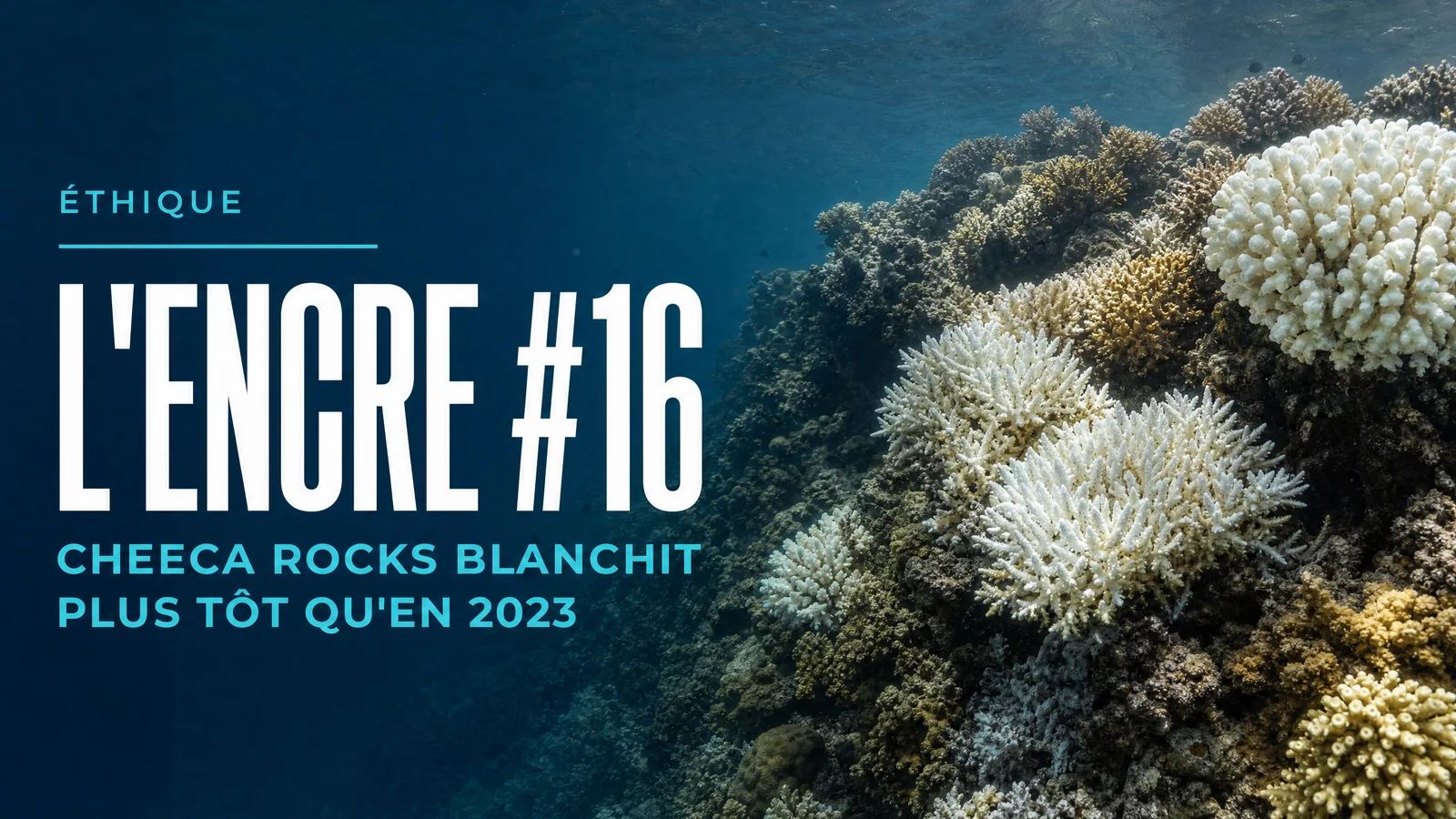
In early July 2026, NOAA AOML documents the first bleaching signs at Cheeca Rocks, earlier than 2023. What you photograph when a reef starts bleaching again.
Cheeca Rocks is a coral reef site in the Florida Keys that serves as a long-term monitoring station for NOAA AOML. Scientists have been measuring water temperature, coral cover, and species composition there for decades. The site bleached completely in 2023 during the 4th global bleaching event, and its data serves as a reference for tracking the thermal trajectory in the region.
The 4th global coral bleaching event lasted from 2023 to 2025 and affected 84% of the world's reefs according to NOAA. It is considered over as of 2025. The thermal stress documented at Cheeca Rocks in July 2026 is a separate and new episode - it arrives earlier in the season than the 2023 stress did, indicating an accelerating thermal trajectory and further shortening the recovery window available for reefs.
NOAA AOML (Atlantic Oceanographic and Meteorological Laboratory) is a laboratory of the US federal agency National Oceanic and Atmospheric Administration, based in Miami. It monitors thermal threats to coral reefs through a network of long-term monitoring stations, including Cheeca Rocks in the Florida Keys.
Bleaching is not automatically fatal. If water temperatures drop in time, corals can reabsorb their symbiotic algae (zooxanthellae) and recover. The window is short - usually a few weeks. Beyond that, the polyp dies and the calcium carbonate skeleton remains white before being colonised by surface algae. Acropora tend to die faster than massive corals like Orbicella, which are more resistant to prolonged episodes.
The Ink is a weekly series on recent marine discoveries. The ink of writing. The anchor of the deep. One issue, a few findings, and what they change when you dive with a camera.
"It is a curious situation that the sea, from which life first arose, should now be threatened by the activities of one form of that life." Rachel Carson, The Sea Around Us, 1951
There is a colour that only exists at the beginning.
Not the chalky white of a skeleton that has expelled all its symbiotic algae. Not the brown of the opportunistic algae that colonises that same skeleton a few weeks later. Something before that.
A translucency at the tips of the branches - almost as if the coral were letting light pass through it in a way it normally does not. Not yet white. Not yet dead.
This moment lasts a few days. At a reef like Cheeca Rocks in the Florida Keys, this moment was there in early July 2026.
And almost nobody photographs it.
Cheeca Rocks is not an anonymous reef in the Florida Keys.
It is one of NOAA AOML's (Atlantic Oceanographic and Meteorological Laboratory) long-term monitoring stations. For decades, scientists have been measuring water temperature, coral cover, and species composition there. It is a gauge: what is observed there each summer informs a trajectory that extends well beyond the Keys.
In 2023, this site bleached completely. It was one of the reference stations that contributed to the picture of the 4th global bleaching event - the most extensive ever recorded, with 84% of the world's reefs exposed to sufficient thermal stress to trigger bleaching (as confirmed by NOAA data in April 2024).
Cheeca Rocks has partially recovered since. Partially, and over two years.
In early July 2026, NOAA AOML documents the first signs of bleaching at this same site.
Earlier than 2023. And 2023 was already a record year.
NOAA Coral Reef Watch projects high thermal risk for Florida, Hawaii, and the Caribbean for the end of summer 2026. The water is warmer, earlier in the season - which leaves more time for heat to accumulate before autumn.
This is not a summary. It is a beginning.
The 4th global bleaching event is considered over as of 2025.
"Over" does not mean that reefs have recovered. It means that global thermal stress has dropped below the threshold of a global alert. In the meantime, surviving corals need time to rebuild their zooxanthellae populations - the symbiotic algae that give them their colour and produce the majority of their energy - to redeposit calcium carbonate, to grow.
That time is getting shorter.
A reef that bleaches twice in under three years, with an incomplete recovery window, is not in the same position as one that had ten years to recover between episodes. The shortening of intervals between thermal events is beginning to test the physiological limits of the most sensitive species.
There is a question that underwater photography poses, that you do not always think about before entering the water.
Not "what settings for this subject" or "what focal length for this reef." A more fundamental question: what deserves to be documented right now, at this site, at this precise moment?
The photographer who dives Cheeca Rocks in early July 2026 is not facing a dead reef. They are facing a reef that is beginning to change. Acropora with pale, almost translucent tips. Some Orbicella colonies that have not yet crossed the threshold, surrounded by others that have begun expelling their zooxanthellae.
This is the image that is missing from the archives. Not the survey of a fully bleached reef. The beginning.
Images of a fully bleached reef have multiplied since 2023. What you see far less often is the first day when the colour starts to leave.
The boundary between living colour and pale translucency lasts only a few days. This image is documentary in the most precise sense: it captures a moment that nothing can reconstruct after the fact, and that informs differently from all images taken before or after.
The value of this testimony is not in its beauty. It is in its date.
Documenting the start of a bleaching event at a reference monitoring station adds a layer that temperature sensors and satellite data do not produce. It fixes the visual granularity of what graphs summarise as curves.
The in-depth article on coral bleaching in 2026 and the 4th global event gives complete context on what reefs went through between 2023 and 2025. The Ink #15 covered the PNAS study modelling what the acceleration of these cycles means for long-term marine biodiversity. And The Ink #14 reminded us that deep in the Atlantic, the ocean continues to produce major discoveries in systems we thought were already mapped.
To develop an underwater photography practice capable of reading what a site is saying at any given moment, the full resources are at AquaExposure training.
Cheeca Rocks is a coral reef site in the Florida Keys that serves as a long-term monitoring station for NOAA AOML. Scientists have been collecting data on reef health there for decades. The site bleached completely in 2023 during the 4th global bleaching event, and its data serves as a reference for measuring the thermal trajectory in this region of the Caribbean.
The 4th global coral bleaching event lasted from 2023 to 2025 and affected 84% of the world's reefs according to NOAA. It is considered over as of 2025. The thermal stress documented at Cheeca Rocks in July 2026 is a separate and new episode, arriving earlier in the season than the 2023 stress did. This indicates an accelerating thermal trajectory and further shortens the recovery window available for reefs.
NOAA AOML (Atlantic Oceanographic and Meteorological Laboratory) is a laboratory of the US federal agency National Oceanic and Atmospheric Administration, based in Miami. It monitors thermal threats to coral reefs through a network of long-term monitoring stations, including Cheeca Rocks in the Florida Keys.
Bleaching is not automatically fatal. If water temperatures drop in time, corals can reabsorb their zooxanthellae and recover. The window is short - usually a few weeks. Beyond that, the polyp dies and the skeleton remains white before being colonised by algae. Acropora tend to die faster than massive corals like Orbicella, which are more resistant to prolonged episodes.
Find previous issues of The Ink on the AquaExposure blog. To learn to read what a reef is saying underwater, the full resources are at AquaExposure training.
There is a colour that only exists at the beginning of a bleaching event, and it lasts only a few days. It is not the colour of death. It is the colour of the turning point. And capturing that moment in an image does something that sensors and satellites do not do.