Ocean Census and JAMSTEC confirm 38 new species discovered in the deep waters of Japan. From the Shinkai 6500 dive in June 2025 to the announcement on August 5, 2026: fourteen months of unseen work.
What is Ocean Census and what is its connection to JAMSTEC?
The Ocean Census is an international scientific program that coordinates expeditions to the least explored areas of the world's oceans. JAMSTEC (Japan Agency for Marine-Earth Science and Technology) is one of the partner institutions. In June 2025, their collaboration resulted in 10 dives using the manned submersible Shinkai 6500 in the Nankai Trough and the underwater Shichiyo seamount chain. The official results were published on August 5, 2026: 38 new species were confirmed, with 28 potentially new ones.
What is the Nankai Trough?
The Nankai Trough is a subduction zone off the coast of Japan in the Pacific Ocean, formed by the Philippine Plate sliding beneath the Eurasian Plate. This tectonic activity generates methane seeps - areas where gas escapes from the seabed - which create unique chemosynthetic habitats that are independent of sunlight and support unusual biological communities.
How long does it typically take between a scientific dive and the publication of new species discoveries?
For the JAMSTEC expedition: there is a 14-month period between the dives (June 2025) and publication (August 2026), with an intermediate taxonomic workshop in Yokosuka in October 2025. The formal validation of each new species in a peer-reviewed journal with a DOI often takes several additional years, depending on the complexity of the taxonomic group involved.
What is the Shinkai 6500 submersible?
The Shinkai 6500 is a deep-sea manned submersible operated by JAMSTEC, capable of diving to depths of up to 6,500 meters. In June 2025, it completed 10 dives in the Nankai Trough and the Shichiyo seamount chain, enabling the direct collection and documentation of species from areas inaccessible to any autonomous diver.
How do these deep-sea discoveries relate to underwater photographers?
The species documented on the reefs accessible from our dive platforms belong to biological families whose origins span all depths of the ocean. Understanding how taxonomy works- how species are named and described- changes what you observe when taking photographs. An animal identified at a depth of 15 meters can contribute to identifications in areas that have not yet been explored.
L'Encre is a weekly series about recent marine discoveries. The ink of writing. The anchor of the seabed. Each issue features news and insights, exploring how these discoveries change our perspective when diving with a camera.
"Each species is a masterpiece, exquisitely adapted to the particular environment in which it has survived." Edward O. Wilson, The Diversity of Life, 1992
It's August 5th, 2026, and Ocean Census is publishing the results of an expedition that took place fourteen months earlier.
In June 2025, the manned submersible Shinkai 6500 from JAMSTEC made 10 dives in two areas within Japan's Exclusive Economic Zone: the Nankai Trough, off the Pacific coast, and the underwater mountain range of Shichiyo. In October 2025, taxonomists from around the world gathered in Yokosuka to identify what had been collected and documented. On August 5th, 2026, the results were made public.
38 new species confirmed. 28 potentially new species, still undergoing validation.
Between the dive and the announcement: fourteen months of unseen work.
What the Shinkai 6500 Discovered
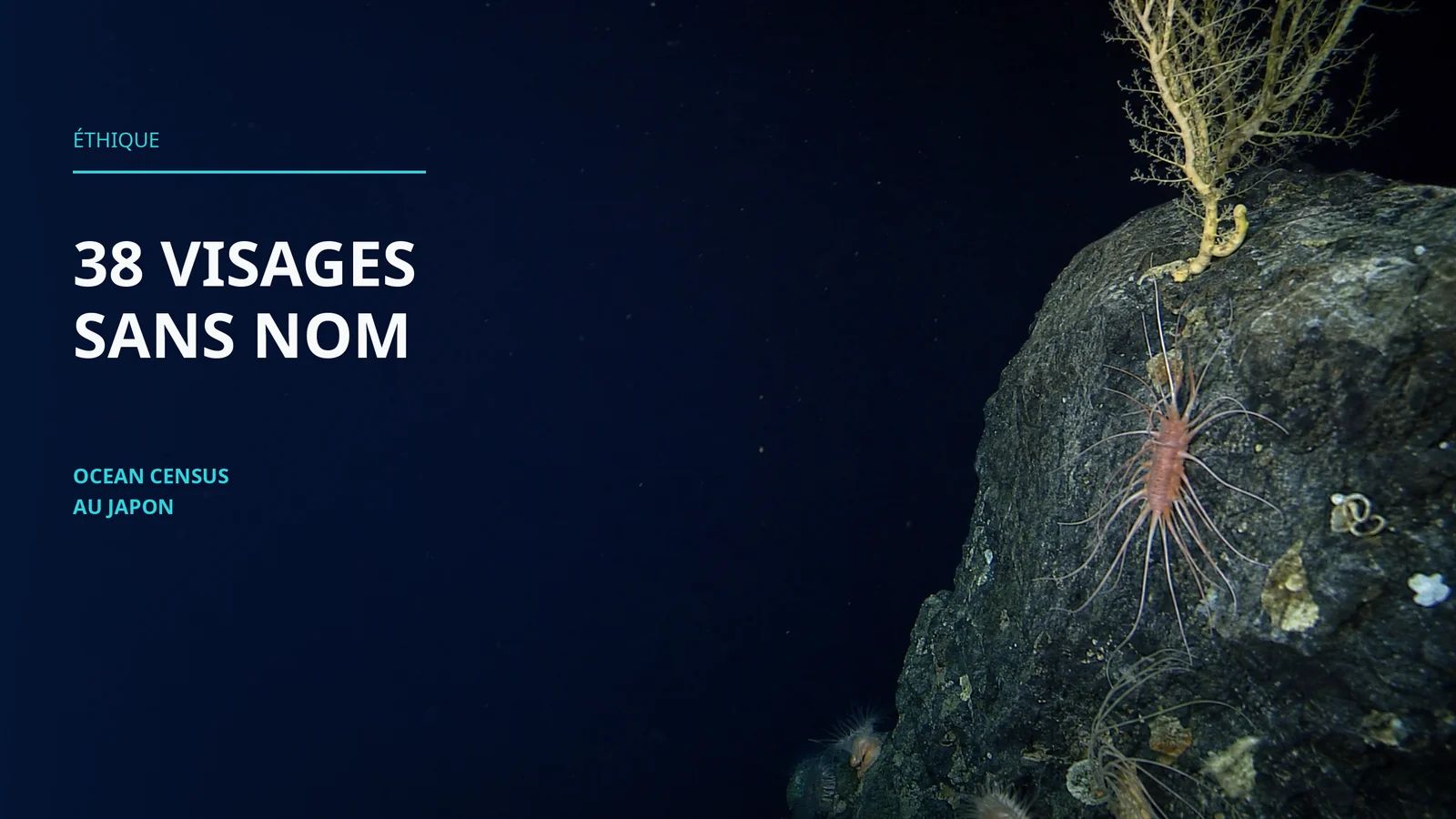
The Nankai Trough is a subduction zone. The Philippine Plate dives beneath the Eurasian Plate, creating a unique area of pressure, heat, and degassing. This tectonic activity maintains methane seeps - areas where chemical compounds slowly escape from the seabed - which generate very localized conditions.In these conditions, sunlight does not reach. Photosynthesis is impossible. The biological communities that live there depend entirely on chemosynthesis- bacteria that obtain their energy from chemical compounds present in the fluids seeping up from the seabed.
These habitats are rare, poorly explored, and biologically very unique.
It was within this context that Dr. Chong Chen, Senior Scientist at JAMSTEC, and partner teams from Nagoya University, Hokkaido University, and the Australian National University worked to identify the specimens collected. 38 species have been confirmed as new to science. 28 others are still undergoing formal evaluation.
Conceptual illustration of a methane seep in the deep waters off Japan, Nankai Trough
Taxonomic studies are published individually, each in a different peer-reviewed journal depending on the discipline (annelids, crustaceans, mollusks, echinoderms). There is no single paper that centralizes all the discoveries- this is the nature of taxonomic work. Each name is a text, signed, submitted, reviewed, and revised before becoming a scientific reality.
The 38 confirmed species have each waited for this process. Some for millions of years in the depths.
The Time Between the Dive and the Name
This is the moment that is never photographed.Diving- we can imagine it: the Shinkai 6500 descending for hours into increasing darkness, the pressure rising, the submersible's lights revealing a seabed that no one had ever illuminated in this way, in this area, with these instruments. Robotic arms collect specimens. Cameras record. The team takes notes. After several hours on the bottom, there is the ascent, returning to the surface, and then to the ship's laboratory.
And then, months of work on land.
In "L'Encre #13," we described the workshop in Buenos Aires, where taxonomists gathered to identify specimens from the Schmidt Ocean expedition in the Mar del Plata Canyon: a similar process, but in another ocean. The same principle applies everywhere: discovery doesn't happen underwater. It happens in a laboratory, months later, when someone opens a box and says "I've never seen this before."
For Japan, the workshop took place in October 2025 in Yokosuka, four months after the dives. Specialists from each taxonomic group examined the specimens, compared them with global reference collections, and exchanged information with colleagues at other institutions.What this means in concrete terms is that among the 38 confirmed species, some have inhabited these depths for millions of years. They had simply been waiting for someone to come and see them, collect them, describe them, and name them.
The discovery begins after the dive.
What this means for a photographer
There are two ways to react to information like this.
One is to think that the deep waters of Japan and their methane seeps have nothing to do with what we do, with our dives in the first 30 meters. The other is to understand that the logic is exactly the same, but at different depths.
When a team identifies 38 new species in the depths of the North Pacific, they do so by comparing them to what is already described in global reference collections. These collections were built by generations of naturalists who observed, collected, photographed, and described animals in all possible environments, including coastal reefs accessible to our dive sites.
Underwater photography fits into this chain, even at 15 meters on a Mediterranean reef.L'Encre #14 on the hydrothermal vents of the Doldrums posed the question differently: the areas accessible to our submersibles are documented in incomparably greater detail than the deep sea. But the density of documentation is not the same as completeness. A well-known reef remains partially undocumented because the documentation depends on who has observed it, with what tools, and under what conditions.
New species discovered in 2026 are not limited to the deep sea: coral microbes, organisms from the water column, and species from seagrass beds. Taxonomy is advancing on all fronts simultaneously. But what the JAMSTEC expedition illustrates very precisely is that a photo that doesn't yet exist is just as real as a photo that has already been taken.
It is simply waiting for someone to go down there and take it.This is one of the reasons why, in the AquaExposure underwater photography course, understanding marine life is part of the curriculum, not just camera settings. To develop the ability to recognize what deserves to be documented underwater, comprehensive resources are available on the AquaExposure platform.
Frequently Asked Questions
What is Ocean Census and its connection to JAMSTEC?
Ocean Census is an international scientific program that coordinates expeditions to the least-known areas of the world's oceans. JAMSTEC (Japan Agency for Marine-Earth Science and Technology) is one of the partner institutions. In June 2025, their collaboration resulted in 10 dives with the Shinkai 6500 submersible in the Nankai Trough and the Shichiyo seamount chain. The official results were published on August 5, 2026: 38 new species were confirmed.
What is the Nankai Trough?
The Nankai Trough is a subduction zone off the coast of Japan, formed by the sinking of the Philippine Plate beneath the Eurasian Plate. This tectonic activity generates methane seeps that create unique chemosynthetic habitats, independent of sunlight, with very distinctive biological communities.
How long does it take between a dive and the publication of new species?For the JAMSTEC expedition: 14 months passed between the dives (June 2025) and publication (August 2026), with an intermediate taxonomic workshop in Yokosuka in October 2025. The formal validation of each new species in a peer-reviewed journal often takes several additional years, depending on the taxonomic group.
What is the Shinkai 6500 submersible?
The Shinkai 6500 is JAMSTEC's deep-sea manned submersible, capable of diving to depths of up to 6,500 meters. It conducted 10 dives in the Nankai Trough and the Shichiyo seamount chain in June 2025, allowing for the direct collection and documentation of species from areas beyond the reach of any autonomous diver.
How do these discoveries relate to underwater reef photographers?
The species documented on coastal reefs belong to biological families whose origins extend throughout all depths of the ocean. Understanding how taxonomy works changes what we observe when taking photographs. An animal documented at 15 meters can contribute to identifications in areas that have not yet been explored.
Find previous issues of L'Encre on the AquaExposure blog. And to learn how to interpret marine life with a camera, comprehensive resources are available on the AquaExposure training platform.
---In June 2025, the Shinkai 6500 submersible descended into the Nankai Trough. In October 2025, taxonomists gathered in Yokosuka. On August 5, 2026, Ocean Census announced the discovery of 38 new species. And in the depths of the northern Pacific, 28 potentially new species are still awaiting their scientific names.
The process of discovery had begun long before anyone realized it.