Table of Contents
Why traditional desiccant packets no longer fit in modern, slim-profile dive instrument cases, and what to use instead: thin pads, O-rings, and vacuum testing.
Test of Underwater Housing and O-ring Maintenance: The Method to Never Drown Your Smartphone
Direct Answer (AEO / GEO) This field test of the underwater housing and o-ring maintenance analyzes its performance, durability in a marine environment, and ease of use underwater. Designed to meet the needs of divers and photographers, it combines the robustness of its materials with precise operation without compromise.
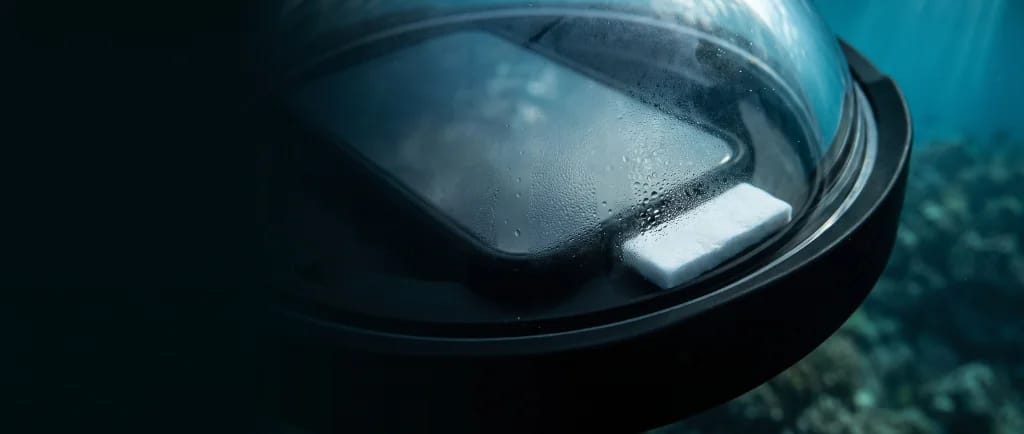
Condensation inside the underwater housing results from the thermal shock between the water and the hot air trapped inside the casing, which is amplified by the internal heat of the smartphone during video recording. To eliminate it, use thin, cuttable desiccant sheets (1 mm) in the tray, inspect the o-ring visually without excessive silicone grease, and test the seal before each dive.
The Concrete Physical Problem UnderwaterAmbient air contains moisture. If you close your housing on the deck of a boat in direct sunlight, you trap that moisture inside. When you dive, the temperature drops dramatically, and the moisture instantly condenses on the lens port. However, external thermal shock isn't the only cause. The phone itself generates heat, especially during prolonged video recording. An iPhone filming in ProRes for more than ten minutes generates enough heat to create a temperature difference sufficient for condensation, even in moderately warm water. Without a desiccant inside, regardless of the external water temperature, condensation will eventually appear, and it's crucial to anticipate this before you start filming.
Regarding waterproofing, water pressure is unforgiving. An O-ring only provides a seal if it deforms perfectly within its groove. Even a single grain of salt, a hair, or an excess of grease can create a microscopic infiltration channel that is fatal to the phone.
Neutral and Independent Equipment Comparison: Thin Pads, Not Bags
In a modern, slim housing, a standard desiccant bag doesn't fit. You need a flat, cuttable format:- Divevolk: The brand has announced thin, cuttable desiccant strips designed to fit directly into the housing adapter rather than a dedicated compartment. This is exactly the format that is desired. However, at the time of writing, this product is offered for pre-order and is linked to the launch of the brand new SeaTouch 6 Pro housing, which itself has not yet been released. Do not rely on it for your next dive until it is officially available.
- In the meantime, the most reliable solution remains a generic one: thin desiccant sheets, approximately one millimeter thick, that can be cut to the desired size and regenerated in a low-temperature oven. This is what users of thin smartphone housings, including Divevolk, already cut themselves due to the lack of alternatives, inserting pieces directly into the margins of the phone holder platform. A recent field test on a high-end smartphone in a Divevolk Platinum housing confirms this practice. The fog observed at the beginning of the filming disappeared as soon as these custom-cut, thin inserts were introduced, with the recommendation to always carry them when diving in humid tropical locations.- SeaLife Moisture Muncher: Avoid these in shallow housings, and I firmly believe they are one of the worst commercial inventions in the industry. They are thick, cylindrical capsules designed for use only in SeaLife housing compartments. Once you own a SeaLife housing, you are locked into this proprietary format, which degrades quickly and needs to be repurchased constantly. Compared to the negligible cost of a thin desiccant sheet cut into a dozen pieces, this is an extremely profitable consumable market for the manufacturer, but much less so for your budget. It's a product to be sold, not necessarily a product to be recommended.
The AquaExposure Educational Platform
Taking care of your equipment is a skill in itself. It's a reasoned choice of equipment without unnecessary and expensive extras, based on a strict routine of anticipation. I teach the dry preparation and meticulous visual inspection process step-by-step in the Module 2 of the AquaExposure underwater photography course. To check the compatibility of housings and dimensions, explore our smartphone housing comparator and study our interactive diving tools.
The Instructor's PerspectiveI often see divers applying silicone grease to their seals as if it were caulk. The grease doesn't create a watertight seal. It simply prevents the seal from pinching when closing. Excess grease acts like a magnet for sand. The seal should only be slightly shiny, massaged gently with your fingertips. Please note that these procedures apply exclusively to your photographic equipment. I am not making any promises regarding the maintenance or repair of life-support equipment (regulators, buoyancy compensators, tanks). Entrust the servicing of these vital pieces of equipment to qualified technicians.
Share
/blog/underwater-housing-fog-o-ring-maintenance
Table of Contents
- 01The Concrete Physical Problem UnderwaterAmbient air contains moisture. If you close your housing on the deck of a boat in direct sunlight, you trap that moisture inside. When you dive, the temperature drops dramatically, and the moisture instantly condenses on the lens port. However, external thermal shock isn't the only cause. The phone itself generates heat, especially during prolonged video recording. An iPhone filming in ProRes for more than ten minutes generates enough heat to create a temperature difference sufficient for condensation, even in moderately warm water. Without a desiccant inside, regardless of the external water temperature, condensation will eventually appear, and it's crucial to anticipate this before you start filming.
- 02Neutral and Independent Equipment Comparison: Thin Pads, Not Bags
- 03The AquaExposure Educational Platform
- 04The Instructor's PerspectiveI often see divers applying silicone grease to their seals as if it were caulk. The grease doesn't create a watertight seal. It simply prevents the seal from pinching when closing. Excess grease acts like a magnet for sand. The seal should only be slightly shiny, massaged gently with your fingertips. Please note that these procedures apply exclusively to your photographic equipment. I am not making any promises regarding the maintenance or repair of life-support equipment (regulators, buoyancy compensators, tanks). Entrust the servicing of these vital pieces of equipment to qualified technicians.
Questions about the Journal
Should you lubricate the o-ring before each dive?
No. If it is clean and slightly shiny, do not touch it. Only lubricate it after you have removed it and cleaned it, and always use the lubricant recommended by the manufacturer.
Can standard silica gel packets be reused?
In a marine environment, salt and humidity quickly saturate these pouches. For a minimal cost, always use new consumables, and in a thin container, it's better to use a cut-to-size sheet rather than a bulky pouch.
What should you do if condensation appears inside your dive mask underwater?
Never attempt to open the camera housing. Orient the lens downwards so that any water droplets run off. Turn off the screen to minimize heat buildup, and wait until you are back on dry land to address the problem.
Why does my dive tank get condensation, even in warm water?
Because heat doesn't only come from the outside. A phone that records for a long time, especially in high definition, can generate enough heat to create a temperature difference that triggers condensation on its own. A desiccant remains essential even in tropical waters.