Table of Contents
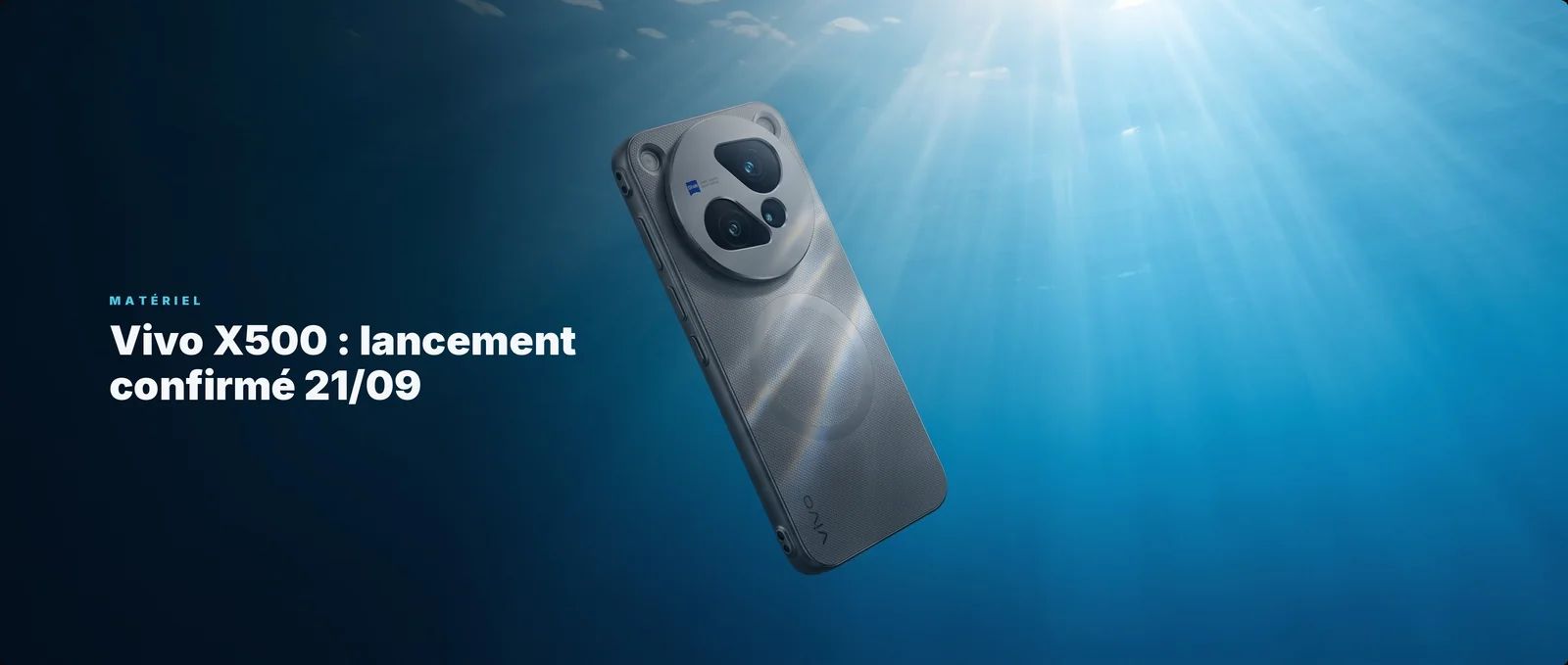
vivo launched the X500 series on September 21, 2026, with a Pro Max sporting a new 200MP telephoto. The 17-stop teaser claim is confirmed. What it means for diving, no housing confirmed for this model yet.
This article used to follow a teaser. That is no longer the case: vivo officially launched the X500 series in China on September 21, 2026, with a Pro Max model that did not exist at the time of our first article on August 25.
On August 24, 2026, Han Boxiao, product manager at vivo, posted an official teaser on Weibo announcing a sensor with 17 stops of dynamic range. The official launch confirms that figure, with a Sony LYTIA 910 sensor developed with Sony, and a brand new Pro Max variant that adds a 200-megapixel periscope telephoto camera not present in the lineup before.
What the official launch confirms
The main sensor, Sony LYTIA 910, 50 MP, 1/1.28" format, f/1.57 aperture, with LOFIC technology. vivo measures 17 stops of dynamic range in Log mode on this sensor, confirming the teaser's figure. This is a manufacturer lab measurement, not yet an independent DXOMARK measurement.
A brand new Pro Max variant, with a 200MP periscope telephoto camera using a Samsung ISOCELL HP0 sensor, 1/1.4" format, f/2.67 aperture, 3.5x optical zoom (85mm), extendable to 400mm with the dedicated accessory. The standard X500 Pro keeps a more modest 64MP telephoto.
8K video at 30fps, 4K slow motion at 240fps, and 4K at 120fps in 10-bit Log, with ACES support for professional color grading. The 4K 240fps slow motion teased in August is confirmed.
CIPA 7.0 stabilization on the Pro Max's main sensor, with a 3-degree OIS vivo describes as "gimbal-grade", and CIPA 7.0 on the telephoto as well.
IP68/IP69 rating, an 8000mAh battery, a Dimensity 9600 Pro chipset built on a 2nm process, and a 6.85-inch 144Hz display.
Why 17 stops changes the game underwater
This point has not changed since our first article, and it remains central.
An IL, or stop, represents a doubling of the amount of light. Each additional stop doubles the range the sensor can handle between the brightest and darkest areas of a single image.
Picture an ordinary dive scene: at the top of the frame, the brilliant, sunlit surface. At the bottom, the drop-off plunging into deep, almost black blue. Between the two, your subject. With insufficient dynamic range, there is no good exposure setting, either you expose for the surface and the drop-off becomes a black mass with no detail, or you expose for the drop-off and the surface blows out to pure, unrecoverable white.
Seventeen stops, now confirmed internally by vivo, place this sensor above most cinema cameras from ten years ago. This won't replace good composition, but it removes a constraint that weighs on every underwater photo dive.
AquaExposure score (web-based estimate, no hands-on test yet)
Overall score: 3.3/5, based on manufacturer specifications and specialized press coverage, without a hands-on test from us at this stage.
| Criterion | Score | What it means |
|---|---|---|
| Optics & sensor | 3.3/5 | Strong LOFIC 17-stop sensor, but ISO, burst and latency undocumented |
| RAW & color | 3.4/5 | Zeiss partnership confirmed, but third-party app and video Kelvin lock uncertain on the China unit |
| Storage & transfer | 3.8/5 | 256GB to 1TB, no external slot |
| Thermal | 2.8/5 | Comparable profile to other aluminum flagships, caution in cold water |
| Battery | 4.0/5 | 8000mAh, comfortable on paper |
| Autofocus | 3.0/5 | Solid PDAF and AI tracking, Google ecosystem status uncertain on the China unit |
| Housing | 2.0/5 | No named model, but vivo generically listed by DiveVolk |
This score is an estimate, not a full hands-on review. It will be updated as soon as a model-specific housing confirmation or an international, Google Play-equipped version is documented.
The housing: still the best track record on the market, but not yet confirmed for this model
DiveVolk has published an official compatibility guide for the vivo X300 and X300 Pro with the SeaTouch 4 Max Platinum, and a Platinum V2 version specifically for the foldable vivo X Fold6. On September 16, 2026, the announcement of the new SeaTouch 6 Pro again lists "vivo" among compatible brands, but generically, without naming the X500 Pro Max or confirming that its thick camera module, periscope telephoto included, fits within the 17mm clearance announced for this housing.
It's worth remembering a fact that matters: the smartphone category of the Underwater Photographer of the Year 2026 was won with a vivo X100 Ultra in a SeaTouch 4 Max housing. We covered this here.
In other words, the track record remains the best on the market, but it is not yet a named confirmation for this specific model.
To check whether your smartphone fits without forcing and to compare interior volumes, check if your model's dimensions fit in this housing.
What remains uncertain
Native RAW support, its exact bit depth, and confirmation of a video Log profile for this model still need to be documented precisely.
A fundamental question already raised in our first article remains open: the unit currently launched is the mainland China model. vivo models sold on that market have historically lacked Google services, which makes MotionCam Pro unavailable. The international version, when it launches, should resolve this, as it has for previous vivo generations.
The exact chassis and cooling system are not documented in detail, which limits a precise assessment of housing condensation risk, a topic covered in our article on overheating and condensation.
Our position
The official launch confirms what the teaser promised on dynamic range, and adds a Pro Max variant with serious video potential for diving. It is the strongest technical candidate from our September review.
But two reservations still prevent a firm purchase recommendation for underwater use: no housing is named and confirmed for this specific model, and the Google Play status of the currently sold unit needs clarifying. If DiveVolk confirms model-specific compatibility in the coming weeks, as it has for the previous two generations, this phone will become a serious recommendation.
Framing technique and reading the light on the way down still matter more than the gear. This is one of the reflexes we train in the AquaExposure course. To compare devices we have already reviewed, browse our camera gear comparison tool.
Share
/blog/vivo-x500-pro-capteur-17-il-photo-sous-marine-en
Questions about the Journal
Has the vivo X500 Pro Max been released?
Yes. vivo officially launched the X500 series (X500, X500 Pro, X500 Pro Max) in China on September 21, 2026. The Pro Max introduces a brand new variant with a 200-megapixel telephoto camera that did not exist at the time of the August 24 Weibo teaser.
What does 17 stops of dynamic range mean, and is it confirmed?
An IL, or stop, represents a doubling of the amount of light. At launch, vivo confirms an internal measurement of 17 stops on the main sensor in Log mode, using the Sony LYTIA 910 sensor co-developed with Sony. This is a vivo lab measurement, not an independent DXOMARK measurement to date.
Why is dynamic range so important underwater?
Because the typical underwater scene is an extreme case, the sunlit surface at the top of the frame can be thousands of times brighter than the drop-off below. With insufficient dynamic range, you have to choose between an overexposed surface and a crushed dark foreground.
Is there a housing for the vivo X500 Pro Max?
Nothing is confirmed by name for this specific model yet. DiveVolk lists "vivo" generically in the compatibility list for its SeaTouch 6 Pro (announcement of September 16, 2026), without naming the X500 Pro Max or confirming that its thick camera module (triple camera including a 200MP periscope) fits within the housing's 17mm clearance. The brand's track record remains the best on the market, DiveVolk has already covered the X300 and X300 Pro.
Should you wait before buying the vivo X500 Pro Max for underwater use?
Yes, wait for a model-specific housing compatibility confirmation before any purchase dedicated to underwater use. On the sensor and video side alone, it is one of the most ambitious systems on the market this season.