Ajustement de votre flottabilité...
“La stabilité est la clé d'un cadrage parfait.”
AquaExposure • Préparation des parametres
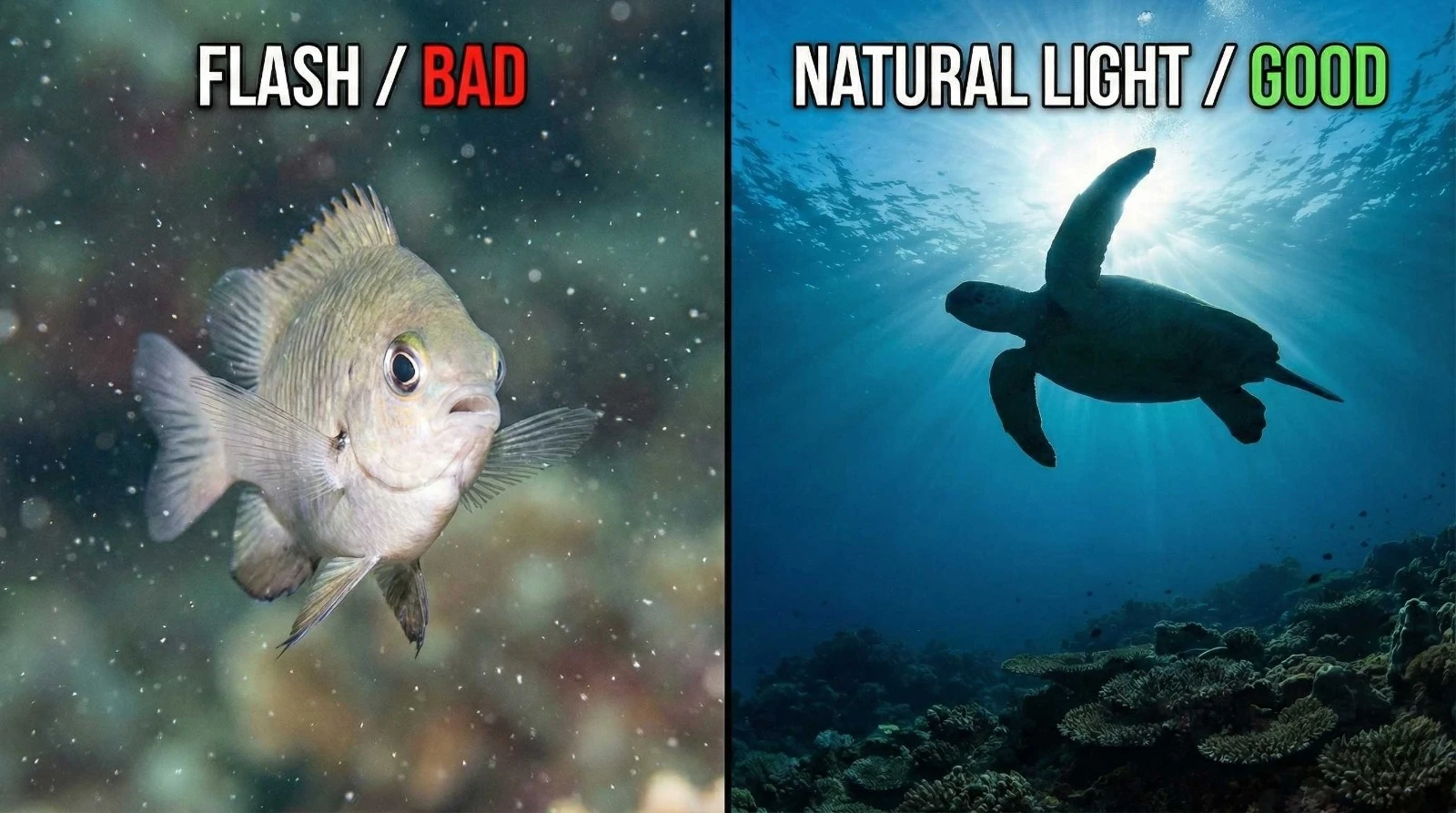
Why give up flash underwater? Discretion, freedom of movement, authenticity. The case for natural light, explained by a field photographer.
To learn how to get the most out of your gear underwater, discover the AquaExposure training.
There is one object you will never find in my dive bag. Not in my suitcase. Not in any corner of my apartment in Brussels. It is an underwater flash.
I owned two. A Sea & Sea YS-D2 and an Inon Z-330. Two excellent strobes, recognized by the community, used by photographers whose work I deeply admire. I sold them both four years ago, and I have not regretted it for a single second.
This is not an anti-flash manifesto. It is the story of a personal choice, grounded in experience, that transformed my practice and that of hundreds of students. If flash works for you, keep going. But if you are just starting out, if you are hesitating about the investment, if you are wondering whether it is truly necessary, here is why the answer is probably no.
Underwater flash is a sensory assault. Not for you. For the animal.
A burst of 5600 Kelvin at full power, triggered one metre from a fish living in an environment where light halves every five metres, is the equivalent of pointing a stadium spotlight into the eyes of a cat at night. The analogy is not an exaggeration. The eyes of many marine species are adapted to dim light, with pupils that dilate considerably to capture the maximum available photons. A flash saturates them instantly.
Studies on the impact of flash in the marine environment are still limited, but field observations are unanimous. A grouper flashed once changes position. Flashed three times, it leaves the area. An octopus hit by flash contracts its chromatophores in a stress reaction, which literally alters the colours you are trying to capture.
The photographer who uses flash often gets the first frame. The photographer without flash gets the full sequence. The animal stays. It continues its natural behaviour. It gives you five minutes instead of five seconds.
In the Maldives, when I was guiding groups of diver-photographers, the difference was visible to the naked eye. Divers equipped with flash captured technically correct images (restored colours, sharp subject) but in flight postures. Divers working in natural light captured less saturated images, certainly, but with authentic behaviour. Gill-cleaning stations. Courtship dances. Calm feeding moments. The kind of images that tell a story.
A full underwater flash setup weighs between 1.5 and 3 kilos out of the water. Two strobes, two articulated arms, a tray, fibre-optic cables or wireless triggers. All bolted onto an already bulky housing.
Underwater, weight is compensated by buoyancy. But volume is not. You swim with a contraption the size of bicycle handlebars in front of your face. Your hydrodynamics are catastrophic. Every fin kick shifts the mass sideways. Every passage through a coral corridor becomes an obstacle course.
I have seen photographers clip coral with their strobe arms without even noticing. Not out of carelessness. Out of bulk. When your setup is 60 centimetres wide, clearance in a reef disappears.
Without flash, my setup fits in one hand. A GoPro in a housing or a compact in its case. Nothing sticking out. Nothing snagging. I slip through gaps that flash photographers go around. I turn in a quarter of a second when an animal appears from behind. I am as mobile as a diver without a camera, which is exactly the point.
Mobility is not a luxury in underwater photography. It is the condition for stillness. To stay perfectly stable on the bottom for ten minutes, you first have to reach the right position without disturbing the entire neighbourhood. And that is infinitely easier when you do not have scaffolding bolted to your housing.
Flash restores colours. That is its knockout argument, and it is a legitimate one. At fifteen metres depth, reds have disappeared, oranges are fading, and everything shifts to blue-green. Flash artificially brings those colours back into the frame by projecting a full spectrum onto the subject.
But "artificially" is the key word.
Flash creates lighting that does not exist in the natural environment. A fish lit by flash at fifteen metres displays colours that neither it, nor any predator, nor any member of its species ever sees at that depth. It is a chromatic truth, but a luminous fiction. The image is technically accurate and ecologically false.
Natural light shows the world as the animal lives it. The cool tones, the soft contrasts, the blue gradients that map out the depth. It is less spectacular on a saturated screen. It is infinitely more honest as a testimony.
And then there is backscatter. Those thousands of white dots that appear on your photos when the flash illuminates particles suspended between you and the subject. The nightmare of every flash-equipped underwater photographer. Hours of post-production removing those luminous confetti one by one, turning an image into a snowstorm.
In natural light, backscatter does not exist. Ambient light illuminates particles uniformly, without turning them into individual reflectors. Your image is clean straight out of the sensor.
Giving up flash does not mean giving up colour. It means moving chromatic restoration from the moment of capture to post-production.
This is exactly what film photographers used to do. They did not control light at the moment of shooting (or very little). They controlled the development. The chemistry of the bath, the paper exposure time, the enlarger filters. The "print" was a creative act in its own right, as important as the capture itself.
Digital post-production in natural light follows the same logic. The RAW file (or the ProRes video frame) contains all the colorimetric information captured by the sensor. The reds are attenuated, not absent. The oranges are present, simply drowned in the dominant blue. The work is to find them again.
Manual white balance first. Calibrated to your shooting depth, it corrects the overall shift. Then LUTs (Look-Up Tables) specific to the marine environment, which remap colours according to scientifically calibrated profiles. Finally, fine adjustments to hue, saturation, and luminance on individual channels.
Module 6 of the AquaExposure training is entirely dedicated to this workflow. Not because it is complicated (modern tools make it accessible to everyone) but because it is a shift in mindset. You move from "capturing the right colour" to "developing the right colour". And that development is reproducible, adjustable, reversible. Unlike flash, which locks in a lighting choice at the moment of release.
I would be dishonest if I did not mention the one context where flash remains, in my view, irreplaceable.
Pure macro photography, in dark crevices where no natural light penetrates. A nudibranch in a coral cavity at thirty metres. A cleaner shrimp under an opaque overhang. A marine worm in a volcanic rock fissure.
In these extreme conditions, natural light is not enough. Even a dive torch does not produce the spectrum needed for faithful colour reproduction at that scale. Macro flash, used with care (minimum power, wide diffuser, respectful distance), remains the appropriate tool.
But these situations represent perhaps 5% of photo dives. For the remaining 95%, from large pelagics to wrecks, through reef scenes, turtle portraits, and coral landscapes, daylight does a better job than flash. More discreetly, more honestly, and with a freedom of movement that changes everything.
Four years without flash. Thousands of dives. Tens of thousands of images.
What I gained cannot be measured in pixels or megabytes. It is a different relationship with the water. Slower. More attentive. More present. Without the obsession of flash settings, without checking the angle of the articulated arms, without the stress of backscatter, one very simple thing remains: a diver with a camera, and an animal that does not know it is being photographed.
That is all I wanted when I started. That is all natural light gave back to me.
That is the core of our training. We use manual white balance underwater and specific colorimetric profiles (LUTs) in post-production (Module 6).
Quite the opposite. Working in natural light teaches you to master your shutter speed, which prevents motion blur that flash often masks in the foreground but leaves visible in the background.
Yes, for pure macro photography in dark crevices where natural light cannot reach. For everything else, from large pelagics to wrecks, daylight remains your best ally.