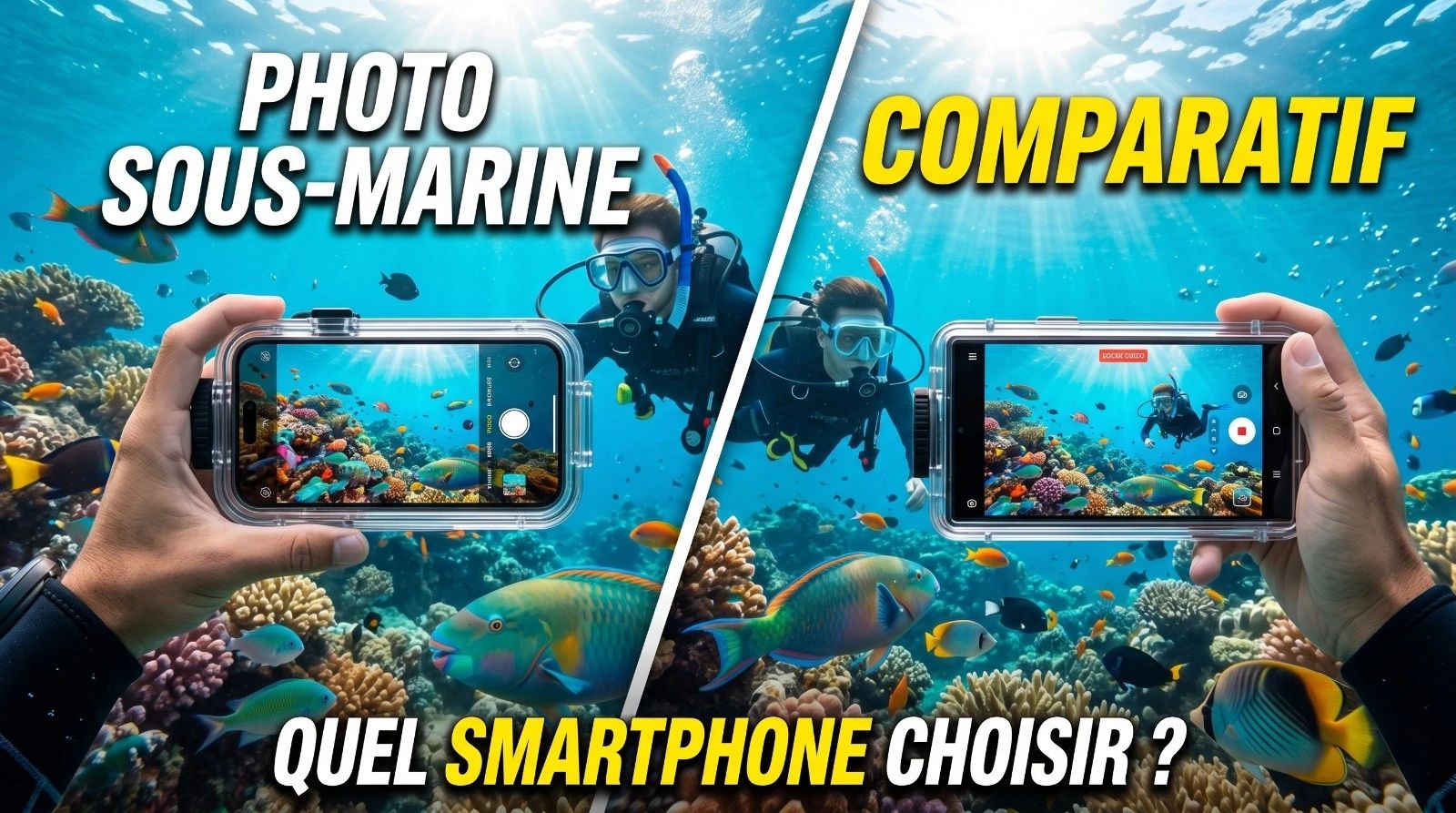
What is the best smartphone for underwater photography in 2026?
There is no single best smartphone for underwater photography: it depends on your use. Samsung Galaxy with Ocean Mode is the most accessible and intuitive for beginners. OPPO Find X9 Pro offers the best colour fidelity thanks to Hasselblad. iPhone 17 Pro excels at professional video. Pixel 10 Pro has the simplest underwater mode to use. All require a housing to dive beyond 2 metres.
Do I need a housing even if my smartphone is "waterproof"?
Yes. IP68 or IP69 certification protects your phone against brief, shallow immersion in fresh water. For diving (salt water, pressure, depth), a dedicated housing like the DiveVolk SeaTouch is essential. All manufacturers recommend it themselves.
Samsung Ocean Mode, OPPO Hasselblad, Pixel Underwater Mode - what is the difference?
Three different approaches to the same problem. Samsung Ocean Mode corrects colours after the shot via AI. OPPO Hasselblad analyses actual light via a multi-spectral sensor before compression. Pixel Underwater Mode uses a specific white balance algorithm. In practice, results are close at the surface, but the difference in philosophy shows beyond 5 metres.
What is the best training to photograph underwater with a smartphone?
AquaExposure offers complete training covering underwater photography from smartphone to semi-professional equipment, whatever phone you use.
For a year or two now, the major smartphone makers have all taken the same turn.
There is a real market for underwater photography, and each responds with its own philosophy: a software mode here, a partnership with a legendary photo brand there, a proprietary algorithm elsewhere. The result in 2026 is that the diving photographer faces four serious approaches that are incompatible - not technically, but in their logic. Understanding these differences means choosing the right tool for your own practice.
Samsung Galaxy S26 - Ocean Mode, the most complete entry point
Samsung is the only manufacturer to have developed its underwater mode in collaboration with marine scientists (Scripps Institution of Oceanography) and tested it in real conditions for coral reef mapping. Ocean Mode, available via Expert RAW on the Galaxy S26, S25, S24, Fold 7, Flip 7 and 2025 foldable models, is the direct result of that fieldwork.
What Ocean Mode does concretely: automatic colour correction, motion blur reduction, interval burst mode at 2, 5 or 10 seconds. Results are solid from 0 to 3 metres, acceptable to 10 metres, and insufficient beyond that without artificial lighting.
The Galaxy S26 Ultra (Galaxy AI, 200MP wide-angle) is the most complete model for underwater photography in the Samsung range. In French-speaking Europe, Samsung is also the most widely distributed manufacturer - ease of purchase, after-sales service, and accessory compatibility all work in its favour.
For whom: the beginner or intermediate diving photographer who wants a turnkey, intuitive solution backed by a solid ecosystem.
OPPO Find X9 Pro - Hasselblad, the science of colour
OPPO is less known in Europe than Samsung or Apple, but its photography results are taken very seriously by specialist reviewers. Tom's Guide described the Find X9 Pro in 2026 as "proof that Samsung and Google aren't trying hard enough." Android Central called the Ultra "the new king of camera phones."
What sets the OPPO Find X9 apart is its Hasselblad partnership at the sensor level. A second multi-spectral sensor analyses light composition independently, and the algorithm from Hasselblad colour science fuses the two readings. The result is colour fidelity that does not depend on post-capture correction but on a better reading of reality at the moment of capture.
At depth, where light changes constantly and blind correction shows its limits, this approach produces more stable results than its competitors. The Native Film Modes (April 2026) integrate into the raw processing pipeline - not as surface filters applied after the fact.
One point worth clarifying: the 200 megapixels refer to the periscope telephoto (3x optical, 13.2x lossless, 120x digital on the Ultra), not the main sensor. The main sensor is 50MP F/1.5, an exceptionally wide aperture for capturing light in difficult conditions. The OPPO Find X9 Pro and Ultra also have a native underwater mode built directly into the Camera app.
For whom: the photographer seeking the best possible colour fidelity who is willing to step outside the Samsung or Apple ecosystem. Particularly interesting for those investing in a DiveVolk housing - the combination ranks among the most capable on the market in 2026.
iPhone 17 Pro - ProRes, ProRAW, the cinema path
Apple has not developed a dedicated underwater mode on the iPhone 17 Pro. This is a deliberate choice. Apple's philosophy for underwater photography is to provide the most professional tools possible (ProRAW, ProRes 4K 120fps Dolby Vision, native Log) and let the photographer handle correction in post-processing.
This is a different approach, not an inferior one. ProRAW offers considerable editing latitude to correct a blue cast after the dive. ProRes opens the path to professional colour grading of underwater video, with image dynamic range that few smartphones can match.
In low-light video, the iPhone 17 Pro Max surpasses the OPPO Find X9 Pro according to DXOMark, with less visible noise in areas of uniform colour.
The limitation is real: without a dedicated mode, you need to know your manual settings or invest in a third-party app (Halide, ProCamera) to get the most out of underwater capture. That is not an obstacle for an experienced photographer, but it does raise the entry level considerably.
For whom: the photographer or videographer already working in an Apple workflow (Final Cut, DaVinci Resolve on Mac), who is at ease with ProRAW and ProRes, and is looking for the best underwater video quality available on a smartphone.
Google Pixel 10 Pro - the simplest to use underwater
The Google Pixel 10 Pro offers what is probably the most accessible underwater mode on the market today. It is integrated directly into the Camera app settings and activates with a single swipe. Once active, focus can reach down to 30 centimetres - a real advantage for underwater macro work.
The white balance algorithm built specifically for the aquatic environment, developed on the Tensor G5, is solid and requires no manual adjustment. The Pixel 10 Pro has a triple rear camera (50MP wide-angle, 48MP ultra-wide with macro focus, 48MP 5x telephoto), a balanced configuration for the variety of situations a dive presents.
Where the Pixel falls short: the colour fidelity of OPPO and the video latitude of iPhone are both beyond it. The Pixel 10 Pro is an excellent all-round tool, not a specialist in high-level underwater photography.
For whom: the diver who wants the fastest and most intuitive workflow, with no manual settings and good default results straight out of the water.
The four approaches side by side
Samsung Galaxy S26
OPPO Find X9 Pro
iPhone 17 Pro
Pixel 10 Pro
Dedicated underwater mode
Ocean Mode (Expert RAW)
Native underwater mode
No (manual ProRAW)
Underwater Mode
Colour approach
AI post-capture correction
Hasselblad multi-spectral
ProRAW manual latitude
Aquatic AWB algorithm
0-3m performance
Excellent
Excellent
Good (manual settings)
Good
3-10m performance
Good
Very good
Good (editing latitude)
Good
Beyond 10m
Limited without lighting
Limited without lighting
Limited without lighting
Limited without lighting
Main sensor
200MP F/1.7
What actually separates them - and what does not
All four phones share the same fundamental limitation: IP68 and IP69 certification was not designed for diving. For serious underwater work, in salt water, over the duration of a dive session, all require a dedicated housing.
Beyond 10 metres, physics takes over from all algorithms. No software mode, no colour science, no multi-spectral sensor can restore wavelengths the water has already absorbed. Artificial lighting remains the only answer at that depth.
What changes from one phone to another is the quality of what remains when conditions are good. And there, the differences are real.
The right choice depends less on a technical ranking than on how you actually work. If you retouch little, take the Samsung or the Pixel. If raw colour fidelity matters above everything and you are willing to explore a less common manufacturer, the OPPO Find X9 deserves serious consideration. If your work lives in professional video, the iPhone is the choice.
The sea will be beautiful with all four.
The AquaExposure training covers capture and settings for all these devices, with a dedicated module on equipment choice based on your level and budget.