Table of Contents
How to photograph an octopus while diving- understand its color changes, choose the right camera settings to capture the colors, and avoid common mistakes that scare it away.
The flamboyant cuttlefish of Lembeh is the most challenging animal I've ever tried to photograph. In April 2022, on a sandy seabed at 12 meters, a local guide pointed out a seemingly ordinary rock to my left. Two minutes later, the rock emitted a crimson wave that swept across its mantle from left to right in 0.4 seconds, leaving behind a trail of white and black spots that faded before my brain even registered what I had just seen.
The problem with cuttlefish is precisely that: the information arrives faster than your hand can react.
Why the cuttlefish is the most complicated subject to photograph
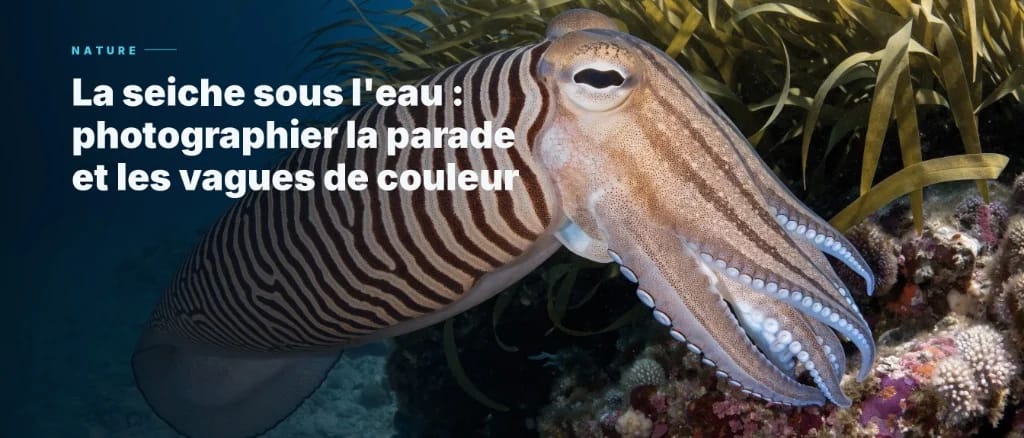
The common cuttlefish of the Mediterranean and the flamboyant cuttlefish of the Indo-Pacific share the same biological principle: chromatophores (pigment cells) controlled by the nervous system, capable of contracting or expanding in a few tenths of a second to create a pattern or dissolve it. The visual result is what is called a chromatic wave: a wave of color that sweeps across the mantle like an electrical impulse.
This wave presents two simultaneous photographic challenges.The first challenge is speed. A complete wave (from one edge of the mantle to the other) takes between 0.3 and 1 second, depending on the size of the animal and the intensity of the signal. With shutter speeds below 1/200th of a second, the color bands appear as blurry streaks rather than distinct lines. To freeze a wave in natural light, you need to increase the ISO, which creates a second problem: noise, which becomes visible in the areas of solid color on the mantle.
The second problem is exposure. The cuttlefish is both very bright (pure whites on the reflective spots) and very dark (deep blacks on the contracted chromatophores) in the same image. The dynamic range in a displaying cuttlefish often exceeds what a sensor can capture in a single shot.
The solution is neither perfect nor universal. It's a compromise between speed, ISO, and exposure.
The Two Types of Displays to Distinguish
Understanding what the animal is doing dramatically changes how you photograph it.
The Spring Mating Display in the MediterraneanFrom March to June, common cuttlefish in the Mediterranean gather in shallow areas (5 to 15 meters) to reproduce. The mating display is rhythmic and slow: the male produces regular waves in warm browns and creamy whites, sometimes with a deliberate asymmetry (one side of the mantle displayed for the female, the other side mimicking to deceive rival males). The animal is less vigilant than usual, which is a good opportunity for the photographer, provided they don't overdo it.
The Dominance Display or a Warning Signal
Faster and irregular waves, predominantly dark patches, a low posture with arms slightly outstretched: this could be a dominance interaction between two males, or a warning signal directed at you. The difference can be seen in the direction: if the wave is directed towards another animal, it's intraspecific communication. If the mantle is directed towards you and the chromatophores contract abruptly, it means you are too close.
Where to Find Cuttlefish
Common cuttlefish can be found throughout the year in the Mediterranean, but spring (March to June) is the breeding season. It is during this period that the displays are the most spectacular and the animals are most accessible. Sandy bottoms between 5 and 20 meters, seagrass beds, cave entrances: the cuttlefish hunts where the light allows it to see its prey.The Catalan coast (Cerbère-Banyuls, Cap de Creus) and the coves of the French Riviera are good starting points. The Balearic Islands are ideal in April and May.
For the flamboyant cuttlefish (Metasepia pfefferi), you need to travel to the Indo-Pacific. Lembeh in Indonesia remains the world's leading destination for the density of marine life. Anilao in the Philippines and the Arafura Sea in Australia are other options. The season in Lembeh roughly extends from April to October, but the flamboyant cuttlefish can be found year-round if you have a good guide.
Camera Settings: The Speed-ISO-Exposure Compromise
The logic is simple: use a shutter speed fast enough to freeze the water movement (a minimum of 1/250, 1/500 if the light allows), adjust the ISO accordingly, and slightly underexpose the center of the image to avoid overexposing bright white areas.
In the Mediterranean at 10 meters with good surface light, a setting of f/5.6, 1/250, ISO 800 is a reasonable starting point. In low light or at greater depths, you'll need to increase the ISO to 1600-3200 and accept some grain rather than dropping below 1/200.
Focus: Use continuous autofocus on the eye or the central mantle. The flamboyant cuttlefish doesn't move as quickly as a passing fish, but the water movement creates local contrasts that can disrupt single-point autofocus. Switch to zone autofocus or tracking if your camera or application allows it.
The Common Mistake That Ruins Everything
Position yourself directly in front of the animal, within its direct line of sight.The cuttlefish has almost panoramic vision thanks to its W-shaped pupils. When you position yourself in front of it, it perceives you as a potential predator that is blocking its path. The display stops, the arms contract, the animal retreats or swims away.
The best position is to the side, slightly below the animal's level, with the camera sensor perpendicular to the mantle. You can see the entire length of the waves, the animal doesn't perceive you as a direct threat, and the natural side lighting highlights the volumes of the mantle.
If two cuttlefish are interacting (during a mating display or competition), avoid positioning yourself between them. This is the position that most quickly interrupts the interaction.
What you will find in the related articlesThe issue of shutter speed when photographing moving subjects is discussed in detail in Why Your Underwater Photos Are Blurry and Blue, which also covers focusing techniques in challenging conditions. The behavioral approach to photographing octopuses (a related species) follows the same observation principles as those developed in the article on Photographing an Octopus. To learn how to find hidden macro subjects in a dive site, including daytime cuttlefish, the article on Finding Macro Subjects While Diving provides field techniques for spotting them.
The AquaExposure Underwater Photography Course covers the cephalopod module within the animal behavior curriculum.
Share
/blog/seiche-photographier-parade-couleurs-sous-marine-en
Table of Contents
- 01Why the cuttlefish is the most complicated subject to photograph
- 02The Two Types of Displays to Distinguish
- 03The Spring Mating Display in the MediterraneanFrom March to June, common cuttlefish in the Mediterranean gather in shallow areas (5 to 15 meters) to reproduce. The mating display is rhythmic and slow: the male produces regular waves in warm browns and creamy whites, sometimes with a deliberate asymmetry (one side of the mantle displayed for the female, the other side mimicking to deceive rival males). The animal is less vigilant than usual, which is a good opportunity for the photographer, provided they don't overdo it.
- 04The Dominance Display or a Warning Signal
- 05Where to Find Cuttlefish
- 06Camera Settings: The Speed-ISO-Exposure Compromise
- 07The Common Mistake That Ruins Everything
- 08What you will find in the related articlesThe issue of shutter speed when photographing moving subjects is discussed in detail in [Why Your Underwater Photos Are Blurry and Blue](/en/blog/pourquoi-vos-photos-sous-marines-sont-floues-et-bleues), which also covers focusing techniques in challenging conditions. The behavioral approach to photographing octopuses (a related species) follows the same observation principles as those developed in the article on [Photographing an Octopus](/en/blog/poulpe-photographier-comportement-approche-sous-marine). To learn how to find hidden macro subjects in a dive site, including daytime cuttlefish, the article on [Finding Macro Subjects While Diving](/en/blog/trouver-sujets-macro-plongee-reperage-patience) provides field techniques for spotting them.
Questions about the Journal
What shutter speed should I use when photographing a cuttlefish?
Between 1/250 and 1/500 to freeze a moving chromatic wave. A color wave passes through the skin of the squid in less than one second. Below 1/200, the color bands appear as blurry streaks rather than sharp lines. Increase the ISO accordingly to maintain proper exposure.
What is the difference between the mating display and the alarm signal in cuttlefish?
The courtship display: This involves regular, rhythmic patterns of color- a warm brown alternating with white spots- as the animal slowly approaches a potential mate or a rival. The alert signal: This is characterized by irregular patterns consisting of dark spots and pale bands, a contracted body, and a low posture. If you see the alert signal, you are too close.
Where can you find octopuses in the Mediterranean Sea?
In the Mediterranean, common cuttlefish are found at depths of 5 to 30 meters, often above sandy bottoms or seagrass beds. Spring (March to June) is the breeding season - this is when the mating displays are the most spectacular and the animals are least skittish. The Catalan coast, the French Riviera, and the Balearic Islands are good locations for observing them.
Does the flamboyant squid exist in the Mediterranean Sea?
No. The flamboyant cuttlefish (Metasepia pfefferi) is an Indo-Pacific species primarily found in Indonesia (Lembeh, Anilao), Australia, and Papua New Guinea. While the common cuttlefish (Sepia officinalis) in the Mediterranean can sometimes produce impressive color displays, witnessing the true visual spectacle of the flamboyant cuttlefish requires a trip to the Indo-Pacific region.
Can you photograph an octopus using a smartphone?
Yes, under good lighting conditions- shallow depth, clear water, and good ambient light. The main issue is the shutter speed- most automatic settings are limited to around 1/120, which can cause slight blur on fast-moving waves. In manual mode or with an app that controls the shutter speed, it is definitely achievable at the surface at depths of 2-5 meters.
What distance should you maintain from a cuttlefish to avoid disturbing its mating display?
A minimum distance of one meter is recommended when photographing a displaying octopus. An octopus in courtship mode is less attentive to your presence than usual, but a direct, head-on approach will invariably interrupt the display. Stay to the side, at the same level as the octopus or slightly below, and avoid positioning yourself between two octopuses that are interacting.
Do you need a flash to photograph an octopus?
No, and even in the deep Mediterranean at depths of 15-20 meters, natural light is sufficient if you increase the ISO. Using a flash significantly disrupts the behavior – cuttlefish are very sensitive to bright flashes and usually stop interacting as soon as the flash fires. Natural light and a high ISO are the AquaExposure method.