Table of Contents
How to photograph squid during night dives or blackwater dives- the ethical dilemma of lighting, the AquaExposure method, and camera settings for pelagic cephalopods.
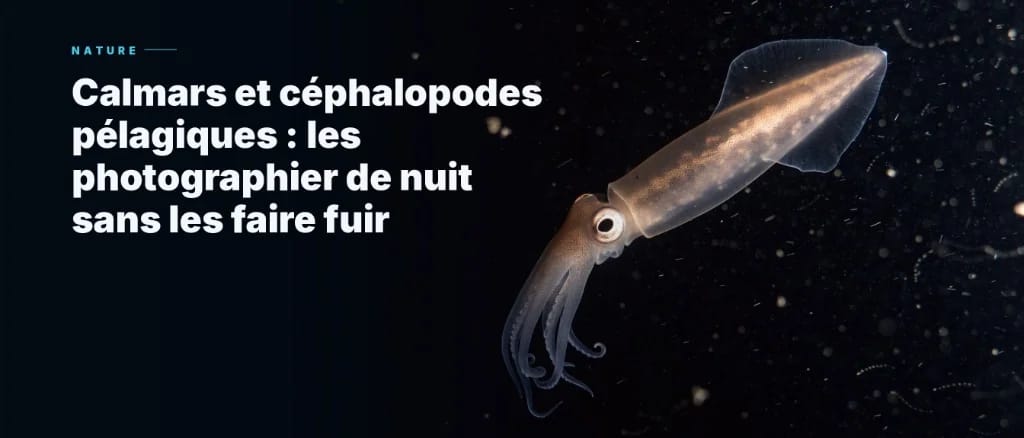
The light is turned on at 10:30 PM, at a depth of 8 meters, off the coast of Cerbère. Within the next 90 seconds, the beam attracts a column of plankton visible to the naked eye – small, luminous points that move within the circle of light. And in the two minutes that follow, the first squid arrive.
This is the dilemma. The light that allows me to see is also the one that disrupts their hunting.
The mechanism that creates the ethical problem
Squid are active nocturnal predators. At night, they hunt zooplankton and small fish in the water column, often in collective formations – a group that encircles a school of prey and closes in like a net. This hunting behavior is not something you often observe during daytime dives.
Artificial light disrupts this system on two levels. First, it attracts zooplankton, artificially creating a concentration of prey in the wrong location. Second, the bright white light signals danger to many nocturnal animals, including squid, whose eyes are adapted to function in near-total darkness.
The result is that you observe squid whose behavior is entirely conditioned by your presence and the light. This is interesting – but it is not their natural behavior.The AquaExposure method does not prohibit nighttime squid photography. It sets guidelines: minimal light, indirect angle, a maximum of one or two shots per subject, and no chasing.
Blackwater vs. Coastal Night Diving: Two Different Contexts
Coastal Night Diving
This is the most accessible scenario. You dive at a known site, with a depth between 5 and 30 meters. Common squid (Loligo vulgaris) in the Mediterranean are frequently found in this context, especially during the summer and autumn when they actively hunt near the coast.
The approach is opportunistic: you encounter a squid or a group attracted by your lights, you manage the distance and light intensity, and you take a picture if the situation allows. Most of the time, coastal squid are less skittish than daytime cuttlefish – probably because your silhouette is less visible in the darkness.
Blackwater Diving
Blackwater diving is a dive in open water, far from the coast, with no visible bottom. You are attached to a safety line with weighted lights below you. These lights attract the water column towards the surface – and everything that lives there at night, including pelagic cephalopods that you would never see otherwise.This is where you might encounter transparent squid, nautiluses if you're incredibly lucky, miniature pelagic octopuses, and all sorts of larval and juvenile stages of species you recognize as adults on the seabed. Blackwater diving is visually fascinating – and more technically demanding because there are no depth or directional references.
The Maldives (far from the coast, towards the channels), the Philippines (Anilao at night), and Lembeh are destinations known for the quality of their blackwater diving. In the Mediterranean, a few operators on the Catalan coast and in Corsica offer offshore sessions.
The Exception to the Rule
AquaExposure is an approach that emphasizes natural light. However, the rule has honest exceptions, and night diving is one of them.
In complete darkness, without artificial light, you see nothing. The question isn't "flash or no flash" – it's "what level of lighting is needed to get an image while minimizing disturbance."
The protocol for nighttime pelagic cephalopods:
Minimal focus light. Use the focus light function of your dive torch (low intensity, typically 10-20% of maximum power) rather than the full beam. Some torches offer a red light mode – cephalopods are generally less sensitive to red light than to white light.Limit flash usage to one or two bursts per subject. This isn't an arbitrary rule. Each flash burst on a nocturnal animal is a disruptive intrusion in an environment where there is normally no light. Two well-placed flashes can produce two good images. Rapid bursts of flash on a fleeing squid don't produce good results and are harmful to the animal.
Do not pursue after the animal flees. If a squid swims away after your first shot, let it go. This rule applies during the day as well, but it is even more important at night, when the animal has fewer cues to assess the threat you represent.
Use an indirect angle. If you are using a flash, do not aim it directly at the animal's eyes. A lateral or slightly overhead angle (to illuminate the mantle without hitting the eyes) is much less disruptive.
Camera Settings for Nighttime Pelagic Cephalopods
The challenge is to combine a fast enough shutter speed to freeze motion with an ISO setting that doesn't overwhelm the image with noise.
Use a wide-angle lens (24-35mm equivalent) to capture context. Pelagic squid in blackwater environments are often accompanied by other interesting organisms - a too-tight crop loses the surrounding environment.
Aperture f/4 to f/5.6, ISO 800 to 1600, shutter speed 1/100 to 1/250. Squid change direction abruptly using jet propulsion - at speeds slower than 1/100, you will get motion blur on the fins. Continuous autofocus is essential.In blackwater diving, focusing is particularly challenging because the animal moves in all three dimensions simultaneously. Switch to area autofocus mode rather than single-point, and frame your shot wide to allow for cropping later.
Other Pelagic Cephalopods You Might Encounter
The squid is not the only one. In blackwater environments, especially in the Indo-Pacific:
Cuttlefish (Sepiadarium sp.) are miniature cephalopods (2 to 5 cm) that are often mistaken for young octopuses. Their behavior in the presence of light is different: they often remain still rather than fleeing, which makes them more accessible for photography.
Juvenile benthic octopuses sometimes rise into the water column at night. At this stage, they resemble small, translucent sacs with pigment spots – nothing like the adult you would recognize on the seabed.
In the Mediterranean, the common squid (Loligo vulgaris) is the most common. The spirule (Spirula spirula) – a cephalopod with an internal spiral shell – is rarely seen alive but is present in the eastern Mediterranean.
To Further Develop Your Night Diving TechniquesNight diving photography is covered in the article on night diving photography - techniques and ethical considerations, which provides a general overview and discusses situations where artificial lighting is acceptable. The question of "when to use a flash" is explored in the article four legitimate exceptions to flashless underwater photography. And for blackwater diving, the article blackwater diving - photographing plankton at night covers the logistics and general techniques for this type of diving.
The AquaExposure underwater photography course addresses the management of artificial light at night in the "extreme conditions" module.
Share
/blog/calmar-nuit-photographier-cephalopode-pelagique-en
Table of Contents
- 01The mechanism that creates the ethical problem
- 02Blackwater vs. Coastal Night Diving: Two Different Contexts
- 03Coastal Night Diving
- 04Blackwater Diving
- 05The Exception to the Rule
- 06Camera Settings for Nighttime Pelagic Cephalopods
- 07Other Pelagic Cephalopods You Might Encounter
- 08To Further Develop Your Night Diving TechniquesNight diving photography is covered in the article on [night diving photography - techniques and ethical considerations](blog/plongee-nuit-photo-technique-sans-flash-ethique), which provides a general overview and discusses situations where artificial lighting is acceptable. The question of "when to use a flash" is explored in the article [four legitimate exceptions to flashless underwater photography](blog/quand-utiliser-flash-photo-sous-marine-exceptions). And for blackwater diving, the article [blackwater diving - photographing plankton at night](blog/blackwater-diving-photographie-plancton-guide-complet) covers the logistics and general techniques for this type of diving.
Questions about the Journal
Why are squid attracted to underwater lights?
Squid are active hunters at night, and artificial light attracts zooplankton and small fish that they feed on. In blackwater dives or coastal night dives, a strong white light quickly creates a "cloud" of plankton, which attracts the squid. This is precisely the mechanism that creates the ethical dilemma: the light that allows for the photograph is also the light that disrupts their natural hunting behavior.
What is the difference between a standard night dive and blackwater diving for squid?
For typical night dives (on the seabed or along a reef), you may encounter squid opportunistically, attracted by the light from your dive lights at depths between 5 and 30 meters. In "blackwater" diving, you dive in open water, attached to a line, with weighted lights below you to attract the water column – and therefore everything that lives in it, including pelagic cephalopods that you would never see otherwise.
What settings should I use to photograph a squid at night?
A wide-angle lens with a short focal length (24-35mm) is ideal for capturing context. Use an aperture of f/4 to f/5.6, an ISO of 800 to 1600, and a shutter speed of 1/100 to 1/250 to freeze the movement of the propulsion. Squid move quickly and change direction unexpectedly, so continuous autofocus is essential. If your equipment allows it, using burst mode to capture 3 to 5 images will maximize your chances of getting the perfect shot.
Is it acceptable to use a flash when photographing squid?
This is an exception outlined in the AquaExposure philosophy. In night dives or blackwater dives, natural light is absent, and a diffused flash at minimal power may be acceptable. This means a maximum of one or two flashes per subject, using an indirect angle (not directly in front of the animal's eyes), and avoiding repeated flashes if the animal flees after the initial flash. The goal is to capture an image, not to reduce the animal to a studio subject.
What species of squid can be encountered in the Mediterranean Sea at night?
The common squid (Loligo vulgaris) is the most frequently encountered species in the Mediterranean Sea, particularly during the summer and autumn months. It can be found and photographed at depths ranging from 5 to 50 meters. The reef squid (Sepioteuthis lessoniana) is less common but present in the eastern Mediterranean Sea. In the open ocean, far from the coast, smaller, more transparent squid (Doryteuthis sp.) may rise in the water column at night.
How can I avoid disturbing squid with the light from my dive torch?
Use the focus light at its lowest intensity instead of your main light. Aim the light towards the bottom or the side, rather than directly at the animal. Avoid sweeping the beam across the group of squid. If possible, switch to red light for the first few minutes – cephalopods are less sensitive to red light than to white light.
Is blackwater photography of squid accessible to a beginner scuba diver?
No. Blackwater diving is a discipline that requires perfect buoyancy control, independent management of the dive line, and orientation in open water without any reference to the seabed. It is generally recommended to have at least 50 dives and an Advanced Open Water certification before attempting it. Night dives along the coast, with opportunistic squid encounters, are more accessible even at the Open Water level.