Table of Contents
Underwater photography in Corsica- explore Scandola, Cap Corse, and the Lavezzi islands. Complete guide to photographing grouper, moray eels, and giant oysters without flash.
There are mornings when the sea dictates the conditions. On that particular morning, the boat left Porto before 7 am, with the Scandola cliffs still in shadow, the light skimming the red rhyolite columns like a hasty brushstroke. I hadn't even put on my mask yet, but I already knew that the images of the day would be different.
Underwater photography in Corsica hinges on details like these. The morning Mediterranean light, the water clarity in the protected reserves, the wildlife accustomed to human presence thanks to decades of strict protection. These are not artificial conditions. They are conditions that exist, right there, accessible to anyone with an underwater housing and the willingness to get up early.
This guide covers the best sites for photography in Corsica: Scandola and its UNESCO reserve, Cap Corse, and the Lavezzi islands. It provides information on settings, seasons, and logistics to help you transform a trip to Corsica into a memorable photography session.
Why Corsica is a unique destination for underwater photography
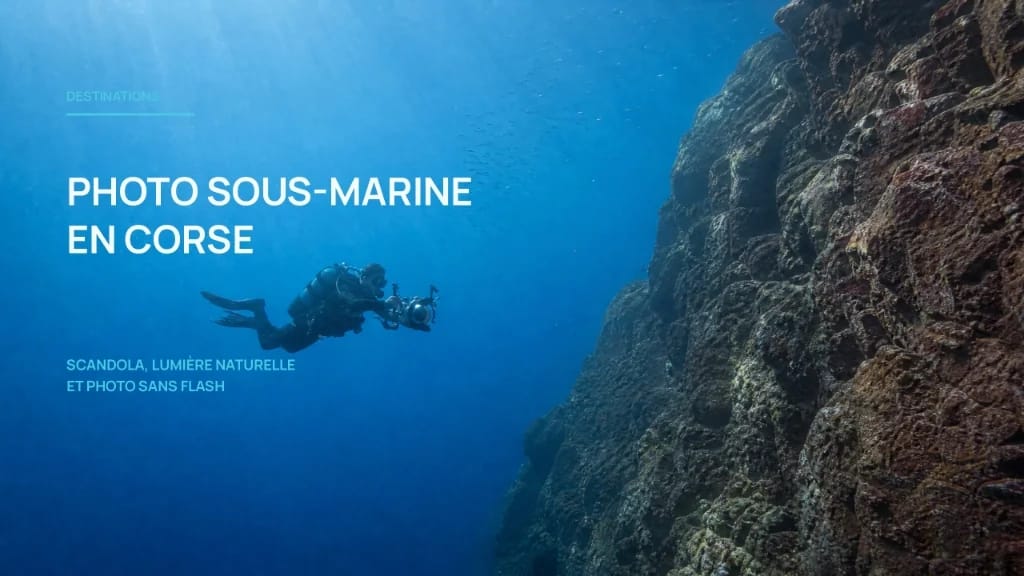
Corsica benefits from a rare combination that the western Mediterranean does not easily replicate. First, there is a long history of protection. The Scandola nature reserve has existed since 1975 and has been a UNESCO World Heritage site since 1983. Fifty years of tranquility is evident in the animals. Grouper approach within arm's reach. Moray eels inspect your fins with a casual curiosity. The wildlife has relearned not to flee.Next, the geology. The red rhyolite and obsidian cliffs of the Gulf of Porto plunge directly into the sea, creating drop-offs, caves, and arches that organize the natural light in a nearly theatrical way. At a depth of 8 meters, between 8:00 AM and 10:00 AM, the light passes through the water in beams that change every fifteen minutes.
Finally, visibility. Outside of the summer months when plankton is abundant (July-August, visibility can drop to 10-12 meters), Corsica typically offers 18 to 25 meters of visibility. For a photographer who shoots without a flash, this is the difference between a usable image and an image lost in a blue-green haze.
The Scandola Reserve: An Unmissable Site
Scandola is only accessible by sea, from Porto or Calvi. This restriction becomes an advantage: fewer people, more tranquility, and animals that have learned that humans do not pose a threat.
What you will find underwater
Brown groupers dominate the landscape. Some reach 60 to 70 cm, masses of orange flesh speckled with spots that allow you to approach them within photographic range without them flinching. They are the stars, and they know it.
Moray eels inhabit the cracks in the granite drop-offs. With a slow approach and a dive light to illuminate dark areas, they often emerge halfway, which provides a natural framing and a clear image without having to back away.Schools of barracuda appear from depths of -15 meters, often forming vertical columns that slowly rotate. Photographing a school of barracuda in natural light requires positioning the sun behind you and waiting for the school to pass through a column of light. No flash. No tricks. Just patience.
If you search carefully in the Posidonia seagrass meadows (the ecological backbone of the Mediterranean), you may encounter the giant scallops, Pinna nobilis. These vertical bivalve shells can reach up to 80 cm. They are protected and have been in significant decline since the arrival of the parasite Haplosporidium pinnae in 2016. Seeing a healthy specimen in Scandola is a privilege worth stopping for.
Logistics for Diving in Scandola
Dives in Scandola must be organized through a certified dive center. Porto Dive Center, Calvi Plongée, and several other operators based in Porto-Vecchio offer regular excursions from April to October.
It is advisable to book 2 to 3 weeks in advance, especially during July and August. The number of divers per excursion is limited by the reserve administration.
The boat trip from Porto takes 45 minutes to 1 hour, depending on sea conditions. The Gulf of Porto can be choppy due to the libeccio (southwest wind) in the afternoon. Local instructors know when to go and when to stay in the harbor. Trust their judgment.
Cap Corse: The Northern Drop-offsThe Cap Corse peninsula, which stretches towards Italy north of the island, offers a different diving profile. There are fewer strictly protected areas, but the seabed is very rocky, with drop-offs reaching -40 meters and a few accessible wrecks.
Wrecks of Cap Corse
Several cargo ships and warships lie in the waters of Cap Corse. The most well-known wreck for photography is the Beaulieu, accessible from -20 meters. The hull is covered in orange gorgonian corals and encrusting corals. In natural light, the contrast between the dark metal of the wreck and the colorful organisms that colonize it creates images with a strong impact.
To photograph a wreck without a flash, you need to choose the right time and the right orientation. A drop-off facing east will be optimal in the morning. A site facing south will offer good conditions between 10 am and 2 pm. Don't hesitate to ask local instructors about the orientation of each site. This is information that no one usually provides, but that every photographer should know before diving.
Red and Orange Gorgonian Corals
At -25 meters on some of the drop-offs of Cap Corse, you can begin to find red and orange gorgonian corals covering the vertical walls. These colonies can measure 1 to 2 meters in diameter. Without a flash, to photograph them, you need to position yourself so that the light comes from the side and slightly from above, and wait for the water clarity to allow you to see the details of the colony.Red coral (Corallium rubrum) can be found under certain overhangs, but it is rare in the Mediterranean due to historical collection. Never touch it.
The Lavezzi Islands: Absolute Clarity in the South
Located at the southern tip of Corsica, between Bonifacio and Sardinia, the Lavezzi Islands form a nature reserve of a unique type. There is less relief and less depth (dives range from -5 to -25 meters), but the water clarity is unmatched anywhere else in Corsica.
Why the Lavezzi Islands are Ideal for Beginner Underwater Photographers
The shallow maximum depth significantly affects the light. At -8 meters in the Lavezzi Islands, even in the middle of June, the natural light is so intense that it feels like you are shooting almost at the surface. The white sandy bottoms reflect light upwards, naturally eliminating shadows under the animals.
This is the perfect place to learn how to photograph in natural light without any unpleasant surprises. Exposure errors are immediately visible on the camera's screen, and the conditions allow you to correct them quickly.
The local fauna includes active octopuses (which hunt crabs in the granite crevices), motionless wrasses on the rocks (perfect for focusing practice), and dense schools of sars and gilt-head bream that swim along the seabed.
Recommended Settings for CorsicaThe waters of Corsica in the Mediterranean range in color from blue-green to turquoise, depending on the depth and season. For photography without a flash:
- White Balance: Use manual mode and adjust according to the depth. At the surface and up to -5 meters, the light is still white enough to use the automatic setting. Beyond that, switch to manual and choose a "sun" or "shade" white balance setting depending on the subject's position. A manually calibrated white balance produces natural, warm tones that a flash cannot reproduce with the same subtlety.
- Shutter Speed: Use 1/125 to 1/200 in calm water, and 1/250 if the swell creates movement. The underwater swell in the Mediterranean caves can be deceptive: subjects move unexpectedly.
- ISO: Use between 200 and 800, depending on the depth and time of day. Don't hesitate to increase to 1600 to maintain a reasonable shutter speed, rather than slowing down and getting blurry images.
- Angle of View: Wide-angle lenses (16-28mm equivalent to full frame) are ideal for wide shots that include the fauna and drop-offs in the background. Medium focal lengths (50-85mm) are more suitable for portraits of groupers and details of gorgonian corals.To delve deeper into the settings suitable for these conditions, the AquaExposure underwater photography course provides detailed coverage of every lighting situation encountered in the Mediterranean.
Seasons and Weather: Choosing the Right Time
| Month | Water Temperature | Average Visibility | Marine Life | Crowdedness |
|---|---|---|---|---|
| April-May | 16-18°C | 20-25 m | Good | Low |
| June | 20-22°C | 18-22 m | Excellent | Moderate |
| July-August | 24-26°C | 12-18 m | Excellent | High |
| September-October | 22-24°C | 18-25 m | Excellent | Moderate |
September is the ideal month for combining photography: warm water, visibility improving after the summer algae bloom, and lower crowds. Grouper are more active than in the peak of summer because the competition for spawning sites is over, and they begin to move around again.
Composing an Image at Scandola: Two Approaches
The Portrait Approach: Close-up of a Grouper
Approaching a grouper at Scandola is easy. Photographing it well is less so. Groupers tend to look directly at you, which results in symmetrical and less dynamic images. To break this symmetry, position yourself slightly to the side and wait for the fish to turn its head. The rule of thirds applies directly: place the grouper's eye at one of the four points of interest in the image, never in the center.
The Landscape Approach: Drop-off and LightThe drop-offs of Scandola are ideal for wide-angle compositions. Position yourself halfway down the drop-off, placing the red cliff in the upper third of the frame and the dark zone of the deep water in the lower third. Allow a ray of natural light to enter the frame if the site's geography allows. This type of image tells the story of the dive as much as it documents it.
Corsica in a Mediterranean Itinerary
Corsica pairs well with Port-Cros (1 hour flight or ferry from the mainland, a dedicated article to follow in this section) for a two-week itinerary entirely dedicated to Mediterranean underwater photography. For those who want to extend the exploration eastward, Croatia and Dalmatia offer a complementary diving profile with wrecks and caves featuring exceptional natural light.
Corsica holds a special place in this itinerary because it combines the three key elements that make a great photography destination: ancient protection, spectacular geology, and clear water. It's not the least expensive destination in the Mediterranean basin. It's simply the most complete for flash-free underwater photography.
Benjamin Coste is a diving instructor and underwater photography instructor. He has been teaching flash-free photography since 2014 on aquaexposure.com.
Share
/blog/corse-plongee-photo-scandola-reserve-naturelle-en
Table of Contents
- 01Why Corsica is a unique destination for underwater photography
- 02The Scandola Reserve: An Unmissable Site
- 03What you will find underwater
- 04Logistics for Diving in Scandola
- 05Cap Corse: The Northern Drop-offsThe Cap Corse peninsula, which stretches towards Italy north of the island, offers a different diving profile. There are fewer strictly protected areas, but the seabed is very rocky, with drop-offs reaching -40 meters and a few accessible wrecks.
- 06Wrecks of Cap Corse
- 07Red and Orange Gorgonian Corals
- 08The Lavezzi Islands: Absolute Clarity in the South
- 09Why the Lavezzi Islands are Ideal for Beginner Underwater Photographers
- 10Recommended Settings for CorsicaThe waters of Corsica in the Mediterranean range in color from blue-green to turquoise, depending on the depth and season. For photography without a flash:
- 11Seasons and Weather: Choosing the Right Time
- 12Composing an Image at Scandola: Two Approaches
- 13The Portrait Approach: Close-up of a Grouper
- 14The Landscape Approach: Drop-off and LightThe drop-offs of Scandola are ideal for wide-angle compositions. Position yourself halfway down the drop-off, placing the red cliff in the upper third of the frame and the dark zone of the deep water in the lower third. Allow a ray of natural light to enter the frame if the site's geography allows. This type of image tells the story of the dive as much as it documents it.
- 15Corsica in a Mediterranean Itinerary
Questions about the Journal
What is the best time of year to go scuba diving in Corsica?
From June to October. Visibility is at its maximum (15 to 25 meters) and the water temperature reaches 22 to 26°C at the surface. July and August are the months with the most tourists, but the marine life remains present. For photographers, June and September offer the best balance of light and visitor numbers.
Can I dive at Scandola without a special certification?
Scandola is a natural reserve with access that is strictly controlled. Diving must be done through a certified dive center. Individual access is prohibited. It is essential to book several weeks in advance, especially during peak season.
What photography equipment should I use for diving in Corsica?
A smartphone in a waterproof housing is sufficient to get started. The visibility and natural light in the Mediterranean Sea allow you to capture excellent images without a flash. To progress, a compact camera like the Sony RX100 or the Olympus TG-7 in its dedicated housing offers more control.
What animals can be photographed at Scandola?
Brown groupers up to 70 cm, giant moray eels, schools of barracuda, octopuses, sea bream, sars, and giant scallops (Pinna nobilis, a protected species). On the surface, cormorants nest on the red cliffs of Scandola.
Is the Scandola nature reserve difficult to access?
It is only accessible by sea, from Porto or Calvi (a 1.5-hour boat trip). There are no land routes leading to it. This presents a logistical challenge, but it ensures limited visitor numbers and a relaxed marine environment, which is ideal for underwater photography.
Do you need a flash to take underwater photos in Corsica?
No. The Corsican Mediterranean offers exceptional natural light between 8:00 AM and 12:00 PM, down to a depth of -12 meters. By manually adjusting the white balance and surfacing at midday, you can achieve warm colors without using any flash. This is the AquaExposure philosophy.
What other dive sites in Corsica are worth visiting for underwater photography?
Here are some recommended dive sites: * **Les Lavezzi** (the southernmost area) is known for its crystal-clear water and white sandy bottoms. * **Cap Corse** offers impressive drop-offs and wrecks. * **Banyuls-sur-Mer**, located just across the French-Spanish border, is a great addition to a Western Mediterranean diving itinerary.