Table of Contents
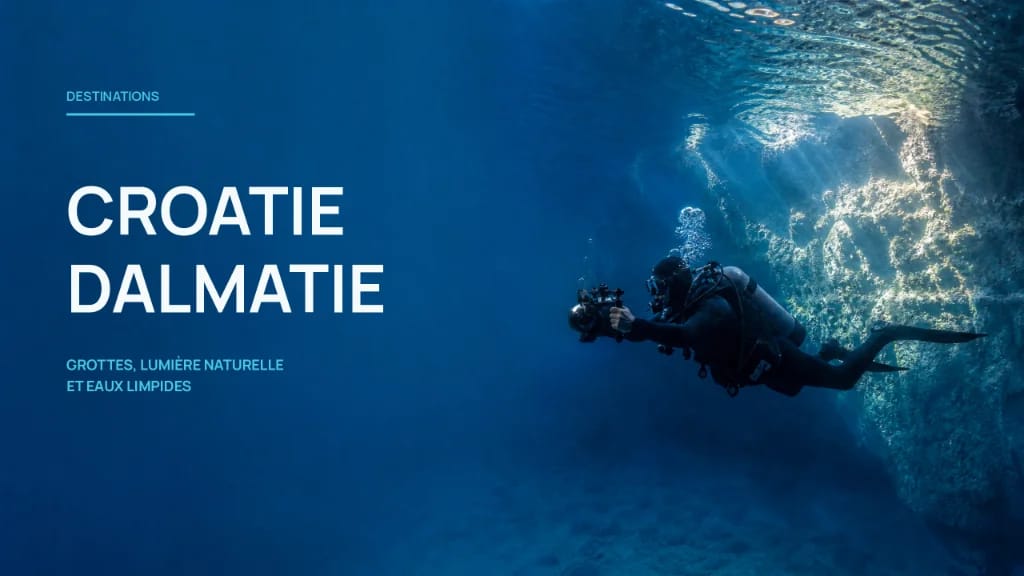
Underwater photography in Croatia- WWII wrecks, light beam caves, cephalopods. Complete guide to photographing in Dalmatia without flash.
The first time I dove in the Adriatic, I thought my dive computer was broken. The visibility displayed 28 meters. In the French Mediterranean, I would have been skeptical. In Croatia, it's the norm.
The Adriatic Sea has a rare characteristic: it is relatively shallow (less than 50 meters along most of the Dalmatian coast), almost enclosed, and the water that enters from the Ionian Sea takes weeks to circulate. The result is a transparency that allows colors to be visible at depths where, elsewhere, everything becomes monochrome. For an underwater photographer working with natural light, this is a fundamental advantage that fundamentally changes what is possible.
This guide covers underwater photography in Croatia, with a focus on Dalmatia: shipwrecks from World War II, caves with beams of light, cephalopods, and settings adapted to Adriatic conditions.
What makes the Adriatic unique for photography
Transparency is the first advantage, but not the only one. The Adriatic is also relatively undisturbed by surface currents, which means that divers are stable in the water, subjects move little, and blurry images caused by involuntary movement are rare.Second advantage: the base color. The water in the Adriatic tends towards a brighter blue-turquoise than the French Mediterranean, particularly around the white limestone islands of Dalmatia (Vis, Hvar, Brač). This naturally light background changes the color palette available to the photographer.
Third advantage: the shipwrecks. The Adriatic has been the site of numerous naval battles during both World Wars. These wrecks, resting between -20 and -70 meters, are now artificial reefs that have been colonized by marine life for 80 years. They concentrate an extraordinary amount of underwater life on photogenic structures that nature alone could not have created.
Shipwrecks of Dalmatia: Structures and Light
The Baron Gautsch (near Rovinj, Istria)
The Baron Gautsch is the most famous wreck in Croatia. This Austrian passenger ship, sunk in 1914 by a mine, rests at -40 meters (the upper part of the hull is at -28 meters). The structure is intact, with portholes, stairs, and bulkheads still standing after more than a century.
To photograph it in natural light, position yourself at the bow of the ship between 9 am and 10 am in the summer, so that the light comes from the east behind you. The hull then stands out against a bright background, and the structure of the wreck is visible without a flash. The depth requires a higher ISO setting (800 to 1600), but the 20-meter visibility allows for wide-angle shots that compensate.
The Shipwrecks of the Island of VisThe island of Vis, off the coast of Split, is home to several accessible wrecks, including a World War II airplane (-40 m) and several cargo ships. These sites are less crowded than the Baron Gautsch and often offer a more peaceful photographic experience.
The wrecks of Vis are guided by experienced local instructors. The dive centers in Vis Town and Komiža are familiar with all the sites and know the ideal times for each wreck. This information, which is difficult to obtain otherwise, is the main reason to dive with a local guide, even for experienced divers.
Caves and Semi-Caves: Beams of Natural Light
The Dalmatian coast is dotted with semi-submerged caves, some of which create lighting conditions that studio photographers could not artificially replicate.
The Blue Cave of Bisevo
Technically, this is a marine cave accessible by boat rather than by diving. Light enters through an underwater opening at -4 m, illuminating the interior of the cave with an electric blue hue between 11 am and 12 pm. The experience is spectacular. To photograph it, position yourself so that the light source is in the frame (contrary to the usual reflex) and expose for the illuminated areas. The dark interior of the cave absorbs light, forcing an exposure that makes the blue even more intense.
The Semi-Caves of the CoastAlong the Dalmatian coast, rocky overhangs create semi-caves where light filters in through the open entrance. These situations are ideal for backlighting shots. Position the subject (a grouper, a moray eel, or a conger) in the shadow of the overhang and allow the external light to outline the animal.
This type of backlighting image is one of the most challenging to achieve in natural light, but also one of the most visually striking. It requires manually adjusting the white balance and accepting a slight overexposure in the areas of direct light to preserve detail in the shadowed areas.
Croatian Fauna: Cephalopods and Diverse Seabeds
Cuttlefish: The Adriatic's Signature Species
The common cuttlefish (Sepia officinalis) is the iconic animal for underwater photography in Dalmatia. Between May and July, cuttlefish gather in seagrass beds and on sandy areas to reproduce. Females lay their black eggs on gorgonians, algae, and artificial structures. During the spawning season, males compete for females in spectacular visual displays, with the chromatophores in their skin changing color in real time.Photographing a cuttlefish during its mating display is one of the most memorable experiences in Mediterranean diving. The animal is large (20 to 30 cm), moves slowly, and the color changes are slow enough to be captured at normal shutter speeds.
Rock Octopuses
Common octopuses (Octopus vulgaris) are present year-round on the rocky seabeds of Croatia. Unlike Corsica or Port-Cros, where they sometimes hunt during the day, Croatian octopuses generally stay in their dens during periods of high light and emerge at dawn and dusk. A late-day dive (5 PM to 7 PM) significantly increases the chances of finding them active.
White Gorgonians of Hvar
The Hvar archipelago is known among local divers for the density of its colonies of white gorgonians (Eunicella singularis) found between 15 and 30 meters. These gorgonians, less commonly photographed than red gorgonians, have a strange and mineral appearance that complements the bluish light of the Adriatic Sea.
Camera Settings for Croatian Conditions
The exceptional visibility of the Adriatic Sea changes how you manage focus. In the French Mediterranean, with a visibility of only 10 meters, you generally work within 2 meters of the subject. In Croatia, with a visibility of 25 meters, you can move back to 3 or 4 meters, which changes the perspective and compression of the image.For wrecks: - A wide-angle lens is essential (16mm or less in full-frame equivalent) - ISO 400 to 1200 depending on the depth - Shutter speed 1/100 to 1/160 (wrecks don't move, so high shutter speeds aren't necessary) - White balance set to "cloudy" or "shade" to reproduce the warm tones of the rust.
For caves and semi-caves: - A faster shutter speed (1/250 to 1/400) to freeze the diver's movements in the scene - A higher ISO (800 to 3200) to properly expose the shadows - White balance in automatic mode to allow the camera to decide between direct light and shadow.
For octopuses and cephalopods: - A longer focal length if available (50-90mm equivalent) to avoid getting too close and stressing the animal - A minimum shutter speed of 1/200 to freeze the water droplets and tentacle movements - Burst mode if the housing allows it: mating behaviors are unpredictable, and burst mode captures what the eye alone might miss.
Croatia in a Mediterranean Photo Tour
Croatia naturally complements a tour that begins in Corsica or Port-Cros. These three destinations cover three different types of underwater photography: marine life in protected reserves (Corsica and Port-Cros), wrecks, and caves with structured natural light (Croatia).Combined over two to three weeks of travel, these trips provide a comprehensive view of what the western Mediterranean and the Adriatic can offer to an underwater photographer working without a flash. The total budget for this Mediterranean circuit, including flights and accommodation, remains lower than many exotic destinations, often offering superior photographic conditions.
To systematically improve specific techniques for each of these destinations, the AquaExposure underwater photography course offers modules dedicated to Mediterranean destinations, with practical exercises tailored to each type of dive site.
Practical Logistics in Croatia
Access from France and Belgium: Direct flights to Split and Dubrovnik from Paris, Lyon, and Brussels. Numerous low-cost airlines operate during the summer. Outside of peak season, consider flying via Zagreb or driving if coming from Belgium or France (Split is reachable in 12 hours from Paris via highways).
Ideal photographic periods: June (when octopus are breeding, with clear water) and September (water is still warm at 23-24°C, fewer crowds, and the light is softer and more beautiful later in the season).Dive Centers: Croatia has a well-developed diving infrastructure. The main hubs are Dubrovnik, Split, Hvar, Vis, Rovinj, and Zadar. The quality of the briefings and knowledge of the dive sites varies significantly between centers. It's best to choose centers that have photo-specialized guides or illustrated site guides.
Dive Costs: A guided dive typically costs between 40 and 60 euros during peak season. Packages offering multiple dives (5 or 10 dives) reduce the per-dive price. Factor in the cost of renting a dive tank if you are not traveling with your own.
Benjamin Coste has been taking underwater photographs for over 4,000 dives in the Mediterranean and in all three oceans. His belief is that the best underwater images are created with natural light and patience, not with expensive equipment.
Share
/blog/croatie-dalmatie-photo-sous-marine-guide-en
Table of Contents
- 01What makes the Adriatic unique for photography
- 02Shipwrecks of Dalmatia: Structures and Light
- 03The Baron Gautsch (near Rovinj, Istria)
- 04The Shipwrecks of the Island of VisThe island of Vis, off the coast of Split, is home to several accessible wrecks, including a World War II airplane (-40 m) and several cargo ships. These sites are less crowded than the Baron Gautsch and often offer a more peaceful photographic experience.
- 05Caves and Semi-Caves: Beams of Natural Light
- 06The Blue Cave of Bisevo
- 07The Semi-Caves of the CoastAlong the Dalmatian coast, rocky overhangs create semi-caves where light filters in through the open entrance. These situations are ideal for backlighting shots. Position the subject (a grouper, a moray eel, or a conger) in the shadow of the overhang and allow the external light to outline the animal.
- 08Croatian Fauna: Cephalopods and Diverse Seabeds
- 09Cuttlefish: The Adriatic's Signature Species
- 10Rock Octopuses
- 11White Gorgonians of Hvar
- 12Camera Settings for Croatian Conditions
- 13Croatia in a Mediterranean Photo Tour
- 14Practical Logistics in Croatia
Questions about the Journal
Is Croatia part of the Schengen Area for European divers?
Yes, since 2023. Citizens of the European Union do not need a visa. Croatia also adopted the euro in January 2023, which simplifies transactions on site.
What is the underwater visibility like in Croatia?
Visibility in Dalmatia is among the best in the Mediterranean- typically ranging from 20 to 30 meters under normal conditions, and sometimes even more in sheltered bays. The Adriatic Sea is relatively shallow- with depths of less than 50 meters along most of the Dalmatian coast- and is very little affected by currents.
Are the shipwrecks from World War II accessible to all diving levels?
Some wrecks are accessible to divers with the Open Water Diver certification, including the Baron Gautsch near Rovinj (with a maximum depth of -28 meters accessible for photography), and other, more accessible wrecks around the island of Vis. Others, such as the Tara at -67 meters, require an advanced technical diving certification.
Are there octopuses and other cephalopods in Croatia?
Yes, in abundance. Croatia is one of the best places in the Mediterranean for observing and photographing octopuses, cuttlefish (Sepia officinalis), and squid. The common cuttlefish is particularly prevalent in seagrass beds and on sandy areas from May to July.
What is the difference between diving in Istria and in Dalmatia?
Istria (north) is known for its shipwrecks and rocky reefs, with many well-documented dive sites around Rovinj and Pula. Dalmatia (central and southern regions, around Split, Hvar, and Vis) offers more caves, secluded coves, and different types of underwater vegetation. Both regions are photographically interesting.
What photography equipment do you recommend for diving on Croatian wrecks?
A wide-angle lens (16-24mm equivalent to a full-frame sensor) is essential to capture the entire structure of wrecks. The exceptional visibility of the Adriatic Sea allows for wide-angle shots that would be impossible in the Atlantic. A compact camera like the Sony ZV-1 or Olympus TG-7 in an underwater housing with a wide-angle port is sufficient for most underwater photography.
Can I go scuba diving in Croatia outside of the peak season?
Yes. Diving is possible year-round. In winter (when the water temperature is 12-14°C), a semi-dry or dry suit is necessary, but the wrecks are accessible, visibility is at its maximum, and dive centers that remain open often cater to smaller groups. This is a great option for photographers who want to avoid the summer crowds.