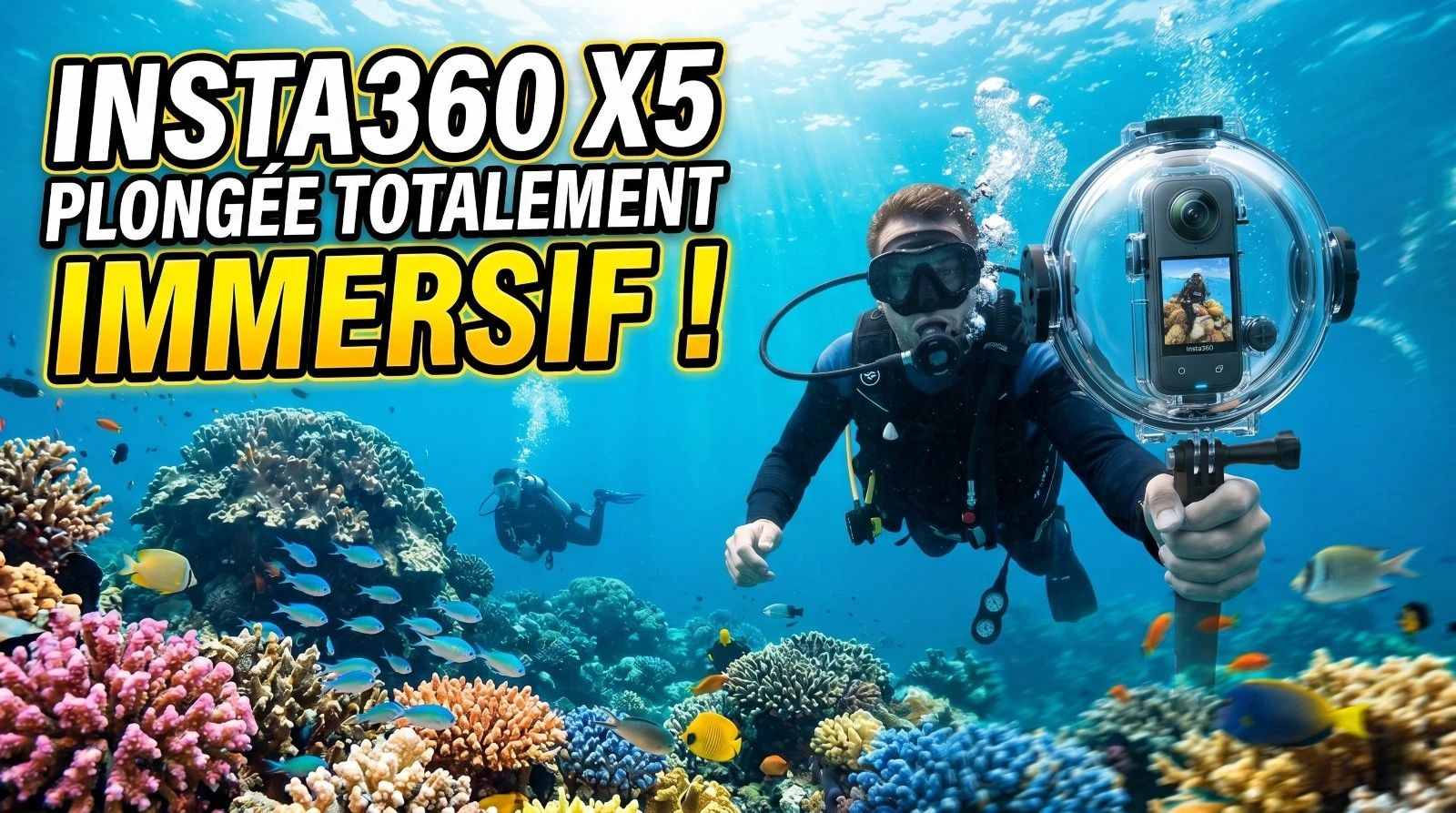
Can the Insta360 X5 be used for diving without a housing?
The native waterproofing of the X5 reaches 15 metres, which covers snorkelling and very shallow dives. For standard recreational diving (18 to 40 metres), the Invisible Dive Case is essential and extends the depth to 50 metres. It is an additional purchase to factor into your budget.
Why film in 360 underwater rather than standard video?
360 captures everything happening around you, including what you do not see during the dive. You choose your framing afterwards, in post-production. It is ideal for drift dives, unexpected encounters with pelagics, or large sites. The downside: editing time is two to three times longer than with traditional video.
How does gesture control work underwater?
A hand movement in front of the camera starts and stops recording. Shake control also works. These commands are particularly useful when the camera is mounted on a pole or when wearing thick gloves, both common situations while diving.
Does the X5 handle green and turbid water well?
Real-world tests (Mediterranean, cold Danish waters) show a clear improvement over the X4. The dual 1/1.28-inch sensor captures more light and reduces noise in dark areas. Backscatter management is also improved thanks to the doubled processing power.
Insta360 X5 Underwater: The Best 360 Camera for Diving in 2026
There is something fascinating about the idea of filming 360 degrees underwater. You no longer choose your framing at the moment of capture. You choose it afterwards, comfortably seated in front of your screen, with all the hindsight in the world. For divers who have already missed the shot of a manta ray passing behind them, the concept is compelling.
With the X5, Insta360 pushes that promise one step further, and the feedback after several dozen dives in real conditions is starting to paint a fairly clear picture.
What changes compared to the X4
The dual sensor jumps to 1/1.28-inch (up from 1/2-inch on the X4), which represents a considerable leap in light-gathering capability. In practice, this translates to better-defined images in shadow areas, less digital noise in poorly lit waters, and more natural colour rendering, particularly in the green, turbid waters that caused problems for the previous generation.
Processing power increases by 140% thanks to a dual image processor, allowing the camera to better handle backscatter (those tiny suspended particles that ruin so many underwater photos) and produce sharper details in challenging conditions.
Native waterproofing goes from 10 to 15 metres, covering snorkelling and shallow dives without additional protection. For real diving, the Invisible Dive Case remains necessary and extends the depth rating to 50 metres.
And a detail that will delight anyone who has already scratched a lens on a rock: the lenses are now user-replaceable. No more sending the camera in for service over a scratch.
Gesture control underwater
One of the most pleasant surprises of the X5 is that gesture control actually works below the surface. A simple hand movement starts and stops recording, which is particularly useful when the camera is mounted on a selfie stick or when you're wearing thick gloves.
The "wiggle" control (a small shake of the camera) also works, and significantly reduces cognitive load during a dive. Fewer buttons to hunt for, more time to observe.
Tested in all conditions
Testers who took the X5 underwater did so in highly varied conditions: tropical waters in the Maldives, temperate waters in the Mediterranean (Greece), and cold, green waters in Denmark. Over roughly twenty cumulative dives, the camera showed reassuring consistency, with notably improved colour management compared to its predecessor in cold, turbid water.
This is exactly the type of testing that matters to divers, because marketing brochures are always shot in crystal-clear water with 30-metre visibility. The reality of diving is often 5 metres of visibility, green everywhere, and a current pushing you two metres sideways while you try to frame.
The flip side: editing
This is the point nobody mentions in product presentations, yet it makes all the difference in the daily reality of an underwater videographer: a 360 camera demands considerably more post-production work than a traditional camera.
With a traditional camera, you frame underwater, cut the bad takes, and edit. With a 360, every shot requires complete reframing. You have to choose your angle after the fact, animate virtual camera movements in the software, stitch the two sensors together, and manage the stitching line that sometimes cuts right through a subject. For a 40-minute dive, expect easily two to three times the editing time compared to traditional video.
This is worth weighing carefully before buying. If you enjoy the editing process and have time to dedicate to it, 360 opens extraordinary creative possibilities. If you're looking for a quick workflow to share your dives without spending hours on them, a camera that shoots in a single direction will better suit your needs.
Who is it for?
The X5 shines in situations where you don't know in advance where the action will be. Drift dives, unexpected encounters with pelagics, explorations of vast sites where your gaze wanders in every direction. Post-production reframing turns a raw 360 shot into a cinematic clip, provided you accept the extra editing time it requires.
For still photography or macro subjects, a traditional camera will remain superior. But for telling the story of an entire dive on video, capturing the atmosphere of a reef, or sharing the immersive experience with non-divers, the X5 is today's most polished tool on the market. As long as you know the real work begins when you get out of the water.
And when your buddy asks how you filmed that turtle passing behind you, you can answer in all honesty: you hadn't even seen it. What you won't tell them is how long you spent reframing the shot to put it in the centre of the image.
Invisible Dive Case Pro: the housing that changes the game
In May 2026, Insta360 completed the X5's underwater ecosystem with the Dive Case Pro, a significantly improved version of the standard housing. The difference lies in the details that truly matter when you dive with a 360.
The Pro housing is rated to 60 metres (versus 50 for the standard model), opening the door to technical dives and deep wrecks. At 420 grams, it remains compact and mounts on the same fixtures as the previous model. But the biggest leap is in the optics: low-dispersion glass elements reduce chromatic aberrations and field distortions, those warping effects that stretched subjects at the edges of the image on previous versions. The stitching line between the two sensors benefits directly, with fewer visible artefacts in the overlap zones.
For divers who were torn between the X5 and a traditional camera in a housing, the Dive Case Pro tips the scales. A complete 360 system (camera plus Pro housing) rated to 60 metres with corrected optical quality, all in a package that fits in a BCD pocket, is an argument that didn't exist six months ago.
AquaVision 3.0: automatic colour correction
The other major addition to the X5 ecosystem is on the software side. Insta360 deployed AquaVision 3.0 in its latest update, and it's probably the feature that will save the most time for those who produce content regularly.
The concept is simple: the algorithm analyses the colour cast of each clip and applies an automatic correction tailored to the water type. Four presets are available (tropical blue water, temperate green water, cold turbid water, and a universal mode), with an intensity slider that lets you dial the effect between 0 and 100%. Processing works on mobile (Insta360 app) and on desktop (Insta360 Studio).
In practice, AquaVision 3.0 produces a surprisingly accurate baseline on tropical blue waters. In green or turbid water, the result serves as a solid starting point that you then fine-tune manually. It's not a replacement for careful grading in DaVinci Resolve or Lightroom, but it's a valuable shortcut for sorting and quick sharing, those moments when you want to show a dive the same evening without spending three hours on it.
At AquaExposure, the recommendation stays the same: shoot in a Flat profile, colour correct manually for final exports, and use AquaVision 3.0 as a pre-visualisation and quick-sharing tool. Automatic processing doesn't replace mastery, but it saves time on the 80% of clips that don't need surgical grading.
FAQ
Can the Insta360 X5 be used for diving without a housing?
The X5's native waterproofing reaches 15 metres, covering snorkelling and very shallow dives. For standard recreational diving (18 to 40 metres), the Invisible Dive Case is essential and extends the depth rating to 50 metres. It's an additional purchase to factor into your budget.
Why shoot 360 underwater rather than traditional video?
360 captures everything happening around you, including what you can't see during the dive. You choose your framing afterwards, in post-production. It's ideal for drift dives, unexpected pelagic encounters, or vast sites. The trade-off: editing time is two to three times longer than with traditional video.
How does gesture control work underwater?
A hand movement in front of the camera starts and stops recording. The shake control ("wiggle") also works. These commands are particularly useful when the camera is mounted on a pole or when you're wearing thick gloves, both common situations while diving.
Does the X5 handle green, turbid water well?
Real-world testing (Mediterranean, cold Danish waters) shows a clear improvement over the X4. The dual 1/1.28-inch sensor captures more light and reduces noise in dark areas. Backscatter management (suspended particles) is also improved thanks to the doubled processing power.
Want to master underwater video, whether 360 or traditional? Our course covers everything from shooting to final editing, regardless of your equipment.