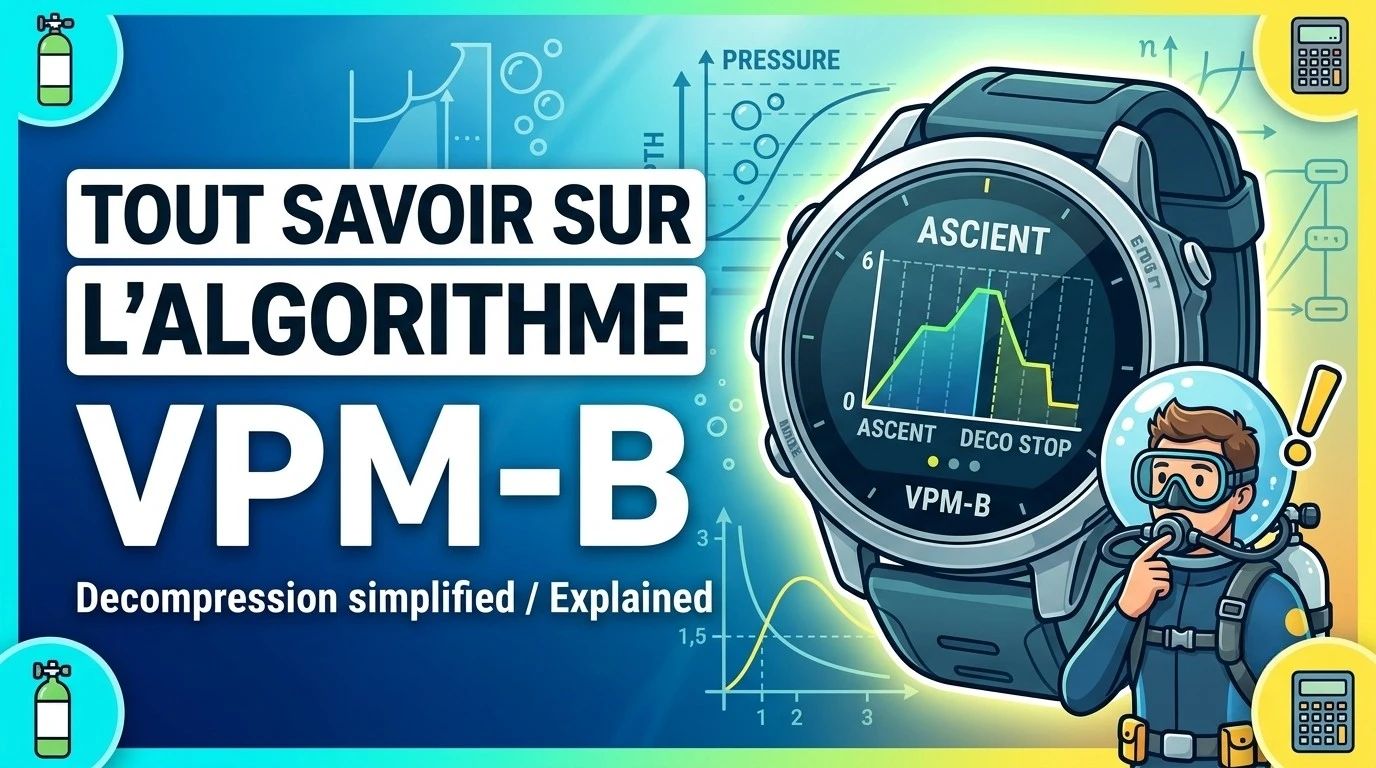
Everything you need to know about the VPM-B algorithm: Reviews, safety, and settings.
Comprehensive analysis of the VPM-B decompression algorithm. Bubble models, debunking deep stops, comparison with Bühlmann, and an instructor's review.
The Varying Permeability Model (VPM-B), originally designed by David Yount and implemented by Erik Baker, is an open-source bubble algorithm that requires very deep decompression stops to limit the growth of microbubbles.
Why does hyperbaric medicine reject the VPM-B?
Clinical studies conducted by the Navy Experimental Diving Unit (NEDU) have shown that the deep decompression stops required by the VPM-B algorithm prevent rapid tissue off-gassing while simultaneously over-saturating slow tissues, thereby increasing the risk of decompression sickness.
Is the VPM-B still in use today?
It is still used by a community of traditional technical divers who are accustomed to it, but the vast majority of the modern technical diving community has returned to the Bühlmann algorithm with gradient factors.
In the history of deep technical diving, theories about decompression have sometimes sparked heated debates. Divers exploring the depths using complex gas mixtures have long sought the perfect algorithm, capable of reducing post-dive fatigue and minimizing the risk of accidents. It was within this context of a quest for perfection that the VPM-B (Varying Permeability Model) algorithm emerged in the 2000s as the standard for technical diving, before being questioned by advances in contemporary hyperbaric medicine.
I remember my deep exploration dives using Trimix on forgotten wrecks in the Bay of Biscay in the 2000s. We all used the VPM-B model on our planning software and dive computers, performing long, very deep decompression stops in the dark, cold water. Although we subjectively felt less fatigue immediately after surfacing, the interminable length of the overall decompression pushed us to the limits of our reserve gas supply. This heroic era marked the beginning of the transition to modern Haldanian models, which are simpler and scientifically validated.
Algorithm ProfileThe VPM model was originally developed by physicist David Yount and researcher Don Hoffman at the University of Hawaii, while studying the dynamics of bubbles in gelatin subjected to pressure variations. The practical implementation of this model for technical diving, as well as its coding in a computer language, was carried out by American engineer Erik Baker. Version "B" incorporates Boyle's Law to better manage the physical compression of bubbles during ascent.
Physically, it is a bubble-based (or two-phase) model. It starts from the premise that microscopic bubble nuclei always exist within our bodies and that ascent will cause them to expand. Its philosophy involves imposing extremely deep decompression stops to crush these nuclei under hydrostatic pressure. This algorithm is open-source and publicly documented. It is primarily found on dive computers designed for technical diving, such as Shearwater models (via an optional paid unlock key) or OSTC computers from Heinrichs Weikamp.
Ease of Use and Conservatism Settings
Setting the conservatism level on the VPM-B is less intuitive than on a traditional Haldanian model. Instead of adjusting saturation percentages, the diver modifies the physical value of the "initial critical bubble radius."On the interface of computers like Shearwater, this mathematical complexity is summarized by simplified presets ranging from "Nominal" (the standard algorithm profile) to "+5" (the most conservative setting).
Designed exclusively for technical diving with complex gas mixtures (Trimix, Heliox, Nitrox), the VPM-B manages multiple gas mixes with exemplary mathematical rigor. Switching gases during a dive instantly recalculates the entire decompression profile, perfectly adapting to the requirements of both open and closed circuit dives.
Adapting to Diver Safety in Real Time
The VPM-B is a strict mathematical algorithm that does not take into account real-time biometric data such as the diver's heart rate or breathing effort to modulate calculations. However, it is extremely sensitive to sudden pressure changes. "Yo-yo" profiles or excessively rapid ascents cause an exponential increase in the calculated bubble radius within the algorithm, which immediately adds significant decompression stops at the end of the dive.
Deep stops are fundamental to the VPM-B. While a standard Haldanian model might allow you to ascend from forty meters to fifteen meters without mandatory stops, the VPM-B will require a very deep initial stop, sometimes as shallow as thirty meters, to compress free gas bubbles.## The Verdict from Hyperbaric Medicine and the NEDU
It was in the medical field that the VPM-B lost its status as an absolute reference. In 2011, the Navy Experimental Diving Unit (NEDU) in the United States conducted a large clinical study comparing deep stop models (VPM/RGBM) to traditional Haldanian models (Bühlmann). The study had to be stopped prematurely for ethical reasons because the protocol using deep stops caused a significantly higher number of decompression accidents.
The contemporary scientific consensus now rejects the philosophy of the VPM-B. Hyperbaric physicians have demonstrated that while the diver pauses at great depth to collapse bubbles, their slow tissues continue to absorb nitrogen and helium due to the high partial pressure. This increases the overall decompression stress during the final ascent near the surface, making the algorithm less effective than a Bühlmann model combined with Gradient Factors.
Strengths and Weaknesses
The main strength of the VPM-B is historical. It enabled the rise of deep technical diving using Trimix and air in the 2000s, and it remains appreciated by veteran divers who are intimately familiar with their own bodies' reactions to this model.The major drawback is the excessive tissue saturation caused by the deep decompression stops required. This unnecessarily prolongs the overall decompression time and increases the risk of desaturation-related accidents in a scientifically proven manner.
Field Performance and Behavior in Group Dives
When diving in a group, the VPM-B's compatibility with other algorithms is very poor. If you dive using VPM-B while your buddy uses a standard Bühlmann ZHL-16C model, your ascent profiles will be completely misaligned, forcing you to stop at much deeper depths than they do. The entire team must absolutely use the same decompression model to dive together safely.
If you would like to analyze in detail technical diving computers that offer this option with other models, we invite you to consult our AquaExposure diving computer comparison tool to compare their performance and features.
Conclusion
The VPM-B algorithm is now considered a traditional technology in the world of scuba diving. While it is not recommended for recreational divers or modern technical divers who prefer the transparency and validated safety of the Bühlmann algorithm combined with Gradient Factors, it retains its place in history for having paved the way for deep explorations. With stars in their eyes.
Everything you need to know about the VPM-B algorithm: Reviews, safety, and settings. | AquaExposure