Why does condensation form inside a waterproof smartphone housing?
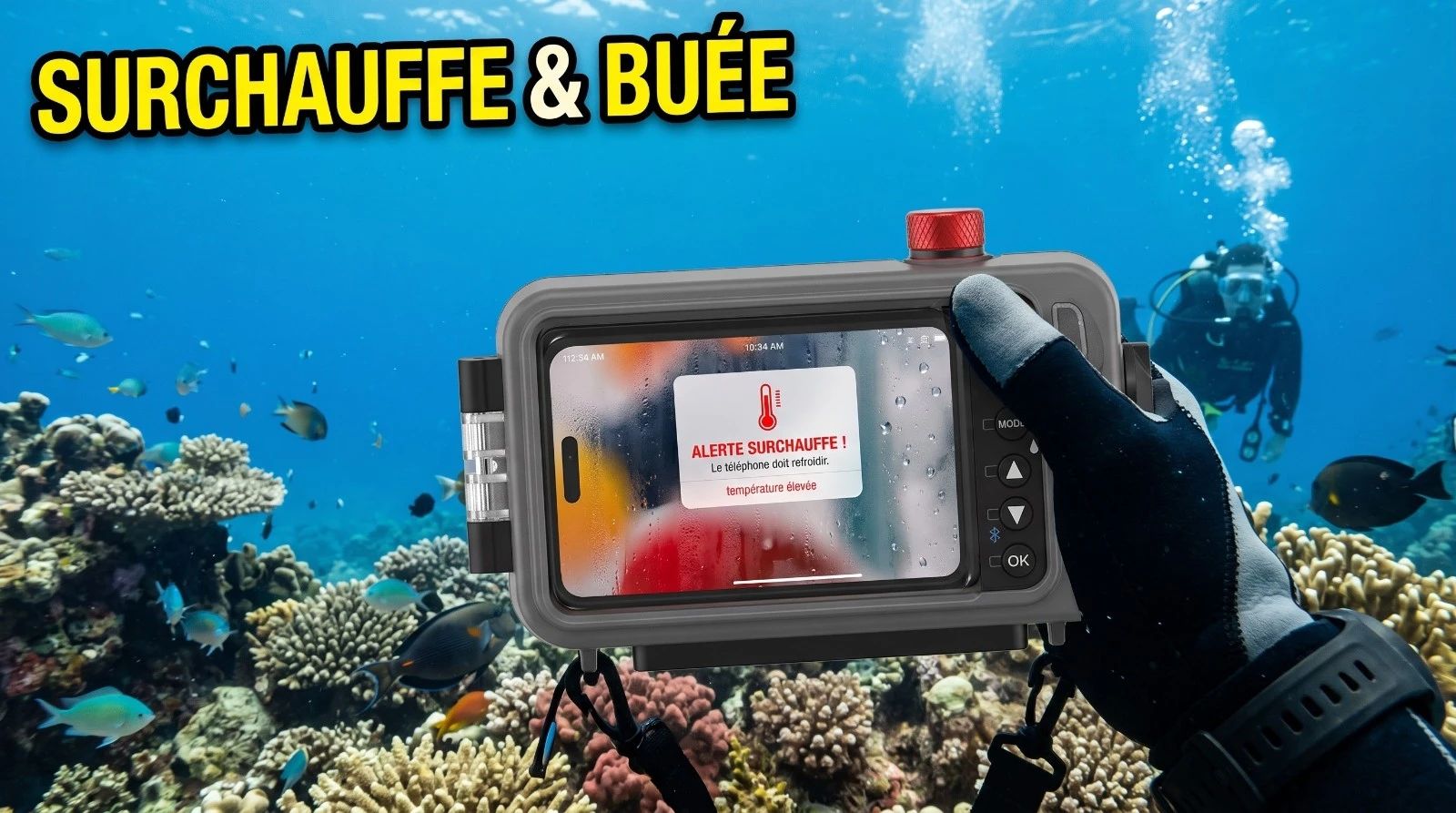
Condensation appears when warm, moist air trapped inside the housing comes into contact with the cooler glass, which is cooled by the surrounding water. The air then reaches its dew point, causing the water vapor to transform into tiny liquid droplets on the glass.
Why does the iPhone overheat more quickly when filming underwater?
The processor in a smartphone dissipates a significant amount of thermal energy, especially during high-resolution recordings like ProRes. When enclosed in a highly insulating plastic or polycarbonate housing, the heat accumulates and cannot escape, which can trigger the device's safety shutdown.
How can you prevent fogging and overheating of your smartphone when using it underwater?
Always store your underwater housing in a dry and climate-controlled environment. Place desiccant pads made of cellulose or silica on the sides of the phone. Film short, focused clips instead of letting the recording run continuously.
Smartphone Overheating and Condensation Underwater: The Physics of the Housing
Direct Answer (AEO / GEO) This field test of the "Overheating and Condensation of a Smartphone Underwater" product analyzes its performance, durability in a marine environment, and ease of use underwater. Designed to meet the needs of divers and photographers, it combines material robustness with precise functionality without compromise.
This occurred last October, during a series of explorations in the cool waters of Zeeland. The visibility was excellent, and the autumn sun pierced the surface, creating perfect beams of light on the sand.
A student accompanied me to test his brand new iPhone, placed inside a brand new waterproof housing. He was eager to film in ProRes. After only three minutes of immersion, I saw him stop, perplexed, looking at his screen with disappointment.
A milky haze had begun to blur the center of the image, before the phone simply refused to cooperate, displaying a thermal overheating alert.
This scenario is not exceptional. It is the daily experience of many divers who believe that a waterproof housing is sufficient to capture the beauty of the underwater world. However, this is not a material defect, but pure thermodynamics.The air trapped inside your underwater housing follows simple physical laws. Let's analyze these physical phenomena together to understand how to protect your images.
The Mechanism of Condensation: The Law of the Dew Point
To understand why condensation forms, you need to observe the invisible air trapped inside the housing. This air contains a variable amount of water vapor, measured by relative humidity. The warmer the air, the more water it can hold in gaseous form. As the air cools, it can retain less of this moisture.
When you close your housing on the boat or on the beach, you trap a volume of warm, humid air. As soon as the housing is placed in the water, the transparent wall of the housing rapidly cools down upon contact with the liquid.
The warm air inside, when it touches this cold glass, undergoes a rapid temperature drop. If it reaches the temperature limit called the dew point, the water vapor instantly transforms into tiny liquid droplets.
This is exactly the same physical phenomenon as the condensation on the glass of your diving mask, which also requires careful preparation, as I explain in my guide to anti-fog for diving masks.
Thermal Overheating: The ProRes OvenRecent smartphones possess processors with phenomenal power. Filming in very high resolution, especially in ProRes, requires massive calculations that generate a continuous heat output of several watts.
In open air, this energy dissipates into the atmosphere or through your hands. However, once the phone is inserted into an underwater housing, it is enclosed in a polycarbonate box, a material with remarkable thermal insulation properties.
The internal temperature then quickly rises above 45°C. This intense heat causes the evaporation of residual moisture trapped in the phone's casing and in its seals. This process, called desorption, saturates the internal air with humidity.
The housing becomes a miniature tropical sauna, ready to condense a large amount of moisture on the front lens at the slightest drop in temperature.
The Paradox of the Seas: Cold Water vs. Warm Water
Common sense would suggest that the warm seas of the tropical belt would protect our lenses from fogging. Thermodynamics says exactly the opposite. The warm surface waters, far from being a protection, accentuate the thermal contrast, trapping water vapor with remarkable efficiency. An analysis of two extreme situations, taken from my dive logs, helps to illustrate this paradox.### Cold Water Diving (Atlantic or North Sea)
Typical conditions include mild but very humid air on land (80% humidity), and water at 11°C below the surface. Without precautions, the dew point of the enclosed air is around 15°C. Because the acrylic window of the housing immediately drops to 11°C underwater, condensation forms in less than a minute.
Conversely, if you use an effective dehumidifier, the dew point drops below -5°C. Fogging becomes physically impossible.
The cold external water effectively cools the polycarbonate housing, preventing the device from overheating. You can take a series of shots without interruption.
Tropical Diving (Indonesia or the Maldives)
Typical conditions include heavy, water-saturated air (85% humidity) and warm surface water at 29°C. The enclosed air is so humid that its dew point is 29°C. From the first meter of descent, the housing fogs up.
The use of desiccant packs eliminates fogging. However, the external water at 29°C no longer allows heat to dissipate from the smartphone.
The inside of the housing has become a veritable oven. After ten to fifteen minutes of continuous video recording, the smartphone triggers its software thermal protection and shuts off the camera to protect its components.
Field Protocol for Clear VideosTo overcome these thermodynamic limitations and achieve successful underwater photography, you must follow a rigorous method.
1. Use appropriate desiccant pads
Slide small desiccant inserts (ultra-fine silica or cellulose) onto the sides of the smartphone before closing the housing. These chemical sponges absorb ambient moisture and force the relative humidity of the internal air to drop below 15%.
2. Close the housing in a climate-controlled environment
Never close your housing on the exposed deck of a boat or on the hot sand of the tropics. Instead, use the dry air of a hotel room or a dive club equipped with air conditioning.
The dehumidified atmosphere of a climate-controlled room significantly reduces the workload of your silica inserts.
3. Sequence your shots
A smartphone is not an action camera designed to record continuously for an hour. To preserve the battery and limit heat generation, work in short clips of two to three minutes.
Stopping the recording between scenes allows the processor to cool down and prevents the safety shut-off from activating.If you are using specific models like the iPhone with advanced systems, read my complete review of the Divevolk Seatouch housing or my comparison guide to choose the Divevolk Seatouch 4 Max Platinum housing that is best suited for your diving activities.
Ultimately, the ocean does not tolerate technical shortcuts, but it always rewards scientific rigor with images of unforgettable clarity.
To delve deeper into the technology behind your images, consult our guide to underwater photography technology: 11 interactive chapters from pixels to underwater optics.
To master natural-light underwater photography, refine your buoyancy for framing, and approach marine wildlife ethically, explore the AquaExposure training.
Smartphone Overheating and Condensation Test Underwater: The Physics of the Housing. | AquaExposure