What animals can you photograph in the French Mediterranean?
The Cote Vermeille is home to more than 1,200 animal species. The most photogenic subjects include the dusky grouper, nudibranchs (purple flabellina, Dalmatian doris), octopus, moray eel, red coral, long-snouted seahorse, gorgonians, conger eel, and schools of sea bream and damselfish. Each species requires a specific approach and settings.
Do you need a macro lens for underwater photography in the Mediterranean?
Macro is highly valued in the Mediterranean because many subjects are small (nudibranchs of 2 to 5 cm, shrimps, tube worms). But wide-angle is equally useful for fish schools, wrecks, and compositions with gorgonians. Ideally, you can switch depending on the subjects encountered. A compact with a macro close-up lens already offers beautiful possibilities.
How to approach a grouper for photography?
The key is patience. Never swim directly toward a grouper. Settle on the sand a few meters away and wait without moving. The grouper is a curious animal that will come to you on its own if you do not threaten it. Avoid sudden movements and excessive bubbles. In the Cerbere-Banyuls reserve, groupers are particularly confident thanks to 50 years of protection.
Is the Mediterranean a good place to start underwater photography?
The Mediterranean is probably the best school of underwater photography that exists. It forces you to develop your eye and search for the subject, unlike tropical reefs where colors explode at every square centimeter. Mediterranean natural light is of remarkable quality. A photographer trained in the Mediterranean arrives on a tropical reef with a much sharper eye.
When you start out in underwater photography, you often think you need to travel far to find interesting subjects. Tropical coral reefs, pelagic encounters in the Indian Ocean, the crystal-clear waters of the Caribbean. All of that is magnificent, of course. But before searching for the extraordinary at the other end of the world, there is a fundamental exercise that the Mediterranean teaches better than any tropical ocean: learning to see.
The marine fauna of the Catalan coast, between Port-Vendres and Cerbere, is remarkably rich, something only patient divers truly discover. Over 1,200 animal species live along this stretch of the Cote Vermeille. And among them, some offer the photographer possibilities of composition, color, and behavior that are well worth serious attention.
Here are ten subjects I recommend to any underwater photographer visiting the Pyrenees-Orientales, with a few tips for approaching each one in natural light.
1. The Dusky Grouper (Epinephelus marginatus)
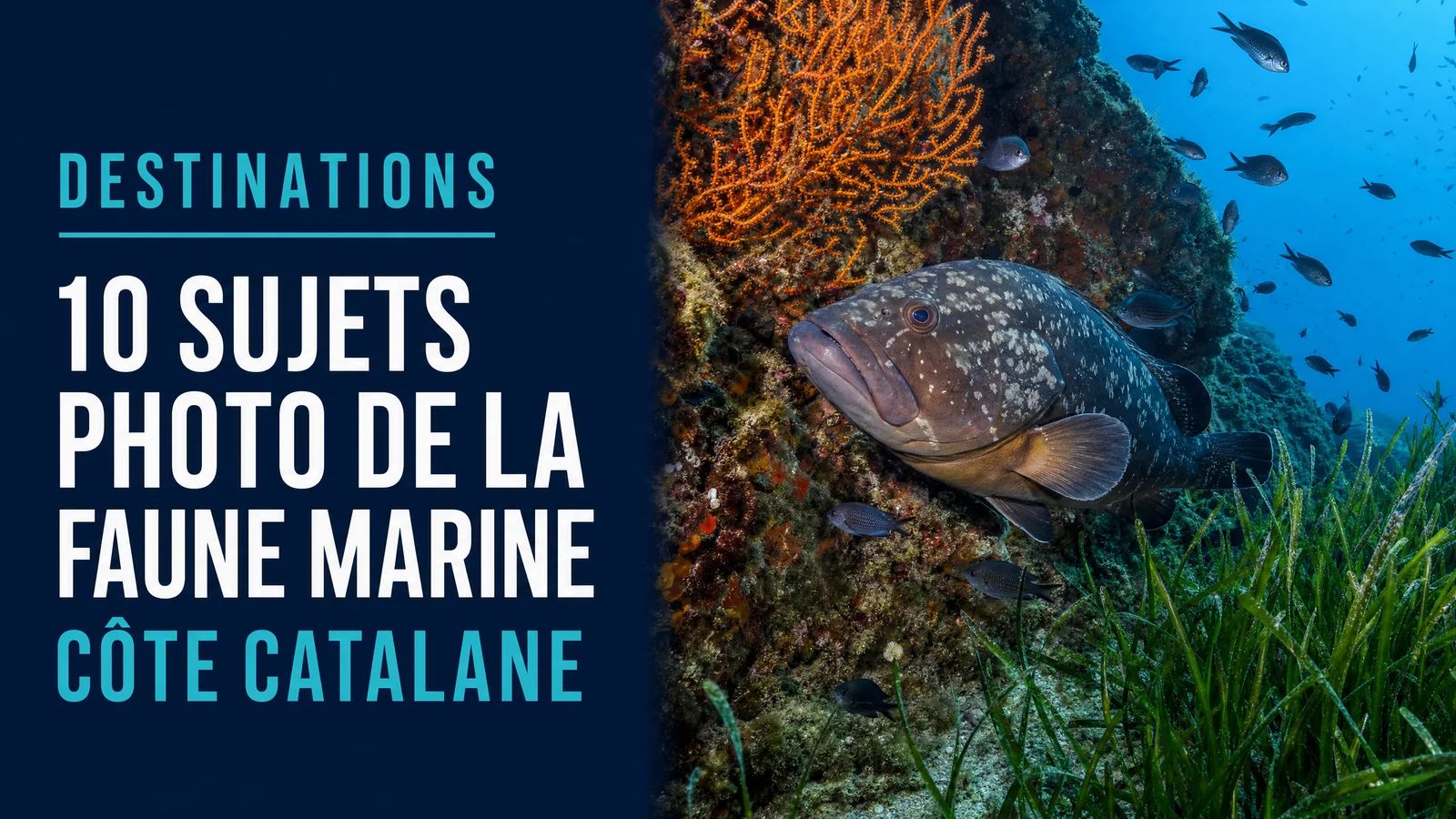
This is the king of the protected Mediterranean. In the Cerbere-Banyuls marine reserve, grouper numbers have gone from 50 individuals in the 1980s to over 630 today. Some exceed one meter in length and can live several decades.
The grouper is a fascinating subject for the photographer because it looks back at you. Unlike most fish that flee or ignore you, the grouper watches you with a calm curiosity that allows for a genuine exchange of gazes. That connection shows in the image.
To photograph it: slow approach, no sudden movements, and above all do not swim toward it. Settle on the sand a few meters away and wait. The grouper will come. In natural light, try to capture it with the surface in the background for a beautiful blue bokeh. Focus on the eye is essential.
2. The Violet Flabellina (Flabellina affinis)
This nudibranch with its intense violet color and translucent cerata (the dorsal "plumes") is one of the most rewarding macro subjects in the Mediterranean. It is found on the hydrozoans it feeds on, often on vertical rock walls from about 10 meters deep.
The flabellina is small (2 to 5 centimeters), which requires working in true macro. The difficulty in natural light is that these nudibranchs often live in shaded areas where light is low. The trick: look for individuals on walls exposed to morning light, or use the surface reflection (when the bottom is shallow) to illuminate the subject from above.
Patience is, once again, the key. Nudibranchs move, slowly but surely. Waiting for the animal to position itself favorably can take several minutes, but the result is always worth it.
3. The Common Octopus (Octopus vulgaris)
The octopus is one of the most intelligent animals in the Mediterranean, and also one of the most photogenic. Its camouflage ability is extraordinary: it changes color, texture, and even shape in a fraction of a second. Every encounter is unique.
It is found in rocky crevices, often signaled by a small pile of shells in front of its den entrance. Photographing it requires delicacy. The octopus is curious but nervous. One movement too sudden and it disappears in a cloud of ink. An arm stretched toward you, a changing texture, an eye fixed on you: if you manage to capture that moment of tension between curiosity and wariness, you have a powerful image.
In natural light, the challenge is texture. An octopus against rock is often monochrome. Look for moments when the animal is moving, when its arms unfurl, when its body contrasts with the substrate.
4. The Mediterranean Moray (Muraena helena)
The moray eel, with its wide-open mouth and visible teeth, has a reputation it does not deserve. The open mouth is not a threat, it is simply how it breathes. And for the photographer, that open mouth is an extraordinary visual gift.
Moray eels are found in rock crevices, cavities under boulders, sometimes in wrecks. They are sedentary and always return to the same spot, which allows you to plan your shots. The approach should be frontal and slow. The moray reacts to movement, not to presence.
In natural light, the moray poses a lighting challenge because it lives in shadowed areas. The trick is to work with the ambient light filtering into the crevice and to accept the strong contrast between the animal in shadow and the illuminated background. That contrast, far from being a flaw, adds drama to the image.
5. Red Coral (Corallium rubrum)
Mediterranean red coral is a protected treasure. It is found from 25-30 meters depth in the Cerbere-Banyuls reserve, on overhangs and in caves where light does not penetrate directly.
Photographing red coral in natural light is an advanced exercise. At these depths, light is low and the red spectrum has already been absorbed by the water, meaning the coral appears dark, almost black, to the naked eye. White balance is your most valuable ally here. In post-processing, white point correction allows you to restore the coral's true color.
The recommended approach is to work in backlight with the surface in the background, the coral as a dark silhouette in the foreground. Or, if conditions allow, find an angle where a shaft of natural light illuminates the coral branch directly.
6. The Long-Snouted Seahorse (Hippocampus guttulatus)
Encountering a seahorse in the Mediterranean is always a special moment. The species is protected and its populations are fragile, making each sighting all the more precious.
The long-snouted seahorse is found in Posidonia seagrass beds and sometimes clinging to gorgonians or algae in calm areas. It is small (10 to 15 centimeters) and perfectly camouflaged, making it a search subject before it becomes a photo subject.
The absolute rule with seahorses: never touch them, never move them, never stress them. If the animal shows signs of stress (turning away, trying to move off), you stop and leave it alone. Ethical approach is not optional, it is a non-negotiable prerequisite.
In natural light, a seahorse in its Posidonia bed produces images of remarkable softness. The grass creates a natural background of gentle green, and the seahorse's texture stands out with a delicacy that flash would have flattened.
7. Red and White Gorgonians
Gorgonians are the visual architects of the deep Mediterranean. These cnidarian colonies spread their fans perpendicular to the current to filter plankton, creating natural compositions of remarkable elegance.
White gorgonians (Eunicella singularis) are found from 15-20 meters. Red gorgonians (Paramuricea clavata) are deeper, from 25-30 meters. Both offer the photographer an extraordinary compositional element.
The classic approach in photography: place the gorgonian in the foreground, with a subject (diver, fish, the surface) in the background. The gorgonian fan creates a natural frame within the frame. In natural light, backlighting with the surface behind brings out the lacework of the branches in silhouette.
8. The European Conger (Conger conger)
The conger is a discreet giant. It can reach 2 meters in length and lives hidden in crevices and cavities, often alongside moray eels. On the wrecks of Port-Vendres, congers are permanent residents that occupy the same quarters from one dive to the next.
Its smooth, grey skin, almost silvery, reflects ambient light in a very particular way. Unlike the moray, which offers textures and patterns, the conger plays on form: that massive head, those round eyes, that body disappearing into the darkness of the crevice. It is a portrait subject rather than a naturalist documentation subject.
9. Schools of White Seabream and Damselfish
Sometimes the most spectacular subjects are not the rarest. A school of common two-banded seabream (Diplodus vulgaris) circling a pinnacle, lit by shafts of light piercing through the surface, is an image that few tropical destinations can match in terms of graphic power.
Damselfish (Chromis chromis), those small, dark fish omnipresent in the Mediterranean, form living clouds around wrecks and drop-offs. Photographed in backlight with the surface behind, they become black confetti in an underwater blue sky.
Wide angle is king for these subjects. Position yourself below the school, the surface above, and shoot at the moment the fish form a coherent pattern. This is patience and timing photography.
10. The Dotted Sea Slug (Discodoris atromaculata)
To close this selection with a subject that perfectly represents the spirit of macro photography in the Mediterranean. The dotted sea slug, with its dark spots on a white background, is instantly recognizable and fabulously photogenic.
It is found on the sponges it feeds on, often on vertical rock walls or under overhangs. It is larger than the flabellina (5 to 10 centimeters), making it easier to work with in macro. Its relative stillness allows you to refine composition and work on depth of field.
In natural light, the challenge is the same as for all subjects fixed in shaded environments: finding the angle that lets ambient light illuminate the subject, or accepting sidelight that will give relief to the nudibranch's texture.
The Mediterranean as a School
These ten subjects are just a glimpse of what the Catalan coast offers the underwater photographer. What I take away from my years of diving is that the Mediterranean is probably the best school of underwater photography there is. It forces you to develop your eye, to seek the subject instead of finding one at every square centimeter, to work with light rather than against it.
When a photographer trained in the Mediterranean arrives on a tropical reef, they see things others do not. Because the Mediterranean taught them how to look.
FAQ
What Animals Can You Photograph in the French Mediterranean?
The Cote Vermeille is home to over 1,200 animal species. The most photogenic subjects include the dusky grouper, nudibranchs (violet flabellina, dotted sea slug), the octopus, the moray eel, red coral, the long-snouted seahorse, gorgonians, the conger eel, and schools of seabream and damselfish. Each species requires a specific approach and settings.
Do You Need a Macro Lens for Mediterranean Underwater Photography?
Macro is highly valued in the Mediterranean because many subjects are small (nudibranchs of 2 to 5 cm, shrimps, tube worms). But wide angle is equally useful for fish schools, wrecks, and compositions with gorgonians. Ideally, you should be able to alternate depending on the subjects encountered. A compact camera with a macro close-up lens already offers excellent possibilities.
How Do You Approach a Grouper for Photography?
The key is patience. Never swim directly toward a grouper. Settle on the sand a few meters away and wait without moving. The grouper is a curious animal that will come to you on its own if you do not threaten it. Avoid sudden movements and excessive bubbles. In the Cerbere-Banyuls reserve, groupers are particularly confident thanks to 50 years of protection.
Is the Mediterranean a Good Place to Start Underwater Photography?
The Mediterranean is probably the best school of underwater photography there is. It forces you to develop your eye and to seek the subject, unlike tropical reefs where colors explode at every square centimeter. Mediterranean natural light is of remarkable quality. A photographer trained in the Mediterranean arrives on a tropical reef with a much sharper eye.
Want to Learn How to Approach Marine Wildlife Without Disturbing It?
Module 3 of the AquaExposure training is dedicated to ethical approach and animal behavior. Knowing how to read a grouper's reactions, respect a seahorse, approach an octopus without stressing it: that is the foundation of all responsible underwater photography. AquaExposure training