Table of Contents
Underwater photography in the Azores: sperm whales, blue sharks, and mobula rays on Princess Alice Bank and Mount Condor. Complete seasonal guide and ambient light settings.
There is a quiet moment, on the boat clearing the harbor of Horta before sunrise, when conversation naturally fades. The volcanic cone of Pico cuts through the morning mist, Faial recedes behind the wake, and the open Atlantic unfolds without any certainty of what the day will bring. In the Azores, you do not book a scripted dive. You commit to an offshore venture. The ocean determines the rest.
This element of unpredictable wilderness is precisely what sets underwater photography in the Azores apart from traditional reef diving. There is no sheltered coral wall or marked underwater trail. Out here, you descend over remote seamounts dozens of miles from shore, suspended in deep blue water with only an anchor line as a reference, hoping a blue shark, a resident sperm whale, or a spinning carousel of mobula rays will cross your frame.
This comprehensive guide gathers field-tested recommendations to approach both resident cetaceans and the massive pelagic gatherings of the open Atlantic.
A volcanic archipelago perched on the Mid-Atlantic Ridge
The Azores comprise nine volcanic Portuguese islands scattered across the North Atlantic Ocean. Positioned directly atop the Mid-Atlantic Ridge, where the North American and Eurasian tectonic plates slowly pull apart, the archipelago features dramatic seabed topography. Abyssal plains thousands of meters deep are abruptly punctuated by volcanic peaks and seamounts rising toward the sunlit surface.
These underwater mountains act as biological magnets. Deep ocean currents collide with their vertical walls, generating nutrient-rich upwellings that sustain the entire pelagic food chain. More than 24 species of cetaceans frequent these waters, from resident sperm whale pods to migrating blue whales, alongside massive schools of tuna, open-ocean sharks, and mobula rays.
Sperm whales: masters of the deep blue
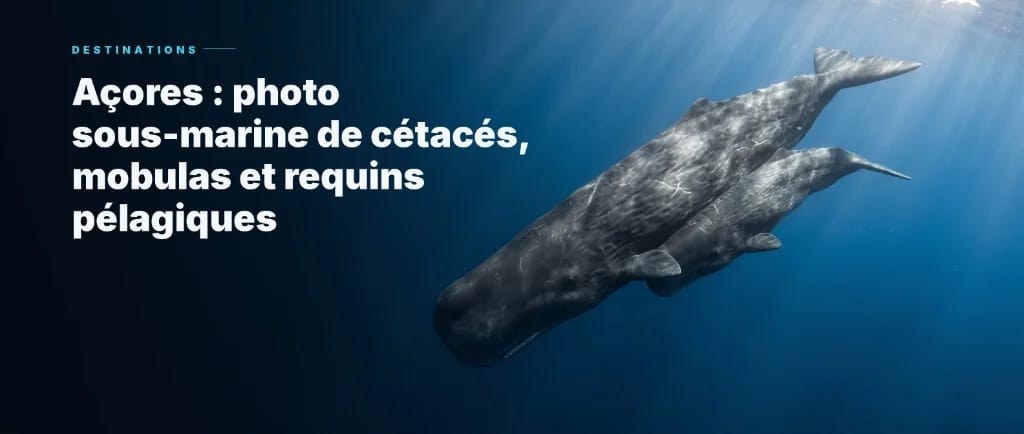
The sperm whale (Physeter macrocephalus) is the living symbol of the Azores. While baleen whales merely traverse the archipelago during seasonal migrations, sperm whales have established permanent residency around Pico, Faial, and São Jorge. Matriarchal pods accompanied by calves find an abundance of deep-sea squid in the surrounding ocean trenches.
The open-water approach protocol
Locating and approaching sperm whales relies on time-tested coastal heritage. The vigias, shore-based lookout towers originally built during the whaling era, scan the ocean horizon with high-powered binoculars to guide observation vessels via radio.
Once a blow is sighted, the in-water encounter is prepared in complete silence. Regional conservation laws strictly forbid scuba diving with cetaceans to eliminate regulator exhaust noise and disturbance. The encounter takes place exclusively in snorkeling gear (mask, snorkel, and fins).
Photographing a sperm whale demands restraint and patience. Swimmers enter the water without splashing, remain motionless on the surface, and let the whale dictate the interaction. A sperm whale initiating a vertical descent into the abyss, lifting its massive fluke against rays of downwelling sunlight, provides one of the most striking compositions in all of wildlife photography.
Spring baleen whale migration
Between April and June, other ocean giants pass through the archipelago on their journey toward subpolar feeding grounds. Blue whales (Balaenoptera musculus), fin whales, and sei whales slice through the surface. Their speed requires instant responsiveness to frame their massive profiles before they disappear into the blue.
The offshore seamounts: kingdom of open-ocean pelagics
For the underwater photographer, the Azores reveal their ultimate pelagic spectacle on two legendary oceanic seamounts: Princess Alice Bank and Mount Condor.
Princess Alice Bank: the mobula ray sanctuary
Located roughly 45 nautical miles southwest of Faial and Pico (about a 3-hour offshore transit), Princess Alice Bank (Banco Princesa Alice) stands among the most extraordinary dive sites on Earth.
This submerged plateau rises to approximately 35 meters below the surface in an ocean surrounded by 1,500-meter depths. From July to October, the bank transforms into an unmatched gathering ground. Dozens of mobula rays (predominantly Mobula tarapacana, the Chilean devil ray, and Mobula mobular) congregate around the seamount.
These rays, reaching wingspans over three meters, perform synchronized vertical ascents along the mooring line, gliding effortlessly from 35 meters up to just below the surface. They circle in tight columns (often 20 to 40 individuals) in water offering visibility exceeding 40 meters. Surrounding the rays are dense schools of yellowmouth barracudas, amberjacks, white trevallies (Pseudocaranx dentex), and occasional Galapagos sharks (Carcharhinus galapagensis).
Shooting on Princess Alice requires an ultra wide-angle or fisheye lens. Positioning yourself beneath the swirling carousel allows you to capture the silhouetted wings against the shimmering silver surface of the Atlantic.
Mount Condor: face to face with the blue shark
Situated around 20 miles southwest of Faial, Mount Condor is an internationally renowned hotspot for photographing the blue shark (Prionace glauca). From July to October, experienced divers drift in open blue water, often secured to a safety line attached to the vessel.
In this boundless blue realm, blue sharks rise from the depths with hypnotic elegance. Their slender, cobalt-blue bodies create an intense contrast against the deep ocean background. Naturally inquisitive, they often inspect their own reflections in camera dome ports.
Occasionally, the lightning-fast shortfin mako shark (Isurus oxyrinchus) makes a dramatic appearance, adding electrifying energy to the dive.
Formigas and Dollabarat: the eastern outpost
At the eastern edge of the archipelago, between São Miguel and Santa Maria, the Formigas Islets Marine Reserve and the Dollabarat seamount form another premier pelagic haven. Swept by strong oceanic currents, these waters attract large schools of predators, and in late summer, whale sharks (Rhincodon typus) are sometimes seen feeding on plankton near Santa Maria.
Camera settings and available light management in blue water
Open-ocean photography without background substrate presents specific technical demands:
- Lens selection: an ultra wide-angle lens (14 to 20 mm equivalent on full frame) is essential. It lets you capture a 3-meter shark or an entire school of mobulas while minimizing the water column between your port and the subject. You can check our underwater photography gear comparison tool to evaluate camera bodies featuring superior dynamic range and dependable autofocus.
- Shutter speed: set your camera to at least 1/250s to 1/400s. Fast-swimming pelagics and surface wave action will quickly introduce motion blur without a fast shutter speed.
- Custom white balance: in open water without sand or rock reflections, automatic white balance often shifts toward cyan tones. Setting a manual white balance between 5 and 10 meters depth restores balanced skin tones on marine animals.
- Highlight preservation: meter for the highlights to prevent blown-out surface sunbeams while preserving detail in the shadows under the bellies of sharks and rays.
To master exposure and framing without artificial strobe lighting, the AquaExposure training platform provides in-depth modules designed for open-ocean ambient light conditions.
Seasonal calendar for the Azores
| Period | Cetaceans | Large Pelagics | Sea Conditions |
|---|---|---|---|
| April to May | Sperm whales, blue whales, fin whales | Low pelagic activity | Spring swell, cold water (16-17°C) |
| June | Sperm whales, spotted dolphins | Early pelagic arrivals | Calmer sea, water warming to 18-19°C |
| July to August | Sperm whales, pilot whales, dolphins | Mobulas at Princess Alice, blue sharks at Condor | Best weather, water at 21-23°C, higher diver volume |
| September to October | Sperm whales, dolphins, late baleen passes | Peak mobula and shark encounters | Prime visibility, golden light, moderate crowds |
To cross-reference optimal travel dates for pelagic encounters across global destinations, you can consult our interactive marine species seasonality calendar.
September stands out as the ideal window for underwater photographers: water temperatures reach their annual high, mobula aggregations peak on Princess Alice, blue sharks remain active at Condor, and tourism numbers taper off.
Logistics and offshore dive safety
Diving the Azorean seamounts requires thorough preparation:
- 1Required experience: blue-water diving without a visible bottom, subject to ocean swells and currents, requires refined buoyancy skills. Ensure your surface marker buoy is dependable and high-visibility (explore our recommendations in our tools section).
- 2Base selection: Faial (Horta) and Pico (Madalena) provide prime access for Mount Condor and Princess Alice Bank. Santa Maria is best suited for combining Princess Alice with Dollabarat and possible whale shark sightings.
- 3Weather flexibility: allow at least 7 to 10 days on location. Long offshore runs to Princess Alice or Condor can be delayed by 24 to 48 hours depending on maritime forecasts.
The Azores in the Macaronesian pelagic triangle
The Azores form the wildest offshore stage of the Eastern Atlantic. Traveling southward, Madeira offers a different atmosphere with coastal dolphins, friendly giant groupers at Garajau, and the monk seal sanctuary of the Desertas. Further south, the Canary Islands showcase monumental basalt cathedrals, well-camouflaged angelsharks, and resident sea turtles.
For any underwater photographer seeking the authentic thrill of open water and world-class pelagic gatherings, the Azorean seamounts remain an unforgettable expedition.
Benjamin Coste is a diving instructor and underwater photography educator. He has been teaching available light photography since 2014 on aquaexposure.com.
Share
/blog/acores-photo-sous-marine-baleines-requins-baleine-en
Table of Contents
- 01A volcanic archipelago perched on the Mid-Atlantic Ridge
- 02Sperm whales: masters of the deep blue
- 03The open-water approach protocol
- 04Spring baleen whale migration
- 05The offshore seamounts: kingdom of open-ocean pelagics
- 06Princess Alice Bank: the mobula ray sanctuary
- 07Mount Condor: face to face with the blue shark
- 08Formigas and Dollabarat: the eastern outpost
- 09Camera settings and available light management in blue water
- 10Seasonal calendar for the Azores
- 11Logistics and offshore dive safety
- 12The Azores in the Macaronesian pelagic triangle
Questions about the Journal
What is the best season to photograph cetaceans and pelagics in the Azores?
Sperm whales are present year-round around Pico and Faial, with peak activity between June and September. Large pelagics (blue sharks on Mount Condor, mobula schools on Princess Alice) concentrate from July to October. To combine cetaceans, mobula rays, and pelagic sharks in a single journey, September remains the most reliable window.
Can you swim with sperm whales in the Azores?
Yes, but strictly under regional regulations. In-water encounters are conducted exclusively by snorkeling (mask, fins, and snorkel), never on scuba for this activity. A minimum distance is enforced and the number of boats and swimmers per pod is strictly regulated.
What is Princess Alice Bank and why is it world-famous for photography?
Princess Alice is an isolated seamount located roughly 45 nautical miles southwest of Pico and Faial. The summit rises to 35 meters within a 1,500-meter oceanic abyss. From July to October, dozens of mobula rays (Mobula tarapacana) gather in dramatic vertical columns and carousels in crystal-clear water.
Is the Condor seamount suitable for beginner divers?
No. Mount Condor is dived in blue water with no visible bottom, influenced by open-ocean currents and surface swell. An advanced certification and flawless buoyancy control are essential, especially when handling a bulky camera housing.
Are whale sharks seen in the Azores?
Whale sharks (Rhincodon typus) are occasionally spotted in midsummer around Santa Maria, drawn by warmer currents and bait balls. These encounters remain opportunistic and unpredictable.
What camera gear should you bring to the Azores?
An underwater housing equipped with an ultra wide-angle or fisheye lens is crucial to capture large pelagics at close range while retaining clarity through the water column.


