Table of Contents
Underwater photography in Madeira: resident dolphins, Garajau marine reserve, Desertas monk seals, and pelagics. Complete dive site guide and ambient light settings.
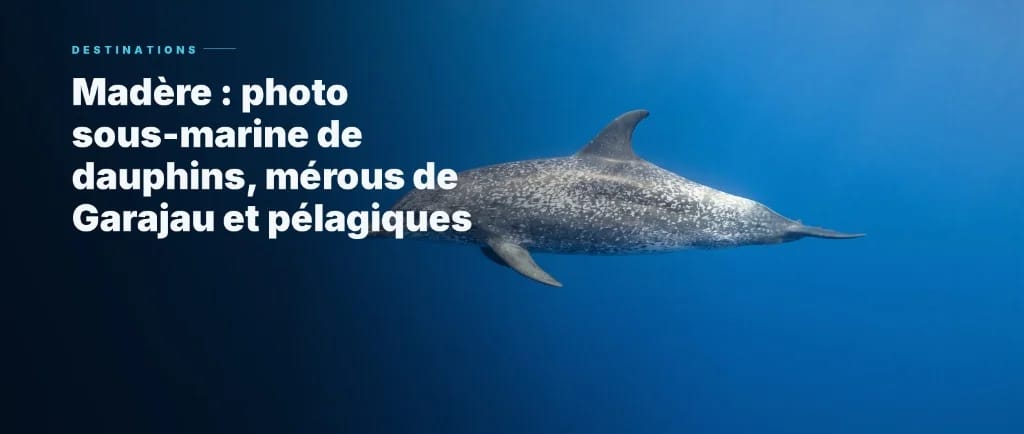
The dive boat departs Funchal harbor at dawn, as Madeira's dark volcanic cliffs catch the first rays of morning sunlight. Suddenly, thirty meters ahead of the bow, a grey dorsal fin slices through the surface. A second fin follows instantly. A pod of Atlantic spotted dolphins moves in to ride the bow wave in effortless synchrony.
Underwater photography in Madeira is defined by these moments of spontaneous grace. Located in the Eastern Atlantic between mainland Portugal and the Canaries, the island of Madeira features steep volcanic drop-offs where cliffs plunge straight into deep oceanic waters, bringing pelagic life within minutes of the shoreline.
This guide explores key dive sites, marine reserves, and ambient light techniques for capturing pelagic wildlife.
Steep volcanic bathymetry
Madeira has virtually no continental shelf to cushion the transition from land to deep ocean. Just beyond the coast, the seabed quickly drops to depths between 1,000 and 3,000 meters.
This bathymetry directly benefits marine life: nutrient-rich deep currents flow very close to shore, allowing divers to encounter cetaceans and pelagic fish without exhausting open-ocean journeys.
The archipelago consists of Madeira itself, Porto Santo to the northeast, and the strictly protected nature reserves of the Desertas and Selvagens Islands.
Dolphins and cetaceans of Madeira
Madeira's clear subtropical waters host more than twenty cetacean species throughout the year.
Atlantic spotted dolphins and bottlenose dolphins
The Atlantic spotted dolphin (Stenella frontalis) and the common bottlenose dolphin (Tursiops truncatus) are the most frequent visitors. Highly inquisitive, spotted dolphins often approach swimmers who remain calm on the surface.
When snorkeling, enter the water without splashing and drift quietly. A wide-angle lens allows you to capture several animals in a single frame, highlighting downwelling light rays through surface chop.
Short-finned pilot whales
Short-finned pilot whales (Globicephala macrorhynchus) form stable family pods off Madeira. Their bulbous heads and peaceful surface behavior allow for calm, graphic wide-angle compositions.
Garajau Marine Reserve: realm of giant dusky groupers
Established in 1986 along the southern coast east of Funchal, the Garajau Marine Reserve is one of Europe's premier marine reserves.
Protected from fishing for four decades, the reserve supports a resident population of giant dusky groupers (Epinephelus marginatus). Some individuals, reaching 1.5 meters and over 50 kg, show complete trust in divers, allowing for crisp, close-up portraits in natural ambient light.
Along Garajau's vertical walls, schools of barracudas, jacks, large stingrays, and summer mobula rays (Mobula mobular) cruise the drop-offs to feed.
The Desertas Islands: monk seal sanctuary
Roughly twenty nautical miles southeast of Madeira rise the three Desertas Islands (Ilhéu Chão, Deserta Grande, and Bugio). This uninhabited volcanic archipelago protects one of the last colonies of the Mediterranean monk seal (Monachus monachus), among the rarest marine mammals on Earth.
Thanks to dedicated conservation efforts by the Madeira Natural Park, the population has grown from a handful of seals in the 1980s to approximately forty individuals today.
Access to the strict nature reserve is tightly regulated. In-water encounters with monk seals are rare and serendipitous. If a seal approaches out of curiosity, divers should stay completely still and let the animal control the interaction.
Porto Santo and artificial reef wrecks
A two-hour ferry ride northeast of Funchal brings you to Porto Santo, known for golden sand bottoms and intentionally scuttled wrecks:
- The cargo ship Madeirense, resting at 30 meters since 2000, densely overgrown with anemones and schooling fish.
- The naval corvette General Pereira d'Eça, sunk in 2016, which attracts abundant pelagic life.
Pelagic encounters: mobulas and ocean sunfish
Open-water excursions around Madeira offer exciting possibilities. From June to October, groups of mobula rays glide near the surface. The ocean sunfish (Mola mola) occasionally rises from the abyss to bask in surface sunlight and allow coastal reef fish to clean its skin.
To track optimal migration windows for pelagics throughout the year, check our interactive marine species seasonality calendar.
Camera settings for Madeira diving
Water clarity (visibility between 25 and 35 meters) and Atlantic sunshine facilitate ambient light photography:
- Wide-angle optics: a 16-24 mm lens (full-frame equivalent) is ideal. It handles large groupers on the reef and swift dolphins at the surface. You can consult our underwater photography gear comparison tool to evaluate camera dynamic range across models.
- Shutter speed: 1/200s for groupers and wall scenery, increasing to 1/320s to 1/500s for active dolphins.
- ISO values: 100 to 400 ISO in the 10-25 meter zone around midday.
- Manual white balance: set a custom balance starting at 5 meters depth to compensate for red light loss and bring out warm volcanic rock hues.
To refine your framing and natural light mastery on volcanic drop-offs, the AquaExposure training program provides comprehensive step-by-step guidance.
Organizing your Madeira photography journey
Madeira offers smooth travel logistics:
- Access: daily direct flights connect major European airports to Funchal.
- Best season: May to October for calm seas, water at 22-24°C, and prime pelagic activity.
- Equipment check: verify your dive safety gear and travel accessories with our tools section.
Madeira in the Eastern Atlantic circuit
Madeira serves as the perfect bridge in Macaronesia. Northward, the Azores offer offshore seamounts and sperm whales. Southward, the Canary Islands display basalt columns and camouflaged angelsharks.
With friendly Garajau groupers, resident dolphins, and deep cobalt waters, Madeira remains an essential destination for underwater photographers.
Benjamin Coste is a diving instructor and underwater photography educator. He has been teaching available light photography since 2014 on aquaexposure.com.
Share
/blog/madere-photo-sous-marine-dauphin-pelagique-en
Table of Contents
- 01Steep volcanic bathymetry
- 02Dolphins and cetaceans of Madeira
- 03Atlantic spotted dolphins and bottlenose dolphins
- 04Short-finned pilot whales
- 05Garajau Marine Reserve: realm of giant dusky groupers
- 06The Desertas Islands: monk seal sanctuary
- 07Porto Santo and artificial reef wrecks
- 08Pelagic encounters: mobulas and ocean sunfish
- 09Camera settings for Madeira diving
- 10Organizing your Madeira photography journey
- 11Madeira in the Eastern Atlantic circuit
Questions about the Journal
What is the best season to photograph dolphins and pelagics in Madeira?
Atlantic spotted dolphins and bottlenose dolphins are present year-round. The period from May to October offers the calmest seas and warm water temperatures between 22°C and 24°C, ideal for boat trips and wall diving.
What are the must-visit dive sites in Madeira?
The Garajau Marine Reserve is famous for its friendly dusky groupers and pelagic schools. Nearby Porto Santo Island features artificial reef wrecks like the Madeirense and the Corveta General Pereira d'Eça.
Can you photograph monk seals in the Desertas Islands?
The Desertas Islands host a protected colony of Mediterranean monk seals (Monachus monachus). Access to the reserve is strictly regulated to safeguard this endangered species. Underwater encounters remain rare and must never be forced.
What open-ocean pelagics can you encounter around Madeira?
Beyond dolphins and pilot whales, divers regularly observe mobula rays (Mobula mobular), schools of barracudas and trevallies, pelagic tunas, and occasionally the ocean sunfish (Mola mola).
Is heavy camera equipment required for diving in Madeira?
No. Excellent water visibility and generous Atlantic ambient light allow superb results using compact or mirrorless systems with wide-angle lenses without artificial strobes.


