Can AI really restore lost colours in my underwater photos?
Yes, but with caveats. Tools like Topaz or Lightroom significantly improve colour rendering in post-processing. NVIDIA SeaSplat goes further by mathematically reconstructing the colours absorbed by water. For now, SeaSplat remains a research project, but current consumer tools already correct noise and backscatter very well.
How do I integrate AI into my underwater editing workflow without losing the authenticity of my images?
The healthiest approach is to use AI only to correct what water has degraded, not to invent what was never there. Noise reduction with Topaz, backscatter removal with RC-Astro, colour adjustments in Lightroom. The guiding principle: everything that appears in the final image must have actually been present at the moment of capture.
Why do underwater photography competitions ban certain uses of AI?
Competitions like the UPY distinguish between technical enhancement (noise reduction, colour correction) and content generation (adding an animal, modifying a background). The first falls under development, the second under creation. This line protects the integrity of photography as a record of reality.
What are the best free or affordable AI tools for beginners in underwater editing?
Lightroom already includes built-in AI features (automatic masking, noise reduction). Adobe Firefly allows local edits. For going further, Topaz DeNoise AI remains the most worthwhile investment for underwater photographers who regularly shoot in low-light conditions.
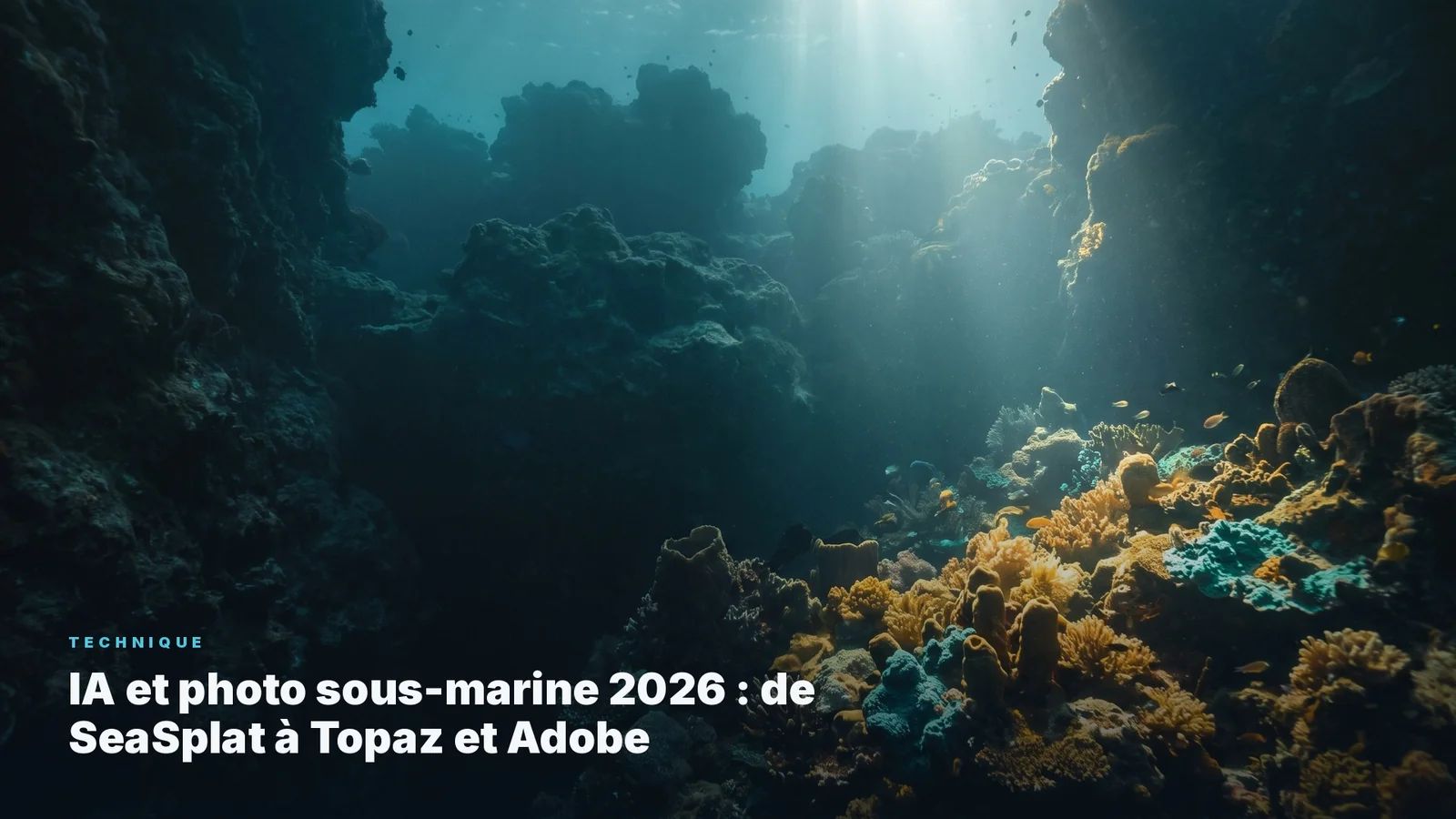
AI and Underwater Photography 2026: From SeaSplat to Topaz and Adobe
Before discussing artificial intelligence and underwater photography, it is important to recall a fact that every diver knows through experience: water is the absolute enemy of color. As soon as you reach the first meter of depth, the reds start to disappear. At five meters, the oranges follow. At ten meters, there is only blue and green left, and your beautiful scarlet nudibranch looks like a gray pebble on a uniform blue background.
This fundamental problem, that of the physics of light in water, is what artificial intelligence is now beginning to solve in a way that would have seemed like science fiction just three years ago.
NVIDIA SeaSplat: The Restoration That Defies Physics
The most ambitious project comes from NVIDIA Research, and it's called SeaSplat. The principle is both simple to understand and incredibly complex to implement: from raw underwater photos, the algorithm reconstructs what the scene would look like without the distortions caused by the water.
SeaSplat uses a technique called 3D Gaussian Splatting to model the scene in three dimensions, and then mathematically removes the effects of water (haze, diffusion, selective color absorption). The result is an image (or a 360-degree navigable 3D scene) that shows the real colors of the subjects, as if they were photographed in the air.
The reds and yellows, which are usually lost within the first few meters, reappear with a surprising fidelity. The fine details of the corals and marine organisms, which are obscured by the underwater haze, appear with newfound clarity. The system runs on NVIDIA L40 GPUs and has already been tested on reefs in the U.S. Virgin Islands and the Red Sea.
For ecologists and scientists, it is a valuable monitoring tool: to analyze the state of a reef from standard photos, without specialized equipment. For underwater photographers, it is the promise of being able to restore images that were thought to be irrecoverable.
The tools you can use now
SeaSplat is still a research project, not a public software. But other AI tools are already in the hands of underwater photographers, and the results are tangible.
Topaz DeNoise AI has become an essential tool for reducing digital noise. In underwater photography, where low-light conditions force users to increase ISO, noise is a constant problem. Topaz analyzes the image and removes noise while preserving fine details, producing results that far exceed what classic noise reduction filters can achieve.
The RC-Astro Backscatter Eliminator tackles another common problem in underwater photography: backscatter, these suspended particles illuminated by the flash or lamp that dot the image with bright spots. The tool automatically detects and removes these particles, a task that previously took dozens of minutes of manual editing per image.
Adobe is testing its Generative Fill feature in Photoshop in beta, with direct applications for underwater photography: filling in a corner of an image cut off by the edge of the dive, removing a section of palm frond in the frame, or slightly extending a blue background. The results are convincing for minor edits, but remain identified as AI generation for major modifications.
The ethical question that competitions already address
The Underwater Photographer of the Year (UPY) has updated its rules in 2026: digital processing remains permitted, but the use of AI to generate entire images or substantial portions of a photograph is strictly prohibited.
This distinction is important for underwater photographers: using AI to correct colors, reduce noise, or eliminate backscatter is a technical enhancement, similar to what was already done in a darkroom. Generating a fish that wasn't there, or a reef that doesn't exist, is creation, not photography.
The line is sometimes fine, and it will continue to move as tools become more powerful. But for now, the community agrees on a clear principle: AI is a tool for development, not a replacement for the underwater photographer.
An AI workflow for the underwater photographer in 2026
For those who want to integrate these tools into their practice without getting lost, here is an approach that works.
We start by sorting: Lightroom or Capture One for selecting and making basic adjustments (exposure, white balance, contrast). We then proceed with noise reduction: Topaz DeNoise AI on images with high ISO. We remove backscatter: RC-Astro Backscatter Eliminator on flash-lit images. Finally, we make fine adjustments: local retouching in Lightroom or Photoshop, cropping, sharpening.
This workflow may add perhaps ten minutes per image, but the difference in final quality more than justifies the time investment. And it preserves the integrity of the photo: everything that is in the final image was actually there at the time of the shot.
AI does not turn a bad photographer into a good photographer. It transforms a good photo taken in difficult conditions into an image that finally does justice to what the diver saw with their own eyes underwater.
And perhaps that's its greatest promise: not to invent a marine reality, but to reveal the one that already exists, hidden behind the blue veil of the water.
Frequently Asked Questions
Can AI really restore the lost colors in my underwater photos?
Yes, but with nuances. Tools like Topaz or Lightroom significantly improve color rendering in post-processing. NVIDIA SeaSplat goes even further by mathematically reconstructing the colors absorbed by the water. For now, SeaSplat remains a research project, but the results on the tested reefs are impressive. Current consumer tools already correct noise and backscatter very well.
How to integrate AI into my underwater photo editing workflow without losing the authenticity of my images?
The healthiest approach is to use AI only to correct what the water has degraded, not to invent what didn't exist. Noise reduction with Topaz, removal of backscatter with RC-Astro, color adjustments in Lightroom. The guiding principle: everything that appears in the final image must have actually been present at the time of the shot.
Why underwater photography competitions ban certain uses of AI?
Competitions such as the UPY distinguish between technical improvements (noise reduction, color correction) and content generation (adding an animal, modifying a scene). The former relates to development, while the latter relates to creation. This line protects the integrity of photography as a record of reality, a fundamental principle in underwater photography.
What are the best free or affordable AI tools to start with underwater photo editing?
Lightroom already offers integrated AI features (automatic masking, noise reduction). Adobe Firefly allows for local adjustments. To go further, Topaz DeNoise AI remains the most cost-effective investment for underwater photographers who regularly shoot in low-light conditions.
AI does not replace the skill of taking pictures. Our Post-processing module in the underwater photography course teaches you how to get the best out of your images, from settings to final retouching.