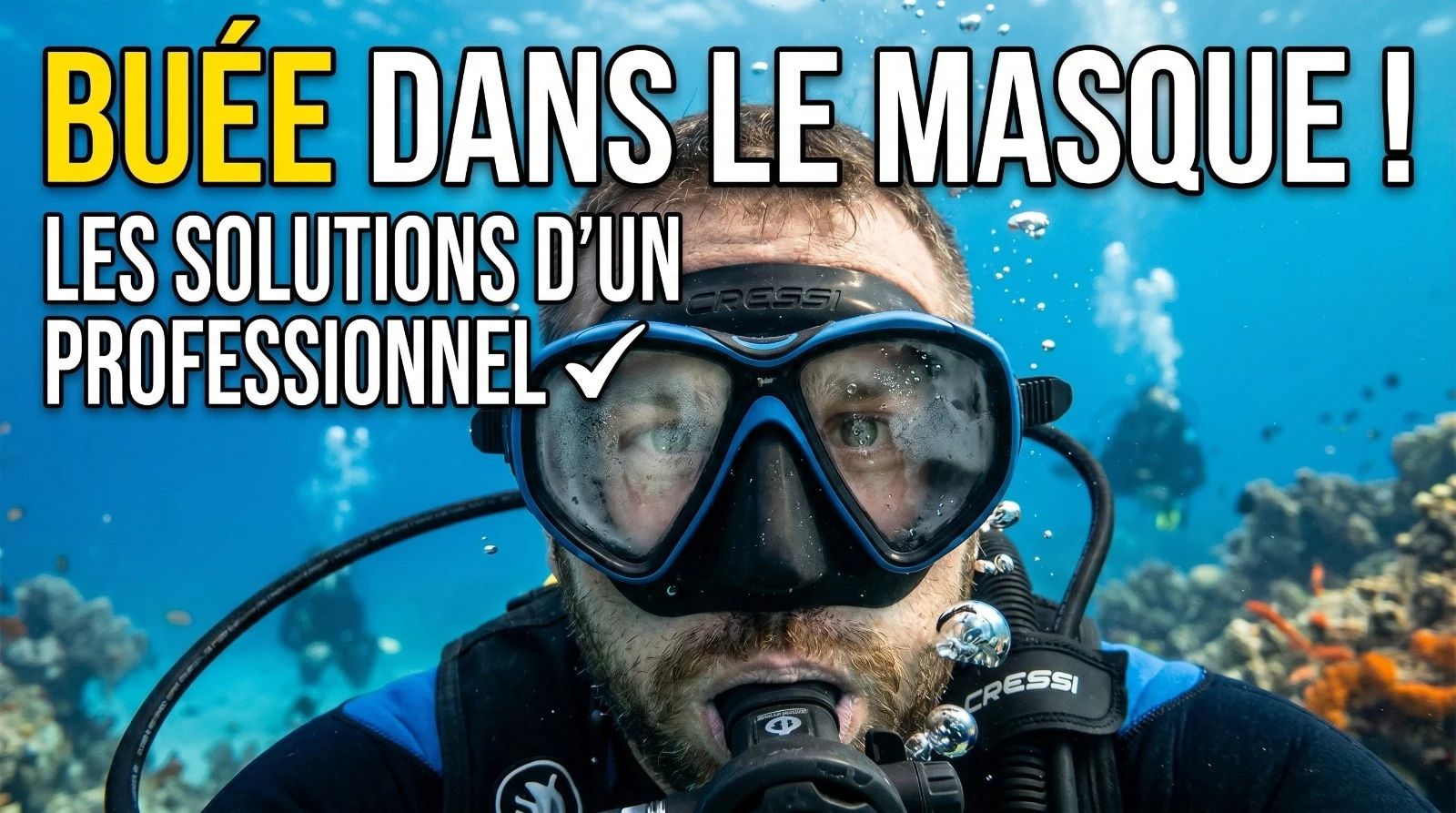
Anti-fog dive mask: the complete instructor's guide
Foggy dive mask? Understand the science, prepare a new mask with a lighter, pre-dive routine. Field-tested guide over 15 years by an instructor-photographer.
Fog forms when the humid air from your breathing touches the colder glass of the mask. Condensation is inevitable, but a properly prepared mask and a correct pre-dive routine reduce it to zero.
How do you prepare a new dive mask against fogging?
Lightly burn the inside of the lenses with a lighter to remove the residual silicone film from manufacturing. Then clean with non-gel toothpaste. This operation needs to be done only once, before first use.
What is the best anti-fog for a dive mask?
Spit remains the most reliable and most widely used solution among professionals. Commercial solutions work but add unnecessary cost. The key lies in mask preparation and routine, not in the product.
To learn how to get the most out of your gear underwater, discover the AquaExposure training.
There are moments underwater where everything aligns. The light falls just right, a school of fusiliers turns in your direction, and you bring the camera to your eye. Except you can't see anything. Your mask is fogged up, and through the milky veil you can make out the scene without being able to frame it. By the time you clear your mask, rinse, raise the camera again, the school is gone. The photo will never exist.
I have lost more images to fog than for any other reason. Not because of equipment, not because of a bad setting, not because of a subject that moved too fast. Because of a poorly prepared mask, a routine rushed before entering the water. And the worst part is that the problem can be completely solved. You just need to understand why it fogs and apply the right protocol, once, in the right order.
This guide is the one I have been giving my students for years. No magic recipe, no miracle product. Basic physics, fieldwork, and 15 years of trials in waters ranging from 4 to 30 degrees.
Why your mask fogs up
The mechanism is simple when you break it down. Your face is warm (around 37 degrees). The water around your mask is cold (often between 10 and 25 degrees depending on the destination). The mask lens, in contact with the water, takes on the water temperature. The air you exhale through your nose is loaded with moisture, and when that warm, humid air meets the cold lens, the water vapor condenses into micro-droplets. It is exactly the same phenomenon as a car window on a winter morning.
What turns this phenomenon into a nightmare for divers is a detail that is rarely explained.
The hidden culprit: the factory silicone film
When a mask is manufactured, the tempered glass is molded into a silicone frame. To ensure the mask releases cleanly from the mold, manufacturers use a release agent (a silicone-based lubricant) that leaves an invisible film on the inner surface of the glass. This film is hydrophobic. It repels water.
Under normal conditions, condensation on a clean surface forms a thin, relatively transparent water film. But on a hydrophobic surface, the water does not spread. It forms thousands of micro-droplets that diffract light in every direction. It is this diffraction that creates the opaque fog, the kind that prevents you from seeing anything at all.
The consequence is direct: a new mask fogs up every time. And no anti-fog product (spray, saliva, soap) works properly as long as this factory silicone film is present. The product slides off the film instead of bonding to the glass. This is why some divers say that "nothing works" against fog. Everything works, provided the glass is clean.
Mask fit: the factor everyone forgets
Before even talking about preparation or anti-fog products, there is an absolute prerequisite. The mask must fit your face.
A poorly fitted mask lets water in constantly. Water seeps through the edges of the silicone skirt, wets the lens, and the fog-rinse-fog cycle starts again every three minutes. No anti-fog in the world can withstand that.
The test is simple: place the mask on your face without putting the strap on, look downward, and inhale gently through your nose. The mask should stay stuck without you pressing on it. If air gets through somewhere, try another mask. The shape of the silicone skirt must follow the contours of your face without pressure points, without folds, without leak zones.
This advice sounds basic. Yet it is the number one comfort factor in diving, and it conditions everything else.
Preparing a new mask: three methods that work
The lighter flame
This is the most effective and fastest method to remove the factory silicone film. It works on all tempered glass masks (the vast majority of dive masks on the market). It does not work on masks with polycarbonate lenses or glued corrective lenses.
The principle is simple: the flame of a lighter reaches a temperature sufficient to burn the silicone film deposited on the glass. Tempered glass resists this heat without any problem (its annealing temperature sits around 400-500 degrees, well above what a lighter produces in a quick pass).
Here is how to do it, step by step.
Light a standard lighter (not a torch, not a candle, a simple gas lighter). Pass the flame over the entire inner surface of the glass, keeping it in motion, as if you were painting the lens with the flame. The glass will turn black. That is normal, it is the silicone film burning.
Do not stop after the first pass. Many guides say "pass the flame quickly" and stop there. That is not enough. Keep burning until fog no longer forms when you breathe on the glass. Test between each pass: blow on the lens as you would on a mirror. If fog still appears, pass the flame again.
The critical point: never bring the flame near the silicone skirt. Silicone melts. Once melted, it deforms the skirt and the mask loses its seal. Keep the flame on the glass, only on the glass, and leave a centimeter of margin from the silicone edge.
Abrasive toothpaste
For those who prefer to avoid the flame (or for masks with polycarbonate lenses), toothpaste with abrasive micro-beads is an excellent alternative. The micro-beads mechanically polish the factory silicone film without scratching the tempered glass.
Apply a small dab of toothpaste on the inner surface of each lens. Rub with your finger in circular motions for a good minute per lens. Rinse with clear water.
There is an often-forgotten advantage: if you choose a menthol toothpaste, the menthol vapors help clear your sinuses. While diving, clear sinuses make ear equalization easier during the first meters of descent. One product, two functions.
The dishwasher
It sounds incongruous, and yet. A long dishwasher cycle at high temperature effectively degreases the silicone film. The combination of prolonged heat and powerful detergent does what a hand rinse cannot.
This is a complementary method, not a replacement. After the lighter or toothpaste, a dishwasher cycle cleans burned residue and degreases the silicone skirt (which also retains oils over time from contact with your skin).
After preparation: soap and degreasing
Whatever method you choose, always finish with a wash using dish soap. The soap removes combustion residue (if you used the lighter) and degreases the silicone skirt. The skirt accumulates sebum from contact with your skin, and this grease gradually migrates toward the glass. Regular degreasing keeps the mask clean.
The ready-made solution: SEAC masks
If this whole protocol feels like too much, there is an industrial alternative. SEAC manufactures masks equipped with a technology called Double Plasma. The principle is the inverse of the problem: instead of removing the hydrophobic film, SEAC applies a hydrophilic treatment on the inner surface of the glass at the factory. The treated glass retains a thin, uniform, transparent water film instead of letting droplets form.
Activation is immediate: soak the mask in fresh water for a few minutes before the dive. No spit, no spray, no preparation. The treatment is durable and does not require reapplication.
SEAC offers this technology on three models (Clear, Pura, and Wild), each suited to a different type of diving. It is the simplest solution if you do not want to deal with preparation.
The pre-dive routine (the AquaExposure protocol)
Your mask is prepared. The factory film is gone. Now you need to prevent fog from returning on every dive. And this is where most divers get it wrong.
The product matters less than the method
Saliva, liquid soap, anti-fog spray: all three work. What makes the difference is not the product you use. It is how you apply it.
All these products work on the same principle: they deposit a surfactant film on the glass that transforms condensation into a transparent water layer instead of opaque micro-droplets. The film lowers the surface tension of water on the glass, and the water spreads instead of beading.
The step most divers skip: let it dry
The most important rule in this entire guide fits in four words. Let the product dry.
When you apply saliva, soap, or spray on the glass, you need to let the product form a dry film on the surface. This dry film acts as a thermal barrier between your face (warm) and the glass (cold). It reduces the temperature differential, and it is this differential that causes condensation.
Most divers apply the product then immediately rinse with plenty of water. The film washes away. The protection goes with it. You might as well not bother.
Three mistakes to avoid before entering the water
Do not leave your mask in the sun before diving. A mask heated by the sun dramatically increases the temperature differential with the cold water. The greater the differential, the faster and more abundant the condensation.
Do not rub too hard when rinsing. A light rinse is enough to remove excess product. Vigorous rubbing removes the protective film.
Do not rinse with abundant fresh water. A trickle is enough. A bucket of water drowns the film.
My personal technique
After years of trials, I settled on a protocol that works on every dive, in all conditions.
I apply saliva (or diluted liquid soap) on the lenses. I let it dry while I gear up. I do not rinse on the boat. I enter the water with the product still on the mask. Once submerged, I do a single quick rinse in the sea water by passing water over the inside of the lenses.
This single rinse in the sea has a double advantage. The sea water is at the diving temperature, so the mask acclimates immediately. And the act of rinsing the mask at the surface also allows you to blow your nose lightly and clear your sinuses, which makes ear equalization easier on the descent.
Result: zero fog for the entire dive. No mask clearing, no wasted time, no missed shots.
Fog and underwater photography: why it matters
For a recreational diver, fog is an annoyance. For an underwater photographer, it is sabotage.
In macro, when you are trying to frame a 2-centimeter nudibranch, the slightest trace of fog prevents you from seeing the details of the subject in the viewfinder. You think you nailed the focus, you press the shutter, and when you surface you discover the photo is blurry because you could not properly distinguish the subject through your mask.
In wide angle, fog often concentrates in the corners of the mask, where the silicone skirt meets the glass. These are precisely the zones you need to watch to verify that your composition is clean, that there are no stray bubbles entering the frame or a piece of reef cut off.
And there is the time cost. Every time you have to clear your mask, surface, rinse, reapply anti-fog, that is two to three minutes lost. While diving, two minutes is a manta ray passing by, a curious grouper approaching, a break in the clouds lighting up the reef. These moments do not repeat.
Mask preparation is not a hygiene detail. It is a technical prerequisite on the same level as setting the white balance or checking your battery charge. If you go on a dive trip with your camera and your mask fogs, you have invested thousands of euros in equipment to stare at milk.
Commercial alternatives
Adhesive anti-fog films, dedicated sprays, sticks to rub on the glass. The market offers dozens of them. They all work on the same principle (depositing a surfactant film), and they all work on one condition: that the glass has been properly prepared beforehand.
If you master the protocol above (new mask preparation + pre-dive routine with drying), these products become superfluous. Saliva or a drop of liquid soap does exactly the same job, for free, anywhere in the world, without needing to find a dive shop.
That said, if you prefer a spray for comfort or habit, choose one without alcohol (alcohol attacks the silicone skirt over time) and apply it with the same method: apply, let dry, minimal rinse.
FAQ
Why does a new mask fog more than an old one? Because a new mask carries a factory silicone film on the inner surface of the lenses, deposited during manufacturing as a release agent. This hydrophobic film prevents anti-fog products from working and amplifies condensation. An old mask has lost this film naturally over time and use.
Is saliva really effective against fog? Yes. Saliva contains mucins, surfactant proteins that lower the surface tension of water. It transforms micro-droplets of condensation into a transparent water film. Its effectiveness is comparable to commercial sprays, provided you let the film dry before rinsing.
Can you use a lighter on all dive masks? On all tempered glass masks, yes. Tempered glass easily withstands the heat of a moving lighter. However, never use a lighter on masks with polycarbonate lenses (they melt) or on masks with glued corrective lenses (the glue can deteriorate). And never bring the flame near the silicone skirt.
How long does preparing a new mask take? Five minutes with the lighter (two to three passes per lens, testing between each pass). Ten minutes with toothpaste (one minute of rubbing per lens, rinse, test, repeat if needed). A complementary dishwasher cycle takes the length of the program. It is a one-time investment for the entire lifespan of the mask.
Can toothpaste scratch the mask lens? Standard toothpaste (without beads) does not scratch tempered glass. Toothpaste with abrasive micro-beads lightly polishes the surface, which is exactly the desired effect to remove the silicone film. The microscopic scratches are invisible and do not affect vision underwater. However, never use scouring powder or strong abrasives.
This article draws on condensation and surface tension principles, mask preparation recommendations from DAN Europe and PADI, and 15 years of practice in real conditions from the Atlantic to the Indian Ocean.
If you are heading out on a dive trip soon, remember to check your batteries and dive lights for flying before departure. And to learn how to photograph without flash (which considerably reduces the gear you need to carry), discover our underwater photography course.
Anti-fog dive mask: the complete instructor's guide | AquaExposure