Table of Contents
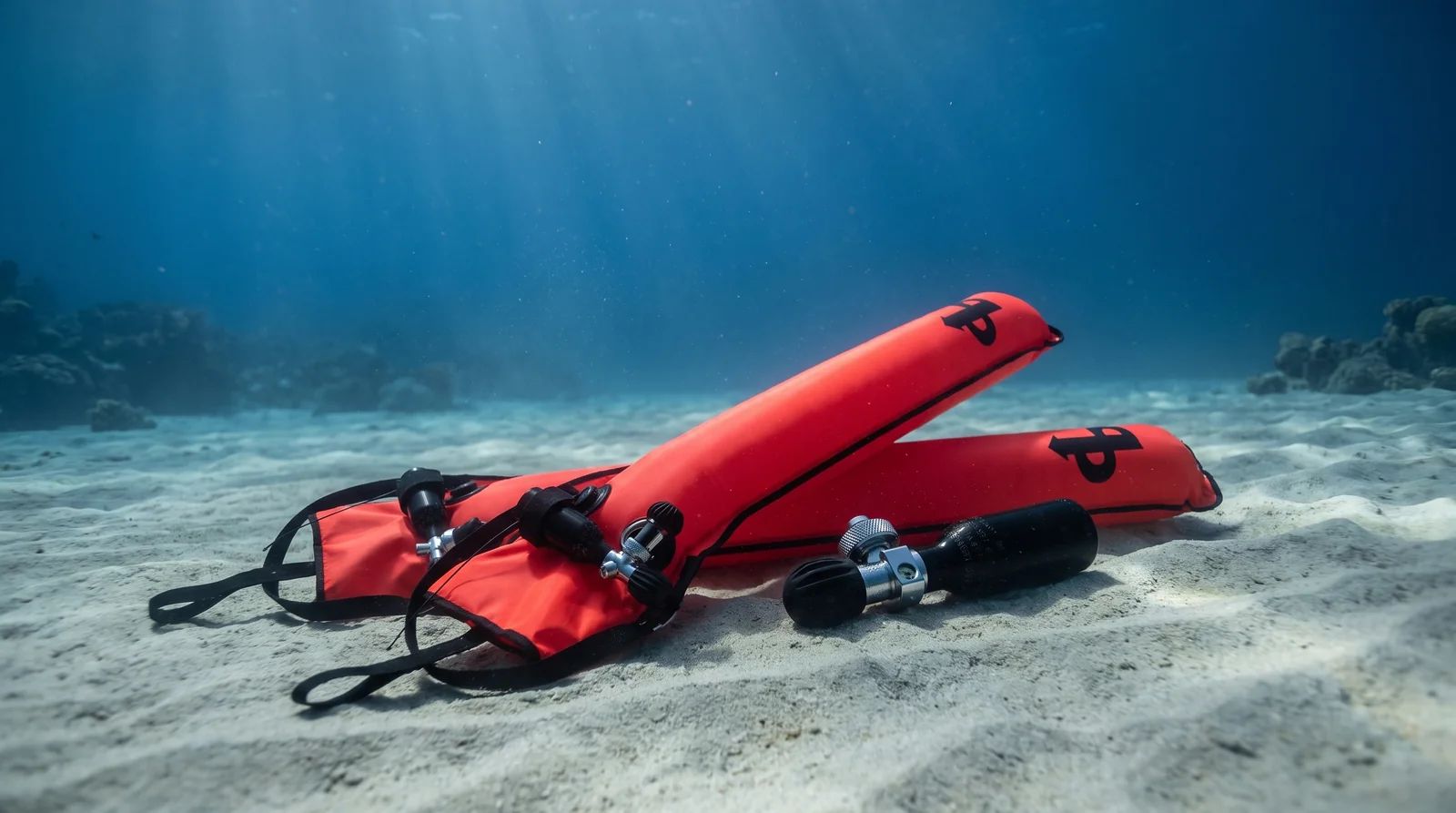
Full review and test of the AP Diving stage parachute- bottle stage parachute (140 cm). Analysis of visibility, inflation safety, and field verdict from AquaExposure.
At the end of a drift dive, suspended at a depth of five meters in the blue, as the current carries you away from the reef, the stage bag is your only link of communication with the surface. In a choppy sea where waves and foam obscure the silhouettes of divers, a stage bag that is too short or that deflates upon contact with the waves becomes a critical hazard. The AP Diving stage bag has been developed to ensure perfect verticality and immediate visual signaling for support boats.
Design and Architecture of the AP Diving Stage Bag
The AP Diving stage bag is designed with a confirmed length of 140 cm. Its high-visibility orange color has been chosen to provide maximum contrast on the water, minimizing the effects of sunlight reflections and marine foam.
Its internal volume guarantees sufficient positive buoyancy to tension the spool line without excessively pulling on the diver during the safety stop. The integrated SOLAS reflective bands significantly increase optical visibility during twilight or low-light dives.
1. Inflation, Air Management, and Purging (D1: 2.9 / 5 - Weighting 35%)Safety during deployment relies on a versatile and secure inflation system. The AP Diving stage parachute allows for controlled air injection, preventing sudden overpressure during a rapid ascent to the surface.
The presence of a calibrated overpressure valve with a manual purge pull allows for the evacuation of excess air during volume expansion. On the surface, the anti-return valve prevents any accidental deflation when the line becomes slack on a wave crest.
2. Visibility at a Distance and Surface Silhouette (D2: 3.0 / 5 - Weighting 30%)
With its straight 140 cm profile, this model stands proudly above the waterline, offering boat watchmen an optimal sighting angle from hundreds of meters away.
Imagine a maritime signaling buoy subjected to swells: if its air volume escapes from the bottom or if its structure lacks rigidity, it will sag on the water and disappear between the waves. The AP Diving stage parachute operates on the principle of a pressurized, sealed column. Once deployed, its anti-return system and valve maintain a perfect straight geometry for visibility from a distance.
3. Materials, Welds, and Mechanical Strength (D3: 3.1 / 5 - Weighting 20%)The durability of a lift bag depends directly on the quality of its fabric and the watertightness of its seams. The AP Diving lift bag uses a high-tenacity nylon fabric coated with thermoplastic polyurethane (TPU), assembled with watertight high-frequency welds.
This construction remarkably resists repeated friction, abrasion from salt, and premature aging caused by UV rays during prolonged surface exposure.
4. Ergonomics, Compactness, and Storage (D4: 3.0 / 5 - Weighting 10%)
Once deflated and rolled up, the AP Diving lift bag has a minimal footprint, easily fitting into a thigh pocket or under a stabilizer vest strap.
The stainless steel D-ring located at the base allows for direct and secure attachment of your finger spool with a double-ender.
5. Quality, Price, and Consistency (D5: 3.0 / 5 - Weighting 5%)
Priced at a suggested retail price of €309, this model offers a level of technical performance perfectly aligned with the safety requirements of modern diving.
Who is this DSMB lift bag for?
| The table below classifies the suitability of the AP Diving lift bag according to your skill level and diving conditions: | Diver Profile | Verdict and Usage Recommendations |
|---|---|---|
| Recreational Diver (Levels 1 & 2) | Ideal, providing all the necessary safety for club dives and drift dives. | |
| Independent Diver & Traveler | Excellent choice, sturdy and easy to pack in a travel bag. | |
| Technical Diver & Offshore Drift Diver | Perfect for ensuring high visibility signaling during the final stage of a decompression stop. | |
| Instructor & Divemaster | Recommended for its operational reliability and longevity in intensive use. |
AquaExposure Verdict on the AP Diving Stage Bottle Parachute (Score: 3.0 / 5 - Status: Acceptable)
The AP Diving Stage Bottle Parachute is a reliable and robust signaling device. Rated as Acceptable on our comparison tool with an overall score of 3.0 / 5, it combines excellent vertical stability on the surface with secure handling underwater.
To improve your skills and master underwater photography, discover our AquaExposure training.
Discover our DSMB parachute comparison tool and all of our diving tools to compare this model with all available options.
Share
/blog/ap-diving-parachute-de-palier-a-bouteille-en
Table of Contents
- 01Design and Architecture of the AP Diving Stage Bag
- 021. Inflation, Air Management, and Purging (D1: 2.9 / 5 - Weighting 35%)Safety during deployment relies on a versatile and secure inflation system. The AP Diving stage parachute allows for controlled air injection, preventing sudden overpressure during a rapid ascent to the surface.
- 032. Visibility at a Distance and Surface Silhouette (D2: 3.0 / 5 - Weighting 30%)
- 043. Materials, Welds, and Mechanical Strength (D3: 3.1 / 5 - Weighting 20%)The durability of a lift bag depends directly on the quality of its fabric and the watertightness of its seams. The AP Diving lift bag uses a high-tenacity nylon fabric coated with thermoplastic polyurethane (TPU), assembled with watertight high-frequency welds.
- 054. Ergonomics, Compactness, and Storage (D4: 3.0 / 5 - Weighting 10%)
- 065. Quality, Price, and Consistency (D5: 3.0 / 5 - Weighting 5%)
- 07Who is this DSMB lift bag for?
- 08AquaExposure Verdict on the AP Diving Stage Bottle Parachute (Score: 3.0 / 5 - Status: Acceptable)
Questions about the Journal
What is the length of this lift bag?
This model measures approximately 140 cm, which gives it an excellent profile for signaling above the waves.
Does this model have an overpressure valve?
Yes, it includes an overpressure valve with a manual pull cord to regulate air expansion during ascent.
Is the strobe visible in low-light conditions?
The combination of safety orange color with SOLAS retro-reflective stripes ensures excellent passive visibility.
How do I attach the spool to this parachute?
It features a reinforced stainless steel D-ring at the base for attaching the double-ended carabiner of the spool.

