Apple's Underwater Optics Patent: What iPhone Photography Without a Housing Will Actually Look Like
Apple filed a patent for an iPhone optic rated to 42 metres underwater, no external dome needed. What it actually promises, what it does not change yet, and the honest take from an underwater photography instructor.
Can an iPhone really dive to 42 metres without a housing thanks to this patent?
No. The patent describes an optic, meaning the glass in front of the lenses. It does not make the phone waterproof (speakers, microphones, charging port and chassis seals remain vulnerable). Until Apple completely redesigns the chassis to withstand that pressure, you will still need a housing beyond five metres.
Can I put my iPhone directly in seawater to take photos?
Bad idea, even at shallow depth. Salt attacks the connectors, microphones and speakers over time. An iPhone that spends more than about thirty cumulative minutes in seawater in a single day will see its lifespan significantly reduced. For the price of a DiveVolk housing (around two hundred and fifty euros), you protect a phone that costs five to seven times more.
Should I wait for this technology before buying a DiveVolk housing?
No. The patent is at the filing stage and Apple has announced no product timeline. Between the idea and an accessory on a shelf, you typically count two to five years. A DiveVolk housing lets you photograph this week, certified to 60 metres.
What does this change for smartphone underwater photography?
On paper, it shifts smartphone underwater photography from an accessory market (DiveVolk, AxisGo) toward integrated optics. For the photographer, that would mean less bulk and zero assembly. For the instructor, it would mean a new set of mistakes to anticipate in training.
Why is Apple getting into underwater photography now?
Because the underwater smartphone market is growing (Samsung Ocean Mode, OPPO Find X9, Google Pixel 10, DiveVolk certified at UPY 2026). Apple no longer innovates alone on imaging and needs to regain ground on specialised use cases where the camera makes the difference.
Does this patent finally make red filters useful on iPhone?
No. The patent covers protective optics, not colour correction. The rule stays the same whether you shoot with an iPhone, a compact or a DSLR: colour lost with depth is recovered through white balance and post-processing, not through a red filter.
To learn how to get the most out of your gear underwater, discover the AquaExposure training.
Apple's Underwater Optics Patent: What iPhone Photography Without a Housing Will Actually Look Like
A few days ago, at the end of May 2026, Apple filed a patent that sent a wave of notifications through the photography world. The title is dry: Plurality Of Optical Centers In A Unified Free Form, Hemispherical Optic. Behind the jargon lies an idea worth pausing for, because it points toward something the diving community has been waiting for a long time.
In my work as an instructor, every month I see students arrive with their iPhone and the same simple question: can I put it in the water directly, or do I need a housing? The answer today is that you need a housing. Tomorrow, maybe less so.
What follows is neither a product promise nor a timeline prediction. It is an honest reading, at the level of a working dive photographer, of what this patent says and what it does not say.
What Apple's Patent Actually Describes
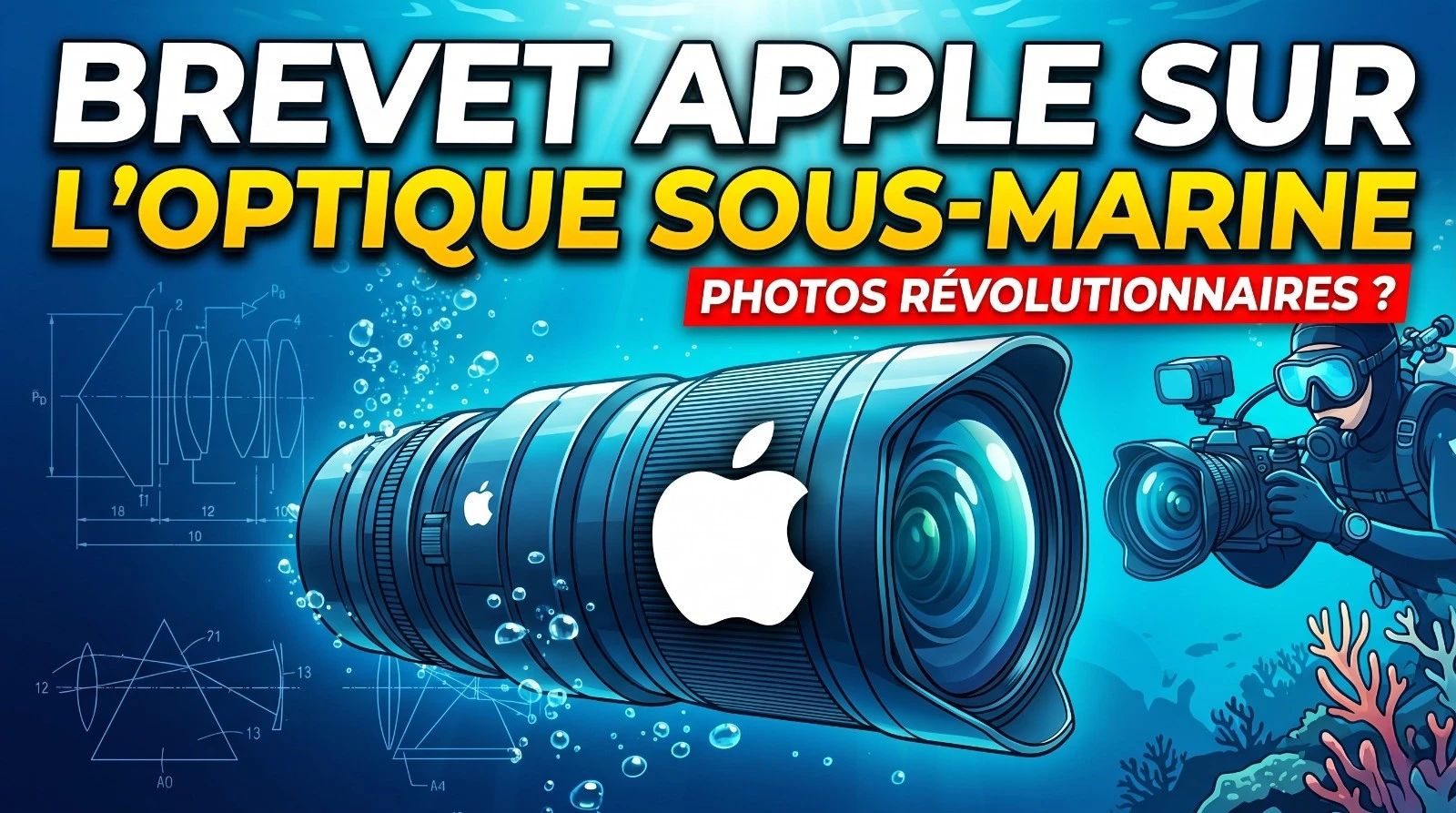
Apple describes a hemispherical optic made as a single piece, capable of covering multiple iPhone lenses at once. This is the opposite of the add-on dome we know today, which mounts over a single lens and sits on top of the phone.
The optic described would be thinner, integrated into the phone design (or a flat accessory), and engineered to reduce underwater distortion. The patent explicitly mentions a target depth of 140 feet, which translates to 42 metres in our diving units.
The named inventors are Ryan M. Sheridan and Benjamin D. Buckner, who worked at Apple on fisheye distortion correction. That is consistent with the patent's angle: this is not a housing project, it is an optics project that solves a physics problem.
The important word here is patent. Not product. Apple files thousands of patents every year. Only a fraction becomes a feature you can buy in a store. Between filing and reaching the shelf, the average delay runs around three to five years, sometimes more if industrial priorities shift.
A Waterproof Optic Does Not Make a Waterproof Phone: The Misunderstanding to Clear Up
Before going further, we need to break a shortcut that surfaces every time someone writes about this patent. Apple is going to make the iPhone waterproof to 42 metres. No. Apple describes an optic. That is the piece of glass (or optical material) that covers the camera lenses. The rest of the phone (speakers, microphones, charging port, buttons, touchscreen, chassis seals) remains exactly as vulnerable as before.
An optic allows the camera to see sharply despite the pressure and distortion underwater. It does not seal a phone. For an iPhone to be truly waterproof at 42 metres, the entire chassis would need to be designed to withstand that pressure, which requires a complete mechanical redesign far beyond an optical element on the front.
Until that broader mechanical work has been done (and it is not even mentioned in the filed patent), the practical rule stays the one we already know: beyond five metres, you need a housing. Not an optical accessory. A real enclosure that isolates the phone from water.
And there is a point I want to add, because I have seen it too many times in training. Even if tomorrow a phone technically survived a dip in two metres of saltwater for a surface photo, salt remains the long-term enemy. An iPhone that spends more than about thirty cumulative minutes in seawater in a single day (entries and exits, surge, splashes, wet pocket) will see its connectors corrode, its microphones crackle, its speakers lose clarity. The brand does not put it quite that way, but field experience says it very clearly.
When you line up the price of a recent iPhone (between twelve hundred and eighteen hundred euros depending on configuration) and the price of a DiveVolk SeaTouch 4 Max Plus (around two hundred and fifty to three hundred euros), the math is quick. For a thousand times less than the phone itself, you buy complete protection that isolates the screen, buttons, connectors and body from all salt exposure. I much prefer that logic over going diving with a device exposed directly to seawater while betting on its actual lifespan.
What this patent promises is fewer optical accessories for imaging. Not the end of the need to protect the phone. Those are two separate problems, and confusing them gets expensive after a few weeks of diving.
What It Actually Promises for Smartphone Underwater Photography
If Apple releases an accessory that resembles this patent, or if the optic ends up integrated into a future iPhone generation, two things change in the daily life of a dive photographer.
The first is bulk. Today, a DiveVolk setup in cabin luggage means the housing, the SeaTouch module, sometimes the add-on lens, the safety lanyard and the pouch. A flat stick-on accessory, or better yet a native phone feature, means zero assembly between dives. For short trips and tight cabin carry-on situations, that is a real change.
The second is friction. A portion of divers who have not yet tried smartphone underwater photography say the same thing in training: fear of forgetting a seal, of locking improperly, of ruining a phone worth several hundred euros. An integrated optic removes that fear in a single step. That will probably be the most visible first wave of adoption.
But there is a point that needs to be heard clearly: a change in optics does not change the physics of light underwater. Water absorbs red within the first two metres, then orange, then yellow. That is true for an iPhone protected by a housing, true for a compact in an Ikelite, and it will be true for a future iPhone with integrated optics. What this patent promises is fewer accessories. Not more colour.
Why Apple Is Getting Into This Now: Market Pressure
Apple would not have filed this patent in 2026 if the underwater smartphone market had stayed the niche it was in 2020.
Over the past eighteen months, the signals have been piling up. Samsung launched an Ocean Mode on its Galaxy range. OPPO released the Find X9 Pro with extended waterproofing. Google built a subaquatic mode into the Pixel 10 Pro. DiveVolk inaugurated a smartphone category at the Underwater Photographer of the Year 2026 competition, and the winning image was taken with a SeaTouch 4 Max Platinum V2.
Apple is watching this ecosystem grow. The phone that used to sell on land-based photo quality now also sells on its ability to go deeper. When a use case becomes mainstream, Apple stops ignoring it.
What is interesting is the angle they chose. Apple is not attacking the housing market (where DiveVolk is solid and margins are tight). Apple is attacking friction. What they are patenting is not a housing, but the idea that you should not need a housing anymore. That is a very Apple approach: do not compete with a product, redefine the need.
What This Changes (and Does Not Change) for Your 2026 Dives
If you are reading this thinking about replacing your current setup, here is the honest take.
Today, June 2026, you cannot wait for this patent. Not because it will never arrive, but because nobody knows when it will arrive. You have dives planned this summer, courses, trips. The gear that works now is the gear that is in stores now.
To photograph underwater with a smartphone this season, the pairing of a recent iPhone with a DiveVolk remains the training reference. I have been using it for four years in courses, and the reliability is there when the assembly procedure is followed. For details on choosing between current models, the article iPhone and DiveVolk for underwater photo and video covers the tested configurations.
In twelve to twenty-four months, the picture could change. If Apple releases a stick-on accessory certified to 42 metres, it will need to be tested in training, compared in image quality against a DiveVolk, checked for durability over time (scratches, seals, repeated use behaviour). Just because Apple releases it does not mean it will be better. It means it will need to be verified.
In five to ten years, if the optic ends up natively integrated into iPhones AND if Apple simultaneously adds true mechanical waterproofing of the chassis (two very different things, I will say it again), the entire accessory ecosystem reconfigures. As long as the second condition is not met, the housing remains essential beyond five metres, and it stays relevant even at the surface to protect the device from salt over time. DiveVolk will probably continue to exist for pro configurations (macro lenses, wide-angle, snoot), just as Ikelite housings still exist for DSLRs in the smartphone era. But the entry ticket to underwater photography drops, and that is good news for growing the practice.
The AquaExposure Doctrine in Light of This Announcement
I will end on a point that matters to me, because it comes up every time a new toy appears.
A patent, a new sensor, an integrated optic, an AI mode: none of these make you an underwater photographer. They remove friction. That is useful. But the friction that keeps most divers from bringing back beautiful images is not the difficulty of waterproofing a phone. It is the approach to the animal, buoyancy control, composition, patience, reading natural light.
None of those elements is solved by an Apple patent. All of them are solved by practice, and that is precisely the ground that AquaExposure training covers. The article why gear does not make the underwater photographer goes into detail on this logic.
When the Apple optic comes out, I will test it. I will tell you what it is worth, without flattery, the way I did for the SeaTouch 4 Max and for the GoPro Mission 1. Until then, you have gear that works, animals that are not waiting, and a season that is starting.
The water will not change because Apple filed a patent. You are the one who changes, dive after dive.