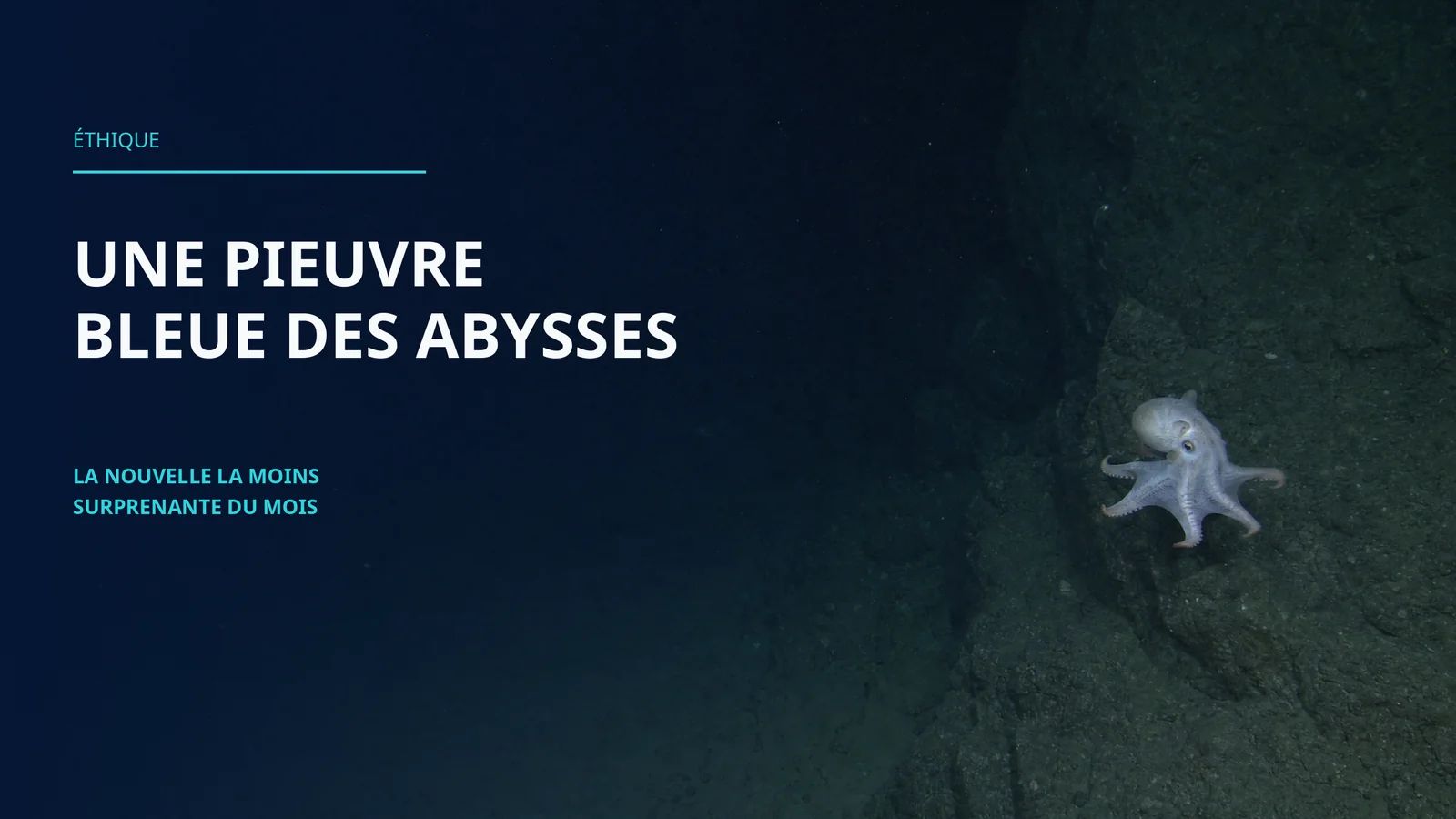
Galapagos blue octopus, an unprecedented life form in the depths, corals growing on alkaline cement. May 2026 spoke volumes.
L'Encre is a weekly series about recent marine discoveries. The ink of writing. The anchor of the seabed. One issue, some news, and what it changes when you dive with a camera.
A small blue octopus was found at around 1,800 metres depth. It is one of many deep-sea discoveries that keep reminding us how little of the ocean we know.
No. These animals live far below recreational diving limits. We meet them only through deep-sea research, submersibles and cameras.
Because it puts our images in perspective. The reef we photograph is the thin, sunlit top of a vast unknown world.
Through remotely operated vehicles, deep cameras and environmental DNA, not through diving. Science reaches where our fins cannot.
Humility and curiosity. Photographing the accessible ocean well is a way to make people care about the parts they will never see.
"The only other place comparable to these marvelous nether regions must surely be naked space itself, out far beyond atmosphere, between the stars." William Beebe
We were in the last weeks of May 2026. Several teams of biologists were working independently, without knowing each other or coordinating their efforts.
They all achieved their results at the same time, as if the sea had chosen that particular month to speak loudly.
This is not a metaphor. It is the calendar.
Three new discoveries, three different registers, one possible conclusion: we know much less than we think we know about what lives in the water.
There was one thing that the researchers said when they saw it appear on the ROV screen, in 2015, at a depth of 1,773 meters off the coast of Darwin Island in the Galapagos.
"It is blue."
Eleven years later, on May 25, 2026, the scientific journal Zootaxa officially described the animal as a new species. Its name: Microeledone galapagensis. A squid from the family Megaleledonidae, inhabiting deep waters.
The size of the animal at the time of its capture was approximately that of a golf ball. Its color, an unusual blue for cephalopods from these depths.
The researchers only had one specimen. To identify it, Janet Voight, a renowned invertebrate curator at the Field Museum of Chicago, refused to dissect it.
She preferred to submit it to a CT scan, obtaining three-dimensional images of the internal organs and the oral cavity, without touching the animal.
"These small octopuses live in the deep waters, and almost no one on Earth has had the opportunity to see them," says Voight. "I simply feel lucky to be working with them."
What is striking about this story is not the color or size. It is the eleven years. The animal was there, preserved in alcohol, waiting for someone to have the time to really look at it. And to find the right tools to look without destroying it.
The Pacific Ocean covers more than the entire landmass of the planet. In this proportion, a blue golf ball at 1,773 meters is less rare than it is common.
In March 2026, a team of taxonomists published the results of a different study: the analysis of 24 new species of amphipods collected in the depths of the Pacific Ocean.
Amphipods are tiny crustaceans, scavengers and decomposers, found in all the oceans of the world and at all depths.
Among these 24 species, researchers have identified not only a new family (Mirabestiidae), but also a new superorder (Mirabestioidea). This is on a different scale than a single species or even a new family.
A superorder is a level of classification that groups together several families and sometimes hundreds of species.
Identifying a completely new phylum is like adding an entire branch to the tree of life - this diagram that organizes all known organisms from their common ancestors.
This branch was missing. Our maps were incomplete in a way that could not be measured, since we cannot count what we do not know how to look for.
These amphipods live in active hunting areas, as both predators and scavengers, in complete darkness. No one had yet clearly defined them as a separate line of life. They were also waiting.
In Miami, in April 2026, a team from the local university made a quieter result public.
They had grown star coral larvae (Orbicella faveolata) on tiles made with sodium carbonate.
Sodium carbonate is alkaline. When the larvae grow on it, the water around the tiles becomes locally more alkaline.
And in more alkaline water, corals calcify better, survive better, and grow faster than corals raised using the classic method.
It's a simple idea. Precise. Potentially scalable.
An alkaline cement tile is inexpensive compared to current coral restoration techniques.
If the result is on a larger scale, it involves modifying the supply chain of all coral nurseries around the world, from the Maldives to the Great Barrier Reef.
Nothing is yet won. The restoration of reefs remains a difficult race against rapid degradation.
For context, see the state of the reefs in 2026 and our article on heat-resistant corals.
But the fact that the idea is so simple, and that it works, deserves to be remembered.
We dive with a camera in an environment where we don't know the inhabitants. We already knew this, in theory.
What these three new developments in May 2026 change is the scale of what "not knowing" actually means in practice.
A species described eleven years after its capture. An entire branch of the living tree that we have just added. A survival technique for corals, which fits in a tile and involves manipulating pH.
For underwater photographers, there is a concrete responsibility in all of this.
Images of reefs, unknown species, and behaviors never documented are more than just photographs. They are biodiversity data.
They are used by biologists who work without ROVs. They are used by marine protected area managers.
They are also used for projects of underwater photogrammetry, which map the state of a reef over time.
The area between 30 and 200 meters, the mesophotic zone, is full of animals that no one has photographed correctly. This is not a metaphor for exploration. It is a real documentary situation.
And the divers who descend with a camera are among the few humans who can access it.
We often return to it through underwater photography training: the best underwater photograph is not always the most beautiful. It is often the most useful.
If you want to learn how to document marine life with precision and intention, the AquaExposure training is available online. And if you are in Belgium, the in-person session will resume in the fall.
Ink, what is it?
This is a weekly series on marine science news, translated into what it means for underwater photographers. The ink of the writing. The anchor on the seabed. One issue, some news, one question: What do we do with a box in our hands?
The previous episodes cover, among other things, the record whale migration and the robot that listens to reefs.
Also see the article dedicated to the giant squid detected by environmental DNA.
Ten years ago, a blue octopus the size of a golf ball swam through the field of view of a camera at a depth of 1,773 meters, near a submarine mountain in the Galapagos. It waited for someone to give it a name. It waited for ten years.
The sea has patience. The question is whether we do too.