Nusa Penida, Bali: Manta Point, Crystal Bay and mola mola photography. Megafauna technique, currents, cold water and ethical approach. A practical guide for dive photographers.
Mola mola are present at Crystal Bay from July to November, peaking in August-September. They ascend from the depths to be cleaned of parasites on coral heads between 15 and 40 meters. The water is cold (18-22°C during this period) and visibility variable.
Open Water for Manta Point (moderate current, max depth 15m). Advanced Open Water recommended for Crystal Bay (strong current, cold water, potential descent to 30-35m for mola mola). Current management skills matter more than the certification level on paper.
Never swim above a manta (it feels blocked), never cut across its path, never touch. Position below or to the side, at least 3 meters away. Wait for the manta to come to you rather than pursuing it. If it changes direction, stop and let it be.
Yes. Water can drop to 18-20°C at Crystal Bay during mola mola season, especially between 20 and 35 meters where upwellings are strongest. A 5mm wetsuit is the minimum - a 7mm or hood is recommended for a comfortable 40-50 minute dive.
Fast ferry from Sanur (Bali) to Nusa Penida takes 30-45 minutes. Padangbai is another departure point. Most dive centers in Sanur organize day trips including the transfer and 2 dives at Nusa Penida. Staying directly on Nusa Penida is also possible with simple guesthouses available.
During high season (July-September), Manta Point can have 10-15 groups simultaneously. Arriving early (first dive at 7:30am) means finding mantas before the crowds. The same rule applies to Crystal Bay. Some local centers offer early morning dives at a slightly higher rate to avoid peak congestion.
At Crystal Bay, mola mola are not always shy: when focused on their cleaning, they tolerate divers at 3-4 meters. The technique: descend quickly and calmly to their depth, stop, and wait. Never fin while looking at one. Use a mid-range focal length (not macro, not extreme wide angle) since working distance varies.
To learn how to get the most out of your gear underwater, discover the AquaExposure training.
Nusa Penida, the small island southeast of Bali, is one of the most accessible megafauna destinations in Southeast Asia. Manta rays reliably present at Manta Point, mola mola (ocean sunfish) in season at Crystal Bay. The trade-off: strong currents, cold water in some spots, and sharply increasing visitor numbers. This guide covers the photography technique and ethical approach.
If you are planning an underwater photography trip to Indonesia, Nusa Penida and Komodo are often compared. They are two different destinations that suit different diving levels.
Nusa Penida is accessible from Bali in 30 minutes by fast ferry. Currents are strong on some sites, but local guides know them well and briefings are reliable. It is an ideal ground for progressing in megafauna photography before heading to more demanding destinations like Komodo.
In workshops in Brussels, when a student tells me they want to photograph manta rays but have never had the chance, Nusa Penida is the first destination I recommend. The mantas at Manta Point are present at shallow depth, in manageable currents, and local guides know how to position groups effectively.
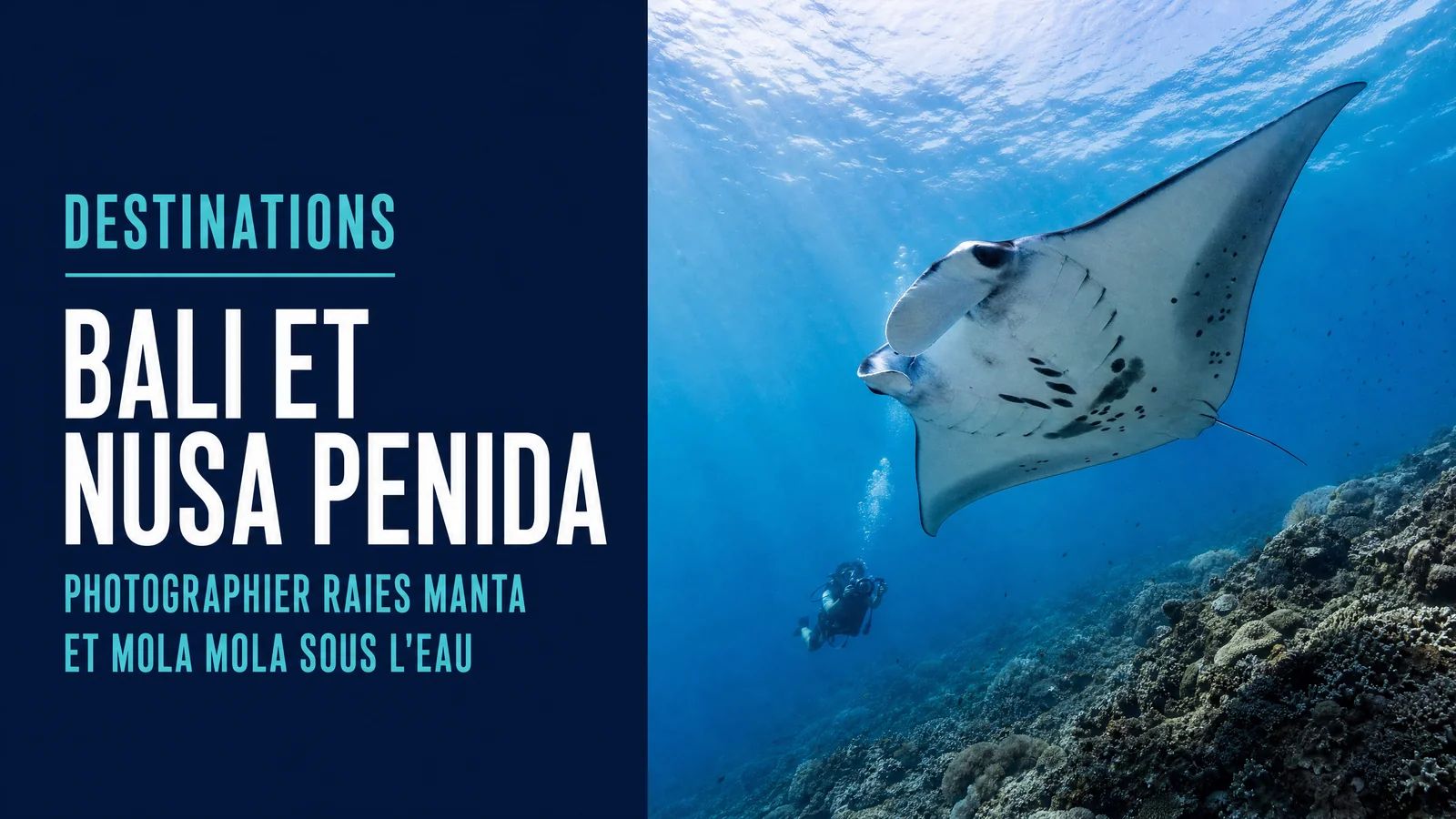
Manta Point sits on the southwest tip of Nusa Penida. Oceanic mantas (Mobula birostris) and reef mantas (Mobula alfredi) come to be cleaned by wrasse and parrotfish on coral heads between 5 and 15 meters depth.
The depth stays manageable for most certification levels, but the current can be sustained and sometimes unpredictable. A competent local guide matters here: they know the safe anchor points (coral formations in slack water) from which you photograph mantas passing overhead.
The manta is a subject to photograph from below, never from above. A manta seen from above is a dark silhouette against a dark background. Seen from below, it is a bright silhouette against the luminous surface, showing its distinctive ventral markings (black and white, each individual unique like a fingerprint).
Recommended settings: - Wide angle: 10-17mm fisheye or 14-24mm standard to capture complete wingspan - f/8 to f/11 for depth of field - ISO 400 to 800 depending on ambient light - Minimum 1/200 shutter to freeze wing movement - Continuous autofocus if available on your camera
Positioning: 3-5 meters below the manta, stationary on a fixed point. If you swim toward the manta, it moves away. If you wait at a fixed point, it often passes within 2 meters.
The good news about ethics at Manta Point: adopting an ethical approach (no chasing, positioning below, waiting still) is also the best photographic strategy. Photographers who chase mantas get blurry tail images. Those who wait get ventral passes at 1-2 meters.
The manta ray and whale shark photography guide from the Maldives covers these principles in detail: they apply identically at Nusa Penida.
Crystal Bay, on Nusa Penida's northeast coast, is a particularly beautiful site: a horseshoe-shaped bay with a rocky point that drops into the deep. Currents are strong and can generate cold water upwellings from the abyss.
It is this cold water (18-22°C in season) that attracts the mola mola. The ocean sunfish, which can weigh up to 2 tonnes, ascends from the depths to be cleaned of parasites on coral heads between 15 and 35 meters.
July to November, peak in August-September. Outside this window, mola mola are absent or very rare. Crystal Bay remains a beautiful site year-round (mantas, turtles, tropical fish) but the ocean sunfish is the primary draw for a Nusa Penida trip in season.
The mola mola is an unusual photographic subject. It is massive (1-2 meters tall) but often photographed poorly because divers approach too quickly and cause it to flee.
The technique: 1. Descend quickly and calmly to the mola mola's depth (follow the guide) 2. Stop at 4-5 meters, stay still 3. Wait for the mola to stabilize at its cleaning station 4. Slow approach, no fin movement, shift your body angle slightly 5. Optimal working distance: 2-3 meters
Focus is tricky because the mola oscillates slightly in the water. Subject-tracking autofocus if available, or manual focus on the eye.
Crystal Bay and neighboring sites also host sea turtles that are relatively relaxed around divers. The same ethical framework applies: no chasing, no blocking the path to the surface, no touching.
Calmer, less visited sites ideal for macro and reef photography. Gamat Bay has a beautiful topography with walls and varied coral formations. Buyuk is known for its approachable sea turtles.
For turtle photography, the same rules apply as with any megafauna: do not touch, do not block the route to the surface, do not swim above them.
Two shallow reef sites (6-15 meters) with excellent natural light in the morning. Batu Abah in particular offers good tropical fish diversity in often-clear water. Perfect for practicing composition and settings before the megafauna dives.
Fast ferry from Sanur harbor: 30-45 minutes, multiple daily departures, approximately €4-7. Padangbai harbor (1 hour from Kuta) also offers ferries to Nusa Penida.
From Nusa Penida, all dives are done by boat (jukung, traditional local boats). Dive centers on the island or from Sanur organize complete day trips.
The day trip from Sanur is the standard approach. Departure at 7am, return by 4pm, 2 dives (Manta Point plus Crystal Bay or Gamat Bay). Efficient for one or two days.
For three days or more, staying directly on Nusa Penida is worthwhile: the villages of Ped and Crystal Bay have simple guesthouses. This allows early morning dives (before the day trip boats from Bali arrive) and late afternoon dives.
Nusa Penida works well as the first stop of an Indonesia photography trip. Combine with Lombok (Gili Air for macro, Gili Trawangan for turtles) or with Komodo at the end of the stay for strong currents and giant mantas.
Check our seasonal guide by destination for the ideal window based on your travel period.
The classic travel photography mistakes guide includes underestimating Nusa Penida's currents: read it before departure.
The manta ray and megafauna photography technique guide developed for the Maldives applies directly here, with specific adaptations for the Indonesian context.
The AquaExposure underwater photography course includes a dedicated megafauna photography module covering approach, settings, composition and ethics - so you arrive with the technique already in place.
AquaExposure receives no affiliate commission from dive centers, ferries or accommodation mentioned in this article.


