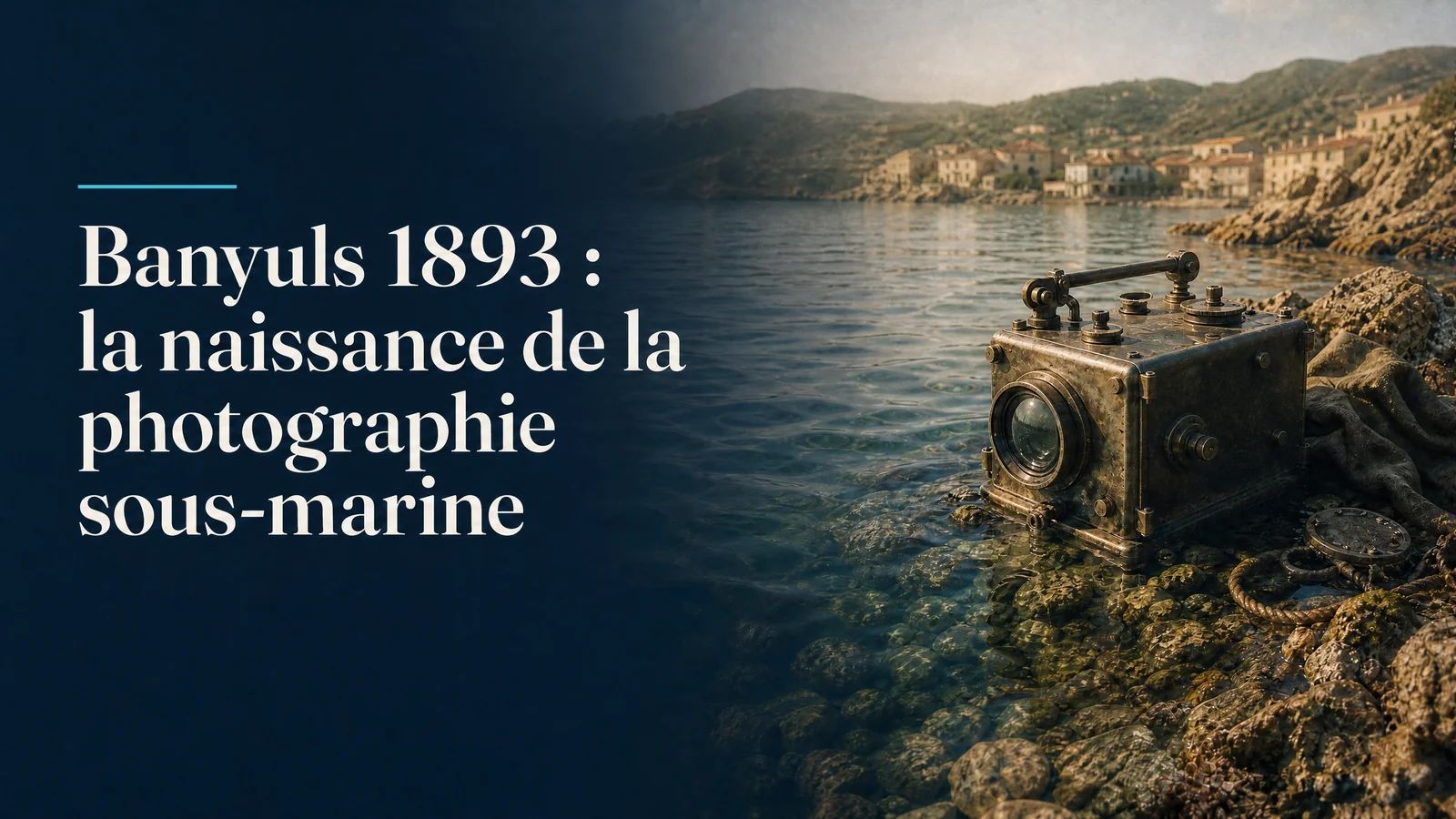
Banyuls, 1893: Where underwater photography was born
Banyuls, 1893: Where underwater photography was born
It's been a few years now that I've been training underwater photographers. I've taught in Greece, Cyprus, the Seychelles, and the Maldives, and now from Belgium and the south of France. But there's one thing I only discovered recently, and that deeply touched me: the very first underwater photograph ever taken was taken on the same shores where I learned to dive.
Louis Boutan, a French naturalist specializing in the study of mollusks, took the first underwater photographs in the world in June 1893. He worked at the Arago Laboratory in Banyuls-sur-Mer and had designed a watertight metal housing himself to protect his photographic equipment. He later published a foundational book on the subject in 1899.
Where was the first underwater photo in the world taken?
The first underwater photograph was taken in the bay of Banyuls-sur-Mer, on the Cote Vermeille in the Pyrenees-Orientales. Boutan worked at various depths, up to 10 meters, in the clear waters of this rocky coast. The Arago Laboratory, a marine station founded in 1882, provided him with the necessary logistics.
Can you dive on the same sites as Louis Boutan today?
Yes. The bay of Banyuls is still an active dive site, accessible from local dive centers and our partner Aquatile in Argeles-sur-Mer. The seabed has not fundamentally changed since 1893, but the marine life has considerably increased thanks to the creation of the Cerbere-Banyuls marine reserve in 1974. There are now more than 630 groupers.
Banyuls-sur-Mer. June 1893. A naturalist points his device towards the bottom of the bay, and underwater photography is born. Just a few hundred meters from the spots where I completed my Level 1.
Louis Boutan, the naturalist who invented everything
Louis Boutan was not a trained photographer. He was a scientist, a naturalist specializing in the study of marine mollusks, affiliated with the Arago Laboratory in Banyuls-sur-Mer. This marine station, founded in 1882, was already a leading research center at the time, located on a coast whose biological richness fascinated European scientists.
Boutan had a specific problem. He wanted to document the species he observed in their natural habitat, not in aquariums or on dissection trays. He wanted to see them as they lived, where they lived. And for that, he needed to invent a way to photograph underwater.
In June 1893, after months of preparation, he descended into the Bay of Banyuls with a camera that he had himself adapted for underwater use. At various depths, up to 10 meters, he took the first underwater photographs in history.
The images were blurry, dark, and imperfect. But they existed. For the first time, a human being had captured on a photographic plate what only divers could see.
The technical challenge of a pioneer
One must place this achievement in the context of the time to appreciate it. In 1893, photography itself was still a relatively new technology. Glass plates were fragile, exposure times were long, and the sensitivity of emulsions was very low.
Underwater, all of this became enormously complicated. The watertightness of the housing was the first challenge: Boutan had designed a metal housing capable of withstanding the pressure, with a glass viewport for the lens. Light was the second obstacle, as at a depth of 10 meters, even in the clear waters of Banyuls, the intensity of light decreases considerably.
Boutan worked for several years to improve his system. He developed underwater lighting devices (arc lamps in waterproof containers), experimented with different emulsions, and refined his diving equipment. In 1899, he published "Underwater Photography and the Progress of Photography," a work that remains a foundational document for the discipline.
What strikes me when I read Boutan's story is that the challenges he faced are fundamentally the same as those we face today. The watertightness of the equipment, light management, and the photographer's stability in the water. The tools have changed dramatically, but the principles remain the same.
Why Banyuls
This is not a coincidence that underwater photography originated in Banyuls-sur-Mer. The Côte Vermeille brought together (and continues to bring together) a unique set of conditions.
First, the water clarity. The rocky coast of the Pyrenees-Orientales, without large rivers to load the sea with sediments, offers a natural visibility that few Mediterranean sites can match. For a photographer working with several-second exposure times, this clarity was essential.
The biological richness, next. The diversity of the marine bottoms of Banyuls, with its rocks, its seagrass meadows, its first coral formations, offered Boutan an exceptional variety of subjects. It was precisely this richness that had justified the installation of the Arago Laboratory ten years earlier.
Finally, the proximity of the marine station. Boutan was not a lone adventurer. He worked from a laboratory equipped with the help of fellow scientists and local divers. Logistics were essential for equipment as bulky and fragile as this.
Today, 130 years later, these three conditions still exist. The clarity of the water, the richness of the fauna (enhanced by the creation of the marine reserve in 1974), and the presence of professional diving centers that allow access to the sites in the best possible conditions.
130 years later, the same shore
There's something quite moving about diving on the same reefs as Boutan, with a camera in hand. The parrotfish that he couldn't photograph (too fast for his exposure times) are now so numerous in the reserve that they almost pose directly in front of the lens. The nudibranchs that he had to bring to the surface to draw, are now photographed in macro with a precision that Boutan could never have imagined.
The Bay of Banyuls has not fundamentally changed. The rocks are the same, the light enters the water with the same crystalline quality, and the sea grass still sways in the same current. What has changed is our ability to capture what we see. And it is precisely this ability that Boutan inaugurated here, on a June 1893 day.
When I train underwater photographers on the coast of the French Riviera, where I often dive with our partner Aquatile, I like to tell them this story. Not for the historical lesson itself, but because it puts what we do into perspective. We are not practicing a leisure activity invented by the tourism industry. We are perpetuating a scientific and artistic discipline that originated here, on this very shore, more than a century ago.
And perhaps that's the most beautiful gift that Banyuls offers to those who come to dive with a camera. The feeling of becoming part of a story. Of looking at the same seabed as the very first underwater photographer. Of continuing, in their own way, what a passionate naturalist started on a summer day in 1893.
The light in Banyuls does the rest.
Frequently Asked Questions
Who took the first underwater photograph?
Louis Boutan, a French naturalist specializing in the study of mollusks, took the first underwater photographs in the world in June 1893. He worked at the Arago Laboratory in Banyuls-sur-Mer and had designed his own watertight metal chamber to protect his camera. He then published a pioneering work on the subject in 1899.
Where was the first underwater photograph in the world taken?
The first underwater photograph was taken in the bay of Banyuls-sur-Mer, on the coast of the French Riviera in the Pyrénées-Orientales. Boutan worked at different levels, down to 10 meters deep, in the clear waters of this rocky coast. The Arago Laboratory, a marine station founded in 1882, provided him with the necessary logistics.
Can we dive at the same sites as Louis Boutan today?
Yes. The Bay of Banyuls remains an active diving site, accessible from local dive centers and our partner Aquatile in Argelès-sur-Mer. The seabed hasn't fundamentally changed since 1893, but the fauna has significantly increased thanks to the creation of the Cerbère-Banyuls marine reserve in 1974. Today, there are more than 630 groupers there.
Want to master underwater light, just like Boutan dreamed?
Module 4 of the AquaExposure training is dedicated to light, exposure, and settings while diving. Understanding how light behaves underwater is the challenge that Boutan tackled 130 years ago, and that every underwater photographer continues to face. AquaExposure training