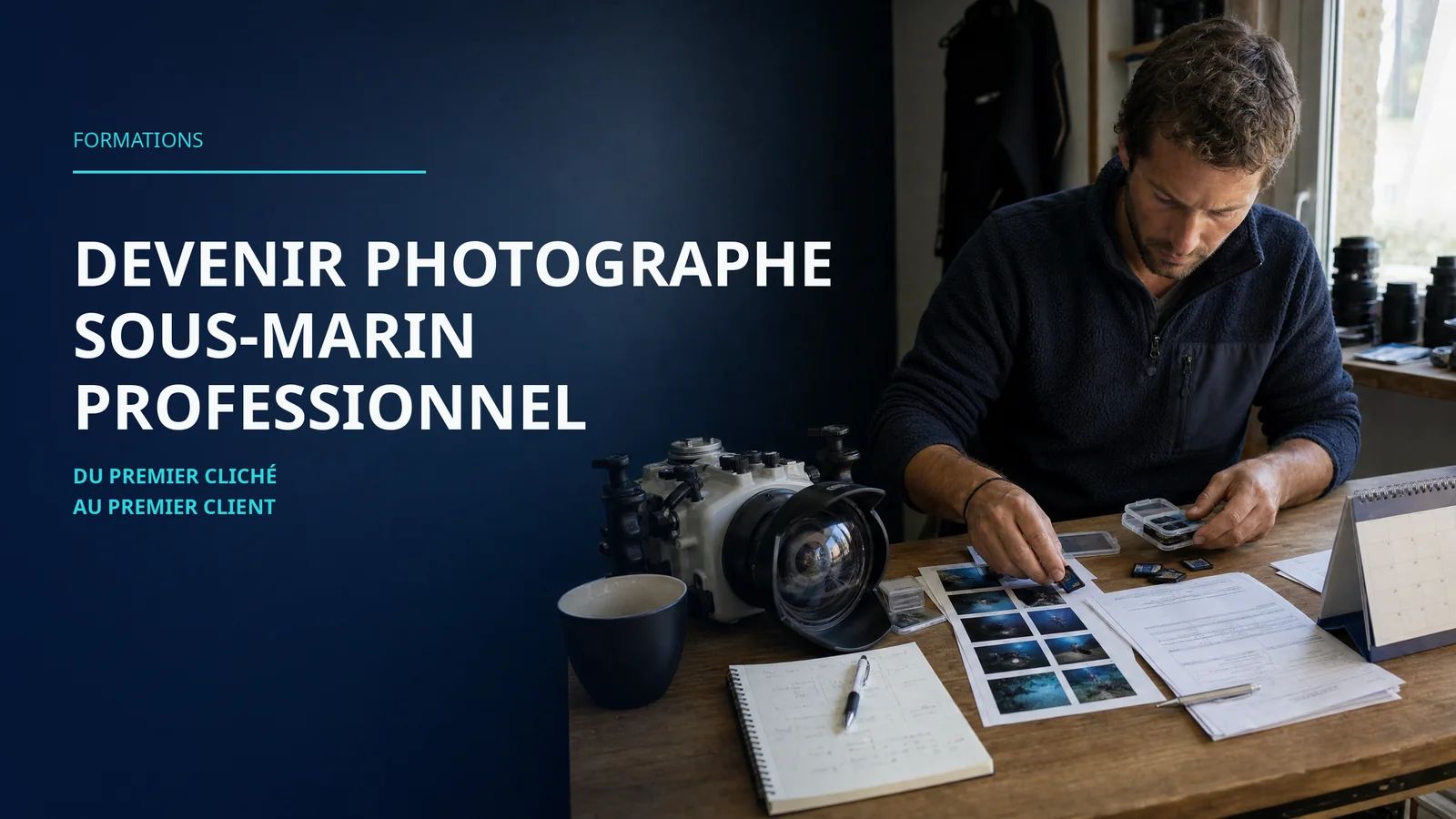
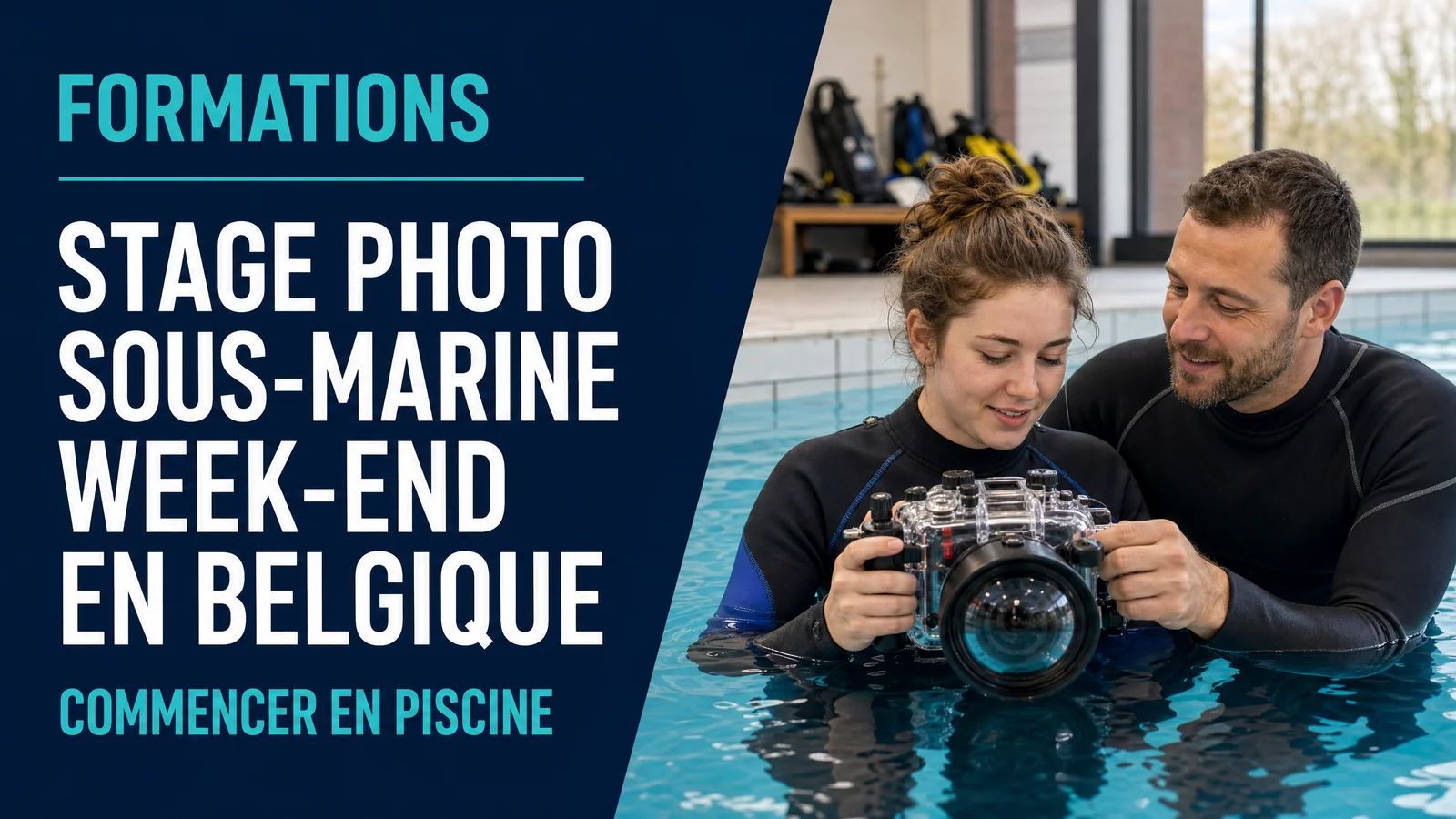
How long before you can make a full living from underwater photography?
Realistically: 18 to 24 months if you do it smartly, with mentorship and immersion. Maybe 3 to 4 years if you do it alone. My personal path took 2.5 years.
Do you need a formal certification to be a professional photographer?
No, not a photography certification. But: you must be an excellent diver (Advanced or better), have a visible portfolio, and real clients. What builds credibility is not a piece of paper, it is your work.
What is the best gear to start with?
Canon 5D Mark IV or Sony A7 IV (2,000 to 2,200 euros), Nauticam or Ikelite housing (1,500 euros), and a versatile lens. Do not overpay for top-of-the-line gear. Learn first with affordable equipment.
I will tell you the truth upfront: I started as a diving instructor in the Maldives in 2012, with a camera a client had lent me. Five years later, underwater photography represented 70% of my income. Today, in 2026, I run AquaExposure and I train photographers through that same transition. But honestly? The path was far more complicated, less financially rewarding at first, and psychologically more demanding than I would have expected.
How much does a professional underwater photographer earn? Between 50 and 500 euros per image depending on the context (stock, tourism, magazine), plus annual contracts with dive destinations (8,000 to 25,000 euros), brand partnerships (15,000 to 100,000 euros per year), and training. Real income rarely comes from a single source.
Here is what nobody tells you upfront, and what I wish I had known before selling my motorcycle to buy a higher-resolution camera body.
Why Underwater Photography, Exactly?
That is an excellent question, and honestly, this is where my own story begins with a magnificent streak of arrogance.
I loved diving. I loved the ocean. I thought those two things together would automatically guarantee me a photography career. What an idiot. Photography is a profession in its own right, with its own rules, its own economy, its own clients. Diving and the ocean are just. the context.
That said, there are real opportunities here. The underwater photography market has exploded since 2015, for three reasons:
1Ecotourism is booming. Dive destinations now spend massive budgets on authentic visual content.
2Outdoor and sports brands are desperately looking for "adventure" content for their social media and campaigns.
3Marine conservation has found its visual voice. Organizations like WWF and The Nature Conservancy no longer photograph just to document. They look to tell stories that create empathy.
So yes, there is real demand. But your passion for corals is worthless if you do not know how to sell that passion to someone who needs it.
The Truth About Income: Where the Money Actually Comes From
Let me be specific, because that is what the useless articles on the web never do.
In 2015, my first six months in Malaysia, I earned 3,500 euros total. That was tourist payments (photographing honeymoon couples, 200-300 euros per session), a few images sold on 500px (between 5 and 40 euros each), and instructor rates that paid me 12 euros an hour.
None of those things was "my real career." It was just. work that paid the bills.
Here is how income actually breaks down for a professional:
1. Tourism contracts (20-30% of income at the start) - Photographer for private dives: 250-400 euros per half-day - Resort partnerships: 15,000-25,000 euros per year + room and board (rare, very competitive) - Liveaboard contracts: 30,000-50,000 euros per season (6 months)
Honestly: this is stable but low income at the beginning. The problem? You are limited by the number of hours you can dive without compromising your safety. Maximum 400-500 dives per year. That means a fairly low income ceiling if you do not diversify.
2. Image sales / Stock (10-15% at first, 40% long-term if managed well) - Stock images (Shutterstock, Getty, Alamy): 5-50 euros per download - Exclusive royalties through agencies: 200-1,000 euros per image sold to magazines - Commercial licenses for brands: 500-3,000 euros per image
I did not start seriously selling stock until 2018. Today, it is my largest source of passive income. But it took 4 years before I had a portfolio legitimate enough for agencies to reach out to me.
3. Brand contracts / Campaigns (15-40% with experience) - Campaigns for outdoor brands (Patagonia, The North Face, etc.): 5,000-50,000 euros per project - Partnerships with tourism destinations for annual marketing: 20,000-100,000 euros - Content for conservation NGOs: 3,000-15,000 euros per project (often lower pay, but very fulfilling)
4. Training and workshops (20-30% with experience) - Photo-dive workshops: 2,000-10,000 euros per workshop (depending on destination and group size) - Online courses: 50-5,000 euros per course (AquaExposure is precisely this) - Mentoring and consultations: 100-300 euros per hour
This is where I found real stability in 2019. Training allows a scaling that does not exist in pure photography.
5. Publications and editing (5-10%) - Magazine articles: 500-2,000 euros per article - Photo books: expect between 10,000 euros and several hundred thousand (if the book sells well), but this is very rare
How I Actually Started: The Non-Linear Path
I need to tell you how it really happened, because you will read articles selling you a perfect narrative. Mine was organized chaos.
Phase 1: The Arrogance (2012-2013) I am an instructor. I have a GoPro. I balance on a reef with 30 clients per week. Surely, I can do photography.
Spoiler: no. I was terrible.
My first 100 photos? They were blurry, overexposed, poorly composed, and technically bad. But a client said "hey, can I buy these?" and gave me 150 euros. I thought "I am going to get rich."
I was a fool.
Phase 2: The Chaotic Learning (2013-2015) I invested in a Canon 5D Mark III and a waterproof housing at 8,000 euros. That was 30% of my savings. For the first three months, my photos still were not any better. Just. in higher resolution.
But I started noticing something: on every dive, there was always one moment, one image that stood out. Not perfect. Not publishable. But better. I set myself a simple mission: every day, one better image than the day before.
It took 18 months before other photographers started seeing me as "a threat" at the local spots.
I studied the best. At the time (2014-2015), that meant: - David Doubilet, who had built his career at National Geographic by being both photographer AND scientist/researcher (you cannot ignore that your value comes from your understanding of the subject) - Brian Skerry, whose National Geographic photographs were not just beautiful, they told a very specific conservation story
I understood: the best photos were not the most colorful ones. They were the photos with a clear intention. David Doubilet never just took a photo of a reef. He photographed the relationship between humans and the reef, or the ecological structure of an ecosystem.
Phase 3: The Professionalization (2015-2017) I decided to stop photographing "everything that moves." I chose five niches: 1. Marine life portrait (fish, individual creatures) 2. Wide angle (full scenes, context) 3. Macro (details, nudibranchs, small creatures) 4. Human element (divers interacting with the ocean) 5. Conservation (what is changing, what is disappearing)
This portfolio structure allowed me to respond to almost any client brief. A tourist resort? Wide angle + human element. A conservation agency? Conservation + marine life. A dive brand? All of it.
This is the structure I now teach at AquaExposure, and it is the first thing photographers miss.
Phase 4: The Business Model (2017-2018) For the first time, I asked myself: "how do I make money systematically?"
At that point, tourism contracts were paying decently (around 6,000 euros per month), but I was limited by the number of dives. I decided to stop being available and start being exclusive.
Instead of shooting for any resort that asked, I picked three and negotiated annual contracts: 1,500 euros per month for exclusive image rights in their region. That freed up 10-15 dives per week that I could dedicate to my own projects.
Laurent Ballesta, the French photographer and marine biologist, built his empire on the same principle: becoming so strongly associated with a destination or type of photography that clients think "Laurent Ballesta" instead of "generic photographer." That transformed his price from 300 euros to 5,000+ euros per image.
The Skills You Need to Acquire (Honestly)
1Advanced diving (mandatory)
2- Minimum: Advanced Open Water
3- Realistic: Master Scuba Diver, nitrox, deep diving, navigation
4- Why? You need to be able to move without consuming air while focusing on composition.
1Technical photography (obviously)
2- Manual mode: understanding the exposure triangle underwater
3- Optics: wide aperture vs. depth of field
4- Post-production: this is not "cheating," it is 40% of the job
This is where most people fail. They think that "good photo" equals good capture. No. A good underwater photo is 40% capture + 60% post-production. Lightroom, Photoshop, and ideally Adobe Substance for advanced retouching.
1Composition and storytelling
2- Study composition (thirds, leading lines, rule of thirds)
3- Understand how to tell a story in a single image
4- Study other photographers and analyze why an image works
Brian Skerry is not technically a better photographer than you. He is better because his images say something. They create empathy. They show what is at risk.
1Business and marketing (nobody teaches you this)
2- How to pitch to clients
3- How to set your prices (universal trap: pricing yourself too high or too low)
4- How to build an audience and monetize it
This is where 90% of talented photographers fail. They can create magnificent images, but they do not know how to sell them.
1Conservation and ethics (the new gold in 2026)
2- Understand the ecological impact of your work
3- Know how to photograph without disturbing creatures
4- Be able to tell conservation stories
Cristina Mittermeier understood this before everyone else. Her photos are not just beautiful, they are explicitly created to change behavior around ocean protection. She built an entire organization (SeaLegacy) around this idea.
In 2026, this has become the real differentiator. Anyone can take a beautiful fish photo. Only photographers with a genuine ecological awareness can create content that changes things.
The Four Traps You Will Encounter
Trap 1: The equipment You will think: "I need to buy the best gear before I start." Wrong. I made my best images of 2015-2016 with a Canon 5D Mark III, a camera released in 2012. What matters: learning to use your equipment at 90% of its potential before buying more.
Your initial investment budget: 2,000-4,000 euros for a decent camera + waterproof housing.
Trap 2: Followers vs. clients You will think: "I need 100,000 Instagram followers to be taken seriously." Wrong. I got my first brand commission (3,000 euros) with 2,400 followers. What matters: being visible to the right people. An account with 5,000 highly targeted followers among travel agencies or conservation NGOs is worth 10 times more than 100,000 generic followers.
Strategy: create content around keywords relevant to your clients (conservation, ecotourism, outdoor brands).
Trap 3: Selling your images too cheaply This is the mistake almost every beginning photographer makes. Someone says "I will pay you 300 euros for 50 images" and you accept, delighted.
You have just set your price at 6 euros per image. Now every potential client expects that price. That is a hole you do not climb out of.
My advice: charge a minimum of 500-800 euros for professional work (half-day). You will find enough clients at that price, and you will build a reputation as a professional, not an amateur.
Trap 4: Isolation You think you do not need to learn from anyone. You can do it alone.
Becoming a Professional Underwater Photographer: The Honest Path from First Shot to First Client | AquaExposure
Wrong. I would have succeeded 3 years sooner if I had invested in a real mentor from the start. Training, communities, connections have become essential.
That is why I created AquaExposure. I realized there was nowhere a budding photographer could learn the complete profession, not just technique, but business, ethics, storytelling, and the realistic path.
How to Build Your Portfolio
Here is what I have learned: a good portfolio does not need 10,000 images. It needs 50-100 truly good images, organized around these five categories.
Portfolio structure (what works):
1Marine Life (15-20 images)
2- Portraits: fish facing the camera, individual creatures
3- Behaviors: a fish hunting, a coral feeding
4- Diversity: show you can photograph different species in different lighting conditions
1Wide Angle (10-15 images)
2- Scenes: entire reefs, drops, walls
3- Human context: divers exploring an ecosystem
4- Scale: showing the magnitude and beauty of a place
1Macro (10-15 images)
2- Nudibranchs, small fish, coral details
3- Show your ability to work in fine detail
4- Clients love macro: it delivers an immediate "wow"
1Human Element (8-12 images)
2- Divers interacting with the ocean (ethically)
3- Reflecting human curiosity
4- This is what tourism clients love
1Conservation (5-10 images)
2- Coral bleaching, pollution, what is changing
3- Show your ecological awareness
4- More and more clients (NGOs, brands) seek this
How to fill this portfolio if you are starting out?
Go to the best dive spots and immerse yourself (literally). Not for one week. 2-3 months minimum. You will have time to: - Understand the best spots for each type of photo - Return to the same location and improve your images - Build relationships with resorts and guides (your first potential clients) - Spot interesting creatures and photograph them under different conditions
It costs money (food, accommodation, dives) but it is an investment, not an expense.
How to Find Your First Clients
This is the chapter everyone skips, and it is THE MOST IMPORTANT.
Phase 1: The "close" clients - Local dive resorts: offer your services for 10-15 euros per hour above your instructor rate - Dive schools: photography for their marketing archives - Tour operators: seasonal contracts
My first "real" client was a resort in the Maldives that offered me 8,000 euros for 6 months of exclusive photos. It was not extraordinary income, but it was systematic and reliable.
Phase 2: Stock and agency clients Once you have a solid portfolio (6 months to 1 year of work): - Approach stock agencies (Getty, Shutterstock, Alamy) - Upload your images on platforms like 500px (caution: there is a lot of noise, but also real clients) - Offer exclusives to premium agencies (higher revenue but more competitive)
Phase 3: Brands and NGOs This is where the real money arrives (5,000-50,000 euros per project).
How to approach them? - Research: identify the 20 brands or NGOs working in your niche - Pitching: send a targeted portfolio + a short pitch (1 page) explaining why your images match their mission - Networking: attend conservation conferences (Blue Ocean Film Festival, etc.) - Partners: find creative agencies working for these clients, offer yourself as an underwater photographer
My biggest contract (35,000 euros) came because I approached a creative agency with a pitch on "how to use underwater photography for conservation campaigns." Not a direct approach to the client, but through an agency route.
The Massive Role of Post-Production
I see many beginning photographers who think: "I need to take the perfect image underwater, and then it is done."
Wrong. Your images straight out of the camera are 40% good at best. The remaining 60% comes from: - Color correction (water absorbs reds, so you need to add them in post) - Contrast and clarity (underwater images naturally lack punch) - Retouching: removing particles, grain, small imperfections - Creative editing: film grain, particular color palettes, artistic styles
The best underwater photographers spend more time in post-production than shooting.
Essential tools: - Lightroom: for RAW editing, color grading - Photoshop: for detailed retouching - Luminar or Affinity: more affordable alternatives
Budget: approximately 30-40 euros per month for Adobe CC.
The Social Media Strategy That Works
The mistake: posting regularly without a strategy.
The right approach: 1. Find your unique angle: not just "beautiful photos." "Conservation + sustainable diving" or "responsible ecotourism" or "strange macro creatures." 2. Create educational content: not just pretty photos, but carousels like "10 things you did not know about nudibranchs" or "why this reef is dying." 3. Post according to your audience: if your clients are creative agencies, post more on LinkedIn. If they are resorts, Instagram. 4. Engage with the right audience: follow and comment on the accounts of conservation NGOs, outdoor brands, tour operators.
Honestly, I have two Instagram accounts: - @aquaexposure_official: 28k followers, very professional, posting 2x per week, high engagement - My personal account: 8k followers, more casual, where I test things
The first brings me contracts. The second entertains me.
Certifications and Credibility
Do you need a formal photography certification to be "pro"?
No, not really. I do not have one. No famous underwater photographer I know has a formal one.
What you do need: 1. Dive certifications: at minimum Advanced Open Water. Ideally: Rescue Diver, Nitrox, Deep Diving 2. A visible portfolio: website, Instagram, your own space to showcase work 3. Past clients: "I worked with X resort" or "I was published in Y magazine" creates credibility 4. Additional training: workshops or mentoring in photography strengthens your legitimacy
At AquaExposure, we issue a certification after the program, but honestly, it is mainly to give clients "proof" that you have been professionally trained. Real credibility comes from your portfolio and your clients.
The Realistic Financial Investment
Here is what it actually costs to become a professional underwater photographer:
Initial Equipment - Camera (Canon 5D Mark IV or Sony A7 IV): 2,000 euros - Waterproof housing: 1,500 euros - Underwater optics (2-3 lenses): 2,000-3,000 euros - Accessories (transport bags, filters, lights): 500-800 euros Total equipment: 6,000-7,500 euros
Training and Learning - Dive certifications (PADI Rescue, nitrox, deep): 800-1,200 euros - Photography training (workshops, mentoring): 2,000-5,000 euros (optional but highly recommended) Total training: 2,800-6,200 euros
Travel and Initial Immersion - Living in a popular dive spot for 3-4 months: 3,000-6,000 euros - Additional dives (200+ dives): 3,000-5,000 euros Total immersion: 6,000-11,000 euros
TOTAL investment to become professional: 14,800-24,700 euros
That seems like a lot. But compare: nursing training costs 8,000-15,000 euros and takes 3 years. You can become a competent underwater photographer in 1-2 years with this investment, and your potential income is similar or better (20,000-60,000 euros per year, quickly).
Why Ethics Has Become Your Greatest Competitive Advantage in 2026
When I started (2012), almost nobody talked about ethics in underwater photography. You wanted a beautiful clownfish photo? Touch it. You wanted a selfie with a turtle? Grab it.
In 2026, this has become. a scandal.
The best clients right now (Patagonia, National Geographic, The Ocean Cleanup Foundation) do not just want beautiful images. They want images created with a clear ecological awareness.
The criteria: - Do not touch the creatures - Do not disturb natural behaviors - Show the impacts of climate change and pollution - Use your platform to educate about conservation
This is where most generalist photographers fail, but where you can differentiate yourself.
If you can say "I do not build my portfolio on violating animal welfare" or better yet "I use my platform to show what is disappearing and why," clients will pay you 3-5x more than for merely beautiful images.
Look at the success of Cristina Mittermeier and her platform SeaLegacy. She is not just a beautiful photographer. She is a beautiful photographer + an advocate for the ocean. That makes her incomparable in the market.
FAQ: The 6 Questions I Get Asked Most
Q1: How long before you can live entirely from underwater photography?
Realistically: 18-24 months if you do it smartly, with mentorship and immersion. Perhaps 3-4 years if you do it alone. My personal path took 2.5 years.
Q2: Do you need a formal certification to be a professional photographer?
No, not a "photography certification." But: you must be an excellent diver (Advanced or better), have a visible portfolio, and have real clients. What creates credibility is not a piece of paper, it is your work.
Q3: What is the best gear to start with?
Canon 5D Mark IV or Sony A7 IV (2,000-2,200 euros), Nauticam or Ikelite housing (1,500 euros), and a versatile lens. Do not overspend on high-end gear. Learn first with affordable equipment.
Q4: How do you find your first truly paying clients?
Start locally: dive resorts and dive schools. Then build a portfolio. Then approach creative agencies working for brands or NGOs. It is easier to convince an agency to use you than to convince a brand directly.
Q5: What portfolio structure works?
5 categories: Marine Life Portrait, Wide Angle, Macro, Human Element, Conservation. Each with 10-20 truly good images. Not 1,000 average ones.
Q6: What is the difference between an amateur and a professional photographer?
Honestly? The amateur thinks it is about changing settings and taking photos. The professional thinks: "why does this client need this image, who else sells similar images, how much can I sell it for, and how can I create it more efficiently than my competitors." It is business, not just photography.
What I Did Not Know in 2012 (But I Know in 2026)
If I could talk to my former self in 2012, a diving instructor with a GoPro and dreams, here is what I would say:
1Photography has no ceiling, but the business has a floor. You can make images as good as David Doubilet, but if you do not know how to sell them, they will not pay your bills.
1Ethics is not a nice-to-have. It is the most powerful competitive advantage. In 2026, it has become the primary criterion. Be an ethical photographer, and you will never face competition.
1The best photographs are made by people who understand the subject. Learn marine biology. Become a better biologist or conservationist, not just a better photographer. That is the difference between "pretty" and "meaningful."
1Mentorship accelerates everything. I would have saved 18 months and 10,000 euros if I had invested in a good mentor from the start. It is one of the rare cases where it is truly "pay more, save more."
1Social media does not make you rich. Clients make you rich. Build your audience, but always thinking about who you are truly trying to attract. If you want resort contracts, create content for resorts. If you want brands, create content for creative agencies.
Conclusion: It Is Hard, But It Is Possible
Becoming a professional underwater photographer is achievable. It is not an easy career. Income requires diversity (not a single source). Competition exists. Clients can be difficult.
But if you love the ocean, if you love telling visual stories, and if you are willing to invest the time and money to truly learn, it is an extraordinary career.
I turned a hobby into professional income. Then I built a company around teaching others the same path. It took me 8 years for the first part, and 3 years for the second.
*The AquaExposure training is not just another course: it is the method I wish I had when I started out. It covers the entire journey, from technical fundamentals to showcasing and distributing your images. If you want to build a serious practice, this is the right starting point. First module free on aquaexposure.com - The certifications that truly matter for a career in underwater imaging. - The 6 best underwater photography destinations 2026 - The spots where you can build your portfolio and meet the clients that matter. - AquaExposure training: from technique to vision - The complete path from dive photographer to recognized creator.