What are the best diving sites in Belgium for underwater photography?
Nemo 33 in Brussels (perfect visibility, ideal for beginners), the Eau d'Heure reservoir in Namur province (atmosphere, partial wreck), the Floreffe and Rochefontaine quarries (macro, surprisingly rich aquatic life), and the Spontin / La Gombe lake. Each site offers a different type of training.
Can I dive with a camera at Nemo 33?
Yes, Nemo 33 allows cameras provided you are certified and comfortable in the water. The exceptional visibility (20+ metres permanently) makes it an ideal place to work on composition and settings without worrying about turbidity. Contact Nemo 33 directly for current regulations.
Is cold water a problem for underwater housings?
Cold water reduces battery life and can stiffen O-rings. Check your housing's temperature range (most work between 0°C and 40°C), warm the housing in a temperate room before immersion, and grease the O-rings more regularly than in warm water.
What wetsuit for Belgian quarries in summer?
A 5 mm suit is comfortable at the surface (18-22°C in summer) but temperature drops to 10-12°C at depth (sharp thermocline at 8-12m). A 7 mm or semi-dry is recommended for dives deeper than 15 metres or longer than 45 minutes. Photographers who stay static cool down faster than active divers.
Is there interesting marine life in Belgium for photography?
More than you'd expect. Perch, roach, pike in the quarries (excellent subjects in natural light). Crayfish, dragonflies and aquatic vegetation for macro. Summer green algae create very distinctive light conditions. Not the Mediterranean, but authentic local wildlife.
How can I start underwater photography in Belgium without travelling abroad?
The AquaExposure training combines pool sessions in Brussels (technique and camera settings) with dives in quarries or Nemo 33 (first housing dive). It is the most efficient path before a photo trip in the Mediterranean or tropical waters.
Belgium is not in most underwater photographers' dreams. When people think about photo dive training, they think of the Red Sea or the Maldives - not a quarry in Namur province at 12°C in February.
That is a mistake.
After ten years of training dive photographers from Brussels, I hold a fairly solid conviction: the best learners are those who dived in Belgium before travelling. Not because it is beautiful (that is a different conversation). Because it is difficult, and difficulty builds skill.
Here are the Belgian sites I use, what they offer for photography, and why the cold green water of our quarries produces more solid photographers than any sunny destination.
Nemo 33 - The Ideal Classroom for Getting Started
Nemo 33, in Brussels (Sint-Pieters-Leeuw), is one of the world's deepest diving pools: 33 metres at its lowest point, water at 33°C, unlimited visibility. This is not natural environment diving - it is controlled environment diving, which is exactly what you need for a first session with an underwater housing.
In open water, you simultaneously manage buoyancy, turbidity, current, moving subjects, safety, and camera settings. That is too much for a beginner. At Nemo 33, you isolate the variables: visibility is perfect, there is no current, and depth is controlled. You can focus on the camera.
What I systematically work on with students there: focusing (autofocus underwater, tracking mode), vertical and horizontal composition, white balance in artificial light, and managing buoyancy with the housing's weight.
The pool has specific regulations on equipment - contact Nemo 33 directly before arriving with a photo system. Free diving spaces (unsupervised) are separate from teaching zones.
For Brussels-based learners who want to start, the pool sessions in the AquaExposure training use Nemo 33 as a working environment.
Eau d'Heure Reservoir - Atmosphere and First Real Challenges
The Eau d'Heure reservoir, in Namur province, is Belgium's most frequented natural dive site. Visibility is decent - between 3 and 8 metres depending on the season and rainfall - and there is a partial wreck that creates an interesting structure for low-angle shots.
What this site brings that Nemo 33 cannot: real underwater natural light. Light filtered through slightly turbid water creates the diffuse, blue-green atmosphere typical of inland water bodies. Learning to expose correctly in these conditions - pulling down bright zones, recovering surface light - is a skill that transfers directly to the Mediterranean.
The aquatic life is also more present than at Nemo 33: striped perch, roach, pike. These are fast-moving subjects, which forces you to work shutter speed and motion anticipation. Exactly what you do next with tropical fish.
Access is coordinated through the local dive club. Plan on a 5 mm wetsuit minimum in summer, 7 mm in spring and autumn.
Floreffe and Rochefontaine Quarries - The Macro Laboratory
The Namur quarries (Floreffe, Rochefontaine and others less well known) offer a radically different type of training: macro photography in cold water.
Water temperature there is between 8 and 16°C depending on season and depth. The thermocline is sharp at 10-12 metres: below it, temperature drops several degrees within a few fin strokes. For photography, this is instructive at multiple levels.
First, the wildlife. American crayfish, perch, large tench, and - what always surprises first-timers - lush summer aquatic vegetation that creates naturally graphic compositions. The filamentous green algae filter light in a way found nowhere else. It is very different from Mediterranean nudibranchs, but it is real macro photography.
Then, the thermal challenge. Shooting with thick gloves (3 or 5 mm depending on season) forces you to simplify settings - one priority button, no complex menus mid-dive. It is a constraint that improves workflow: if you cannot adjust your camera wearing boxing gloves, you have not simplified your system enough yet.
For low visibility techniques, see also our article on photography in difficult conditions - the techniques there translate directly to quarry diving.
Spontin / La Gombe - The Quiet Site
La Gombe at Spontin (Namur province) is smaller, calmer, and often less crowded than the Namur quarries. It is a lake managed by a local club, with structured access and a relaxed atmosphere well suited to first open water outings with a photo system.
Visibility is variable (2-6 metres) but the moderate depth (max 12-15 m) makes it a safe environment for a learner doing their first housing dive in natural water after pool training.
Villers-deux-Églises Quarry - The Quirky Paradise and Wildlife Approach
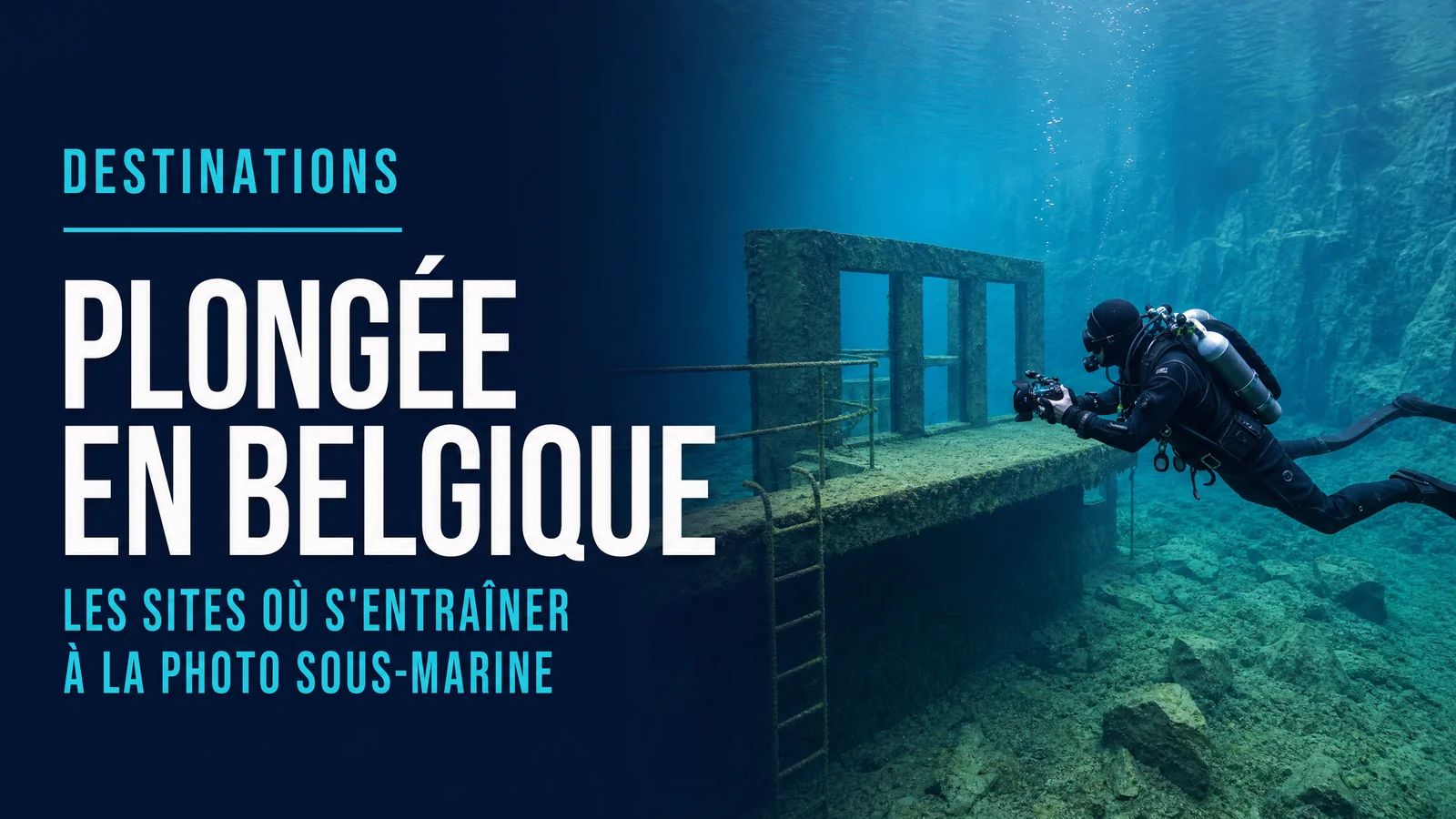
Also located in the Namur province, the Villers-deux-Églises (V2E) quarry is an absolute must for photographers living in Belgium. This site is famous for its numerous submerged decors: it is the primary place where you can photograph unusual statues of mermaids, sharks, or manta rays without leaving the country. It is a fantastic playground for practicing composition and underwater staging.
Beyond these artificial decors, it is also a privileged location for freshwater wildlife. The quarry's fish (notably beautiful sturgeons and carp) are accustomed to a near-permanent human presence. This allows you to take your time to approach subjects, understand their behaviors, and learn interactions at close range, without the stress of skittish wildlife. A great spot for taking your first steps in freshwater wildlife photography.
Why Cold Water Builds Better Photographers
Here is the argument I have been making for several years.
In warm clear water, conditions are so pleasant that technical errors go unnoticed. An overexposed shot in a Bora Bora lagoon still looks beautiful. In cold green Belgian water, nothing is forgiven: exposure must be right, composition must be strong, the subject must stand out - because the context compensates for nothing.
The learner who has done 20 dives in Belgian quarries before going to the Mediterranean arrives with real technical grounding. They have learned to work with available light (no flash, no red filter - AquaExposure doctrine), to handle variable conditions, and to find interesting subjects where nothing is obvious.
In the Mediterranean, with 15 metres of visibility and golden morning light, they take photographs. Those who only trained in a pool take blurry pictures of beautiful places.
Practical Organisation for Diving in Belgium
Most sites require club affiliation or prior coordination. The LIFRAS (Ligue Francophone de Recherches et d'Activités Subaquatiques) groups French-speaking Belgian clubs and publishes the list of authorised sites and managing clubs. The Flemish equivalent is NELOS.
For gear logistics, see our dive photography luggage guide - the same principles apply for day trips in Belgium, at a smaller scale.
For cross-border sites, Dutch Zeeland is accessible from Brussels in 2 hours and offers genuinely marine wildlife (North Sea species) radically different from quarries - a useful bridge between Belgium and the Mediterranean.
Starting in Belgium, Finishing at Sea
The training path I recommend to Belgium-based learners:
1Nemo 33 pool sessions (2-3 sessions): basic technique with the housing
2Eau d'Heure or quarry outings (2-3 dives): natural light and real subjects
3First sea dive: Opal Coast or Mediterranean (Catalonia, Cerbère-Banyuls)
Each step has a precise goal and prepares the next. It is not the most romantic path - but it is the most solid.
If you want to structure this learning journey, the AquaExposure underwater photography training is available from Brussels with pool sessions, field outings and personalised follow-up. It is designed for certified divers who want to progress quickly in photography, regardless of starting level.