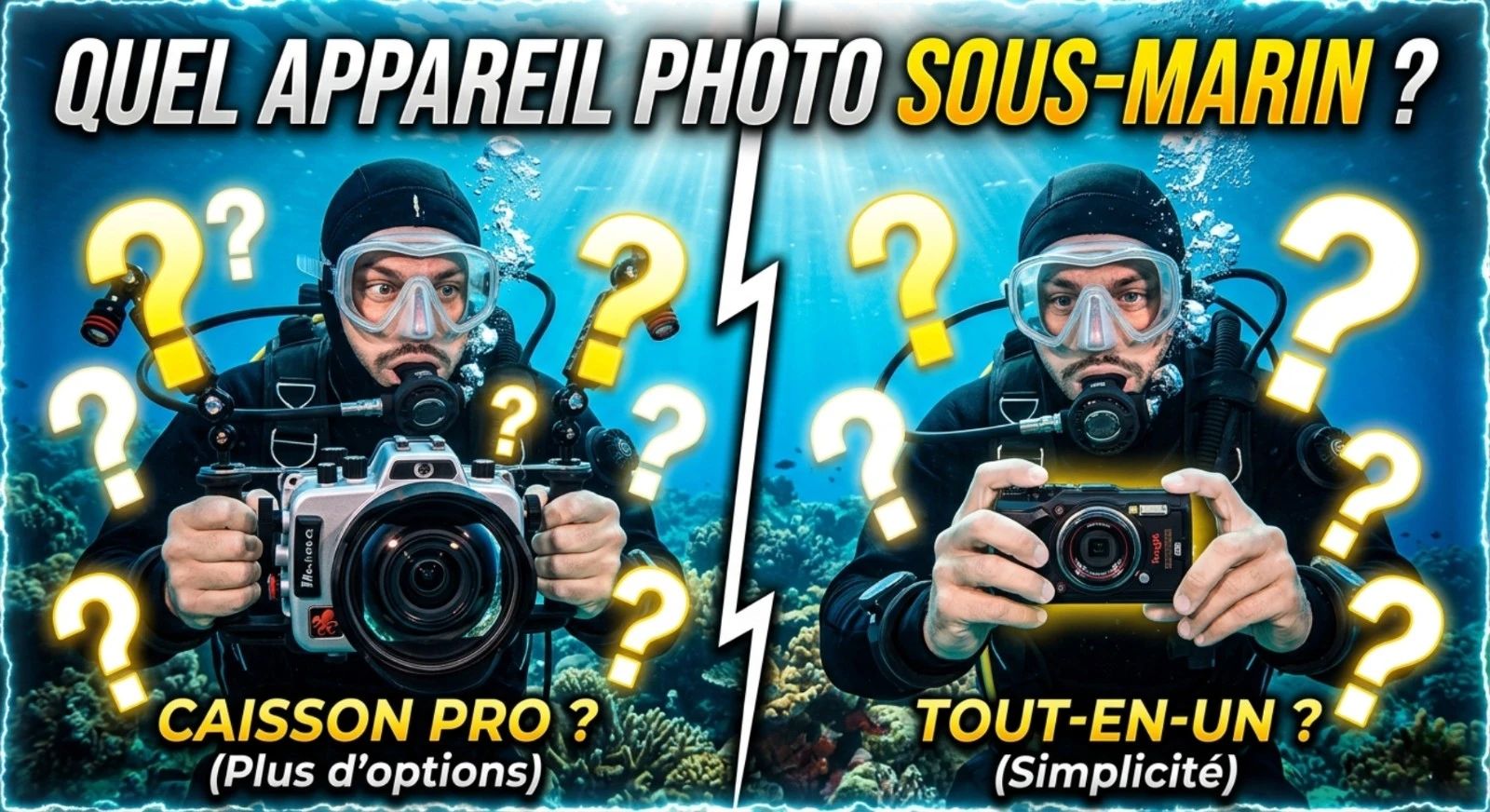
The best underwater camera for beginners is the cheapest one that meets your actual needs. A smartphone with a pouch or housing, a second-hand GoPro, or an entry-level waterproof compact will do. Investing in expensive gear before mastering composition and framing is the classic beginner trap.
Do I need an expensive camera for good underwater photos?
No. The skills that matter most (composition, subject approach, natural light management, post-production) do not depend on camera price. They are acquired through practice on land and underwater. A trained photographer takes better images with a 400-euro compact than a beginner with a 5000-euro body.
Smartphone, GoPro or waterproof compact: which should I really choose?
Use what you already own. If starting from scratch, a smartphone in a housing offers the best quality-cost-versatility combination in 2026. The GoPro is superior for wide-angle video. The Olympus TG-6 or TG-7 is the best choice for macro photography and regular divers who want manual controls.
How much should I spend to start underwater photography?
Between 30 and 400 euros depending on the option. A waterproof pouch for your smartphone at 30-80 euros is the most sensible entry point. Beyond 400 euros as a first purchase, you are buying technical headroom you will not use yet.
When should I invest in more advanced underwater photo gear?
After 30 to 50 dives with your current setup, when you have identified a specific, recurring limitation that your equipment cannot address. Before that point, upgrading will not solve your real problem, which is almost always a lack of practice.
Should I buy a red filter for my underwater photos?
No. Learn colour restoration in post-production. Two minutes on an iPad or Lightroom Mobile give you far more control than a physical filter, applicable at any depth and in any lighting condition.
Why practise photography on land before diving?
Underwater, you manage buoyancy, gear, subject approach, and lighting all at once. If taking the photo itself is not yet automatic, your brain will overload. A thousand land photos build the framing and composition reflexes that transfer directly underwater.
Which smartphone for underwater photography in 2026?
iPhone 15 Pro, 16 Pro, Samsung Galaxy S24 Ultra or S25 Ultra, or Google Pixel 9 Pro. These models offer a usable RAW or ProRAW mode, advanced video stabilisation, and sensor quality that surpasses most dedicated compacts from previous generations. The DiveVolk SeaTouch 4 Max housing is compatible with most of these models.
What Is the Best Underwater Camera to Start With? The Honest Answer
The best underwater camera to start with is the cheapest one that covers your actual needs: a smartphone with a basic housing, a second-hand GoPro, or an entry-level waterproof compact. Gear doesn't make the photographer: to improve, shoot 1,000 photos on land before you dive.
That's the answer most websites never give you. Because it doesn't generate affiliate commissions.
I'm going to explain why it's true, and how to choose what actually fits your situation.
The classic beginner trap
I started with a GoPro that I damaged on my second photo dive. Then I bought a waterproof compact in a housing. Then a DSLR in a housing. At every step, I thought the problem was the equipment. My photos were blurry, blue, lifeless. I kept upgrading.
The problem was me.
My unstable buoyancy made the image shake. My head-on approach scared fish away before I had time to frame. My auto white balance made every photo inconsistent.
When I understood that and corrected those fundamentals, my photos with the same basic GoPro surpassed those I was taking with the 2,000-euro DSLR.
This isn't an argument for sticking with entry-level gear forever. It's an argument for not starting with the camera.
There's another reality the industry doesn't tell you: underwater photography increases your air consumption by 30%. A heavy setup (DSLR in a housing, strobes on each side) maxes out your mental load, makes you consume more air, and scares the animal away before you've even pressed the shutter. A diver with a smartphone in a 50-euro housing, perfectly stable and silent, often gets images the pro setup can't capture. Because the animal stays.
What actually determines the quality of your images
Before talking about gear, here's what truly makes the difference between a good and a bad underwater photo.
Neutral buoyancy. If you're not perfectly stable in the water, no camera will give you sharp images. Optical stabilisation doesn't compensate for an unstable position at depth.
Composition and framing. These skills develop on land, not underwater. A photographer who can't frame with their phone on the street won't frame any better underwater with a 3,000-euro DSLR.
Subject approach. The way you move toward an animal determines whether it stays or flees. This skill has nothing to do with your camera. It's learned through practice, on the surface and during dives.
Natural light management. Water absorbs red wavelengths within the first few metres. Understanding this phenomenon and knowing how to correct it in post-production is worth more than any filter or strobe.
Post-production. Two minutes of colour restoration on an iPad transform a blue, dull image into a usable photo. This isn't cheating, it's understanding the physics of light absorption and correcting it. This skill applies to any camera.
Once these fundamentals are in place, gear starts making a marginal difference. Not before.
The three real options for getting started
Option 1 - Smartphone in a housing (50 to 500 euros for the housing)
Who it's for: beginners who want to start at low cost, divers who primarily post to social media, those who want a versatile tool without switching gear.
What you get: decent to very good image quality for the web and social media. The ability to edit right after the dive on the same device. A lightness that changes your presence in the water.
What you probably don't know: an iPhone 15 Pro or 16 Pro far surpasses the quality of many dedicated compacts from previous generations. The main sensor, ProRAW handling and video stabilisation match what setups costing 2,000 euros produced ten years ago.
Budget range: 30 to 80 euros for a basic waterproof pouch (test it in a pool first). 200 to 500 euros for a rigid DiveVolk or Nauticam housing depending on your phone model.
My current setup: iPhone in a DiveVolk SeaTouch 4 Max housing. I replaced all my previous dedicated equipment with this setup for my daily professional use.
Option 2 - Action camera (200 to 600 euros all-in)
Who it's for: video-oriented divers, those who want a compact, rugged setup for travel, and freedivers.
What you get: a natively waterproof camera (GoPro Hero 13 down to 10 metres without additional housing), a fixed wide angle suited to broad underwater landscapes, smooth stabilised video.
The real limitations: the fixed wide angle means you need to be very close to your subject. Not ideal for macro or skittish animals. RAW images less exploitable than on a dedicated compact for large prints.
Budget range: 350 to 450 euros for a new GoPro Hero 13, 200 to 300 euros second-hand. A dedicated housing is recommended for dives beyond 10 metres: 60 to 150 euros additional.
What I recommend: a second-hand GoPro Hero 11 or 12 with the official housing. The quality difference between the 11 and the 13 doesn't justify the price gap for a beginner.
Option 3 - Dedicated waterproof compact (250 to 600 euros)
Who it's for: divers who want more manual control over settings, those who do macro, those who dive regularly and want to progress step by step.
What you get: a truly usable RAW mode, an optical zoom (a real advantage for macro), full manual controls accessible even with gloves.
The reference model: Olympus TG-7 (or a second-hand TG-6). Natively waterproof to 15 metres, microscope mode for macro, RAW, rugged. This is the camera I recommend to divers who dive more than 20 times per year and want to progress seriously without investing in a DSLR housing.
Budget range: 350 to 500 euros new for the TG-7. The TG-6 second-hand goes for 200 to 280 euros, with near-identical performance for standard underwater photography.
What you should not buy first
A DSLR or mirrorless in a housing: not because it's bad (it's excellent), but because you won't be able to exploit its capabilities during your first 50 photo dives. And because managing a 3,000 to 8,000-euro setup underwater with still-imperfect buoyancy is risky.
Strobes (underwater flashes): if you're reading this article, you don't need them. Natural light, properly managed and restored in post-production, delivers superior results for the vast majority of subjects and typical recreational depths.
A red filter: its effectiveness varies too much depending on depth, turbidity and lighting. Learning colour restoration in post-production will give you far more precise control, for less money.
When to invest in more advanced gear
The rule I apply with my students: invest in better gear when you've identified a specific gap that your current equipment cannot fill, and you've observed this over a minimum of 30 to 50 dives with your current setup.
Not before.
If you're thinking "my photos would be better with a better camera" after 5 dives, the answer is almost always no. The problem lies elsewhere.
If you're thinking "I've tried everything with my TG-7 and the macro bokeh isn't enough anymore" after 80 dives, then you've identified a real need.
How to actually improve (regardless of gear budget)
The skill that separates underwater photographers who improve from those who plateau is not the price of their camera body. It's the volume of practice.
Practice before buying. This is AquaExposure's golden rule. Don't spend a single euro until you've built the basic reflexes. The method we advocate is shooting 1,000 photos on land to automate framing and composition. Read our full guide on the 1,000 land photos method to understand why it's your best investment.
Handle your housing in a pool. Before each season, get in the pool with your setup and take 200 photos of a diver. You'll learn more about your gear in one hour of pool practice than in 10 open-water dives where you're also managing wildlife, current and your buddy.
Dive regularly. This sounds obvious, but it's the number one factor. Two dives per year will never allow real progress. If geography is your constraint, compensate with land practice and pool sessions.
If you haven't bought anything yet: start with your current smartphone in a 30-euro waterproof pouch. Do two dives. If you enjoy it and see the pouch's limitations, buy a rigid housing for your phone. It's the least expensive and most educational path.
If you already own a GoPro: don't switch yet. Master post-production, improve your approach in the water, and reassess in 20 dives.
If you want a dedicated underwater camera: a second-hand Olympus TG-6 for 200 to 280 euros. It's the best value-for-learning ratio on the market right now.
If your budget is 500 euros and up: a recent smartphone (iPhone 15 Pro or Samsung S24 Ultra) plus a DiveVolk or Nauticam housing. You'll have a professional-grade setup that you already half-know because it's your phone.
AquaExposure receives no affiliate commission on any gear mentioned in this article. Our advice is independent.
Want a practical summary to bring on your next dive? The free AquaExposure guide "The 7 Essential Settings for Underwater Photography" is available as a PDF download. White balance, exposure, focus, distance, angles, pre-dive checklist and natural light: the basics you can apply on your very next outing, without buying any gear. Download the guide for free
The 7 articles in this cluster to go further
This guide is the central hub of AquaExposure's Gear cluster. Each supporting article dives deeper into a specific aspect:
And if you'd rather follow a structured learning path than progress on your own, our online underwater photography course guides you step by step, from your first housing to your first portfolio.
Frequently asked questions
Do you need an expensive camera to take beautiful underwater photos?
No. The decisive skills (composition, subject approach, natural light management, post-production) don't depend on the price of your camera body. They're built through practice, on land and underwater.
Smartphone, GoPro or compact: which one to choose?
Use what you already own. If you're starting from scratch, a smartphone in a housing offers the best quality/cost/versatility combination in 2026. The GoPro is superior for wide-angle video. The TG-6/TG-7 compact is the best choice for macro photography and regular divers who want manual controls.
How much should you spend to start underwater photography?
Between 30 and 400 euros depending on the option you choose. A waterproof pouch for your smartphone at 30-80 euros is the most prudent entry point. Beyond 400 euros for a first purchase, you're buying technical headroom you won't yet be able to use.
When should you invest in more advanced gear?
After 30 to 50 dives with your current setup, when you've identified a specific, recurring gap that your current equipment cannot fill.
Should I buy a red filter?
No. Learn colour restoration in post-production. It will give you far superior control, applicable at any depth and in any lighting condition.