I am a beginner in underwater photography. Where should I start?
The Maldives. Full stop. There you have stability, clarity, predictable wildlife, and photo instructors everywhere. You learn the basics of composition, exposure, and buoyancy without stress.
What is the minimum budget for each destination?
For 8 days total: Philippines (Dauin) 1,200 to 1,500 euros, Maldives 2,000 to 2,500 euros, Raja Ampat 1,800 to 2,200 euros, Baja California 1,500 to 2,000 euros, Azores 1,200 to 1,600 euros, Moorea 3,500 to 4,200 euros.
Where will I see the most manta rays?
Raja Ampat from November to February (reliable cleaning stations), Moorea from November to March (accessible lagoon), Maldives from June to August specifically at Baa Atoll, Baja California from October to November in La Paz.
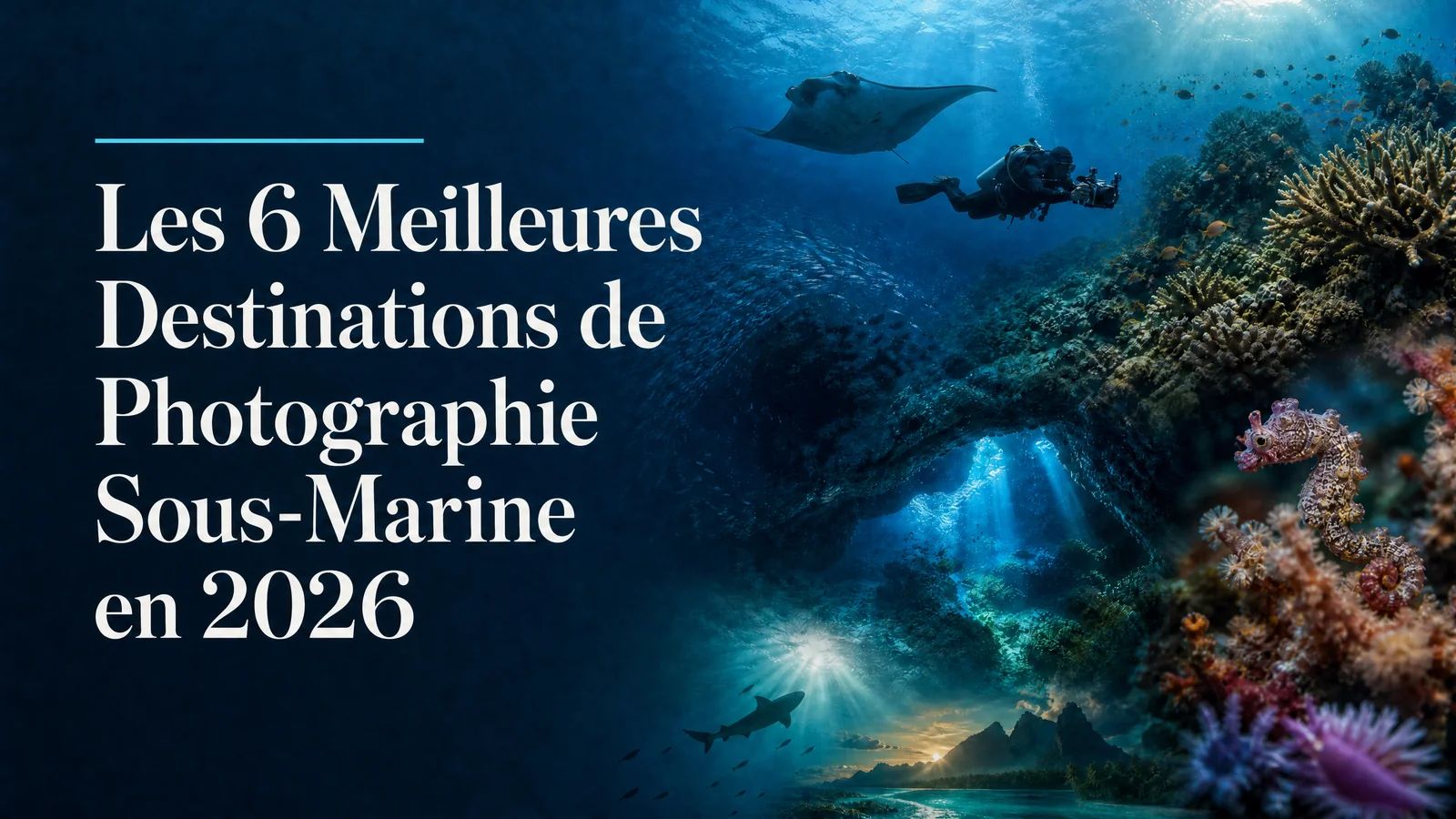
Wondering where to dive to capture the most spectacular underwater images of your life? Here's a confession: after 15 years diving on the most beautiful reefs on the planet, and after training hundreds of photographers in the Maldives, I finally have my definitive list. The six must-visit destinations in 2026 are the Maldives (my secret garden), Raja Ampat in Indonesia, Baja California in Mexico, the Azores in Portugal, the Philippines (Dauin and Anilao), and Moorea in French Polynesia.
What's funny is that every diver asks me the same question on the boat: "What place will turn me into a real photographer?" The answer isn't that simple. But I've learned one thing as an instructor: it's less the place that makes the difference than your preparation and mindset. That said, certain places make things much easier.
So put on your mask and come along. Let's go.
1. The Maldives: Where I Discovered My Calling
The real story
I still remember the day I first set foot in the lagoon of Rangali Island. It was 2008, I had my first digital body with a makeshift macro lens, and I was shaking like a leaf in warm water. Literally.
The Maldives is the country where I spent my years as a diving instructor and photographer. It's also the country that taught me that real underwater photography isn't just about having good gear, it's about understanding the creatures, the conditions, and having Buddhist-level patience (spoiler alert: I worked on the express version).
Why the Maldives in 2026
Best season: November to April (and September-October for the more adventurous)
The Maldives offer a stability of conditions that few places in the world can match. Warm waters (27-30°C), crystal-clear visibility (30-40 m average), and abundant coastal fauna create a perfect laboratory for refining your techniques. Here for macro? You'll find nudibranchs, leaf scorpionfish, and dream-worthy small fish. Looking for big animals instead? The drop-offs attract sharks, manta rays (especially June to August in the North Maldives), and trevallies.
What I systematically told my students: "The Maldives forge a solid foundation. You'll learn to compose, manage your buoyancy underwater, and not panic when a leopard shark passes 2 meters from you."
AquaExposure Techniques That Work
Rule of thirds and leading lines: Maldivian coral structures are naturally geometric. Use these natural "paths" to guide the eye.
Night diving: The Maldives offer magical night dives where small creatures come out of hiding. It's tricky gear-wise, but the results are worth every euro spent.
Silhouettes against the light: With good backlit exposure, butterflyfish and fusiliers become almost translucent. Magical.
Ethics and Responsibility
The Maldives have been suffering from coral bleaching since 2016. The photographer's duty is to show the beauty AND the fragility at the same time. Don't touch anything. Use a camera rather than a hand. If you see dead coral, document it respectfully but don't rearrange it for the photo.
Approximate Budget (per person, 8 days)
All-Inclusive Dive Resort: 2,500-4,500 euros
Budget Liveaboard: 2,000-3,500 euros
Equipment rental: 300-400 euros
My tip for saving money: Go in September-October (after the wet season). It's cheaper, less touristy, and the tropical rains create incredible sunrise light.
2. Raja Ampat, Indonesia: The Biodiversity Sanctuary
The photographer's visit
I discovered Raja Ampat by chance, thanks to a friend instructor who was shouting on the phone: "Mate, it's insane here, you're coming!" Three months later, I was there, camera in hand, jaw literally on the floor.
David Doubilet, the legendary National Geographic photographer, rightly called it "the greatest aquarium on the planet." He wasn't exaggerating. Raja Ampat is 1,400 islands in the heart of the richest tropical biodiversity zone on Earth. You'll see creatures here that you won't see anywhere else: leaf fish, bicolored nudibranchs, giant octopuses, and hard coral walls stretching 40 meters deep.
The Magic of Raja Ampat in 2026
Best season: October to March (especially November-February)
Visibility varies enormously (10-40 m depending on currents), but that's precisely what makes it strong. Strong currents bring nutrients: that's why the fauna is so abundant and so large.
Raja Ampat is not for divers looking for "easy" conditions. It's for divers who want to enter communion with the ocean. You'll feel its power. You'll understand why Sylvia Earle, the legendary oceanographer, dedicated her life to exploring and protecting reefs.
Wide-angle: coral walls, fish schools, underwater geological formations
Nocturnal creatures: use night dives for octopuses, shrimp, sea snakes
AquaExposure Techniques
Current management: It's an art. You need to maintain a stable position while photographing. Use the terrain as visual anchoring.
Backlighting in natural light: Raja Ampat has many small transparent fish. Backlighting reveals their internal structures, without flash, just by positioning yourself with the sun behind you.
Extreme patience: I waited 3 hours for a leaf fish to show itself in the ideal position. It's crazy. It was worth every minute.
Budget (8 days, per person)
Premium Liveaboard: 2,800-4,500 euros
Standard Liveaboard: 1,800-2,800 euros
Equipment and rental: 200-350 euros
Navigation tip: Fly from Sorong, not from Jakarta. It saves an internal flight and gains adaptation time.
3. Baja California, Mexico: The Unlikely Encounters
The photographer's surprise
Baja California, I discovered it thinking "oh, just a surf and coastal adventure destination." I was wrong. It's one of the most unique underwater ecosystems on the planet.
Why? Because you have two oceans meeting: the cold Pacific from California and the warmer Sea of Cortez. This collision creates dynamic, unexpected, and often spectacular conditions for photography.
The Two Faces of Baja
To the north (San Diego, San Clemente Islands): giant kelp forests, sea lions, blue sharks. It's documentary cinema.
To the south (La Paz, Espiritu Santo): warmer waters, tropical fish, enormous schools, the famous manta rays. It's a tropical dream with a touch of wildness.
Best Season
July to November for kelp and sea lions in the north. November to May for warm and calm southern waters.
Personal tip: I love Baja in October-November. You get both worlds: tropical reefs AND some temperate creatures hanging around.
Iconic Photography Subjects
Sea lions: playful and curious creatures, perfect for portraits
Kelp forests: almost extraterrestrial perspectives, especially with the right light
Manta rays: in the south, "manta cleaning station" dives let you wait in silence
Large predators: blue sharks, trevallies, tuna
Essential AquaExposure Techniques
Symmetrical composition with creatures: Sea lions respond to symmetry. Use the rock formations behind them to create balance.
Wide-angle + forced perspective: Kelp forests demand dramatic perspective. Get close, show the human scale.
4K video for sea lion portraits: Sea lions move fast and are unpredictable. Film in 4K video and extract the perfect frame, it's much more effective (and respectful) than firing away.
Crucial Ethics
Never chase sea lions. Wait for them to come to you. That's one of the most important lessons I've learned. The respectful photographer is invisible.
Budget (7 days, per person)
Resort + dives: 1,500-2,500 euros
Cortez Liveaboard: 2,000-3,500 euros
Equipment rental: 250-400 euros
4. The Azores, Portugal: Depth and Mystery
Personal Discovery
I crossed the Atlantic for the Azores with one question: "Does Europe have world-class underwater photography destinations?" The answer: yes, absolutely.
Laurent Ballesta, the world-renowned French diver and photographer, documented the Azores for years. He says it's a "living museum of lost and rediscovered creatures." The Azores offer an authentically exploratory dive experience. You photograph in often cold waters (15-18°C), but you discover worlds of pelagic creatures, deep reefs, and geological amphitheaters that no other place in Europe can offer.
The Azores Advantage in 2026
Best season: May to October
The 6 Best Underwater Photography Destinations in 2026: A Guide by a Former Instructor | AquaExposure
No massive tourist packages (compared to the Caribbean or Maldives)
European accessibility: a flight from France, Spain, or Portugal
Major pelagic fauna: whales, dolphins, ocean sunfish, sharks
Blue and grey sharks: healthy populations, interesting behavior
Whales and dolphins: document social interactions
Rare deep-water creatures: with a good instructor, you'll see rarely photographed creatures
Deep hard coral reefs: unusual formations, surprising colors
AquaExposure Techniques
Drift diving: The Azores demand a certain mastery. You drift with the currents. It's a dance. Learn to position yourself ahead of the subject to capture it while drifting.
Minimalist compositions: With often 15-25 m visibility, less is more. One shark + the blue void = power.
Natural light + exposure: Not many small tropical creatures. You work with geology, shapes, light.
Budget (7 days, per person)
Resort + dives: 1,200-1,800 euros
Specialized Liveaboard: 2,500-3,500 euros
Full equipment rental: 150-250 euros (very affordable)
Budget tip: The Azores are far cheaper than the Caribbean or Southeast Asia. Your money lasts 30% longer.
5. Dauin and Anilao, Philippines: The Macro Paradise
My Revelation in Mindanao
I have to confess something: I almost missed the Philippines. A friend instructor told me, "Mate, forget Palau, the Philippines is the real deal." I went to Dauin. Three days later, I was renting a bungalow for a month.
Dauin (Negros Oriental) and Anilao (Batangas) have become two of the world's most astonishing macro destinations in just a decade. Why? Because the sand and rock ecosystems create dense microhabitats. You see more micro-creatures in a single dive than you can imagine.
The Biodiversity Explosion
Best season: November to May (dry season)
Warm waters (26-29°C), shallow depths (5-20 m on average), and species diversity create a laboratory where you can dive 2-3 times per day and discover new things on every immersion.
Here's what you'll see in one week: - 20+ nudibranch species - Pygmy seahorses - Frogfish - Crustaceans camouflaged in mind-blowing ways - Miniature octopuses - Brittle stars, sea urchins, crinoids
Obsession-Worthy Macro Photography Subjects
Nudibranchs: This is El Dorado. Every dive, you find 2-3 new species
Symbiosis: anemones + clownfish, but also lesser-known interactions
Advanced AquaExposure Techniques
Tight macro composition: Use a VERY tight frame. Eliminate chaos. Just the creature + its immediate habitat.
Natural light + diffusion: Shallow water allows natural light. Use a diffuser to soften shadows.
Focus stacking mentality: Think about depth of field. In macro, 2-3 mm of depth is all you have. Compose accordingly.
Patience and "golden hour": The best creatures come out at sunrise and sunset. Dive early or late.
Sustainability and Responsibility
The Philippines suffers from overfishing and coastal destruction. Responsible photography is crucial. Anilao and Dauin are actively trying to regenerate. Don't touch anything. Use a personal guide rope. If you see illegal dynamite fishing, report it to local marine authorities.
Budget (10 days, per person)
Eco-responsible resort: 800-1,300 euros
Unlimited dives: 25-35 euros/dive
Equipment rental: 150-250 euros
Food/accommodation: very affordable (3-8 euros/meal)
This is the CHEAPEST destination on this list. You might spend 1,500-2,000 euros for 10 days all-inclusive. Yes, really.
6. Moorea, French Polynesia: Where Everything Becomes Dramatic
Tropical Poetry
Moorea hit me like a wall in 2015. I arrive, I see the mountain peaks piercing the clouds, the turquoise lagoon, the coral walls dropping to 500 meters. And I think: "How can this much beauty exist in such a small place?"
Moorea is dramatic. The geological formations are theatrical. The colors are surreal. It's a playground for wide-angle photography and epic compositions.
The 2026 Appeal
Best season: May to October
Moorea has everything: shallow lagoons with tropical fish, drop-offs with large pelagics, seasonal manta rays, reef sharks, and terrestrial landscapes reflecting in the waters.
Dramatic Photography Subjects
Manta rays: From November to March, they pass through the lagoon to feed on plankton
Lemon and Blacktip sharks: Abundant, non-aggressive, photogenic
Wide-angle lagoon shots: Palm trees, mountain peaks, reflections, tropical fish
Macro as a secondary focus: The walls host nudibranchs, crustaceans, small fish
Tropical species portraits: Sea lizards, parrotfish, fusiliers
Critical AquaExposure Techniques
Wide-angle + decreasing light: Use depth of field to show lagoon + wall + pelagics
Triangular composition: Exploit the mountain peaks visible above and the underwater structure below
Behavior vs. composition: Document manta rays feeding. Tell the story.
Natural color saturation: Moorea doesn't need any filters. The coral colors are naturally vivid.
Ethical Considerations
Moorea's manta rays are accustomed to divers but are beginning to show signs of stress. Maintain your distance. Don't chase. Be patient, they'll come if conditions are right.
Budget preparation: Moorea is the most expensive destination on this list. Plan for 3,500-4,500 euros for a real week.
FAQ: The 6 Questions You Always Ask Me
1. "I'm a beginner at underwater photography. Where do I start?"
Answer: The Maldives. Full stop. Here, you have stability, clarity, predictable fauna, and photo instructors everywhere. You learn the basics of composition, exposure, and buoyancy without stress. The Maldives forge solid foundations.
Baja California is also good for beginners, but more variable. The Azores demand a certain technical level. Raja Ampat will eat you alive if you can't manage currents. The Philippines in macro require finesse (focus, diffusion, patience). Moorea is accessible but expensive for beginners.
2. "What's the minimum budget for each destination?"
The secret: The Philippines and the Azores offer the best value for money.
3. "Where will I see the most manta rays?"
Direct answer: - Raja Ampat: November-February, reliable cleaning stations - Moorea: November-March, lagoon (accessible, less deep) - Maldives: June-August specifically at Baa Atoll - Baja California: October-November, La Paz, cleaning stations
If you're coming in 2026 between November-February, Raja Ampat or Moorea. If you're coming June-August, Maldives specifically Baa Atoll.
4. "I want pure macro. Where?"
Easy: The Philippines, Dauin or Anilao. No debate. You'll see 100+ micro-creatures per day. You'll never have enough memory card space.
Second choice: Maldives (but less diversity than Philippines). Third: Raja Ampat (but less predictable, harder to find the creatures).
5. "Where do I see whales?"
Honest answer: - Azores: Sharks, whales, dolphins, regular - Moorea: Seasonally (December-April) - Baja California: Certain specific spots (remote) - Maldives: Blue whale very rare, occasional dolphins - Raja Ampat: Dolphins, not really whales - Philippines: Whale sharks at Oslob (Cebu) but that's captive feeding, not my recommendation
The Azores are your best bet for major marine mammals overall.
6. "What's the best 'overall season' to dive in 2026?"
My instructor's verdict:
January-February: Maldives TOP TIER, Moorea (manta rays), Philippines OK
March-April: Maldives excellent, Baja California season starts, Philippines OK
July-August: Maldives (sharks, low crowds), Baja California dry
September-October: Maldives budget, Baja California prime, Raja Ampat approaching
November-December: Raja Ampat MAGICAL, Moorea (manta rays), Philippines, Maldives budget
My personal advice: If you can take a break in October-November, go to Raja Ampat. It's the sweet spot: conditions improving, prices not too high, major fauna starting to activate.
Conclusion: Choose Your Adventure
There you have it. Six destinations. Six different worlds. Each one changed my life as a photographer, and I'm certain one of them will change yours.
My final thought: The best place for underwater photography isn't the most exotic or the most expensive. It's the one where you're mentally ready to explore, make mistakes, and learn.
Benjamin Coste Founder, AquaExposure Underwater instructor and content creator
*Before you go, the question of gear and settings is often what makes the difference between images that work and images that fail. Module 2 of the AquaExposure course covers choosing your setup based on your destination and level. Freely accessible on aquaexposure.com - Choosing your setup before a photo trip: the criteria that change by destination. - Underwater Photography in Freediving - Some destinations (Maldives, Moorea) reveal themselves better in freediving than with tanks. - I Brought Back My Best Maldives Photos with a GoPro - Proof that the destination matters more than the gear budget. - TG-6 Without Flash in the Maldives - How to photograph mantas and sharks in natural light with a compact camera.