To improve your mastery of your equipment and optimize your procedures while diving, discover our specialized training modules on AquaExposure training.
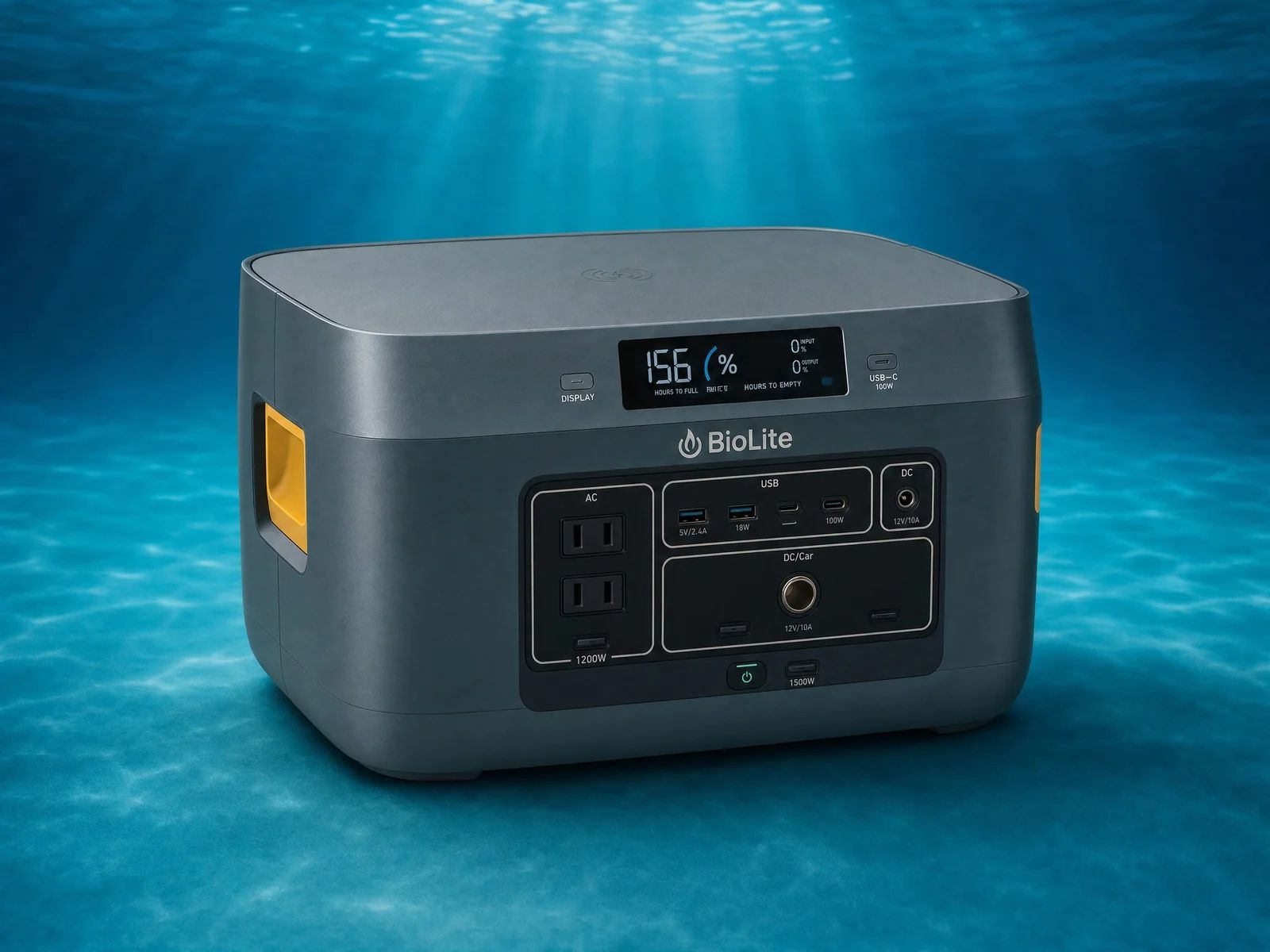
BioLite BaseCharge 1500: Complete power for diving expeditions
Between a still-damp camera bag, the deck of a boat, and the transfer times between dives, power becomes a central logistical concern. In remote areas where electricity remains a luxury, every watt counts for preparing the equipment for the next day. It is in this context of a base camp or an autonomous dive center that the BioLite BaseCharge 1500 truly comes into its own. Unlike small portable batteries, this massive unit powers a complete operation involving cameras, lights, and communication tools.
A massive power reserve for base camps
Its 1521 Wh capacity is its key advantage. For a photographer, this number allows for dozens of recharges of camera bodies or external flashes over several days. This reserve relies on NMC Lithium-Ion cells designed to retain 80% of their capacity after 1000 cycles. At AquaExposure, we consider these figures as editorial benchmarks to guide your large-scale projects. Weighing 12.1 kg, it is intended for semi-permanent installations on a boat or in a dive center rather than for prolonged manual transport.Its robust design makes short transfers easy and it serves as the central hub for an entire team. Once set up, it becomes the nerve center of the operation, capable of handling simultaneous demands without showing any signs of weakness.
Versatility and connectivity beyond a simple USB port
The BaseCharge 1500 features two 230 V AC outlets, each delivering 1200 W continuously. This power allows you to use the original chargers from manufacturers, which are often preferable to third-party USB solutions, and can even power a small compressor. The front panel offers a 100 W USB-C PD port for a laptop, complemented by two 15 W USB-C ports and two USB-A ports.
A 10 W Qi wireless charging platform on top allows you to charge a smartphone without adding extra cables. This versatility allows you to manage the entire electronic equipment of an expedition simultaneously. This is a detail that prevents the accumulation of wires on a workbench already cluttered with diving equipment.
These features ensure that your expensive equipment remains protected even under intensive charging conditions. Unlike low-end inverters, it provides a current identical to that of a standard wall outlet, which is a crucial protection for sensitive electronic devices used in underwater photography.
The station accepts up to 500W of combined input, allowing it to reach 80% charge in approximately 4 hours via the AC power and USB-C PD ports. In the field, compatibility with solar panels via the HPP (High Power Port) transforms the setup into a self-sufficient unit. Initially, this compensates for the power consumption of smaller accessories.We reach a point where battery life no longer dictates the pace of the expedition. Recharging your strobes after a night dive becomes a routine, with the BaseCharge 1500 handling the cycles with reassuring consistency. Being able to rely on such a power reserve provides invaluable peace of mind during extended stays far from any infrastructure.
This model is not intended for recreational divers traveling light, for whom compact batteries are sufficient. The BaseCharge 1500 targets professionals and organizers of expeditions in remote areas. It is suitable for photographers managing large battery packs and power-hungry equipment. In a base camp or on a support vessel, it becomes an essential logistical hub.
Its ability to power electrical tools also makes it useful for minor repairs away from a workshop. It is an investment in uninterrupted service and overall operational safety. For fixed installations, it provides a reliable backup solution in the event of a prolonged power outage.
Please note that BioLite discontinued sales of this model in the summer of 2025, although technical support remains available. Finally, its 12.1 kg constitutes a weight constraint that must be factored into your load calculations. This is an important parameter for the logistics of transfers by zodiac or the loading of an all-terrain vehicle.
The BaseCharge 1500 is a key logistical component for extended expeditions. It transforms the uncertainty of remote areas into a smooth routine, allowing you to focus on capturing images. When the batteries are full, there's a vision of a silent campsite under the stars, where technology fades into the background, overshadowed by the wilderness. This is perhaps the greatest luxury offered by such a power reserve.
To compare this model with all the products on the market, consult our external battery/power bank comparator and our complete selection of diving equipment.[1]: https://www.bioliteenergy.com/products/basecharge-1500 "BioLite BaseCharge 1500 Product Page" [2]: https://help.bioliteenergy.com/hc/en-us/articles/9237498591131-BaseCharge-1500-Product-Guide "BaseCharge 1500 Product Guide" [3]: https://help.bioliteenergy.com/hc/en-us/articles/9237819995163-Can-I-take-my-BaseCharge-1500-on-a-plane "BioLite Air Travel Policy" [4]: https://www.iata.org/en/programs/cargo/dgr/lithium-batteries/ "IATA Lithium Battery Regulations"